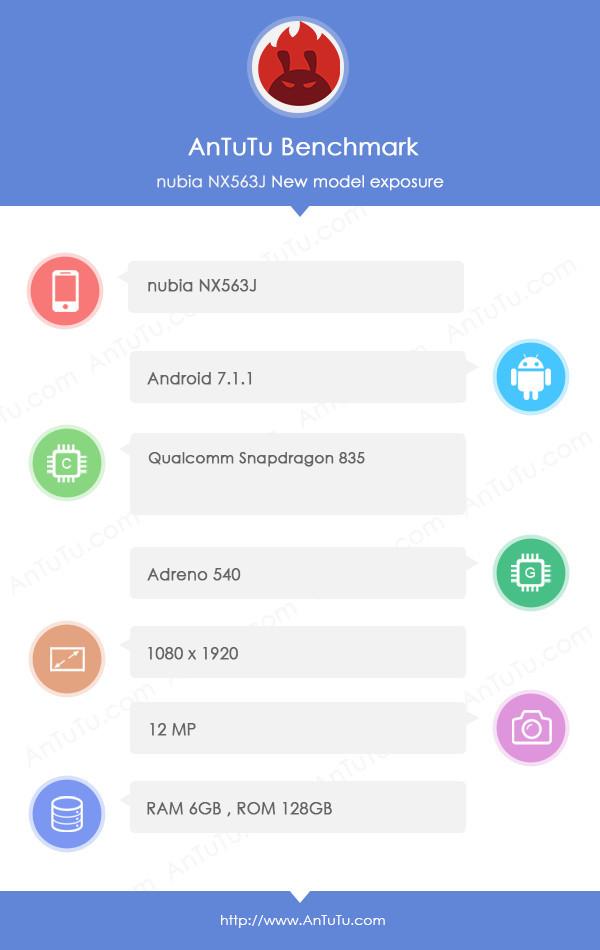
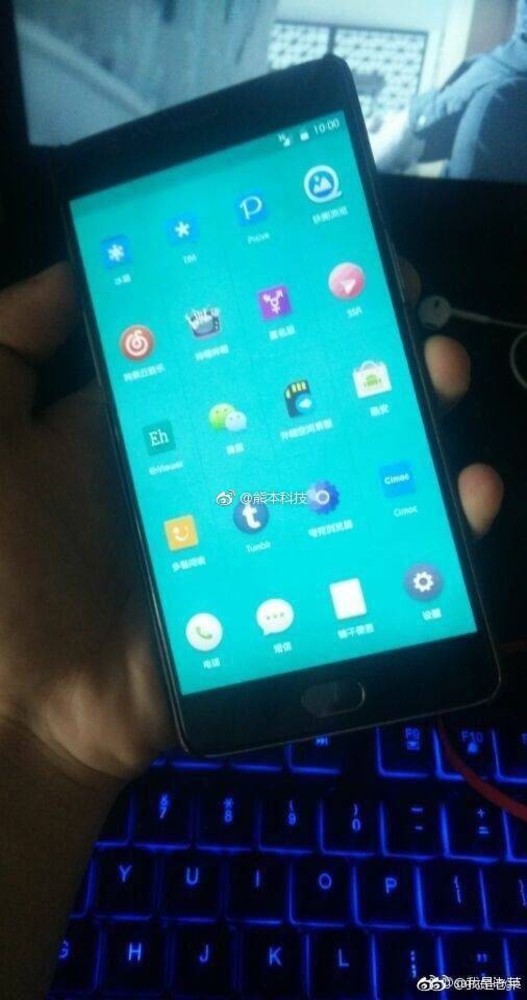
A new Nubia smartphone has appeared on AnTuTu’s Weibo page revealing some key specs of the smartphone. The device hits AnTuTu with the model number Nubia NX563J and the major highlight on the device is the Snapdragon 835 processor it is listed to feature. The Nubia smartphone is very much believed to be the Nubia Z17 which has been the subject of leaks and rumors lately.
The Snapdragon 835 chip is backed by a 6GB RAM while there is a massive 128GB storage onboard. The Nubia smartphone is also listed to pack the Adreno 540 GPU and run on Android 7.0 Nougat. The display size isn’t listed but the suspected Nubia Z17 is pitched as having a 1920 x 1080 pixels display resolution. Finally, we had heard rumours that the Z17 will sport a dual-lens camera setup but all we have on the AnTuTu listing is a single 12MP main camera. That doesn’t rule out the likelihood of the Z17 packing dual cameras at the rear.
Although the AnTuTu listing isn’t the last we’d be hearing about the Nubia Z17 but it goes to show that a launch is imminent. The device had earlier appeared on GeekBench with the same NX563J model number and just recently, the Z17 was spotted on Nubia’s official website with similar specifications. We expect a launch any moment from now and if that happens, that would make Nubia one of the early birds to the Snapdragon 835 elite club.
Meitu is a Chinese smartphone manufacturer whose name sounds like that of fellow manufacturer, Meizu. But the latter has been around longer than Meitu and apart from phones, Meitu also makes selfie apps. I am sure you remember the controversial selfie app that was in the news back in January.
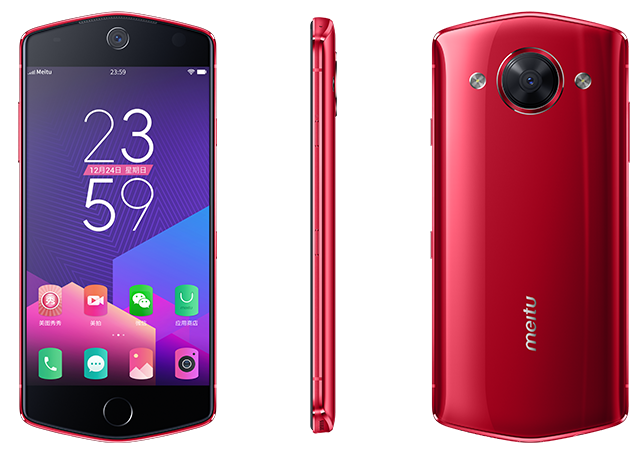
Meitu has released two new smartphones today, the M8 and an upgraded Meitu T8.
Meitu M8 Design
The Meitu M8 has the same hexagonal design as other Meitu phones. There is a large home button that greatly reminds us of the iPhone. The back and front are covered in glass and there is a middle frame that goes around it.
Meitu M8 Specs
Since Meitu is also a selfie app making company, you wouldn’t be wrong to expect that their imaging technology will make its way to their phones. And the M8 doesn’t disappoint. The front facing camera is a Sony IMX362 dual pixel self-timer camera. The camera has PDAF, OIS, and uses Meitu’s 4th-gen dual imaging tchnology. The rear camera is a 21MP Sony IMX230 sensor with a LED flash flanking it on each side.
Meitu says the M8 also comes with a built-in artificial intelligence system that helps take better selfies. When taking selfies, most phones can only detect age, gender, and a few facial features. The Meitu M8 takes things further by detecting hair color, skin color, and a number of other features.
The Meitu M8 has a 5.2-inch FHD display, 4GB of RAM, and a Helio X20 processor. There is 64GB of built-in storage, a 3000mAh battery with 9V 2A fast charge support, a dedicated HiFi audio chip, and a USB Type-C port.The Meitu M8 runs MEIOS 3.6 based on Android Marshmallow.
Meitu M8 Price
The phone is available in blue, red, white and pink alongside a special Hello Kitty Edition, and a Sailor Moon Pretty Soldier Edition. There is also the option to personally customize your phone.
The standard variant is priced at ¥2599 (~$376), the Hello Kitty Special Edition is ¥2799 ($405), the customized edition will set you back ¥2899 (~$420), and the Pretty Soldier Limited Edition with just 10,000 units will sell for ¥2999 (~$435).
Registration for the Meitu M8 will begin today and sales will commence on Friday, May 12 at noon on the official website. It will then be available for purchase on Jingdong and Suning at 8 pm on the same day.
Earlier this year, images revealing Meizu’s product road-map for 2017 surfaced online. The images showed that most of the phones will be powered by MediaTek processors just like last year, with one or two sporting Qualcomm chipsets.
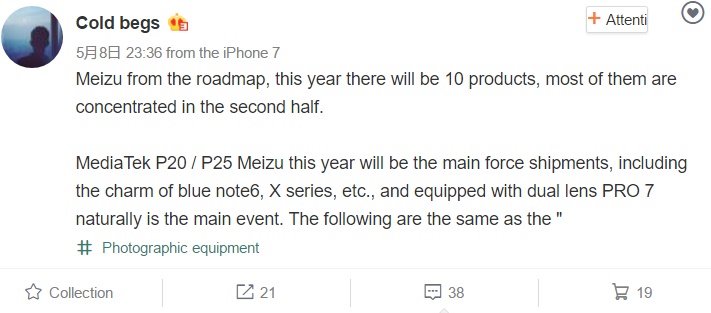
A supply chain analyst (@Cold begs) has revealed more details about Meizu’s product lineup for the rest of the year. In his Weibo post, he mentions that this year, Meizu will release 10 phones in all and most will feature the Helio P20/P25.
Either of the two chips will be in the M6 Note and the new X series. The recently released Meizu E2 is one of the phones that will have the Helio P20 SoC. Last year, most of the phones released by Meizu were powered by the Helio P10 processor. The M3 Note, M5 Note, and the U20 are examples.
He also mentions that the Meizu Pro 7 will be the flagship phone and will join the dual-camera train. The Pro 7 might be equipped with a Samsung or Qualcomm high end chip.
Meizu is one of the major Chinese manufacturers that still relies heavily on Mediatek processors and it doesn’t seem that will be changing soon. A few months ago, there was a rumor that the OEM was working with Texas Instruments to develop its own processor but we haven’t heard anything after that.
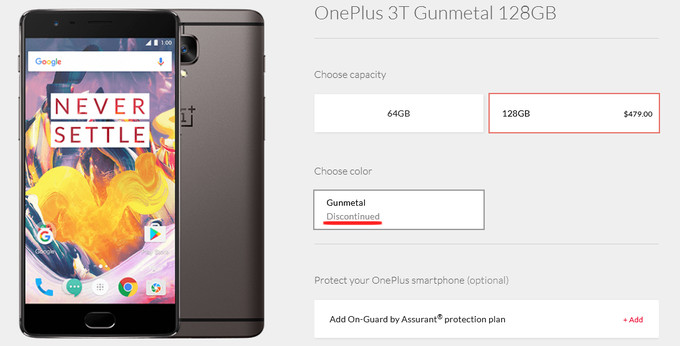
UPDATE: Company representative makes it clear that the OnePlus 3T 128GB edition is just out of stock and not discontinued globally. While the website said discontinued, it looks like you’ll be able to get the larger storage model when the next wave of stock arrives.
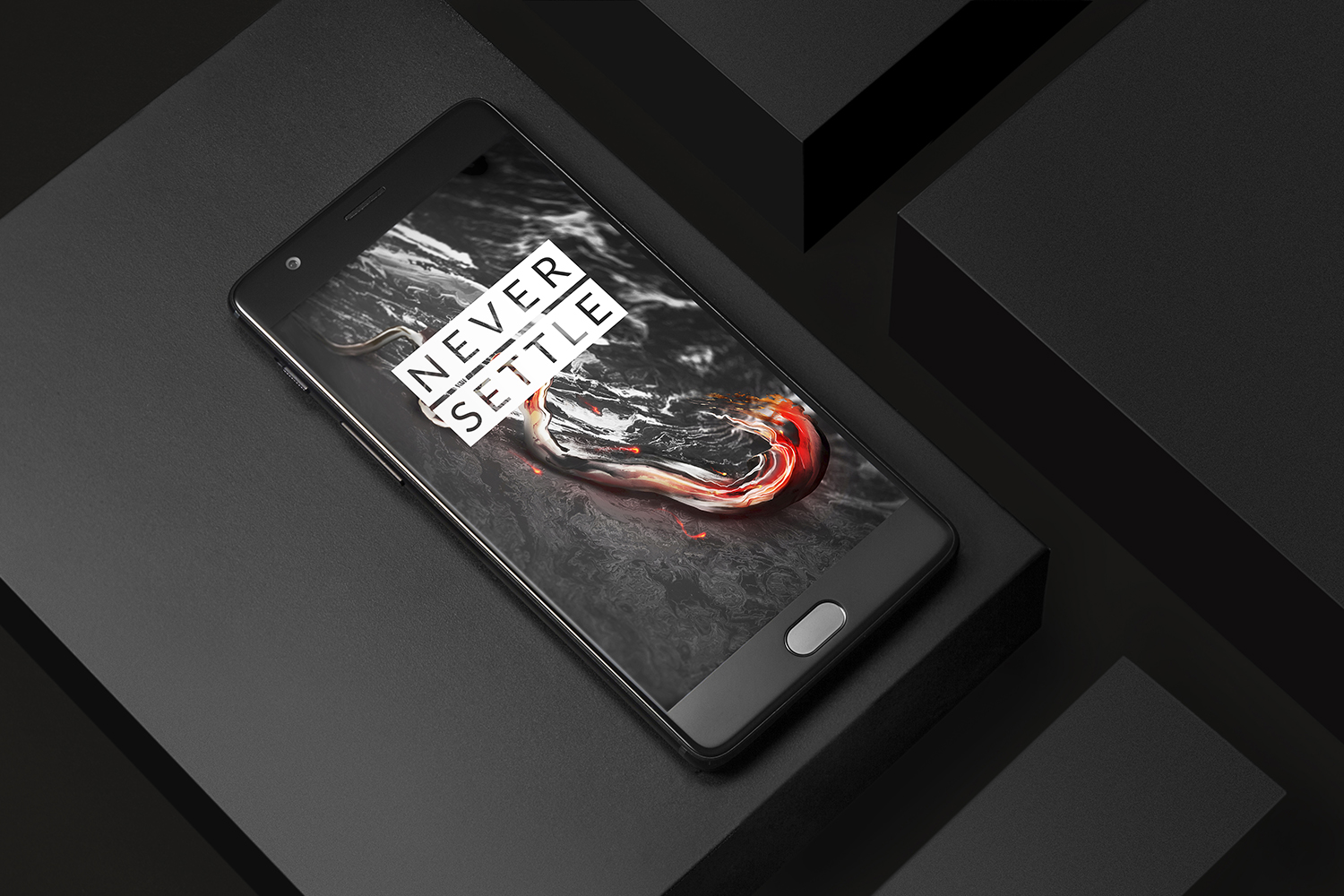
Five months after the OnePlus 3T 128GB version was announced, the production of the high-end OP3T variant has been discontinued. The OnePlus 3T was announced last year and came in Gunmetal and Soft Gold variants as well as a 64GB and later on the 128GB version. But OnePlus‘ official website is showing that the OP3T 128GB version has been discontinued.
According to a OnePlus representative who was responding to an inquiry as to why the company discontinued the 128GB variant, OnePlus needed to focus its efforts one just “one flagship device” beign that the company is a small company. This could be taken to mean that the company may soon launch the OnePlus 5 who name has been officially confirmed via a teaser as there is no other flagship on the company’s radar other than the upcoming OP5.
Apparently, the OnePlus 3T 64GB version is still on sale ($439, available on Giztop for $399) and that is because there is a large inventory of this version available. Besides, there is still some months ahead before the OnePlus 5 will hit store shelves. The OnePlus 3T comes with a Snapdragon 821 chipset backed by 6GB of RAM while the upcoming OnePlus 5 is rumored to feature a Snapdragon 835 chip and there are talks of a 8GB RAM version as well as a dual camera setup onboard the flaghship.
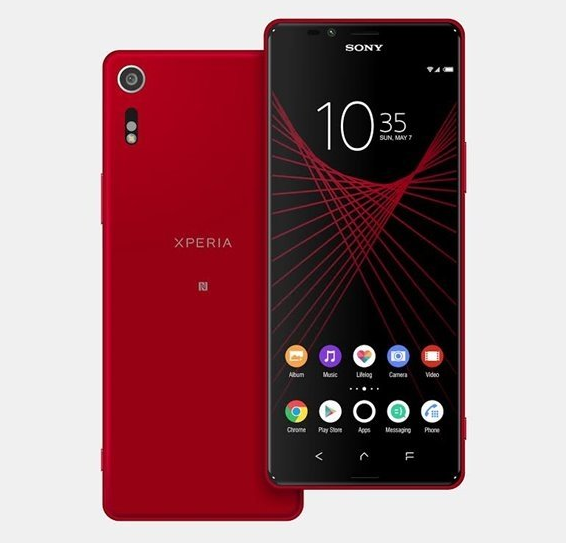
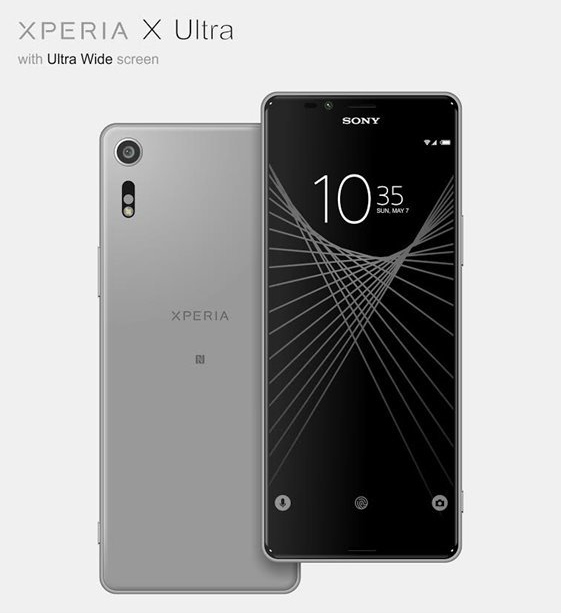
The LG G6 and Samsung Galaxy S8 and Galaxy S8+ smartphones feature huge displays that offer widescreen aspect ratios. Sony too is expected to follow this trend as it is rumored to be working on a phablet called Xperia X Ultra featuring a widescreen of 6.45 inches. Rumors have it that the Xperia X Ultra will be coming with a higher aspect ratio than the LG G6 and Samsung Galaxy S8 duos.
The 5.7-inch screen of LG G6 offers an aspect ratio of 18:9. The Galaxy S8 featuring a 5.8-inch screen and the Galaxy S8+ with 6.2-inch offer an aspect ratio of 18.5:9. Leaked information suggest that the 6.4-inch display of Xperia X Ultra will be able to deliver an aspect ratio of 21:9. There is no information available on the screen resolution of the phablet.
The leaked photos of the alleged Xperia X Ultra suggests that it will be coming with super-slim bezels. It also shows that the smartphone would be available in two colors like Red and Grey. The volume controllers can be seen present on the right side of the phone and there is a camera shutter key located at lower part of the same side. These images also suggest that the phablet would be arriving with a set of dual speakers. Even though the Xperia X Ultra boasts a premium appearance but it is unlikely to rival with other high-end smartphones.
Speculations have it that the Xperia X Ultra will be driven by Snapdragon 660 mobile platform, the newest midrange SoC from Qualcomm that has been built to deliver flagship-like performance on midrange devices. The SoC will be accompanied by 4 GB of RAM and the phone would be coming with a native storage of 64 GB. It is rumored to be running on Android 7.0 Nougat OS and is expected to come with an IP68 certified water and dust resistant chassis.
For photography, the Xperia X Ultra is pegged to include a 19-megapixel rear camera. The front side of the phone is expected to feature a 13-megapixel selfie snapper. Speculations state that it will be equipped with a X10 LTE modem. it is rumored to be equipped with a 3,050mAh battery that will carry support for Quick Charge 4.0 rapid charging.
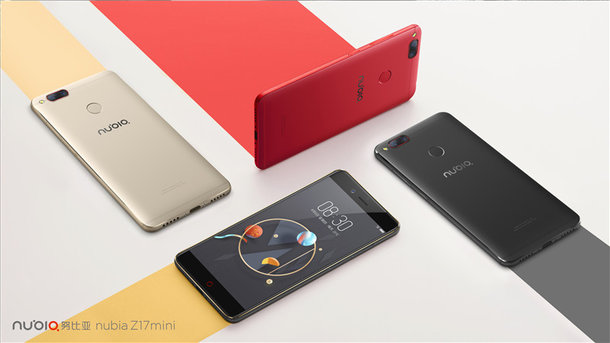
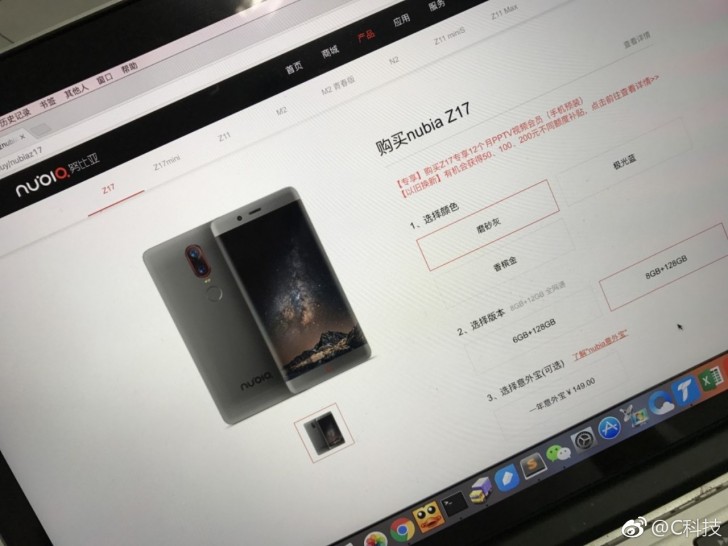
After the success of ZTE Nubia Z17 Mini, the company is gearing up for the launch of the Nubia Z17. The alleged smartphone had appeared on the official to reveal some of its key specifications. A leaked shot of the listing was taken before the official listing was taken down. However, the authenticity of the leaked shot has not been confirmed.
The ZTE Nubia Z17 Mini has a horizontally arranged dual rear cameras, but the image of the alleged Nubia Z17 that has appeared on the official listing shows that it will be coming with a vertically stacked twin rear cameras. A fingerprint scanner can be seen present below the rear camera module. Speculations have it that the Nubia Z17 would be coming with 23-megapixel + 12-megapixel dual rear snappers. The phone is expected to come with a 16-megapixel frontal camera.
The frontside of the phone seems to feature dual-edge curved display as the side bezels are not visible. Rumors have revealed that the Nubia Z17 will be coming with a 5.5-inch display. The listing on the official site suggest that the ZTE Nubia Z17 will be available in two RAM variants in China. The base model features 6 GB of RAM and 128 GB of storage whereas the second model has 8 GB of RAM and 128 GB of storage.
The ZTE Nubia Z17 can be seen listed in three color options such as Frosted Gray, Aurora Blue and Champagne Gold. The leaked images of Blue and Gold variants of Nubia Z17 have also appeared in leaked photos recently, but these images show the phone featuring a horizontally designed dual camera setup.
The alleged phone had spotted on Geekbench benchmarking platform in the previous week. It revealed that the smartphone has a model number of NX563J and it is powered by Snapdragon 835 chipset featuring a 1.9 GHz octa-core processor. However, Geekbench listing suggest that it features 4 GB of RAM. The ZTE Nubia Z17 that was used on Geekbench could be a prototype unit or a low-configured variant that is headed to another region outside of China. The ZTE Nubia Z17 is rumored to get announced on June 1.
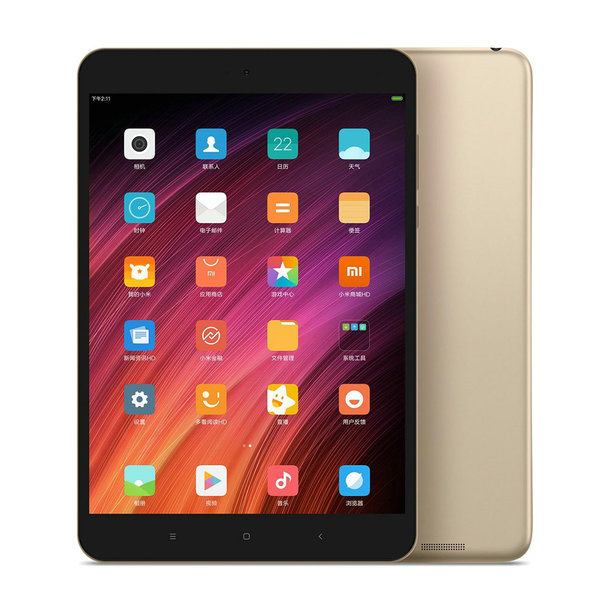
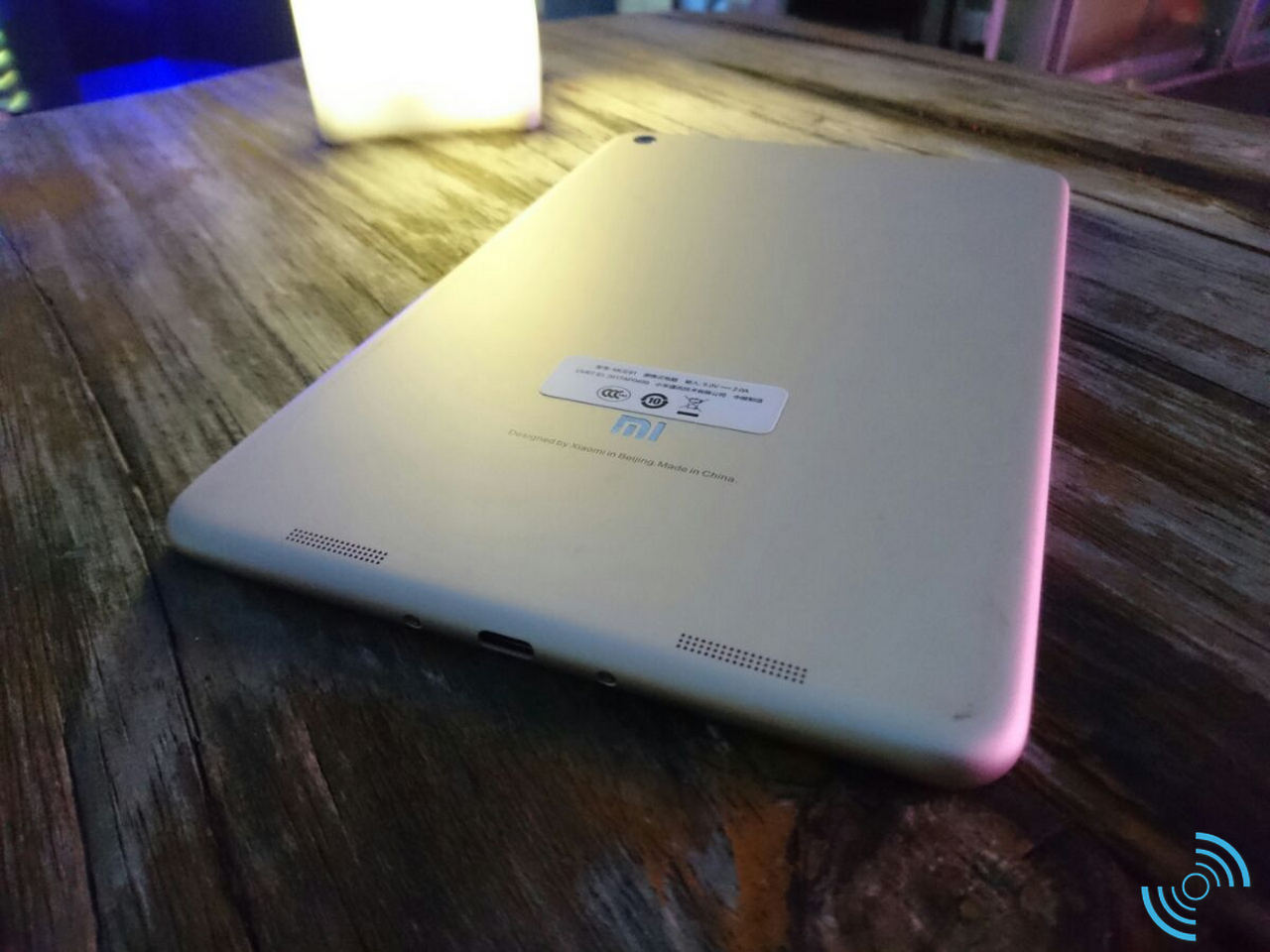
After a wait of more than 1.5 years, Xiaomi finally updated its popular tablet lineup with the brand new Xiaomi Mi Pad 3. The tablet carries forward a similar design language as the Mi Pad 2, which isn’t really a bad thing given that the all-metal built looks quite premium on the tablet.
The Xiaomi Mi Pad 3 comes with a 7.9-inch 2K display and is powered by a large 6600mAh battery. This should be enough for nearly 12 hours of video playback on the device. Inside, the MTK MT8176 hexa-core processor sporting 2 x Cortex A72 cores + 4 x Cortex A53 cores and 4GB RAM ensures good performance. Overall, the Mi Pad 3 is a pretty decent upgrade over its predecessor.
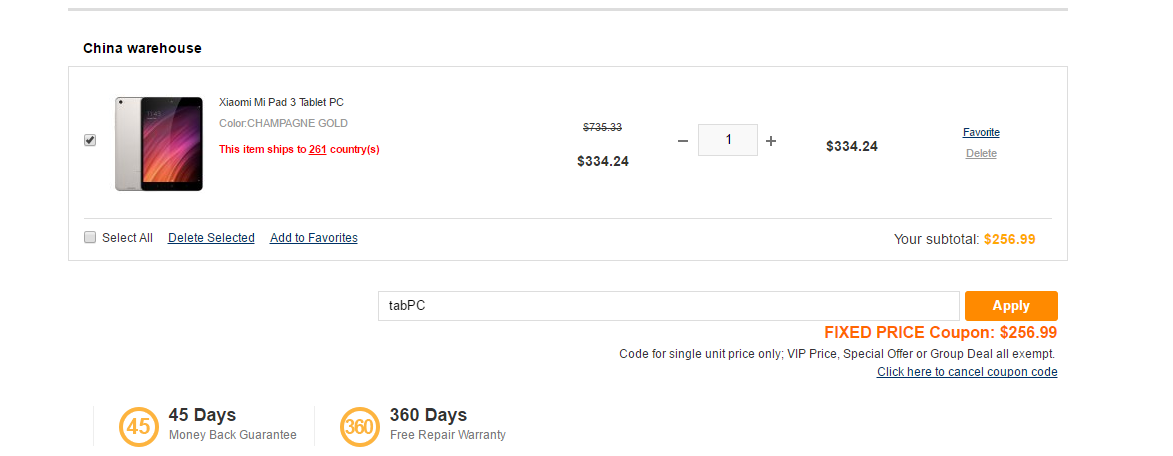
The tablet was launched at around $215 in China and resellers are charging as much as $50-$100 premium on this price. However, during the current flash sale on Gearbest.com, the seller is offering the tablet at $269.99. Now, that may not really be the best price in the market today but to make things more interesting, we have just got a special coupon for the Mi Pad 3 flash sale.
You can purchase the Xiaomi Mi Pad 3 for just $256.99 right now using the coupon: TabPC. As of writing this article, I have personally checked the coupon and it does reduce the price to just $256.99. It’s a good price if you are in the market looking to purchase the new Xiaomi tablet. But please note that just 50 units are available on Gearbest at this price, so you might want to check it out as soon as possible, before the deal runs out!
Check out the Mi Pad 3 Deal on Gearbest down below.
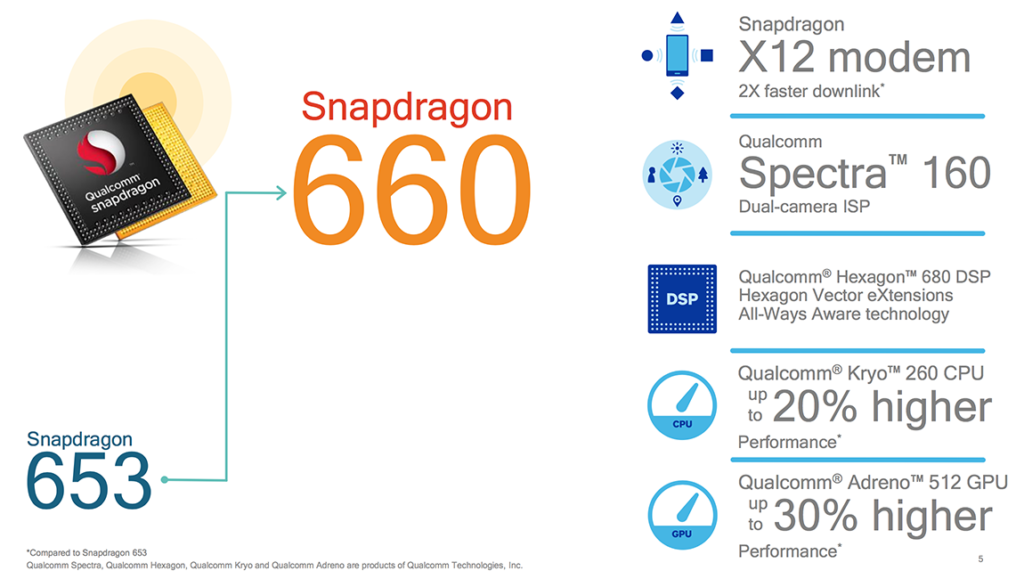
In 2016, several mid-range smartphones were powered by Snapdragon 652 and Snapdragon 625 chipsets. Earlier today, Qualcomm unveiled their upgraded versions such as Snapdragon 660 and Snapdragon 630 chipsets that not only offers better performance but also promises faster LTE connectivity and enhanced battery life.
Snapdragon 660
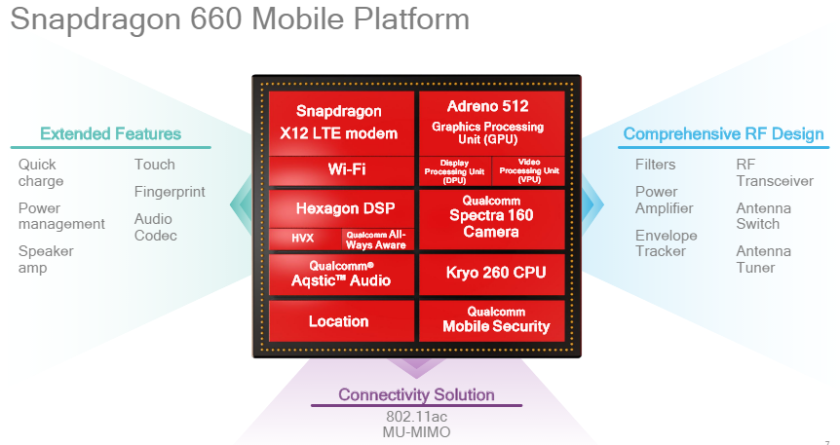
The Snapdragon 660 is a 14nm chipset that includes four cores of Kryo 260 working at 2.2 GHz and another four cores of Kryo 260 functioning at 1.8 GHz. Qualcomm has not revealed any information on what constitutes the Kryo 260 cores, but it is likely that the company may have built it using ARM Cortex Technology that it used for Kryo 280 present in Snapdragon 835 chipset for flagship phones.
It features Adreno 512 graphics with Vulkan API support. According to Qualcomm, the CPU of the Snapdragon 660 offers 20 percent better performance and its GPU offers 30 percent better graphics performance than the Snapdragon 653 chipset.
The maximum resolution supported by the chipset is 2,560 x 1,600 pixels. It supports4K Ultra HD video shooting at 30 fps and full HD video shooting at 120 fps. The Snapdragon X12 LTE modem offers a maximum download speed of up to 600 Mbps and upload speeds of 150 Mbps. The Snapdragon 660 chipset includes Hexagon 680 DSP All-Ways Aware Hub, dual 14-bit Spectra 160 ISP with support for up to 24-megapixel camera, up to 8 GB LPDDR4 RAM, memory speeds of 1866 MHz, Bluetooth 5, USB Type-C 3.1, 2 x 2 MIMO Wi-Fi, and Quick Charge 4.0.
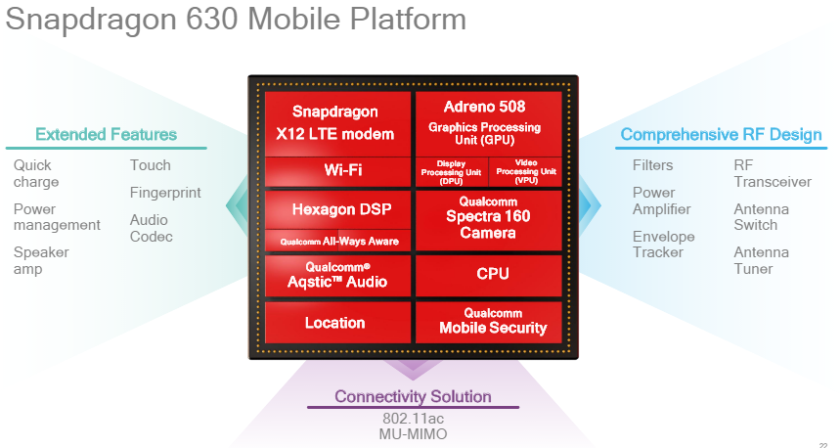
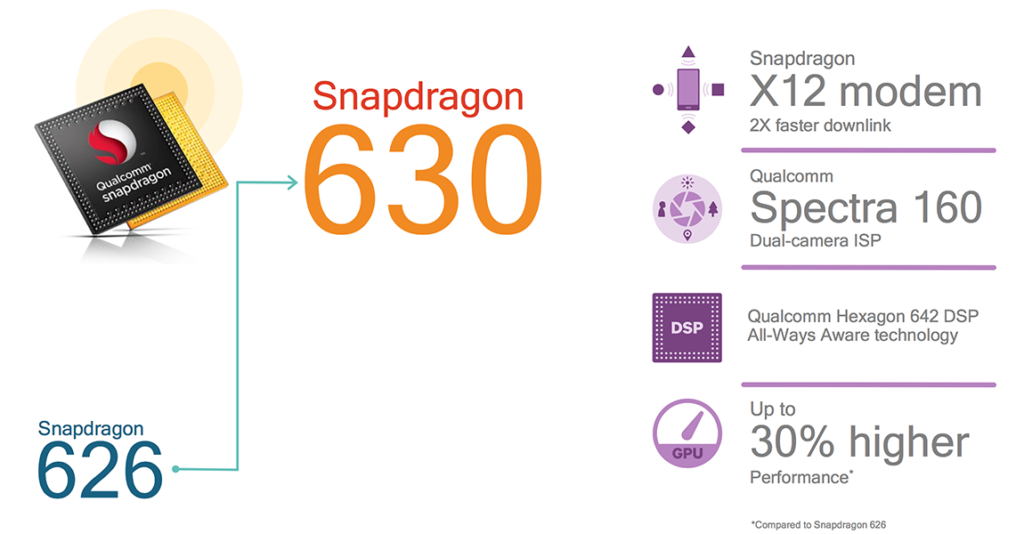
Snapdragon 630
The Snapdragon 630 is not so powerful in comparison to SD 660. The 14nm chipset has four cores of Cortex A53 working at 2.2 GHz whereas the remaining four cores of Cortex A53 function at 1.8 GHz. Its Adreno 508 graphics support Vulkan API.
The Snapdragon 630 carries support for a maximum screen resolution of 1,920 x 1,200 pixels. It offers features like Hexagon 680 DSP All-Ways Aware Hub, dual 14-bit Spectra 160 ISP with support for up 24-megapixel camera, 4K UHD video recording at 30 fps and full HD video shooting at 120 fps, 8 GB LPDDR4 RAM, memory speeds of 1333 MHz, Bluetooth 5.0, USB Type-C 3.1, Snapdragon X12 LTE modem with 600 Mbps downlink speeds and 150 Mbps and enhanced chips for machine learning, and Quick Charge 4.0
Also, both chipsets have been built to deliver improved battery performance. For example, while using location based services, users can experience around 50 to 75 percent lower consumption of battery. Even the power consumption during downloading on Wi-Fi has been reduced by 60 percent on Snapdragon 660.
The Snapdragon 660 and 630 chipsets have been manufactured to bring flagship-like performance on affordable smartphones. Qualcomm has also started shipping the Snapdragon 660 SoC whereas the Snapdragon 660 shipments will start at the end of this month. Smartphones running on these new chipsets are expected to get announced beginning from June and these devices can be made available for buying by the third quarter of this year. Some of the smartphones that are rumored to be powered by Snapdragon 660 include OPPO R11, Samsung Galaxy C10, Sony Xperia X Ultra, Vivo X9s Plus, Xiaomi Redmi Pro 2, Xiaomi Mi Max 2, and Nokia 7/8.
Since Xiaomi announced its flagship Mi 6 in April this year, the smartphone has gone up on flash sale on more than two occasions. The Snapdragon 835-powered device would again be available for purchase today in the Xiaomi Super Brand day on Tmall and Xiaomi has assured that there is large stock available for the sales festival. No doubt, the Mi 6 stock shortage isn’t as acute as was experienced on models like the Mi Note 2 or Mi Mix. However, there is no denying that there is not enough stock as the units available is far lower than the demand for the Mi 6 flagship.
According to an insider source, the reason for the shortage isn’t intentional to create artificial scarcity, neither is it as a result of a slow production process per se. But according to the source, the grade of material used on the design of the Mi 6 is too high and the key components are not supplied in high quantity to meet the demand. So, there is low supply of the key components needed to assemble the Mi 6. The major component which slows down the production of the Mi 6 shell is the ceramic glass body it uses, which is said to come with up to 8 times the hardness. The body material is difficult to produce and also costly and thus makes the supply of the Mi 6 limited.
Another reason is said to be the Snapdragon 835 chip the flagship uses which is still short in supply as compared to demand. The Snapdragon 835 chipset is manufactured using a new 10nm process and that has not helped matters. The fact that Samsung also needs the flagship chip for its Galaxy S8 and S8+ which is in high demand makes for a complex situation.
Overall, the Xiaomi Mi 6 flagship processor, memory, camera modules and other core components are said to fall within the final price tag of 2499 Yuan. So, Xiaomi isn’t offering the device for a price less than the production cost. Meanwhile, the Mi 6 is still available for purchase on Giztop if you’re outside of China and want this beautiful flagship.
Meizu last week announced that it is opening up its Flyme 6 interface so that it can be installed on third-party smartphones bringing the intuitive skin and features of its latest Flyme OS which is based on Android Marshmallow. Although the company stated that it will officially announce the list of models that would be supported due to compatibility issues, rumours are making the round that the OnePlus 3T will be among the models which would get to be able to use the Flyme 6.
Users in the OnePlus community are said to have received the Meizu Flyme 6 test news that the OnePlus 3T will be opened for Flyme 6 beta tomorrow by 10 AM. This would make the OP3T the first third-party smartphone to get the Flyme 6 if it turns out to be true. That would likely be officially known in a couple of hours from now when Meizu is expected to make the announcement.
Just in case you’re wondering what’s so special about the Flyme OS, Meizu’s latest Flyme 6 comes with a number of cool features which include a new search feature which allows users to search for answers on the internet via their phone’s camera. All that is needed is to snap the photo of the problem or question and then it gets uploaded up into the cloud (Meizu’s database) automatically. In some cases, it takes as fast as 0.5 seconds to display the answers and the answers are elaborate. Meizu claims it has got more than 65 million study questions with their answers in its database ranging from subjects like Physics, Chemistry, English language, Political science, History and other. The OS also lets users edit the theme onboard in order to personalise them and the videos in the gallery can be edited and filters added.
While Meizu fans are eagerly waiting to see the arrival of Meizu PRO 7 flagship smartphone, leaked information sourced from China claims that the Chinese firm is likely to split two companies in future. The new company that is expected to emerge from the split is “Blue Charm.”
Meizu has been releasing two line of products. The Meizu branding includes smartphones such as the upcoming Meizu PRO 7, Meizu PRO 6 Plus and so on. And there are M line of devices which includes affordable smartphones from the company such as Meizu M5, Meizu M5 Note, Meizu M3 and so on that are released under Blue Charm branding (aka Meilan in China).
The M series of phones from Meizu rival with Xiaomi Redmi and Huawei Honor smartphones. Xiaomi has not separated the Redmi brand but even though Honor brand is owned by Huawei, it is a separate company. In the same way, Meizu is now rumored to launch a new company called Blue Charm that will continue to launch lower and midrange smartphones.
Rumors have it that the existing vice president of Meizu, Li Nan would be pioneering the new Blue Charm company as CEO. Zhe Yang, the former CMO with Huawei will be coming to Meizu to as the new vice president. Even though the rumor mill has revealed the name of the new company and the name of person who will be leading it, Meizu has not confirmed on any of these rumored information. However, the news has already triggered a controversy on social sites in China as there are some people who are unhappy about the split and there are others who have welcomed the move.
Like Honor, the Blue Charm may function as a separate firm. Honor phones are currently running the same software that are available on Huawei phones. That is one of the reasons why people end up calling it Huawei Honor of phones instead of just calling it Honor phones. It is likely that the Blue Charm smartphones would be running on Meizu’s software.
Rumors claim that the split will cause Blue Charm to launch smartphones running on Snapdragon chipsets by Qualcomm. As far as Meizu is concerned, it is rumored to launch smartphones powered with Exynos chipsets from Samsung.
What do you think about the split? Share us your views by posting your comments.
Asides from the HTC U 11, the OnePlus 5 is the only other Snapdragon 835 phone that is trending lately. Tagged the 2017 Flagship Killer, mobile phone enthusiasts are eager to see what OnePlus comes up with.
The OnePlus 5 is rumored to join the dual camera train and feature two cameras on the back and maybe two in front too. New renders of the device have surfaced online.
The render shows the OnePlus 5 with a glass and metal body with the cameras positioned on the top left corner like that of the Xiaomi Mi 6. The front features thinner bezels at the top and bottom and there is a fingerprint scanner that doubles as a home button. The design reminds us of the Onyx Black OnePlus X.
Compare that to a different render that surfaced a few months ago. The cameras are stacked vertically in that one. There is a dual tone LED flash sitting between them and the whole setup is positioned in the middle of the phone. Which of the two renders do you prefer?
Just in case you are wondering, this isn’t the next round of the usual Mi 6 flash sale but is, all the same, an opportunity to grab the Xiaomi Mi 6 if you’re in China. Xiaomi has hinted that the Mi 6 would be available for purchase tomorrow May 9 exclusively on Tmall. Yeah, Tmall again. Tomorrow is Xiaomi Super brand day on Tmall and the Mi 6 will join other Xiaomi products in going up for sale on the Official Xiaomi flagship store at Tmall.
The Mi 6 will be up for grabs at three different periods, obviously in the usual flash sale pattern. The first sale will be at 0.00AM, the next at 10.00AM and the last sale will be at 8.00 PM. Xiaomi has assured that there will be a large stock of the flagship smartphone which they termed “Crazy huge quantity” during the Super Brand day.
Unlike the Mi 5S and Mi 5S Plus which saw a 200 Yuan reduction in their prices, the Xiaomi Mi 6 will be sold for its official 2,499 Yuan price for the base model and 2,899 Yuan for the top model. Recall that only the 6GB + 64GB version had been available in the previous flash sales but this time around, the 6GB + 128GB high-end version will be available for purchase. The offer also comes with free shipping.
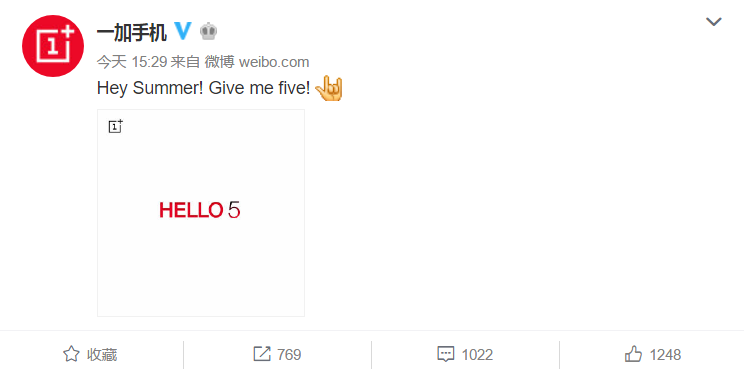
OnePlus today released a teaser image for the OnePlus 5. Posted on Weibo, the image has the word “Hello 5” written on it and is accompanied by the text “Hey Summer! Give me five!”. Both confirm the name and release date respectively.
Summer is expected to begin on Wednesday, June 21 in the Northern Hemisphere, and end in September. Last year, the OnePlus 3 launched in June, so we expect the OnePlus 5 will follow the same calendar.
The device is expected to feature dual rear cameras but we have also seen sketches showing that the front will also sport dual cameras. While dual front and rear cameras are no longer new features for a phone, it is the RAM we are most concerned about. The rumor flying around says that the OnePlus 5 will have 8GB of RAM and it seems we just might have our first confirmation.
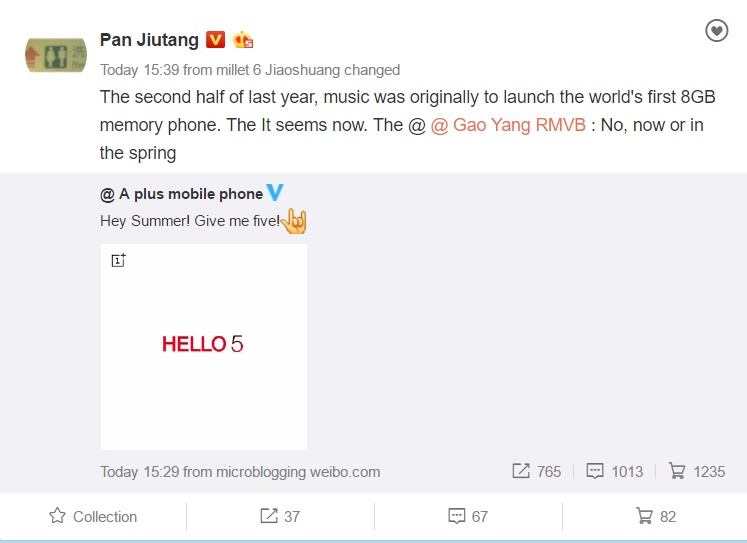
Analyst, Pan Jiutang’s response to the teaser image hints at the OnePlus 5 having 8GB RAM. A rough translation of his response says “last year LeEco was supposed to launch the world’s first 8GB RAM phone (but they didn’t), the time seems to be now”. Since he’s directly replying to the OnePlus 5 post, we believe he’s dropping a hint and not just speculating.
Gionee has released a teaser image confirming that the Gionee S10 will indeed feature dual front and rear cameras. The teaser image shows Chinese singer, Xue Qian holding a dual camera phone.
The image was posted by Gionee’s VP, Yu Lei on Weibo and was accompanied by a text mentioning the phone’s four cameras. It has also been stated the singer will serve as brand ambassador for the Gionee S10 phones.
We have seen three variants of the Gionee S10 surface on TENAA. One has just a single camera on the back and front, another has dual cameras on the rear and a single camera in front, and the most recent one confirmed to be called the S10 and not S10 Plus (the other two will have suffixes attached to their names) has four cameras.
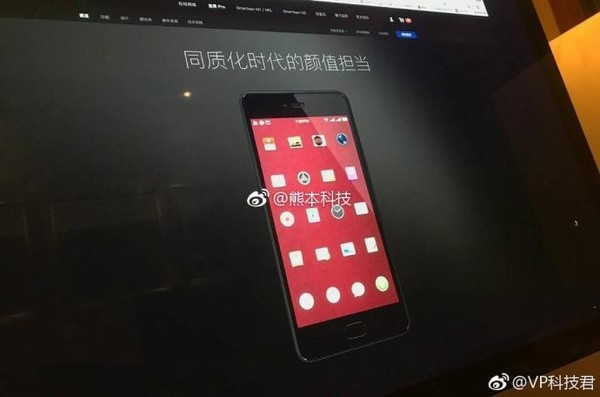
Smartisan has scheduled a press conference for tomorrow May 9, where the company is expected to announce its next smartphone believed to be named Smartisan Nut Pro. Ahead of tomorrow’s conference, images of the Nut Pro have appeared online showing us what the phone looks like.
What is likely the phone’s official product page containing the real photo of the machine is among the images that leaked. Tthe images show Smartisan is retaining the design language used on previous Smartisan phones. The images also reveal the Smartisan phone will come with a front physical home button. It is billed to be a mid-range smartphone so you really shouldn’t be surprised about the bezels at the sides and the large ones at the bottom and top aspect o the display. That doesn’t take away the prospect of this being a beautiful mid-ranger, though.
Although nothing was mentioned of the likely specs of the device, earlier rumours had tipped the Smartisan Nut Pro to pack a Snapdragon 626 processor backed by 4GB of RAM. The device may likely have two storage versions of 32GB and 64GB respectively. The Nut Pro possesses all the features of a decent mid-ranger including a 13MP rear camera as well as 4MP selfie shooter. There is also the Android 7.1.1 Nougat OS providing the interface.
The OnePlus 5 has been confirmed to be the next flagship phone from OnePlus. The phone is scheduled for a summer release and one of the expected features is dual rear cameras. Design sketches of the phone released online shows we might be getting more than that.
We have not been able to confirm the authenticity of the images, so you shouldn’t swallow this hook, line, and sinker. The overall design shows the phone to have a more curved design compared to the OnePlus 3T. However, that is the least interesting part of the design.
The OnePlus 5 has dual rear cameras and…..dual front cameras. Yes, we might be getting four cameras in all. The rear cameras are stacked vertically with a dual LED flash sitting below. All three share a single housing. On the other hand, the dual front cameras are on the left side of the earpiece. The sketch doesn’t show the pixel count of the sensors.
[envira-gallery id=”130145″]
The sketch also shows the phone will have a two piece back just like the Pixel and Pixel XL. The top part that extends just a little bit below the camera is stated to be made of ceramic with a 0.5mm thickness. There is also an alert slider on the left and probably the volume rocker below it.
The remaining part of the back is most likely metal and has an antenna line running across it.
The bottom of the phone shows the OnePlus 5 still won’t have stereo speakers since the speaker grille is on one side only. There is a USB Type-C port in the middle and a 3.5 mm audio jack on the left.
Nubia has released a few phones this year already. There is the Nubia M2, Nubia M2 Lite, and the Nubia Z17 Mini. However, they are yet to release their flagship device. News has it that Nubia’s flagship will be launched as the Nubia Z17 and it will come with Qualcomm’s Snapdragon 835 SoC.
A Nubia phone with model number NX563J was spotted on GeekBench last week with 4GB of RAM and a MSM8998 processor. It is said to be the Nubia Z17 since it shares a similar model number to the Z17 Mini (N569J) and sports a Snapdragon 835 SoC.
[envira-gallery id=”130135″]
New renders of the upcoming device have been leaked online and it shows that the Nubia Z17 will come with dual rear cameras and a dual tone LED flash. It also has a rear-mounted fingerprint scanner and a metal frame that goes around it. The renders are available in gold and dark blue. The design isn’t bad, however we are not happy with the huge front bezels since the fingerprint scanner is on the back.
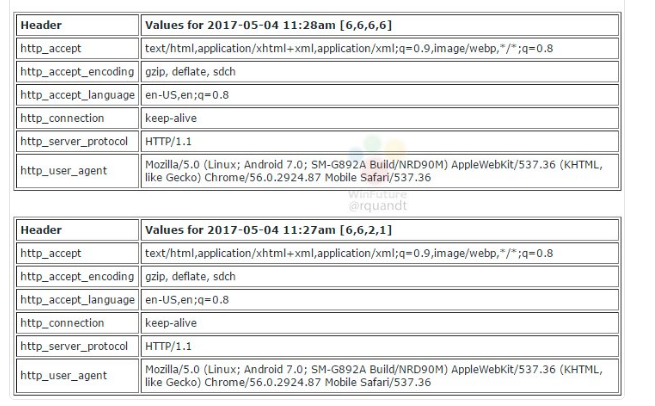
In the previous month, the rumor mill had revealed that Samsung is working on a rugged version of Galaxy S8. The report revealed that the alleged Galaxy S8 Active which will be an AT&T exclusive phone is codenamed as Cruiser. The model number of the Galaxy S8 Active is SM-G892A.
Like the Galaxy S7 Active, the rumored Galaxy S8 Active is expected to be a MIL-STD-810G compliant device that will also come with IP68 certification. The rumored Galaxy S8 Active has appeared on User Agent String which gives us a proof on the existence of the device. Except for the fact that it will be running on Android 7.0 Nougat, its User Agent String listing has revealed no details on its specifications.
As Galaxy S7 Active came with same specs as regular version but the only exception was that the Active variant featured a larger battery. The Galaxy S7 has a 3,000mAh battery, but the S7 Active includes a 4,000mAh battery. Hence, it is likely that the Galaxy S8 Active would be coming with a larger than 3,000mAh battery present inside the regular Galaxy S8.
The Galaxy S8 does not feature any hardware buttons on the front, but the Active variants have always featured them. Hence, there is a possibility that the Galaxy S8 Active may come with hardware buttons below the display. Also, the Galaxy S7 came in multiple color choices such as Black, White, Gold, Pink Gold, and Silver, but its Active variant came in different color options like Camo Green, Titanium Gray and Sandy Gold. In the same way, the Galaxy S8 Active may come in different colors than the Midnight Black, Orchid Gray, Arctic Silver, Coral Blue, and Maple Gold that are available for the regular version of Galaxy S8.
As far as specifications are concerned, the Galaxy S8 Active to arrive with a 5.8-inch display that will support quad HD+ resolution of 1,440 x 2,960 pixels. It will be powered by Snapdragon 835 SoC and 4 GB of RAM. It will be arriving with an internal storage of 64 GB. Like the Galaxy S8, the Active will be coming with a 12-megapixel rear snapper. It is expected to feature a 5-megapixdel snapper in the front. Just as the Galaxy S7 Active was launched in June 2016, the Galaxy S8 Active is expected to become official in June.
Xiaomi is set to offer its range of products including smartphones, Smart TV, Smart home gadgets and others at a reduced price. This isn’t a permanent reduction though, as the tech giant is offering fans the opportunity to take advantage of the Xiaomi Super Brand day on Tmall coming up tomorrow May 9. During the event, fans can get some Xiaomi products at highly reduced prices.
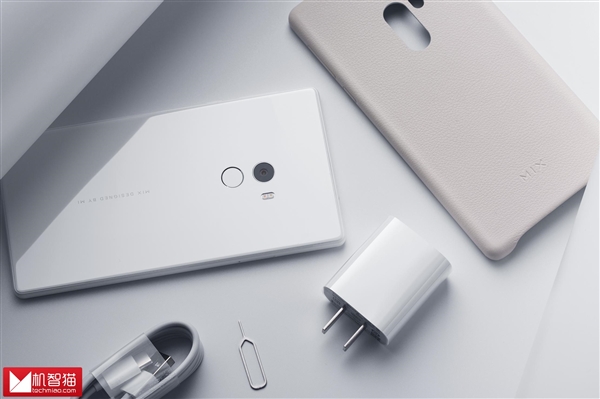
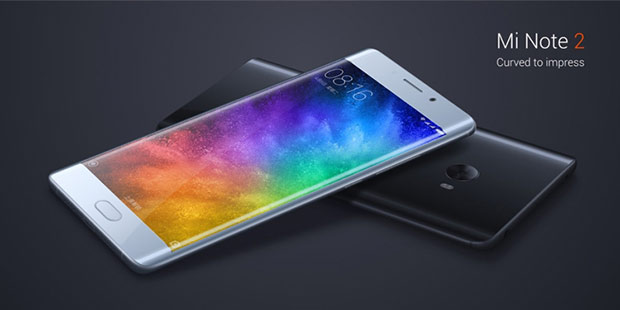
Among the products listed up for sale at reduced prices are models which are at best difficult to get in the market but we are being assured that there is enough stock for all the products. Top on the list is the Pearl White coloured Xiaomi Mi Mix 128GB which will be on sale for 3499 Yuan. Recall that the Pearl White Mi Mix was only unveiled at CES 2017 in Las Vegas and it later went on sale in China but wasn’t readily available just like the Black variant. Another device is the Xiaomi Mi Note 2 Silver variant 64GB which will be available for 2799 Yuan.
In addition, the Xiaomi Mi 5S 3GB + 64GB price has been reduced by 200 Yuan bringing it down to 1799 Yuan. The Mi 5S Plus 4GB + 64GB is also getting a 200 Yuan reduction and will be up for 2,099 Yuan. If you’re looking for a budget phone, the Xiaomi Redmi 4 will be offered for 50 Yuan less the original price at 949 Yuan.
The price reduction will also extend to the Xiaomi TV 4A (65-inch) which will be sold for 6,099 Yuan which is 400 Yuan less the original price. The offer also includes shipping for the same price. The Xiaomi Super Brand day also brings a 100 Yuan price slash to the Mi Notebook Air 13.3-inch which will be on sale for 4,899 Yuan. The Mi Water Purifier will come with six free cotton filter while the Mi Robot Vacuum will be on sale with a 59-Yuan extension box free.
Once again, the Mi Super Brand day on Tmall will hold tomorrow, May 9 and unfortunately, these prices and products are only available in China. Here’s the link to Xiaomi’s official flagship store on Tmall, in case you are interested.
We use cookies on our website to give you the most relevant experience by remembering your preferences and repeat visits. By clicking “Accept”, you consent to the use of ALL the cookies.
This website uses cookies to improve your experience while you navigate through the website. Out of these, the cookies that are categorized as necessary are stored on your browser as they are essential for the working of basic functionalities of the website. We also use third-party cookies that help us analyze and understand how you use this website. These cookies will be stored in your browser only with your consent. You also have the option to opt-out of these cookies. But opting out of some of these cookies may affect your browsing experience.
Necessary cookies are absolutely essential for the website to function properly. This category only includes cookies that ensures basic functionalities and security features of the website. These cookies do not store any personal information.
Any cookies that may not be particularly necessary for the website to function and is used specifically to collect user personal data via analytics, ads, other embedded contents are termed as non-necessary cookies. It is mandatory to procure user consent prior to running these cookies on your website.