Samsung Galaxy S8 and Galaxy S8+ are already generating good revenue and the company wants to drive more sales by introducing a new blue color variant. A leaked image of the blue edition of Galaxy S8 and Galaxy S8+ have been revealed by the well-known leakster, Evan Blass. This blue color variant would be probably introduced as Blue Coral.
The Galaxy S8 and Galaxy S8+ are available in color choices such as Midnight Black, Orchid Gray and Arctic Silver in the U.S. Blass also only revealed the image of the upcoming Coral Blue variant of Galaxy S8 duo but he is not shared any information on their release timeframe. Moreover, there is no information on which carriers and retailers in the country would be selling the Coral Blue Galaxy S8 and Galaxy S8+. It is likely that the new color variant will be available for purchase through Samsung’s official website.
The Blue Coral variant of the Samsung Galaxy Note 7 was very popular, but the phablet ended with a premature death because of its faulty battery. Later, Samsung had introduced the Galaxy S7 Edge in Blue Coral option. When Samsung had introduced the Galaxy S8 duo in the U.S., it had revealed five color options such as Midnight Black, Orchid Gray, Arctic Silver, Maple Gold and Coral Blue. Out of these, the last two color variants are yet to be available in the U.S.
Now that the alleged Blue Coral (with a slightly dark shade) variant has been spotted, it seems that the Maple Gold edition would also surface in the near future. The Coral Blue model for Galaxy S8 duo is unlikely to cost higher than the other color options.
in the last week of May, Samsung’ Taiwanese website had revealed that Taiwanese customers would be getting the Galaxy S8 in colors Ice Lake Blue, Smoked Purple Grey and Quicksand Gold. This shows that Samsung is probably using market-specific strategy to sell the color variants of Galaxy S8 and S8+. In China, Samsung is selling heavily customized version of Galaxy S8 and S8+.
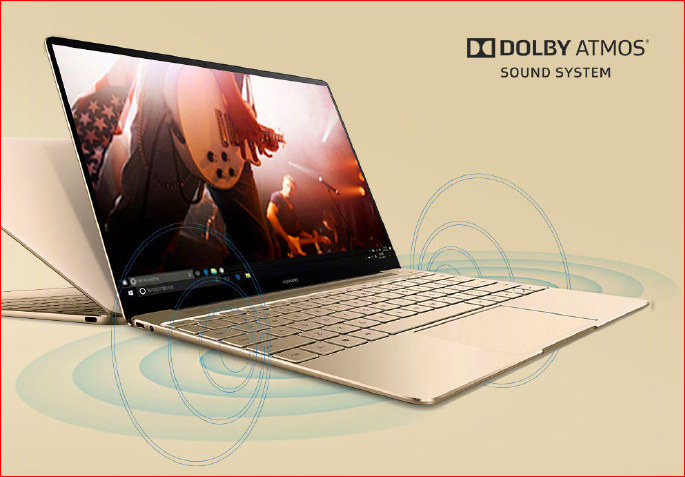
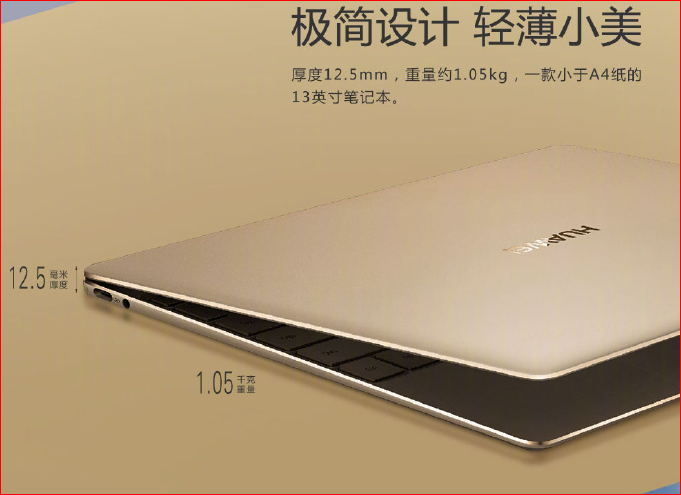
The Huawei MateBook models were announced in Germany and as should be expected, Huawei has gone official with the laptop models in China. The company launched the new generation models in Shanghai China today and as a result, we get to find out their prices as well as get a reminder of the exclusive features the MateBook series come with.
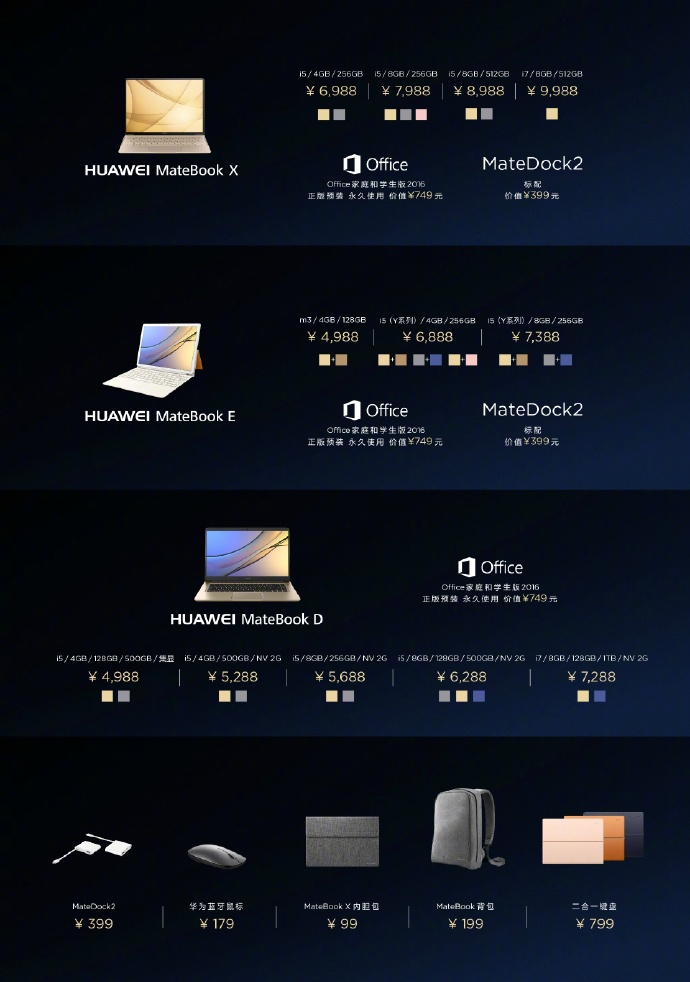
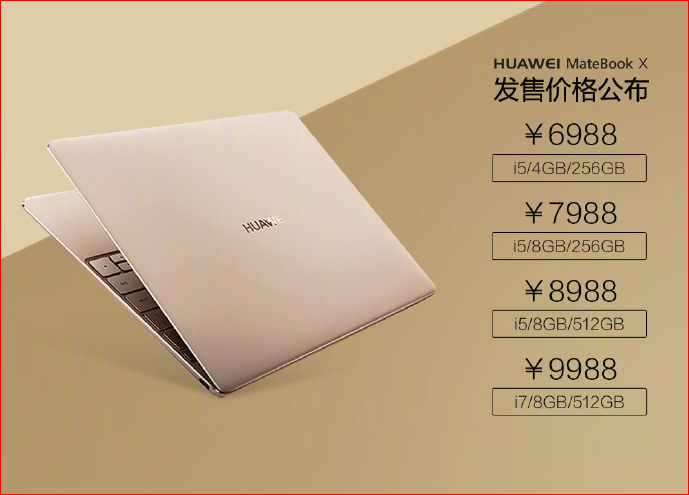
As for their prices, the Huawei MateBook X versions starts at 6988 Yuan ($1,028) for the model with Intel Core i5 chip, 4GB RAM and 256GB storage. The model with Core i5, 8GB RAM and 256HB storage goes up for 7988 Yuan ($1,175). The Matebook X model with Core i5 chip, 8GB RAM and 512GB storage will cost 8988 Yuan ($1323) and finally, the topmost model with Intel core17 processor, 8GB RAM and 512GB storage will retail for 9988 Yuan ($1,470).
On the other hand, the Huawei MateBook E is available in three models. The base model with a 7th Gen Intel Core M3 processor, 4GB RAM and 128GB storage is priced at 4988 Yuan ($734). The model with a Core i5 chip 4GB RAM and 256GB storage starts at 6,888 Yuan ($1013) and finally, the top MateBook E model with Core i5, 8GB RAM and 256GB storage carries a price tag of 7,388 Yuan ($1,087).
On its part, the Matebook D models are priced as follows; the model with Intel Core i5+4GB RAM+128GB SSD+ 500GB HDD is priced at 4988 Yuan ($734), Core i5+4GB RAM+ 500GB SSD+ NV 2G will sell for 5,288 Yuan ($778). Same configuration but with 8GB RAM takes the price to 5,699 Yuan ($838). Finally, the Matebook D top most model packing a Core i7+8GB RAM+ 128GB SSD+ 1TB HDD 7,288 Yuan ($1072).
In addition to the laptop models, Huawei also launched some accessories which would be sold separately like the MateDock 2 with a price of 399 Yuan ($58). There is also a wireless mouse priced at 179 Yuan ($26), a Matebook Backpack priced at 199 Yuan ($29), a protective case for the Matebook X which cost 99 Yuan ($14).
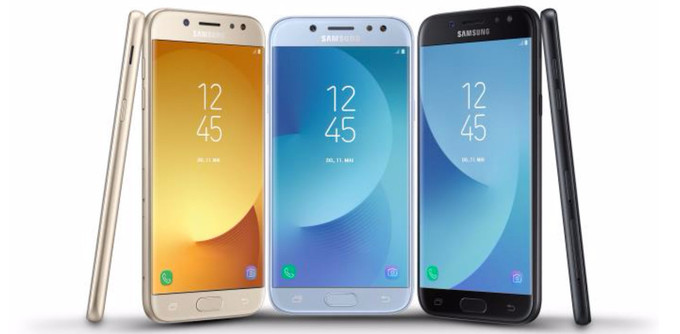
Samsung has listed the Galaxy J3 (2017), Galaxy J5 (2017) and Galaxy J7 (2017) on the official site of the company in the Netherlands. The website contains the European launch timeframes of these phones.
The most expensive among the three Galaxy J (2017) phones is the Galaxy J7 (2017). It has a 5.5-inch AMOLED display that offers a full HD resolution of 1,920 x 1,080 pixels. It is also driven by the 1.6 GHz quad-core processor present inside the Exynos 7870 chipset. It features 3 GB of RAM and has a native storage of 16 GB. It also features a microSD card slot and supports dual-SIM. A front-facing fingerprint scanner is also available on it.
Like the Galaxy J5 (2017), the J7 (2017) has a 13-megapixel camera at the rear and another 13-megapixel camera at the front. It is driven by 3,600mAh battery. In Europe, it is expected to be available with a pricing of €339 (~$382) in July.
The Samsung Galaxy J5 (2017 has a 5.2-inch AMOLED screen that also supports a HD resolution of 720 x 1,280 pixels. The Exynos 7870 SoC featuring a quad-core processor that works at 1.6 GHz and 2 GB powers the smartphone. It has an inbuilt storage of 16 GB and carries support for microSD card and dual-SIM. It features a front-mounted fingerprint reader.
It has 13-megapixel cameras at the front as well as back. It receives power from a 3,000mAh battery. The Galaxy J5 (2017) would be available for buying in Europe later this month (probably on June 22) with a pricing of €279 (~$315)
The Samsung Galaxy J3 (2017) is the lowest powered and cheapest phone among the 2017 Galaxy J series smartphones. It features a 5-inch TFT screen that supports an HD resolution of 720 x 1,280 pixels. It is driven by Exynos 7570 chipset that includes a quad-core processor that clocks at 1.4 GHz and 2 GB of RAM. The internal storage of the phone is 16 GB. It also features a microSD card and carries dual-SIM support
Its main camera is of 13-megapixel and its front-facing camera is of 5-megapixel. A 2,400mAh battery is packed inside the Galaxy J3 (2017). Even though it’s a low range phone it sports a metallic body. It will be available for purchase in August with a pricing of €219 (~$245). This phone is also available through AT&T in the U.S. since the past weeks.
All the three Samsung Galaxy J (2017) smartphones feature metallic chassis and are running on Android 7.0 Nougat OS. Other markets are also expected to receive the new Galaxy J phones in the coming months.
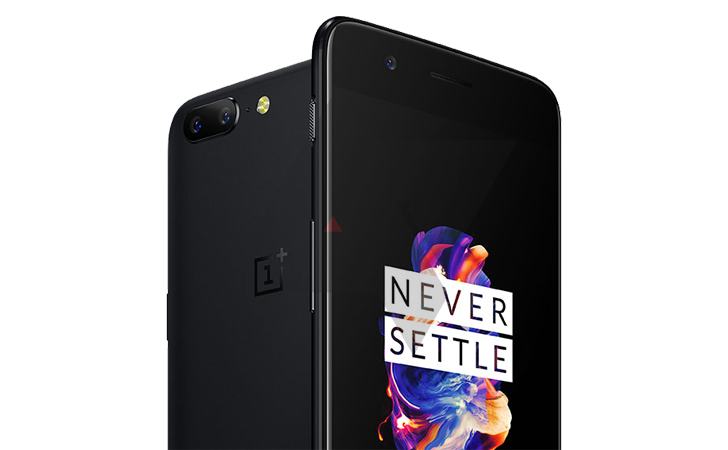
It has been officially confirmed by OnePlus that the OnePlus 5 would be unwrapped on June 20. Android Police has revealed an actual image of the OnePlus 5 flagship. It claims that it that a second source has also confirmed that the image is accurate. This means that all the leaked renders of the OnePlus that have surfaced in the past are fake. Interestingly, the image shared by the publication is almost same as the render that we posted few hours ago.
The above image reveals quite a few things about the upcoming OnePlus flagship. It confirms that OnePlus 5 will arrive with a dual rear camera setup. A laser sensor and a LED flash seems to be present on the right side of the dual camera module. The dedicated mute switch as well as the volume buttons can be also clearly seen on the left side of the OnePlus 5. The Power key is present on its right. A selfie camera is available on the left side of the earpiece on the front panel of OnePlus 5.
The Chinese firm has confirmed that the OnePlus 5 would be fueled by Snapdragon 835 chipset. Several rumors have consistently hinted that the OnePlus 5 would be coming with dual rear cameras. This seems probable because other Chinese brands like Xiaomi, Huawei, LeEco, and more have all released dual rear camera phones.
A leaked image of the retail box of OnePlus 5 was also spotted with the text that rear “Dual Camera. Clearer Photos.” Also, some photos shots that were reportedly taken using OnePlus 5 had surfaced recently. A black and white image among those photos suggested that OnePlus 5 may feature twin rear cameras and one of its lenses would be able to shoot monochrome images. A monochrome sensor in dual camera setup helps in determining lighting conditions in a better way. It indicates it will be able to shoot impressive photos in low light conditions. Rumors have it that the other lens will be able to shoot wide angle images.
Rumors suggest that the upcoming flagship killer from OnePlus has a pair of 16-megapixel f/1.8 aperture lenses. OnePlus has confirmed it is in works with DxOLabs to ensure that OnePlus 5 will be able to deliver stellar photography experience.
In our previous report on ASUS ZenFone AR, it was confirmed by ASUS CEO Jerry Shen that the smartphone would be going on sale in the home market of Taiwan starting from the middle of this month. An official invitation from ASUS confirms that it will be launching on June 14 in Taiwan.
ASUS had announced the ZenFone AR at the Consumer Electronics Show (CES) 2017 in January this year. It has been nearly six months since its launch and the smartphone is yet to reach the hands of the customers. Since the Taiwanese firm has started sending media invites for the launch event of ZenFone AR, finally its arrival seems imminent.
The ASUS ZenFone AR is the first smartphone to support Google Tango AR as well as Google Daydream VR. On its rear, there is a tri-camera system that includes a 23-megapixel Sony IMX318 sensor coupled with motion tracking and depth measuring sensors.
The triple cameras of the ZenFone AR allow it support 3D mapping. GAP, a clothing merchandise firm had demonstrated its AR app earlier this year. It showed that a Google Tango enabled phone will enable the user to try their merchandise on a virtual mannequin with the body that is similar to the user. The ZenFone AR is also the world’s first smartphone with 8 GB of RAM.
The probable reason behind the delay of the arrival of the ZenFone AR is that not many Tango apps were available for it. Our last month’s report states that there are 100 Tango apps available and the company would be soon adding 1,000 Tango apps for the users of ZenFone AR.
As far as the U.S. arrival of the ZenFone AR is concerned, it is expected to be available by next month. Verizon will be the only U.S. carrier that would be selling the ZenFone AR. An unlocked version of ZenFone AR is also expected to be available in the U.S. through third-party retailers.
The ZenFone AR will be coming in two variants, one featuring an 8 GB of RAM and the other one has 6 GB of RAM. It is likely that ASUS would be releasing 6 RAM variant in the U.S.
Again, there is no information on the pricing of the ASUS ZenFone AR. Shen has claimed that the ZenFone AR won’t be priced higher than the Samsung Galaxy S8 which indicates that the phone would be priced under $799.
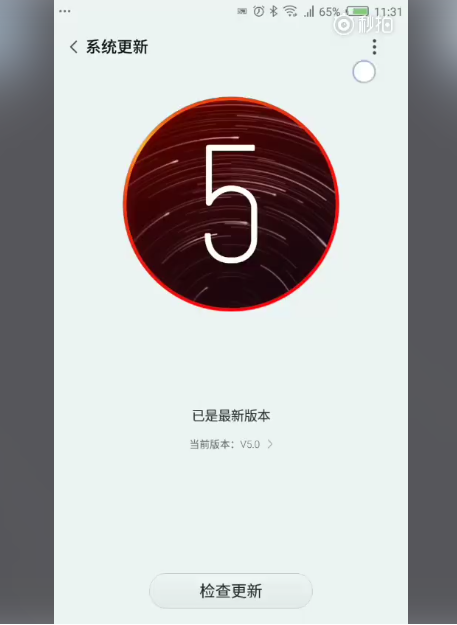
Alongside the announcement of the Nubia Z17, the Chinese manufacturer also announced its new UI, Nubia UI 5.0. Nubia has announced that the new UI will be available for eligible devices and have released a roll-out plan.
The update starts with a closed beta version for the Nubia Z11 this month. Then it will make its way as a stable version to the Z17 Mini, the Z11, Z11 Max and Z11 Mini in August.
Second stage of roll-out includes the Z11 Mini S, Z9, Z9 Mini, Z9 Mini Elite Edition, Z9 Max Full Netcom version, Z9 Max Mobile Unicom version and the Z9 Max Elite.
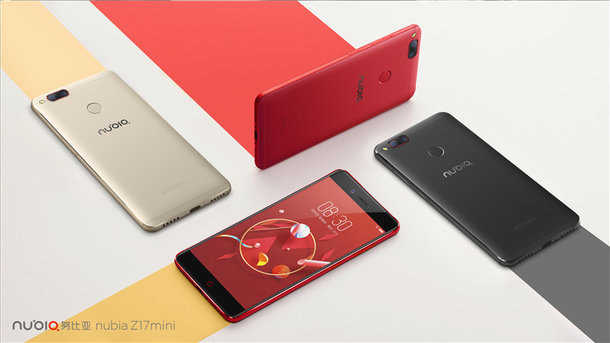
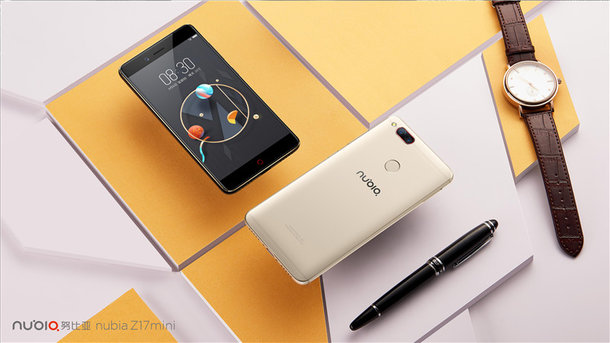
ZTE’s Nubia has announced the official launch of its Z17 Mini in India. The Nubia Z17 Mini made headlines in April when it was first unveiled in China due to its amazing design and powerful dual cameras. The dual cameras turned out to be the main focus on the device and that is what Nubia is projecting in the Indian market according to a statement by Eric Hu, Country Head, Nubia India.
The Z17 Mini will sell for Rs. 19,999 (~$310) in India which is slightly higher than the price for the base version (4GB + 64GB) in China which started at ¥1699 ($247). If you factor in shipping costs and tax, then the price is just fair enough. Sales of the device would be exclusive to Amazon.In and would commence on June 12 at 12 PM. But you can register now at www.nubiaZ17mini.com so you’ll be notified when the device goes live on Amazon.In. We are looking at a Flash sale here.
The Nubia Z17 Mini isn’t a flagship, the Z17 is, but its design will make you think it is a flagship device. Moreso, the device is available in four different colours which include champagne gold, black gold, red and elegant black. Specs wise, the Z17 Mini uses a Snapdragon 653 processor which is backed by 6GB of RAM. There is also a Snapdragon 652-powered version with 4GB of RAM and this is the version that has hit India.
Perhaps, the most stand-out feature on the Nubia Z17 Mini is the dual camera setup at the rear, as well as the large pixel selfie shooter. The main camera is a powerful 13MP Sony IMX258 sensor and the secondary sensor is a black and white camera which is a depth of field camera. The dual camera supports 0.1s mixed focus and also 4K ultra-high definition video recording. It can also capture in slow motion and has time lapse feature.
Andy Rubin’s Essential Phone was the topic on the front burner last week when it was unveiled officially to the public. The Essential Phone-1 dazzled with the sleek design it came with as well as the powerful specs it features. The major highlight was no doubt the Snapdragon 835 chip it would launch packing. Another spectacular feature is the rear camera setup.
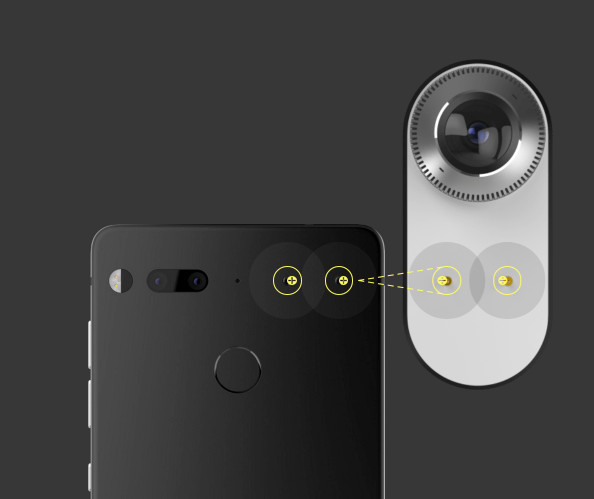
The Essential PH-1 packs two 13MP f/1.85 lenses on its rear panel arranged in a horizontal manner, one of which exclusively captures monochrome (black and white) images, while the other one records colours. The two work in conjunction to deliver high-quality photos that would hardly be achieved with conventional single-lens mobile camera setups.
Apart from the dual cameras, the device has a module from where a 360-degree camera can be clipped on the device to enable a whole different kind of phone-based photography. Essential President Niccolo de Masi has now given us a glimpse of what the 360-degree camera and the dual camera samples look like. Interestingly, the dual camera sample photos look quite grainy with lots of image noise all over. The two sample images don’t look like what have been captured by a flagship phone. We may even find much better samples from budget phones. The two sample photos have since been deleted from his Twitter account but the crisps clear panoramic video apparently captured by the Essential Ph-1 is still on his timeline.
We really can’t say why the Essential Phone’s camera samples came out bad bot we’re sure the company will reveal better samples soon. But then, if much better ones surface, it becomes difficult knowing what’s true and what’s not.
Mark your calendars! The highly-anticipated OnePlus 5 launches on June 20. The announcement was made by OnePlus CEO Pete Lau via his official Twitter account. A few minutes later, the official OnePlus Twitter account also made the announcement.
The event like all other OnePlus launches will be live-streamed at 12:00 PM EDT (4:00 PM GMT). Should we expect new VR glasses this year? We can’t say yet.
There will also be pop-up events holding at various locations. It will hold in New York on the same day at 7:00 PM at the Meatpacking District. OnePlus Co-founder Carl Pei and popular YouTuber MKBHD will be present.
It will also hold in Paris on June 21 at 11:00 AM at 213 Rue Saint Honore. Other locations are listed on the page created for the event.
Yesterday, the date leaked online via an image but was disproved and said to be for the OnePlus 2. Turns out that while that date might have truly been for the OP2 (April 20, 2015), whoever posted it again was giving us a hint.
The OnePlus 5 will be powered by Qualcomm’s Snapdragon 835 processor. A picture posted by OnePlus hints at the device being smaller than the OP3T. The main feature most people are looking forward to is the camera which is rumored to be dual sensors. Heck! The official launch poster even teases it with the phrase “Focus On What Matters”.
There even appears to be a hint buried in the event page. The box holding the text “Focus On What Matters” moves slightly in both directions like a panorama. Try moving around with your cursor and you should notice it.
Every Tuesday, Xiaomis Mijia Platform announces at least one new product. Over the weekend, they teased two new products which we thought were sports-themed but turns out we were wrong. One of them is destined for the kitchen and that is the Red Dot Prize Stainless Steel Pot Series.
The Red Dot Prize Stainless Steel Pot Series consists of a soup pot, a sauté pan, and a milk pot. All three are made by Wu Yi Technology Co., a company based in Shenzhen, China that will also handle shipping and after-sales services.
The pots are made from SAE 304 stainless steel and sport glass lids with red handles. They can be used on induction cookers, gas stoves, electric stoves, and even electric furnaces and are non-stick pots.
There are a number of neat features on the pots. For example, the handles on the lids are designed to hold turning sticks and ladles and the inside of the pots have markings for measurement.
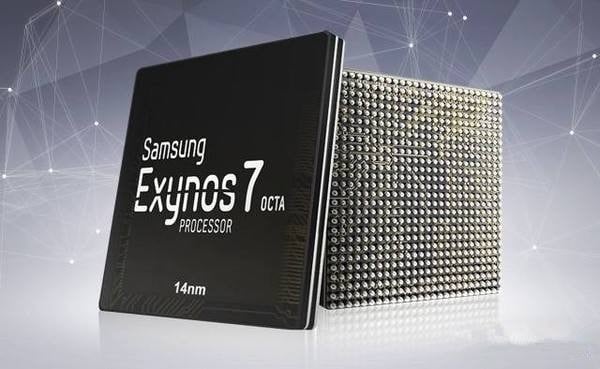
Samsung is working on a new 14nm chip called the Exynos 7872. The new mid-range chip has a number of features going for it, key feature being full network support. Although the chip is yet to launch, Meizu already has plans to release a phone powered by the chip.
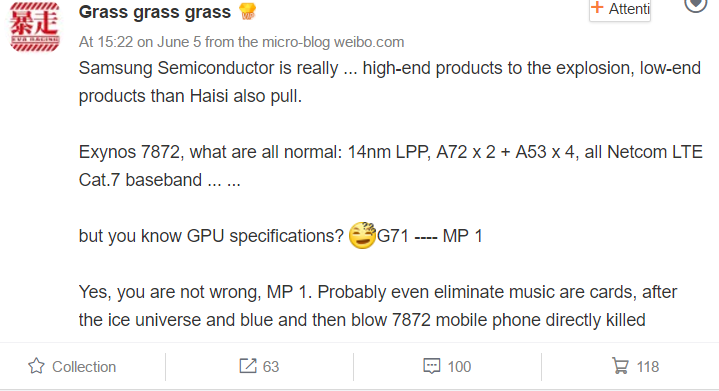
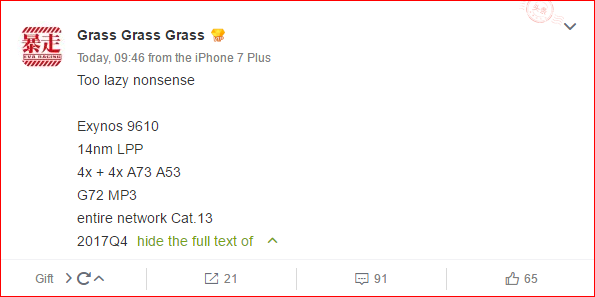
Previous details revealed about the chip says it will have six cores: 4 Cortex-A73 and 2 Cortex-A53 cores, paired with a Mali-T830 GPU. According to a Weibo post by @Grass Grass Grass, there has been a change. Instead of the T830, the GPU has been swapped for a Mali-G71 MP1.
This is a high performance ARM GPU and a variant of the one found in the Kirin 960 (Mali-G71 MP8). The difference lies in the number of cores. The MP1 has just a single display core while the MP8 as the name suggests has 8. The Mali-G71 actually maxes out at 32 cores.
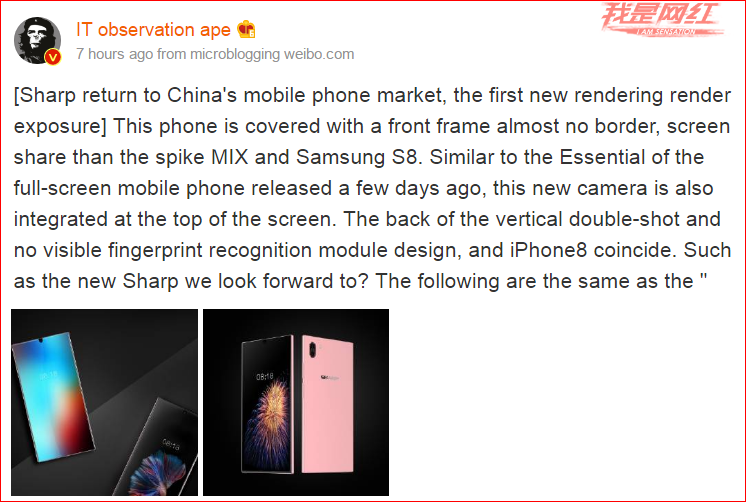
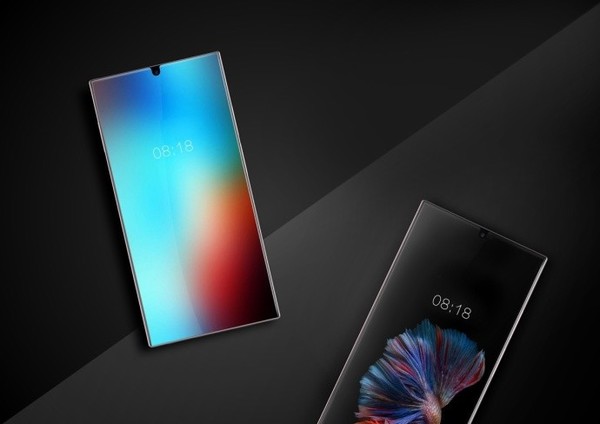
We had thought Sharp was planning to launch a bezel-less smartphone in China on May 25 but that never happened. The Japanese tech giant had shared a teaser pointing at an event slated for May 25. The date has long come and gone but that has not stopped the leaks surrounding the expected Sharp bezel-less phone from abating. The rumours started resurfacing since Sharp reopened its Weibo page, something that is seen as a sign that the company is preparing to make a comeback in the Chinese market.
A Weibo user has shared a couple of photos said to be renders of a bezel-less Sharp model. On a closer look, it could be noticed that the device comes with a design having very narrow bezels at the sides.The display covers the entire screen with just a small cut out in the upper edge for the selfie camera. The screen to body ratio is way higher than those of the Samsung Galaxy S8 or the Xiaomi Mix. Now, we would have thought this is a fan generated render that might not see the light of day but that perception was changed by the Mi Mix and other bezel-less devices that have hit the market since Xiaomi unveiled the Mix last year.
Still talking about the design, the bezel-less Sharp phone features a dual camera setup at the rear, aligned in a vertical direction. The device also has a ultra-thin body and looks more like the recently unveiled Essential Phone 1. Since there is no rear fingerprint sensor, the device will likely feature a front fingerprint sensor. In the absence of any form of bezel under the display, the sensor may be an onscreen sensor.
OnePlus is known for releasing stellar flagship smartphones with affordable pricing. However, the one department that the company needs to improve is customer service. In order to ensure that the customers are provided with the best customer service, it has released a new video that reveals how the company has improved its customer service department and how important is aftersales service for the company.
The video with the title “OnePlus – A Closer Look at the Customer Service” states that the company started in 2013 with 5 people in its customer care department and now it has more than 500 employees for customer support. The customer care team of OnePlus is reachable through various channels such as phone, live chat, social media and forum. Apart from repair centers in the U.S. and Europe, the Chinese firms has numerous local support teams and repair centers across the globe. The video also talks about the different steps involved in dealing with the problems of the customer. Here is the video:
The video has been released just before the impending launch of OnePlus 5 flagship phone. This indicates that the company wants its customers to know that what sort efforts it is making to overcome its weakness. OnePlus has been consistently releasing teasers on its upcoming flagship, the OnePlus 5. The video seems to be one of the strategies to build the hype around the OnePlus 5 that is pegged to launch this month.
The Chinese firm has already confirmed that the Snapdragon 835 will be present under the hood of OnePlus 5. Rumors have revealed that the OnePlus 5 would be coming with dual rear cameras. And OnePlus has also confirmed that it is working with DxOLabs (best known for DxOMark benchmarking platform for cameras) to deliver the best photography experience on OnePlus 5.
The OnePlus 5 is expected to sport a thinner chassis than the predecessor models. It is rumored to come with a 5.5-inch FHD screen. It is expected to be available in 64 GB and 128 GB storage options along with 6 GB RAM of RAM.
OnePlus is still silent on the launch date of OnePlus 5. Speculations hint that it may launch on June 15 and there are other rumors that it may get unveiled later in this month. It is expected to arrive with a costlier price tag than its predecessor.
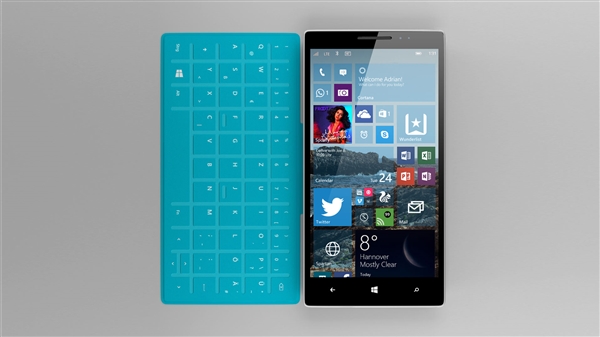
It appears that Microsoft hasn’t shelved its dream of making a Surface Mobile. A video accidentally uploaded on video sharing website, Bilibili via the official Microsoft account has revealed details about the upcoming phone.
The video is titled “1706 Engineering Equipment”and its description contains info about the Surface Mobile. Although the video has been deleted, someone managed to get a screenshot of the video’s description. After it was translated, we were able to make out key info about the device.
Surface Mobile Code Names: Surface Peking and Surface Slovania
Apparently, there will be two variants. One is called the Surface Peking (Beijing used to be written as Peking) and the other is called Surface Slavonia. They might differ in terms of screen sizes and or internal configuration.
Surface Mobile Design, Processor and Features
The Surface Mobile will be powered by Qualcomm’s Snapdragon Mobile Platform. This will most likely be the Snapdragon 835. Microsoft is already working with Qualcomm and a bunch of other hardware partners to release SD-835 laptops. If its powering Windows laptops, its definitely powering the Surface Mobile.
The Surface Mobile will have an exclusive Surface Pen with a dedicated key that brings up OneNote. The phone itself will have a hinge design that bends up to 185°.
A recent Microsoft patent showing a hinged device may provide a hint as to what the Surface Mobile will look like. This device has two displays and can be seen to flex to different angles.
[envira-gallery id=”134786″]
This is a different design entirely from what we are used to seeing. And based on what CEO Satya Nadella said in an interview a few months ago, the corporation has been working on personal computing devices with new form factors.
There is also the mention of new “ONTO TABLE” Projection Continuum function that lasts up to 1 hour of desktop work.
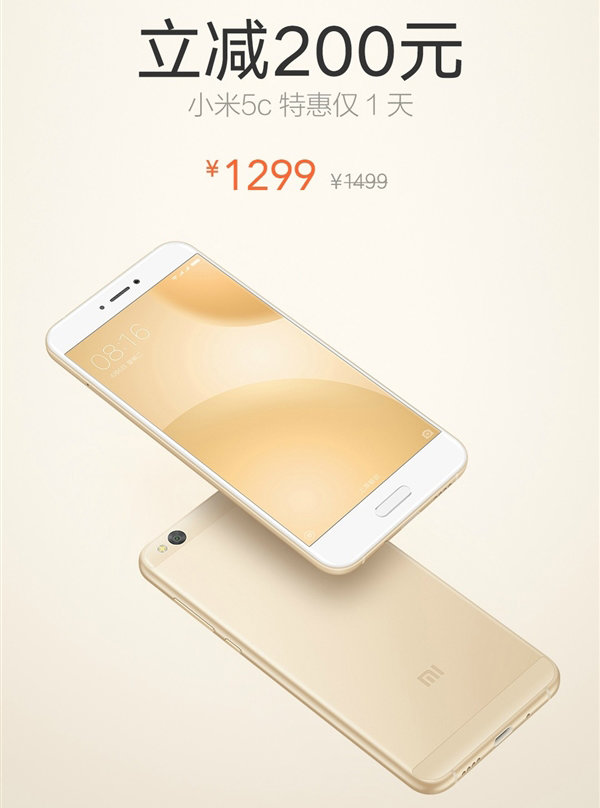
Xiaomi announced its new chip, the Surge S1 this year and the first phone to be powered by it is the Xiaomi Mi 5C. Initially priced at ¥1499 (∼$220), the Mi 5C has now gotten an official price cut….that lasts just one day.
The Mi 5C will now sell for ¥1299 (∼$190) before returning to its old price. The price cut is for the on going 618 promotion. So what does a $190 phone have to offer?
Like the name says, the Mi 5C is similar to the Mi 5. It has the same display size and resolution, and shares the same fingerprint scanner design and location. However, that is more or less where the similarities end.
There is 3GB of RAM on board and 64GB of storage with no support for expansion. Its octa-core processor is clocked at 2.2GHz and it has a Mali-T860MP4 GPU. The main camera is a 12MP f/2.2 sensor from OmniVision that takes pretty impressive shots. You also get a 8MP shooter in front.
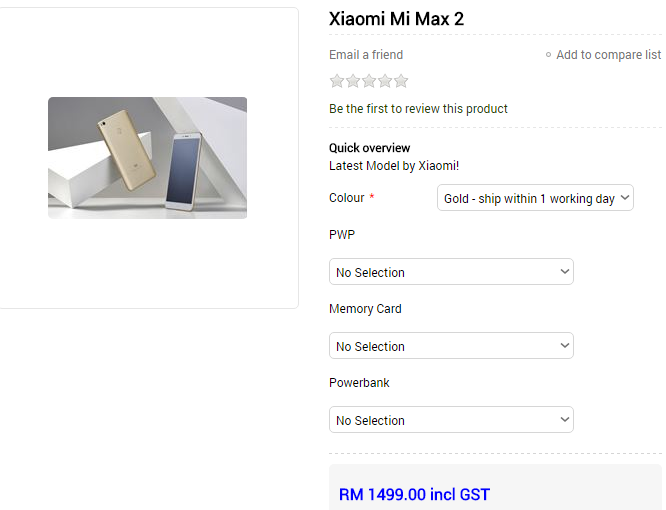
The Xiaomi Mi Max 2 was unveiled on May 25 to replace the last year’s MI Max 2. Since its launch, the Xiaomi phablet has been only available in the home country of China. However, within weeks of its official announcing, the Mi Max 2 has landed in Malaysia with a pricing of RM 1,499 (~$350) with GST included for the 64 GB model.
A Malaysian retailer, DirectD has listed the 64 GB Xiaomi Mi Max 2 in gold color. The Mi Max 2 was also announced in 128 GB storage options which is not listed on the Malaysian retailer site.
The Xiaomi Mi Max comes with a 6.44-inch full HD display that produces a resolution of 1,920 x 1,080 pixels and is powered by Snapdragon 625 chipset and 4 GB of RAM. It comes in two storage choices of 64 GB and 128 GB. The phablet comes preloaded with Android 7.1.1 Nougat OS with MIUI 8.2 overlaid on it. It also includes a microSD card slot, a USB Type-C slot and a rear-facing fingerprint scanner.
For photography, Xiaomi has included a stellar 12-megpaixel Sony IMX386 sensor which features large pixels that measure 1.25 microns. It’s the same camera sensor available on Mi 6. The camera is capable of shooting high quality photos in low light conditions. It features an 85-degree wide angle 5-megapixel selfie camera. Here is a comparison camera shots taken from Xiaomi Mi Max 2 and the dual rear cameras of Mi 6.
The phablet is also equipped with stereo speakers. It is powered by 5,300mAh battery that is coupled with Quick Charge 3.0. In China, its 64 GB and 128 GB models are respectively priced at 1,699 Yuan (`$250) and 1,999 Yuan (~$294). Speculations are rife that it would be arriving on July 23 in India.
ZTE’s elite brand Nubia launched the Z17 flagship on June 1 with the first sale slated to hold on June 6 on Jingdong as well as on Nubia’s official store. The Nubia Z17 did indeed go on sale today as schedule and the record of the sales from Jingdong indicate that the Z17 was sold out in record time and quantity. Jingdong says it sold 10K units of the Z17 in just 51 seconds. That isn’t all, the Nubia flagship only needed four minutes before breaking Jingdong’s single product first sales figure in the mobile phone category.
The Z17’s sales performance isn’t much of a surprise considering the strong specs lineup it launched with. The Nubia Z17 is perhaps the most spectacular Snapdragon 835-powered smartphone around presently as a result of the massive 8GB RAM it features on its topmost model. That makes it one of the first smartphones in the world to feature such, second only to the Zenfone AR. The Z17 is also the first device to utilise Qualcomm’s latest Quick Charge 4+ fast charging technology even though users won’t get a supported charger for now. The flagship device also packs a dual camera setup at the rear which is a telephoto and wide angle lenses. The flagship also has waterproof properties.
Another quality that may have triggered the record sales the Nubia Z17 achieved may be its competitive price tag. The 6GB + 64GB Z17 version retails at 2799 Yuan ($411) while the 6GB + 128GB variant retails at 3399 Yuan ($500). Surprisingly, the topmost 8GB + 128GB variant costs just 3999 Yuan ($587). This price makes the Z17 well positioned to take on the Xiaomi Mi 6. The next round of sales would commence on June 12 at 10 AM (CST).
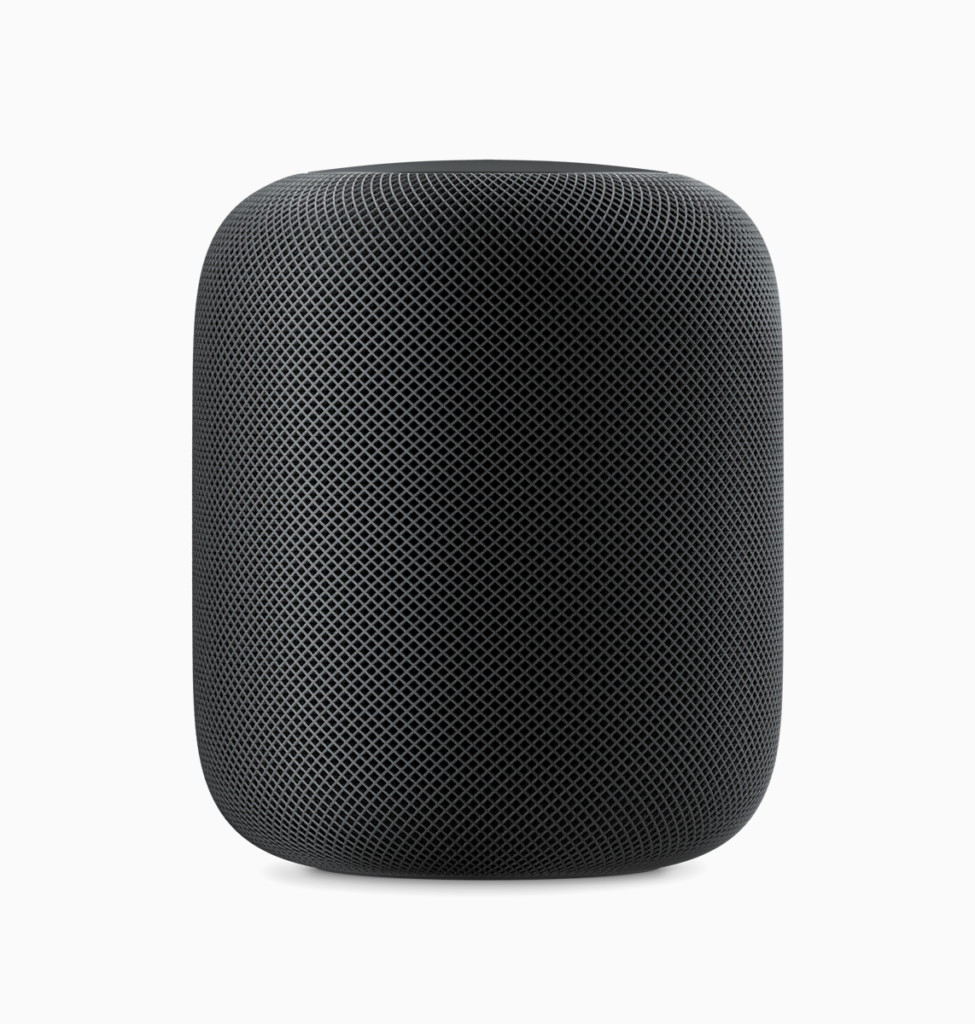
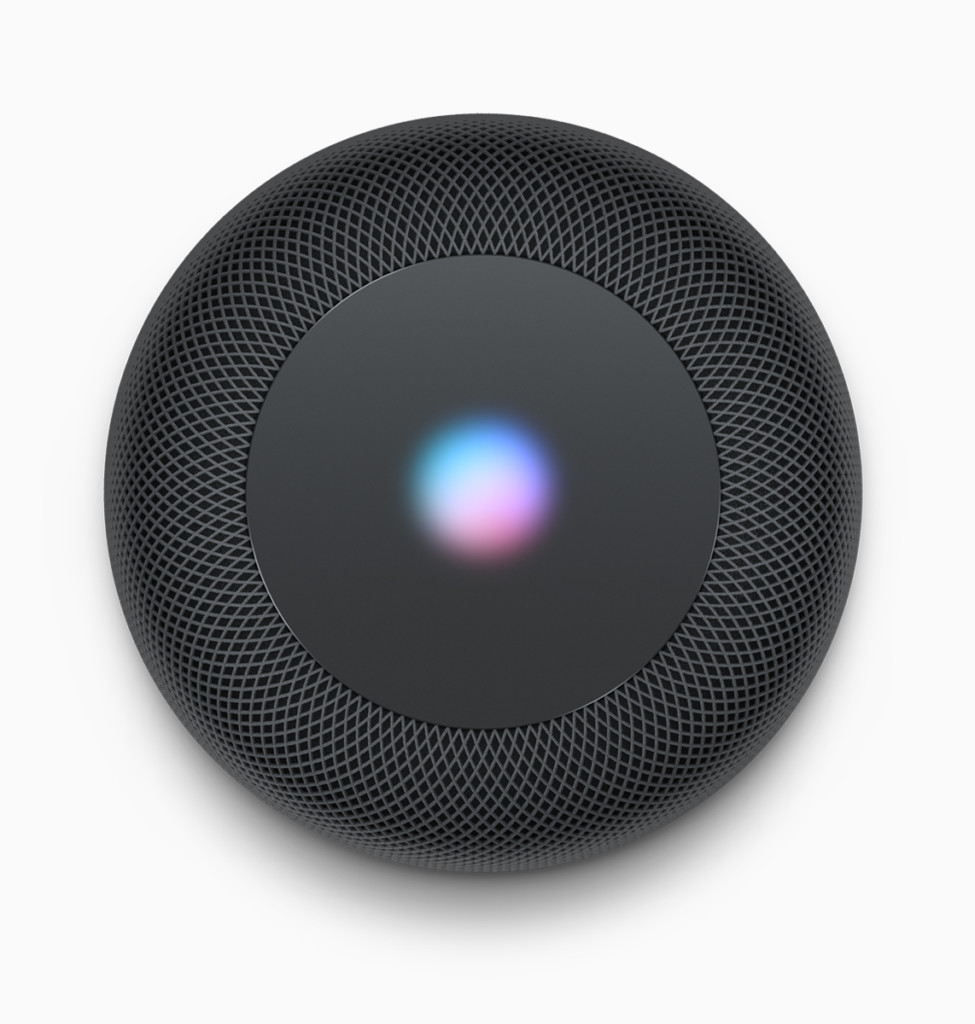
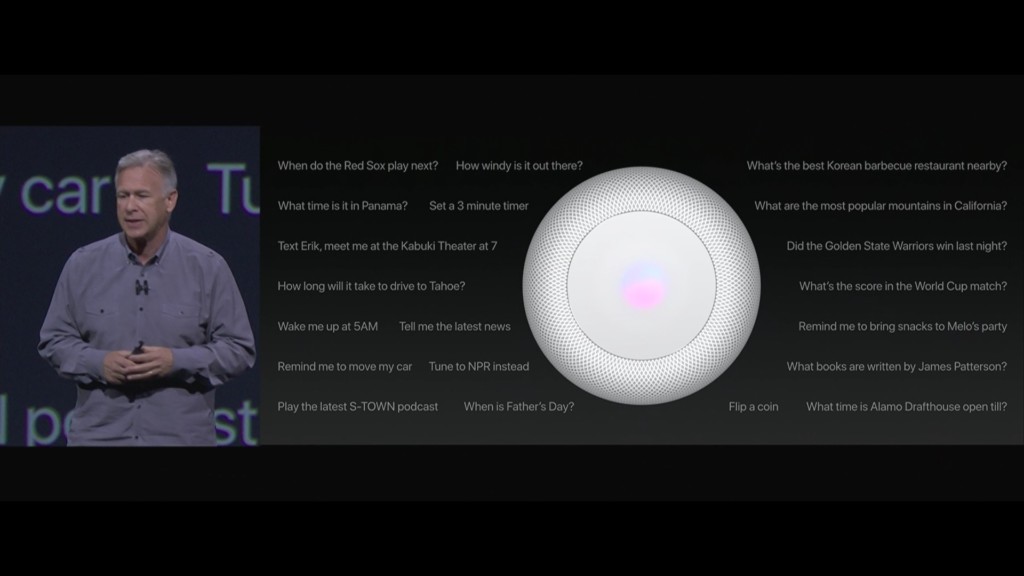
The size of the HomePod is less than 7 inches, but it is packed with a seven-tweeter system at its bottom and at the top is a 4-inch woofer with auto bass EQ designed by Apple. it is equipped six microphones to recognize voice even the music is playing at high volume. The entire speaker system is powered by Apple A8, the same chipset that is present under the hood of iPhone 6. It is very easy to setup a HomePod as it only requires the user to hold the iPhone close to the HomePod and it is smart enough to detect it and start playing music.
With spatial awareness onboard, the Apple HomePod can automatically detect the spaces and features of the room where it is placed and accordingly it can adjust the sound and deliver optimized sound output. If two HomePods are kept in the same room, both the devices can detect each other and function together to deliver the best sound experience without any ads.
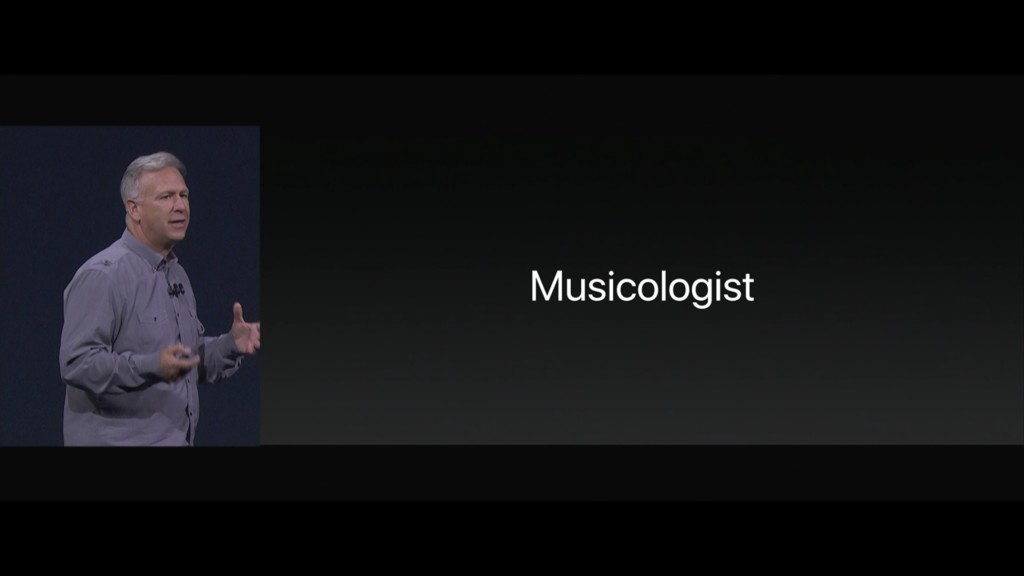
The Apple A8’s prowess is coupled with Siri AI which transforms HomePod into a smart speaker system. The HomePod is integrated with Apple Music which makes it possible to listen to wide array of 40 million songs from its library. Siri can serve as a musicologist for music lovers as it can quick provide answers to questions like “Who is singing this song?” and “Who is playing the drums in this song?”
With Siri intelligence, the HomePod offers various features such as listening to news, unit conversions, setting reminders, send messages, control other smart devices, weather updates and more. When the HomePod users is not at home, he/she can use the Home app on an iPhone or iPad and access its features remotely.
As far as availability of Apple HomePod is concerned, it will be available in December starting with regions like the U.S, the U.K. and Australia. More countries will be added later on. It will be priced at $349 and will be available in color choices like White and Space Gray. The HomePod is compatible with iDevices running on iOS 11 and iPhone 5s and above.
Here is the official introduction video of Apple HomePod:
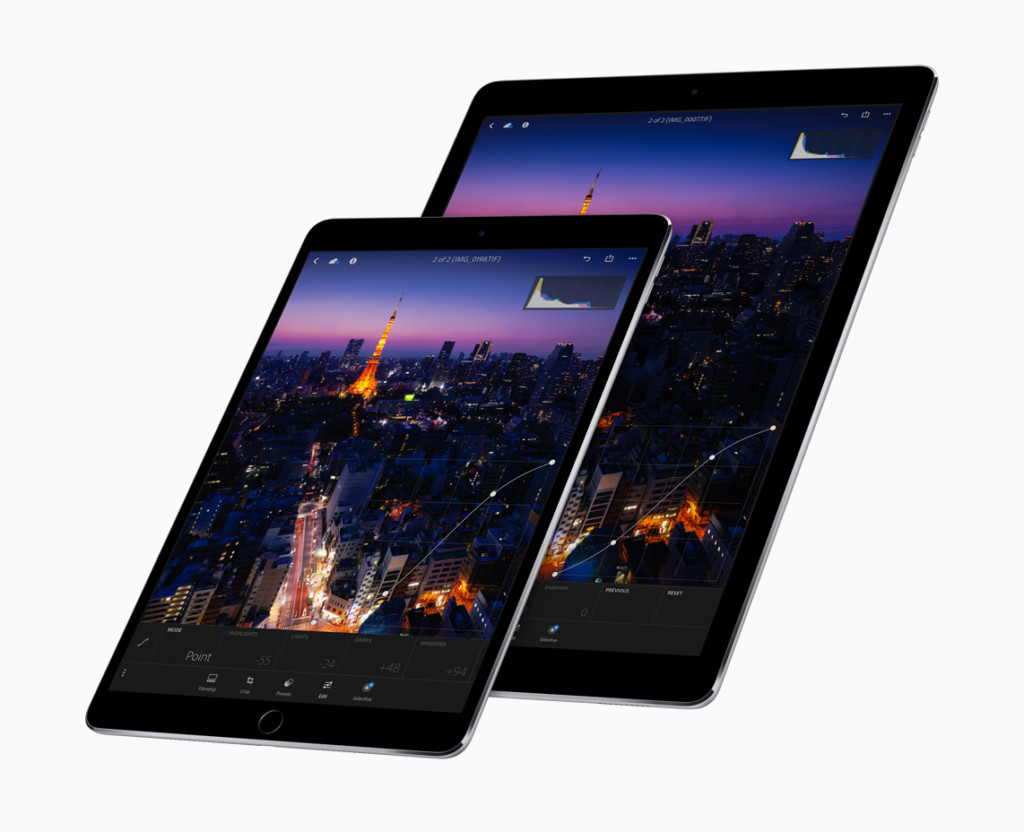
At the ongoing Worldwide Developers Conference (WWDC) 2017, Apple has finally unveiled the all-new 10.5-inch iPad Pro to replace the 2016’s 9.7-inch iPad Pro. It has also announced a refreshed 12.9-inch iPad Pro as a successor for the original version that was launched in 2015.
10.5-inch, 12.9-inch iPad Pro Specifications and Features
Apple has managed to include a 10.5-inch screen into the same form factor of a 9.7-inch iPad Pro by cutting down on the bezels by 40 percent. The weight of the tablet is only 1 pound. The new 10.5-inch and the refreshed 12.9-inch iPad Pros come with True Tone screens that can automatically adjust the temperature of the color on the basis of lighting conditions.
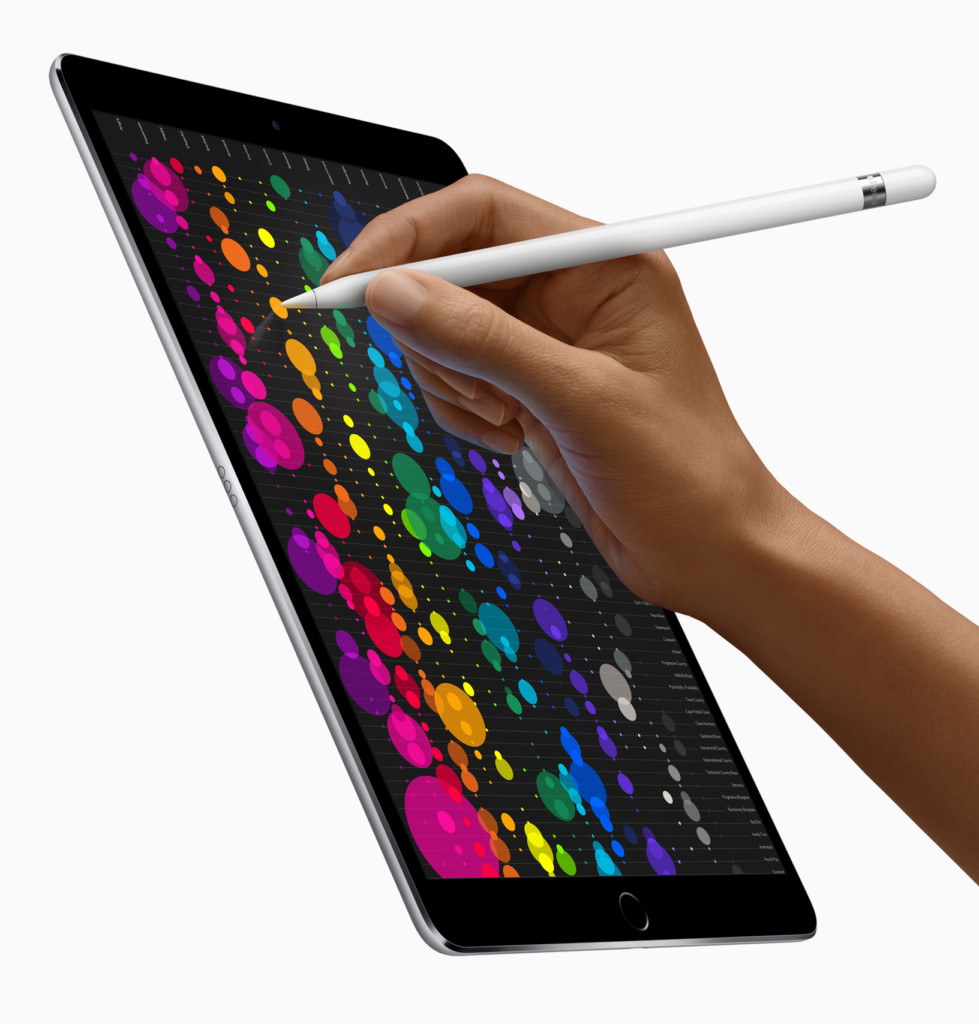
The displays also offer a maximum refresh rate of 120 Hz which means users can take advantage of smooth scrolling and responsiveness along with 20ms latency for Apple Pencil. The ProMotion feature enhances display quality by consuming less power and automatically adjusts the refresh rate. Other features of the display include wide color gamut with HDR video support, ultralow reflectivity and 600 nits brightness.
The new iPad Pros are fueled by Apple A10X Fusion chipset that features a hexa-core processor which includes three high-performance cores and three high-efficiency cores. It also includes a 12-core graphics that delivers 40 percent better graphics performance than Apple A9X. The new iPad Pros can deliver a battery performance of up 10 hours along with fast charging support.
The 10.5-inch iPad Pro and the refreshed 12.9-inch iPad Pro also feature the same 12-megapixel with f/1.8 aperture rear-facing camera sensor that is available on the backside of iPhone 7. It carries features like Optical Image Stabilization, quad-LED true tone flash, and 4K video shooting support. It has a 7-megapixel FaceTime HD camera.
The new iPad Pros are also fitted with quad-speaker audio system. For connectivity, the two devices offer features like embedded Apple SIM, Wi-Fi 802.11ac, and LTE Advanced. The Touch ID sensors on both devices can be not only used for unlocking but also for authenticating transactions on Apple’s online stores
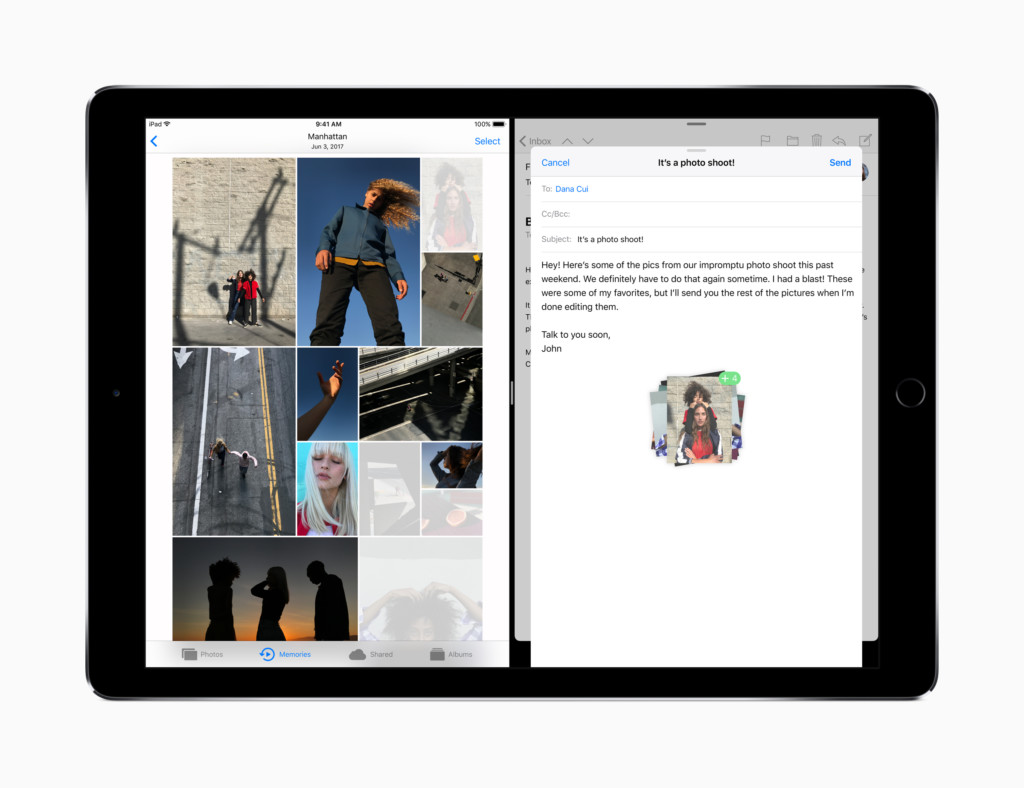
The all new iOS 11 comes preloaded on the new iPad Pros. It brings a plethora of new features such as a full-sized onscreen keyboard, a customizable dock that gives access to frequently used apps and documents from any screen, a enhanced multi-tasking, revamped app switcher, a new Files app that gives access to iCloud Drive, Dropbox and other online storages, a new drop-and-drop feature between apps and a document scanner for scanning single or multiple documents. The Apple Pencil supports inline drawing, PDF annotation, drawing on screenshots, Instant Markup support for easily signing on documents, and a simple tap on the Lock Screen launches the Notes app instantly.
The 10.5-inch and 12.9-inch iPad Pro color variants include Silver, Space Gray, Gold and Rose Gold. The Wi-Fi only 10.5-inch iPad Pro with 64 GB storage is priced at $649. Its Wi-Fi + Cellular model is priced at $779. The Wi-Fi only variants of 256 GB and 512 GB storage variants are respectively priced at $749 and $849.
The Wi-Fi only 12.9-inch iPad Pro with 64 GB storage is priced at $799. Its Wi-Fi + Cellular model is priced at $929. The Wi-Fi only 256 GB and 512 GB variants are respectively priced at $899 and $1,099. The 12.9-inch iPad Pro is available in colors like Silver, Space Gray and Gold.
The new iPad Pros are available from online stores and authorized resellers of Apple in the U.S. and other countries like Australia, Canada, China, France, Germany, Hong Kong, Italy, Japan, Netherlands, Russia, Spain, Sweden, Switzerland and the UK. Countries like India, Turkey and UAE will be receiving the new iPad Pros later this month followed by Brazil, Mexico and South Korea in July.
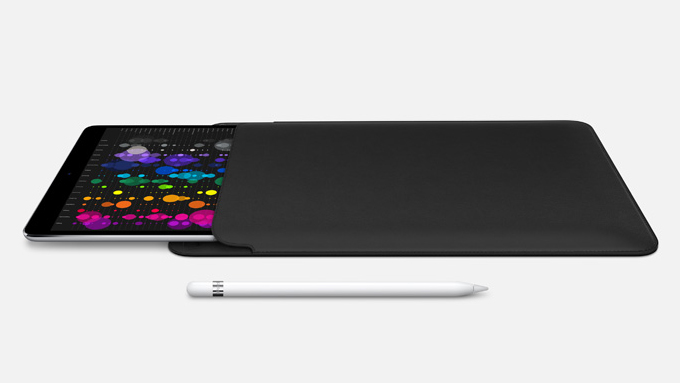
The Apple Pencil is priced $99 and Charcoal Gray Smart Keyboard for 10.5-inch iPad Pro costs $159. The Smart Keyboard for 12.9-inch iPad Pro is priced at $169. Apple is also new Leather Sleeve, Apple Pencil cases, and Smart Covers for the new iPad Pros.
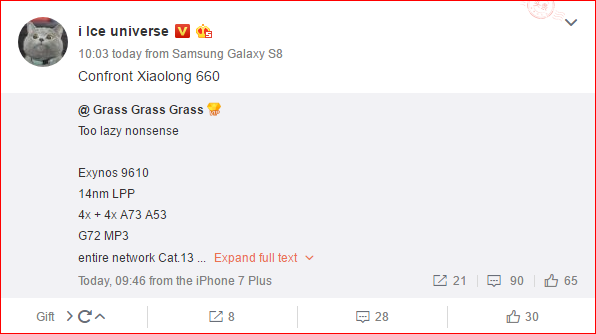
There are indications that Samsung may be working on a new mid-range chipset which is said to go by the name Exynos 9610. Samsung already has the Exynos 8895 chip featured on its latest high-end Galaxy S8 models which also use Qualcomm’s Snapdragon 835 chip. The Exynos 9610 is said to be due to the release of the Snapdragon 660 chip which is a mid-range chip. The Exynos 9-series will be a new series on its own, according to the source. Recall that Samsung had teased the launch of an Exynos 9-series chip some time ago but instead launched the Exynos 8895. But the Exynos 9610 is tipped as the true Exynos 9 series eve though we wonder why the 9 series would be a mid-ranger.
Configuration wise, the Exynos 9610 is said to be manufactured using the 14nm LPP process and integrates the entire network baseband. The chip is made up of four Cortex -A73 cores and eight Cortex-A53 cores. The Exynos 9610 is also said to feature a G72MP3 GPU which looks like a Nvidia GPU.
Further, the Exynos 9610 is expected to debut in the fourth quarter of this year and may likely be used by Meizu first. We had earlier heard that the Exynos 7872 chip which was spotted on the specs sheet of a Meizu phone will also debut this year and that rumour joins this as well. We can’t say how true this is anyway. Already, OPPO is gearing up to utilise the Snapdragon 660 chip and should be launched any moment from now. We may likely be seeing the chip in benchmarks if this rumour turns out to be true.
We use cookies on our website to give you the most relevant experience by remembering your preferences and repeat visits. By clicking “Accept”, you consent to the use of ALL the cookies.
This website uses cookies to improve your experience while you navigate through the website. Out of these, the cookies that are categorized as necessary are stored on your browser as they are essential for the working of basic functionalities of the website. We also use third-party cookies that help us analyze and understand how you use this website. These cookies will be stored in your browser only with your consent. You also have the option to opt-out of these cookies. But opting out of some of these cookies may affect your browsing experience.
Necessary cookies are absolutely essential for the website to function properly. This category only includes cookies that ensures basic functionalities and security features of the website. These cookies do not store any personal information.
Any cookies that may not be particularly necessary for the website to function and is used specifically to collect user personal data via analytics, ads, other embedded contents are termed as non-necessary cookies. It is mandatory to procure user consent prior to running these cookies on your website.