Vivo India has sent out media invites to confirm that it will be unleashing something new on Feb. 20. Previous leaks have claimed that Vivo India may launch the Vivo V15 Pro by the end of February. Hence, it appears that the company is all set to debut the Vivo V15 series which includes the Vivo 15 and Vivo V15 Pro handsets in India on Feb. 20.
Vivo India has recently discontinued the Snapdragon 845 powered Vivo NEX flagship phone that came with a pop-up selfie camera. The probable reason behind it is that the company is soon going to launch the comparatively cheaper Vivo V15 series with pop-up selfie camera. The media invite shown below clearly shows that the phone launching on Feb. 20 has a pop-up front camera.
The inclusion of pop-up front camera on the Vivo V15 series suggests that the Vivo V15 and Vivo V15 Pro smartphones will be arriving with notch-less AMOLED screens. Previous reports have claimed that both smartphones will be equipped with in-display fingerprint scanners.
The Vivo V15 Pro is rumored to arrive as the first V-series phone from the company with triple rear cameras. It is speculated to include 32-megapixel lens as the primary sensor. The Vivo V15 is also expected to feature the same camera lens on its rear. However, there is no confirmation on whether it will be featuring a dual camera setup or triple camera setup.
Some rumors have claimed that the Vivo V15 Pro will be featuring the Snapdragon 710, but there is no concrete evidence available on it yet. There is no information available on the other specifications of the smartphone. Leaks surfacing ahead of the Feb. 20 are expected to reveal more information on the Vivo V15 series.
A recent report had claimed that the Chinese manufacturer may launch the Vivo V15 Pro smartphone as Vivo X25 in March in China. The Vivo V15 is expected to arrive in India within Rs. 25,000 (~$350) whereas its Pro edition could be costing between Rs. 25,000 (~$350) and Rs. 30,000 (~$420).
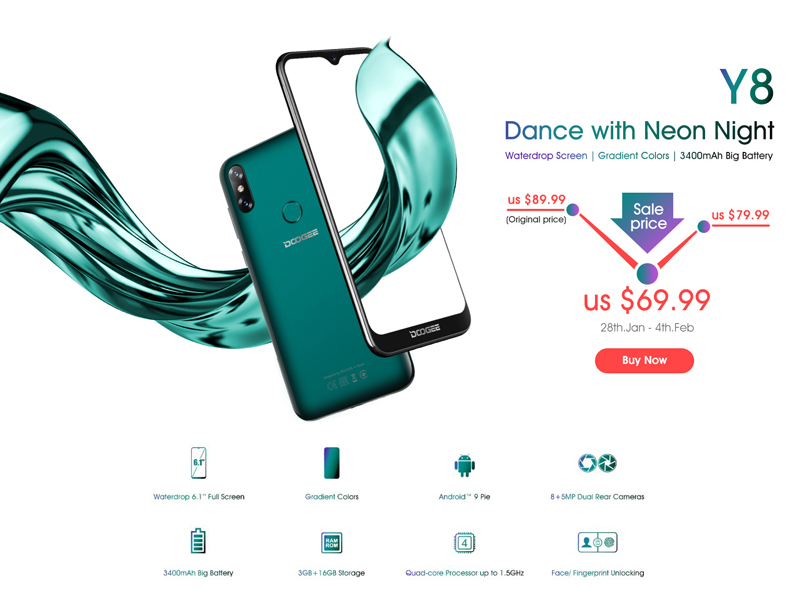
Much to the delight of the loyal DOOGEE fanbase, the Shenzhen-based handset manufacturer took the wraps off its long-awaited DOOGEE Y8 smartphone earlier this month. Loaded with top-end specifications and awe-inspiring features that are usually found on phones carrying steep price tags, the DOOGEE Y8 is surprisingly easy on the pocketbook.
In fact, DOOGEE’s latest feature-laden smartphone has gone up for pre-order bearing a heavily discounted price on Banggood.
In order to grab the biggest discount, which will be valid for a limited number of pieces, you need to pre-order the handset as soon as possible.
While the original asking price of the Y8 is $119.99, you can buy the first 899 pieces at a dropped price of only $69.99.
Those who fail to grab this 42 percent discount will have a chance to buy the Y8 for $79.99. This price will be limited to 1399 pieces only.
The remaining 1899 pieces would set you back $89.99. It is worth noting that the aforesaid discounts will be valid for three eye-catching color versions of the phone including luminous black, phantom purple, and emerald green.
The DOOGEE is designed to sweep smartphone lovers off their feet. It sports an appealing 6.1-inch full-screen display which features an HD screen resolution of 600×1280 pixels and a pixel density of 270ppi (pixels-per-inch).
The phone is powered by an MT6739, 4X Cortex-A53, up to 1.5GHz processor and it packs a competent IMG GE8100 graphics processing unit, under the hood.
The Y8 ships with 3GB of RAM and offers 16GB of internal storage capacity that can be expanded up to 128GB via microSD card.
This ensures you have enough space to save your favorite multimedia content on the phone.
The dual-SIM phone houses an 8.0MP+5.0MP dual-camera setup with F/2.2, auto-focus and LED flash on the back.
Up front, there’s a 5.0MP front shooter with F/2.2 and 80-degree wide-angle for flawless selfies and an uninterrupted video chatting experience.
The Y8 runs Android 9.0 Pie OS and is backed by a built-in 3400mAh polymer battery. Aside from a rear-mounted fingerprint sensor, the phone comes with various other useful sensors.
You can visit the promotion page by following this link if you are interested in checking out more details about the DOOGEE Y8.
Don’t forget to grab the biggest discount available on the phone before the remaining pieces get sold out.
Electronic items have become an inseparable part of our lives.
We heavily rely on these gadgets that not come in handy in day to day life but also efficiently handle a slew of other daunting tasks like keeping your home clean and tidy all the time.
On the downside, electronic items aren’t easy on the pocketbook. But it looks like Banggood is bent of changing that.
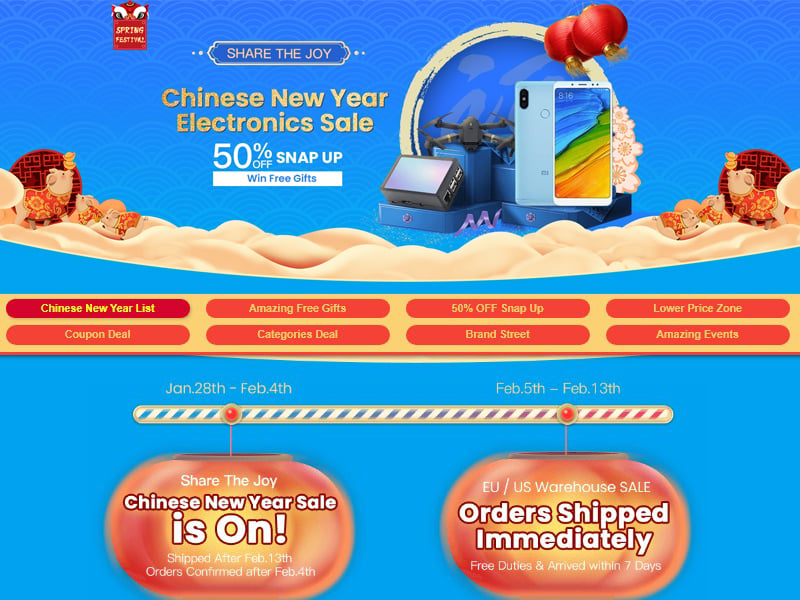
With the Chinese New Year just around the corner, Banggood has launched a new promo wherein buyers can get their tech greedy hands on a wide selection of electronic items at lowered prices.
Dubbed as ‘Chinese New Year Electronics Sale,’ the recently kicked-off promo offers Banggood users an unmissable chance to grab a 50 percent off snap-up.
Aside from that, they can win free gifts, and use a big site-wide coupon for extra discounts on specific items for a limited period of time. We’ll shed more light on the coupon in just a bit.
In a bid to simplify and expedite the search process, the promotion has been split into multiple categories like Chinese New Year List, Amazing Free Gifts, 50% Off Snap Up and lots more.
Each of the aforesaid section features a slew of electronic items that you can now buy without burning a hole in your wallet.
For the sake of an instance, the 4GB RAM, 64GB ROM variant of the Xiaomi Redmi Note 5 smartphone that usually sells for $269.99 can now be yours at a slashed price of just $184.98. You can even extend this 33 percent discount with the help of coupon code 19RDM5. The coupon can be applied at the time of checking out to bring the already lowered retail price of the phone further down to $148.73.
Likewise, select items featured on the promotion page have been assigned specific coupons that you can use to save more money before placing your order.
You can reduce the retail prices of products that do not carry any sort of discount on GeekBuying simply by applying the site-wide coupon 19CHNEW. Note that the coupon will expire at UTC+8 on February 13th.
The ‘Amazing Free Gifts’ section features the PUPPYOO WP615 Smart Robot vacuum cleaner that normally sells for S$279.03. Thanks to a 32 percent discount, you can now buy it for only $189.99.
If you buy products from this page and your order turns out to be one of the top three highest value orders, you qualify to win a gift. Note that this offer is only valid until February 13th and each buyer can only win one gift.
Banggood is also offering its users a chance to avail a 50 percent off snap-up, which kicks off at 0:00 am (UTC+8) daily. It is worth noting that this limited offer will be valid only on February 2nd, February 5th, and February 13th.
Likewise, the rest of the categories are brimming with high-end electronic items that have now gone up for sale carrying reduced prices.
You can click here to visit the promotion page and check out the products and take advantage of the discounts before the promo ends.
Chinese online store GeekBuying has a reputation for offering the country’s best electronic items at unbeatable prices.
Staying true to its notoriety, GeekBuying has launched a new promotion, wherein buyers can get their tech greedy hands on a wide selection of electronic gadgets without emptying their pockets.
Dubbed as ‘New Arrivals of Local Warehouses,’ this recently kicked-off promo has been separated into Hot Sellers and New Arrivals categories.
Each section has further been divided into DE Warehouse, IT Warehouse, ES Warehouse, and PL Warehouse sub-categories.
More importantly, all items you can see on the promotion page can now be bought at considerably lowered prices.
For the sake of an instance, the Xiaomi WeLoop Hey smartwatch usually sells for $158.99, but you can buy it for just $89.99 under the ‘Hot Sellers’ category.
This 43 percent discount will be valid for two days and the product will be shipping from a warehouse located in Germany.
Aside from taking advantage of the aforesaid discounts, you can use coupon code GIZ_EZASAXKX to get an extra 5% off on all items under the ‘Hot Sellers’ and ‘New Arrivals categories’.
For example, thanks to a 34 percent discount, you can now buy the Ramsta S800 480GB SSD at a lowered price of $63.99, under the ‘New Arrivals’ category.
You can apply the aforesaid coupon code to get an extra $3.20 off. In other words, you can bring the already lowered selling price of the item further down to only $60.79 simply by applying the aforesaid coupon.
Much to the delight of music lovers, the Tronsmart Encore Spunky Buds as well as the QCY T1C TWS Dual Bluetooth 5.0 Earphones have also gone up for sale carrying heavily discounted price tags.
We’ll not only shed light on the discounts but also show how you can save a considerable amount of extra money during the checkout process.
Tronsmart Encore Spunky Buds
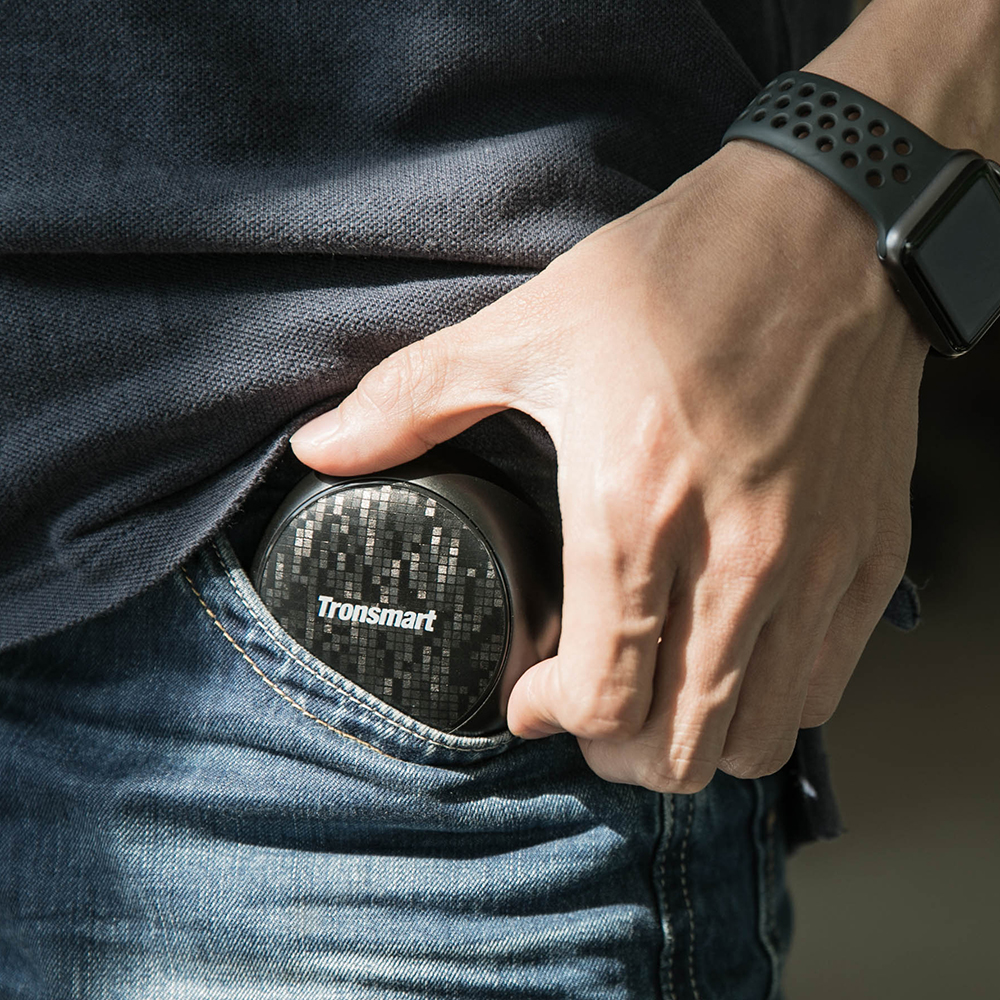
Encore Spunky TWS Buds are high-quality headphones that feature a true wireless setup, enabling the user to pair and connect through Bluetooth.
The headphones adopt the latest connectivity option in a bid to provide a stable connection and enhanced range. Moreover, the wearer does not need to worry about accidental splashes since the Encore Spunky Budscarry an IPX5 water resistance rating.
In fact, they can be worn even during rain without causing any sort of damage to the headphones. Their ergonomic design makes the headphones perfect for a longer duration of wearing.
The Encore Spunky TWS Buds would normally set you back $50.99 on both online as well as offline stores, but you can now buy it for just $35.99 on GeekBuying.
You can extend this 29 percent discount with the help of coupon code GIZ_EZASAXKX.
The coupon helps you save $1.80 more by reducing the retail price of the Encore Spunky TWS Buds to just $34.19 before you place your order.
You can visit this link to avail the discount, which will be valid for the black color version of the headphones. The promo will be valid for five days.
Alternatively, you can get a 43 percent discount on the black-tinted Tronsmart Encore Spunky Buds. It sells for $67.87, but can now be yours for just $38.99. Regrettably, the promo is slated to end shortly.
If you fancy listening to your favorite music just as you would in the Concert Hall, the QCY T1C might just fill the bill.
It adopts Bluetooth v5.0 technology in a bid to ensure twice higher sound transmission speed. Aside from that, it boasts enhanced anti-interference performance for a more stable connection.
Furthermore, it eliminates sound delays to provide a superior calling and game-playing experience. The QCY T1C uses CVC 6.0 noise reduction technology along with high sensitivity silicon wheat to enhance speech recognition. While you’d normally end up spending a lot of money on earphones that offer comparable features, the QCY T1C can now be yours if you are willing to shell out just $24.99 on GeekBuying.
This is a noteworthy 14 percent drop in the device’s original asking price of $28.99.
You can use coupon code GIZ_EZASAXKX during the checkout process to get an extra $1.25 off. This will reduce your grand total to just $23.74.
You can follow this link to grab the discount, which will be valid only for the black color version of the earphones. It is worth noting that the promo was on the verge of wrapping up at the time of writing.
Xiaomi‘s affordable flagship phone Poco F1 is unarguably a flagship killer considering its solid specs lineup and affordable pricing. Aside from the polycarbonate back, the device has all the attributes of a flagship except when it comes to pricing. If the Snapdragon 845 chipset at its heart isn’t enough to convince anyone that the device is no fluke, then the powerful rear camera which has just been benchmarked by DXOMark definitely should.
DXOMark has come to be regarded as a formidable benchmark to compare camera performance. For now, only the Poco F1’s rear cameras were tested and in terms of quality, the device performed at the same outstanding level as the iPhone 8. We should fail to point out that the iPhone 8’s price is twice as much that of the Poco F1.
The device performs better in still photography, delivering pleasing colors and accurate exposure. The camera also comes with fast and accurate autofocus. The Poco F1 get a total score of 91 points, same as the iPhone XS. For still photographs, the got a score of 92 which is slightly higher than the 91 points it manages for videos. The score for still photography was affected by some issues with the secondary camera which made bokeh rendering to come out poor.
Further, the video camera shows its prowess in autofocus and colors. The rear camera also performed outstandingly for stabilization. Sadly, if your Poco F1 isn’t doing a good job shooting videos in low-light conditions and dynamic range, that’s because the device doesn’t perform well in that aspect. In fact, shooting and dynamic range are two aspects where the Poco F1 falls behind premium phones. DXO recently started testing selfie camera, So, we expect the Poco F1 20MP selfie camera getting benchmarked soon. Apart from the iPhone 8, other models the Poco F1 surpassed include the Xiaomi Mi Note 3 and the original Pixel which scored a 90. The flagship Galaxy Note 8 and iPhone 8 Plus scored 84 when they were tested.
Deemed as one of China’s best online stores for electronic items, GeekBuying has launched the ‘Xiaomi Jimmy JW31’ promotion.
Aside from the Xiaomi JIMMY JW31 Lightweight Cordless Pressure Washer, this recently kicked-off promo features a wide selection of other items.
In a bid to avoid any sort of confusion and to expedite the search process, all items have been split into various categories including Top Selling, Cleaning Appliances, Smart Gadgets, and Local Stock.
While each item included in the aforesaid sections has gone up for sale bearing heavily discounted prices, we’ll take a gander at the JIMMY JW31 pressure washer.
The JW31 features the faucet as well as the self- priming modes, which enables you to use various sources of water including a bucket and even a stream.
In other words, the JW31 enables you to clean anywhere without requiring you to carry a lot of water. Moreover, it’s long cleaning lance increases pressure and enhances accuracy, reach and control.
The water intel of the JW31 comes with a filter mesh, that filters impurities. The Eco mode + shower mode is an ideal combination offered by this self-priming faucet for bathing a pet.
Likewise, you can use the combination of Eco mode + fan mode to ensure the screen doesn’t get damaged due to the water pressure.
It is backed by 2500mAh*5 removable batteries that generate enough power to clean two cars at the same time. You can charge it with a 21W fast charger in 2.5 hours.
If you thought a highly useful product like the JW31 would carry a steep price tag, we got good news for you.
As part of its latest promo, GeekBuying is now offering this feature-laden cordless pressure washer at a dropped price of just $155.99.
This is a noteworthy 51 percent drop in the device’s original asking price of $319.75.
While the discount will be valid for the black-tinted, global version of the JW31, it is worth noting that the promo was on the verge of wrapping up at the time of writing.
You can click here to visit the promotion page and take full of the discount without wasting time.
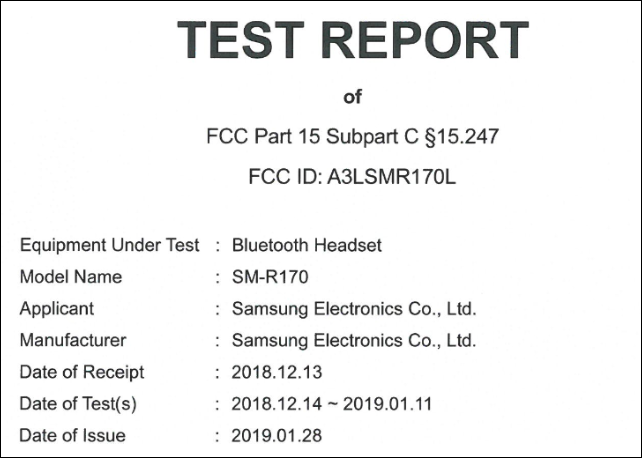
Samsung recently revealed the name its next truly wireless earbud will be called when it filed a patent for the Galaxy Buds moniker. The Galaxy Buds is likely the successor to the gear IconX (2018) earbuds which were launched last year. The new wearable device has now been certified by the US Federal Communications Commission (FCC). This is coming on the heels of the Bluetooth SIG certification the device received recently. The FCC certification comes with the model number SM-R170 and is listed as “Samsung Bluetooth Headset.” This is the same device that was certified by Bluetooth SIG last week. The certification document shows Samsung will manufacture the earphones in its factory in Vietnam.
Samsung is expected to hold its annual Galaxy Unpacked event on February 20 when the flagship Galaxy S10 models will be unveiled. The South Korean giant is also expected to announce the Galaxy Buds alongside other wearables such as the Galaxy Fit during the event. The Galaxy Buds are expected to come with Bluetooth 5.0 support and 8GB of internal storage. The device will be available in black, white, and yellow colours.
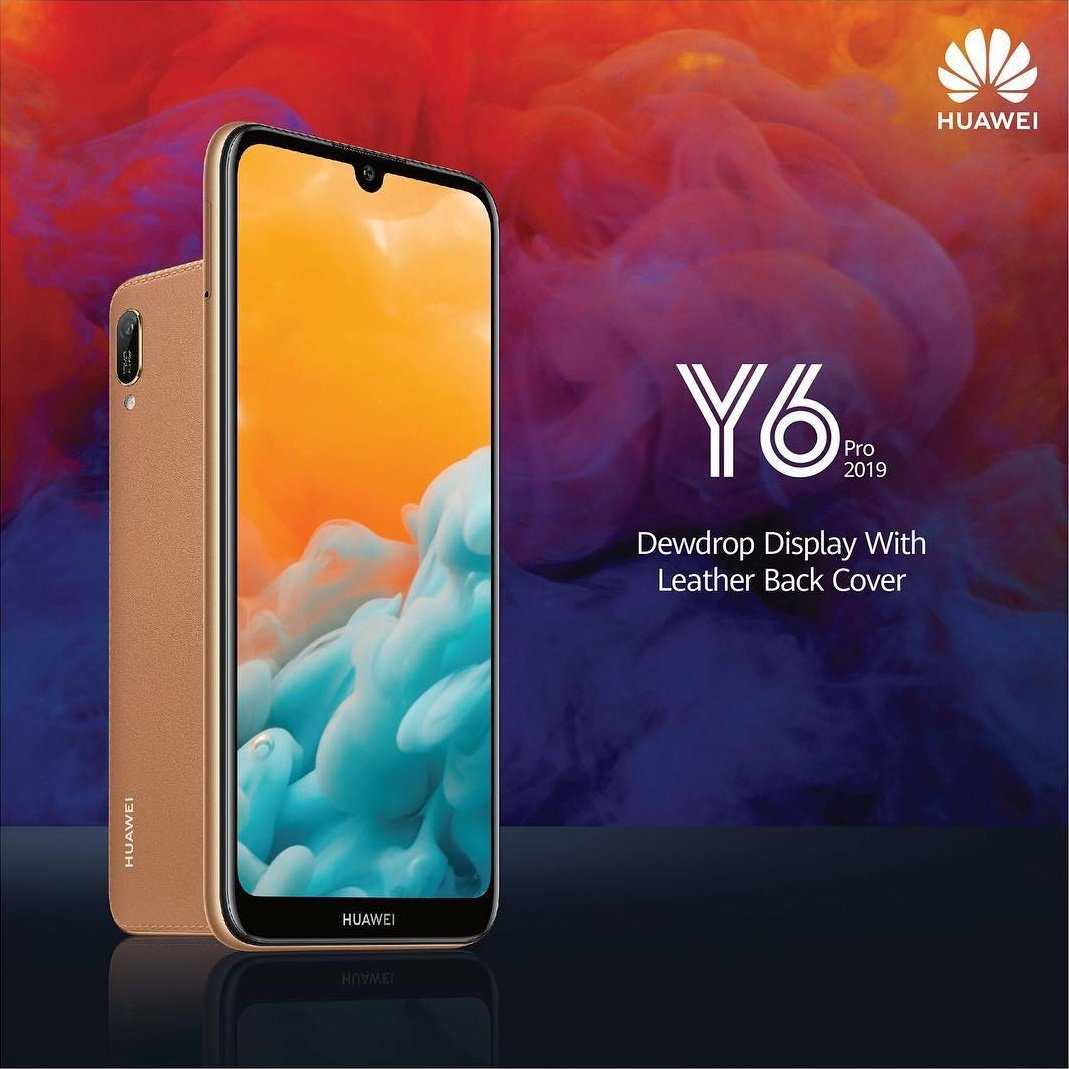
Last week, Huawei launched three new phones in Sri Lanka. They are the Huawei Y9 (2019), Huawei Y7 Pro (2019), and Huawei Y6 Pro (2019). We already covered the first two devices when they launched in India and Vietnam respectively. However, the Y6 Pro (2019) is a spanking new device and an interesting one at that.
We learned of the Y6 Pro (2019)’s launch from Twitter user @ZyadAtef and did some digging of our own to get more details. The phone has a 6.09-inch 1520 x 720 Dewdrop FullView display. The dewdrop or waterdrop notch may not excite you but you will be happy to know that Huawei has given the phone a textured leather finish on the back to make it stand out from other phones.
We are not sure if it is genuine leather like that of the P20 Pro but it is nice to see a mid-range phone that doesn’t have polycarbonate or metal back. The Y6 Pro 2019 will be available in Amber Brown and Midnight Black.
The phone comes with 3GB of RAM and 32GB of storage but there is no mention of its processor. The Huawei Y6 Pro 2019 has a single 13MP sensor on its back while an 8MP sensor is housed inside the notch. There is no fingerprint scanner but there is Face Unlock which also works in low-light.
Unlike the Y7 Pro 2019 which runs EMUI 8.2 based on Android 8.1 Oreo, the Y6 Pro 2019 runs EMUI 9.0 based on Android 9 Pie out of the box. Under its leather rear is a 3,000mAh battery.
The phone will be sold by the online store, Singer. However, it wasn’t yet listed as at the time of writing. There is also no info on the phone’s price.
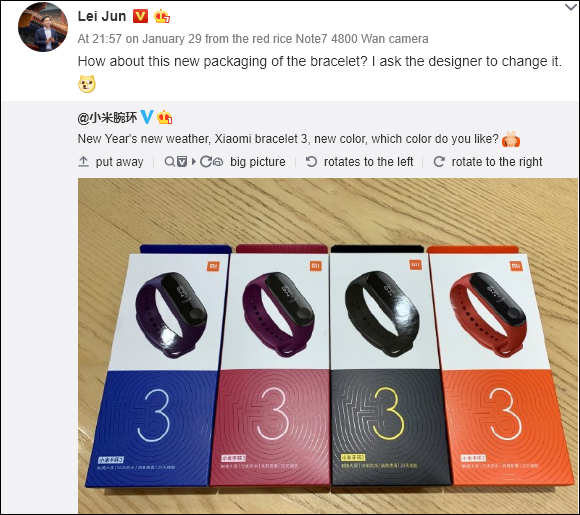
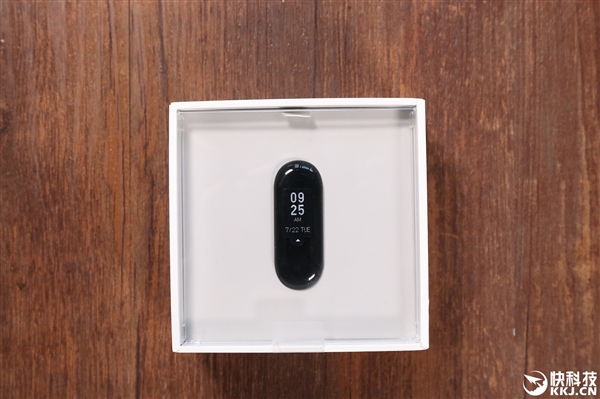
Despite their popularity, Xiaomi‘s range of Mi Bands often come with simple packaging boxes. The Mi Band 3’s packaging box was a square-shaped box just like the Band 2’s but with a transparent plastic cover which allows buyers to savour the beauty even before buying. The Chinese company has now unveiled a redesigned Mi Band 3 packaging box.
The new retail box is no longer square-shaped rather, it adopts a rectangular parallelepiped shape with a colourful design. The packaging box won’t all have the same colours. Instead, the Band 3’s new box casing will have a colour shade matching the colour of the straps. As would be recalled, the Band 3 comes with black, blue, and orange straps but there is a fourth colour which is Burgundy.
As a reminder, the Mi Band 3 is an improved version of the Band 2 which was released in 2016. The Band 3 features a 0.78-inch OLED capacitive touchscreen. which offer a better viewing and user experience. The display can show call notifications and an option to reject calls and also incoming messages on a paired smartphone. The rubber strap also got some improvement which ensures it isn’t just comfortable, the fitness tracker cannot fall off. Further, it comes with way more functions when compared to Mi Band 2. Some of the functions include heart rate monitor, weather forecast, alarm clock, daily steps count, sedentary reminder, sleep monitor, event reminder and find my phone function. There is a variant with NFC which cost 199 yuan (~$31). Furthermore, the Mi Band 3 comes with an improved battery, which can last for up to 20 days on a single charge.
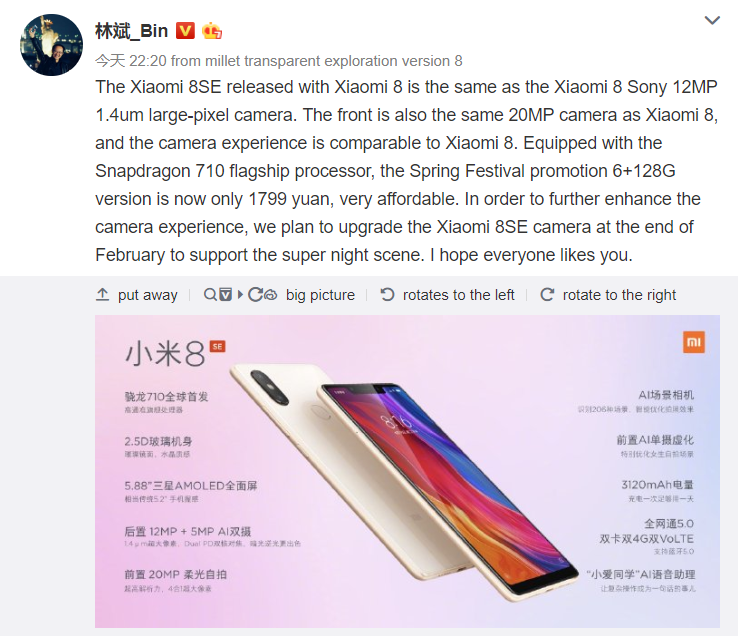
The Mi 8 SE is currently Xiaomi’s most powerful mid-range phone. It has an AMOLED display and is powered by the Snapdragon 710 processor. Xiaomi’s co-founder and president, Lin Bin, announced via a Weibo post that the phone will also get the Super Night Scene mode of the Mi MIX 3.
In the post, Mr. Bin said since the Mi 8 SE sports the same 12MP primary rear camera as the Mi 8 and also has the same 20MP front-facing camera, its camera performance is comparable to that of the Mi 8. However, in order to further improve its performance, they will roll out an update that brings Super Night Scene Mode to the phone. The update will arrive at the end of February.
Update: A Visionox executive confirmed that Xiaomi’s double-folding smartphone was a joint project between both companies. The executive revealed the double-folding display is a breakthrough for the mobile industry in an interview today.
If you have been wondering who the display panel supplier for Xiaomi‘s double-folding smartphone is, industry sources have revealed that it is Chinese display maker, Visionox.
According to Chinese market research firm All View Consulting, Visionox was the third largest AMOLED display manufacturer in 2018. At the end of 2018, the display manufacturer began construction of its G6 flexible AMOLED display production line in Hefei, Anhui Province of China.
The production line is expected to boost the display industry in the region and also China’s status as a display manufacturing country.
Xiaomi’s co-founder, Lin Bin, who showed off the foldable prototype said they had to surmount a number of technical difficulties while developing the device. The phone is still under development and will be commercially available later.
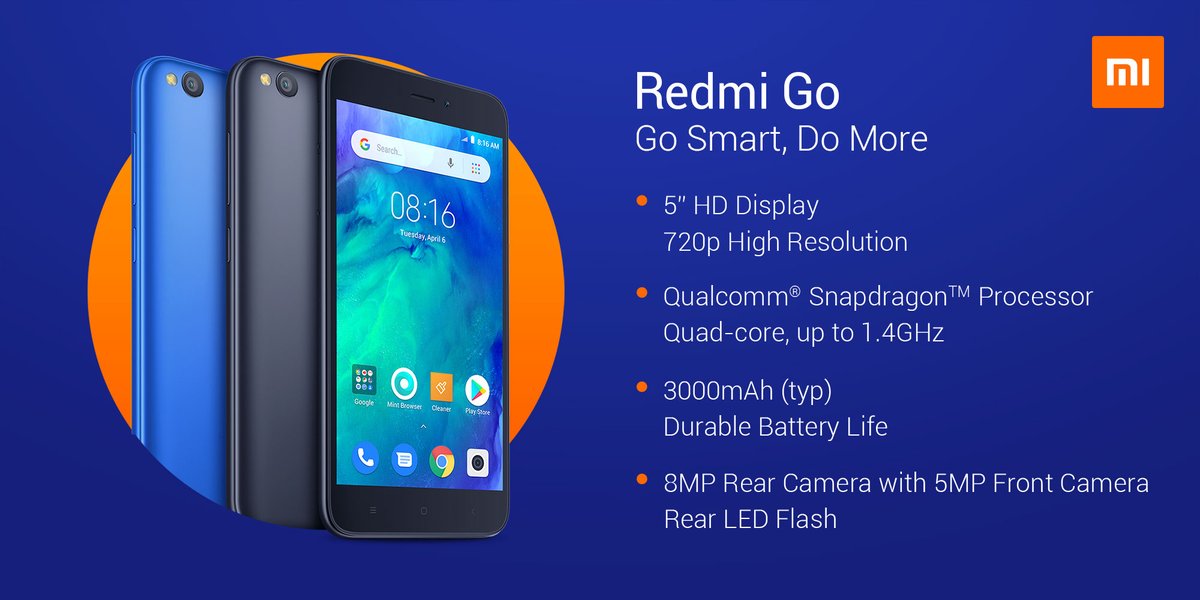
Xiaomi took the wraps off its first Android Go smartphone today which it named Redmi Go. The phone is expected to be available in Europe and also launch in other markets.
The Redmi Go has a 5-inch 1280 x 720 display and is powered by a 1.4GHz quad-core Snapdragon processor said to be the Snapdragon 425. Like other Android Go phones, it has 1GB of RAM and 8GB of storage. There are reports of a version with 16GB of storage but we haven’t seen evidence of that yet. Nevertheless, a MicroSD card slot will let you add extra storage.
The phone has an 8MP rear camera with an LED flash and a 5MP front-facing camera. It runs Android Oreo (Go Edition) and packs a 3,000mAh battery. Other specs not mentioned in the official announcement include dual SIM support, a 3.5mm audio jack, and a MicroUSB port for charging and data transfer.
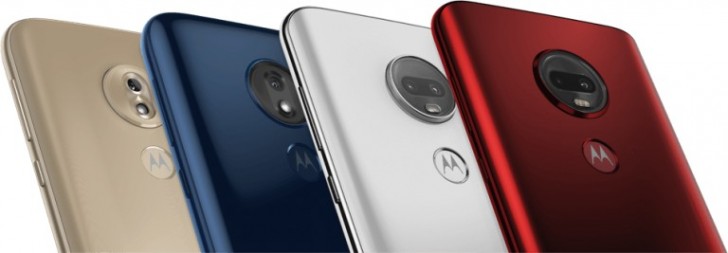
A recent poster had suggested that Motorola will officially unveil the Moto G7 lineup in an event scheduled to hold on February 7 in Brazil. The company is yet to release a launch itinerary for Europe but a new leak has emerged revealing the Moto G7 and G7 Plus pricing for Europe. According to the leak from a Twitter tipster, the Moto G7 pricing in Europe will start at €300 while that of the G7 Plus will start at €360. Earlier on, the tipster had revealed that the G7 Play will be sold for €149 while the G7 Power will be offered for €209.
The Moto G7 lineup has already been featured on Motorola’s website and is made up of four models; MotoG7, G7 Plus, G7 Play and G7 Power. As for their specs, the Moto G7 packs a 6.24-inch display with a waterdrop notch and 1080×2270 resolution. It’s powered by the Snapdragon 632 chipset, paired with 4GB of RAM and 64GB of storage. At the rear aspect, there’s a 12MP + 5MP dual rear camera setup while the device is fired up by a 3,000mAh battery. The G7 Plus specs are almost similar except that it is powered by a Snapdragon 636 and the main rear cam to a 16MP unit.
On the other hand, the Moto G7 Play features a 5.7-inch display with a resolution of 720×1512 pixels. It is powered by a Snapdragon 632 paired with 2GB of RAM with 32GB of storage. There is a 13 MP rear camera, and the same 3,000 mAh battery. Finally, the G7 Power lives up to its name in the battery aspect as it packs a 5,000 mAh cell. It equally features a bigger 6.2″ display with the same resolution as the G7 Play. The model is also powered by the Snapdragon 632 and has the same 32GB of storage, but 3GB of RAM. The beautiful thing is that all four models run Android 9 Pie.
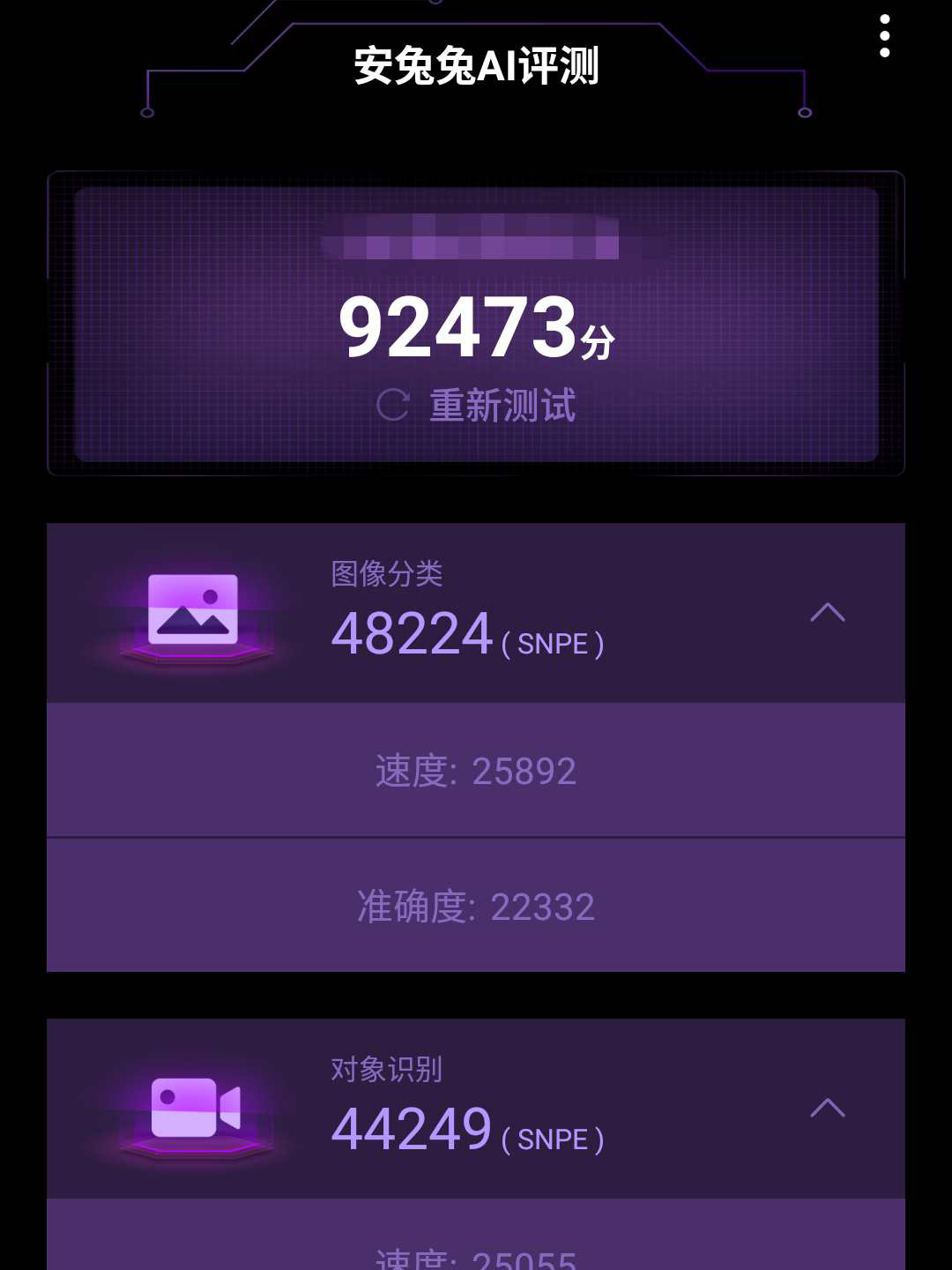
With AI performance being a much-advertised feature of processors and phones these days, we can say the tool has arrived just in time. AnTuTu says the tool is still in beta.
In an official press release, AnTuTu revealed there is still no unified standard for AI as each chipset manufacturer sees it differently. Qualcomm uses its DSP to handle AI tasks while Huawei, Samsung, and MediaTek have a dedicated AI unit called NPU (APU for MediaTek). All the chip manufacturers also have different SDKs too.- NeuroPilot for MediaTek, SNPE for Qualcomm, and TensorRT for NVIDIA. Samsung hasn’t announced its own yet.
Nevertheless, they have been able to develop a unified standard for testing thanks to cooperation from processor manufacturers. The test is said to be divided into two categories – image classification and object recognition.
Image Classification is based on Inception v3 neural network and the test includes 200 pictures. Object Recognition is based on mobilenet SSD neural network and its test is a 600-frame video.
AnTuTu advises that the test should be done using Wi-Fi as the data packet is about 160MB in size even though the app itself is just 33MB. Downloading the data packet on a device you intend to test is a one-time thing even if you plan to run the test multiple times. However, there will be a data packet verification every time.
Devices are ranked based on a combination of speed and accuracy. Hence, a device that is fast but not accurate will rank lower. AnTuTu says there are other conditions that may make a device score lower.
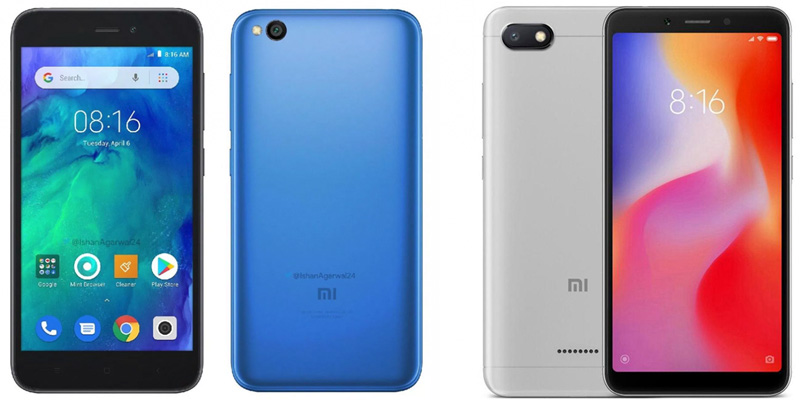
Xiaomi finally joined the Android Go club by announcing the Redmi Go for the global market. It is the most affordable last-generation phone by the Chinese company, but it is not its only device sold for less than €100. There is another super cheap Xiaomi device that people can opt for: the Redmi 6A. After the launch of the Redmi Go, a lot of potential buyers are wondering which one is worth buying, given that they share a similar price. Here, we will try to let you find out with in-depth specs comparison between the two compact and affordable handsets.
Even though it is a more recent device, Xiaomi Redmi Go has a more outdated design than Xiaomi Redmi 6A. The latter comes with a taller display as well as thinner bezels, so a definitely better look on the front side. Regarding the rear sides, all depends on your tastes. Xiaomi Redmi 6A has a body that looks like metal (but it is plastic) while Xiaomi Redmi Go has a cleaner backside but it is evident that it is made of polycarbonate. On the other hand, Xiaomi Redmi Go is more compact and also more lightweight, even though there is not a big difference in weight and dimensions as you can see from the specs sheets above.
Display
When you are about to buy an entry-level phone, you should never expect an excellent display. Xiaomi Redmi Go and Xiaomi Redmi 6A are equipped with different IPS panels, but their viewing quality is almost the same. They have more or less the same level of detail and similar color reproduction (just sufficient). The big difference is the size: Xiaomi Redmi 6A has a bigger and taller display, while Xiaomi Redmi Go has a smaller panel with the classic 16:9 aspect ratio. If you often use your device with one hand, then Xiaomi Redmi Go may be ideal for you, but if you want a better display for multimedia and advanced activities, then go for the Xiaomi Redmi 6A. But again, even under this point of view, differences are marginal.
Specs & Software
Xiaomi Redmi 6A has a much better hardware department than Xiaomi Redmi Go. It comes with one of the most performing quad-core chipsets, up to 3 GB of RAM and up to 32 GB of internal storage. Xiaomi Redmi Go comes with only 1 GB of RAM. However, while Xiaomi Redmi 6A has the classic MIUI, Xiaomi Redmi Go runs Android Go, so it can deliver a similar performance in daily use. Android Go is an enlightened version of the operating system which takes less space and runs smoothly even on devices with 512 MB of RAM. So the fact that Redmi Go has just 1 GB of RAM is not a big issue. By the way, if you want to play games, then you should still go for the Xiaomi Redmi 6A.
Camera
While both Xiaomi Redmi Go and Redmi 6A have the same, sufficient front camera for selfies, what changes in the camera setup is the rear sensor. The Redmi Go has a more disappointing 8 MP sensor which cannot even record videos in 1080p, while Xiaomi Redmi 6A has a more acceptable 13 MP rear camera. Xiaomi Redmi 6A is everything but a camera phone, but its shots are not so bad when light conditions are good. So, it wins the camera comparison, even though Redmi Go has a brighter f/2.0 which is more useful with low light.
You cannot understand which device will last more from the battery capacity as both Xiaomi Redmi Go and Redmi 6A boast a 3000 mAh battery. Basing on the specs on the paper, Redmi Go should last more because it has Android Go installed, a very efficient SoC and a smaller display to manage. But in order to give a definitive verdict, we will have to test Redmi Go’s battery life and now we still cannot do it as the phone is not on sale.
Price
People wonder which device is the best to buy because, as we said at the beginning of this article, their prices are very similar. While Redmi Go costs €80/$91 in the global market, Xiaomi Redmi 6A is available for about €90/$103 in the Chinese market. Despite the presence of Android Go on the Redmi Go, I would personally spend a bit more and go for the Xiaomi Redmi 6A because it has a better camera, more RAM and more internal storage than Redmi Go.
Japan tech giant Sharp has unveiled its OLED panel line designed for handsets, sources indicate. The brand which is owned by Foxconn Group is reportedly aiming to enter the supply chain for future iPhones that would utilise OLED displays. In addition, there are speculations that Fitipower Integrated Technology, another Foxconn company, is engaged in the development of OLED panel driver ICs jointly with Sharp.
OLED seems to be the future of smartphone displays and more LCD panel suppliers are now capable of producing OLED displays for smartphones in commercial volume. As a result, Taiwan-based driver IC firms and related backend houses are gearing up to grow their presence in the OLED panel segment in 2019. According to industry sources, Taiwan-based LCD driver IC firms including Novatek Microelectronics and Himax Technologies, and related backend companies including Chipbond Technology and ChipMOS Technologies are looking to start developing their businesses in the OLED panel sector in 2019. Chinese vendors such as BOE technology and Tainma are also putting efforts to grow their OLED panel supply. A recent data showed that BOE technology surpassed LG in terms of OLED supply for last year and the company is reported to supply Huawei OLED panels. LG Display has also seen improvement in sales of its OLED panels which accounted for over 10% of total panel revenues, according to the sources.
Samsung Display still dominates the market for OLED panel, something it has been doing for quite some time now. AU Optronics (AUO) with its flexible OLED panel technology is also likely to cut into the supply chain of Android phone vendors, the sources continued. The industry is also said to be promoted on mid-range models featuring OLED displays this year and not just on flagships. Meanwhile, foldable smartphones adopting OLED panels are being reportedly regarded as the development focus of major brand vendors for their new generation series this year.
Last year, OnePlus announced it was entering the smart TV business with its first TV scheduled to launch this year or in 2020. It appears they are not the only smartphone manufacturer expanding their portfolio. A new report has revealed that Huawei and its Honor sub-brand will launch smart TVs this year.
Huawei and Honor plan to release smart TVs this year
According to the source, Honor will launch its first smart TV in April while Huawei will launch its first TV in the second half of the year. Huawei’s smart TVs won’t be affordable ones like Xiaomi’s but mid-range and high-end ones. They are also expected to start from 65-inches and up. Honor-branded TVs are expected to be cheaper and available online only.
The report says Huawei already has a team of about 200 – 300 people for its TV division which is under its Internet of Things Department. However, its plan isn’t just to release TVs but to create a demand for 5G communication. Huawei believes the popularity of 4K and 8K TVs will increase demand for 4K and 8K content which is best provided via a reliable and fast internet connection which 5G will provide. And since Huawei is also known for its network business, this is a win-win situation for it.
Google has introduced AR core for Android device couple of years ago. Since then, most of the Android devices come packed with this AR core kit to bestow devices with Augmented reality features. It needs some primary sensors to fully work on any device. Google allows third-party developers to utilize the ARCore platform to bring augmented reality on various Android apps. Despite the complex mechanism it can work even on mid-level devices without any issue. Sadly, it seems to be out of gear on different LG flagship smartphones.
Recently, Google has updated a list of Android devices which currently support AR core. Surprisingly, LG’s four flagship devices have not made it to the list. Google has not found AR core fully functional on LG V30, LG V35, LG V40, and LG G7. Particularly, Autofocus in AR mode is not working on either of the devices mentioned above. Even though despite having different variants like LG G7 Fit, LG G7 One, LG V30+, LG Signature edition, none of them works perfectly with Autofocus on AR. On the other hand, LG’s mid-range devices such as LG Q6 and LG Q8 are unaffected by the issue.
AR Core camera uses Autofocus to set a fixed focus for motion tracking. In order to eliminate poor tracking quality on various device, Google added autofocus. Though due to some technical complications, LG’s flagship devices are unable to use Ar core functionalities.
App developers who are trying to utilize the AR core kit on their apps won’t be able to run it on above mentioned LG smartphones. The Korean giant has not responded about the issue, and even there’s no information about the acknowledgment of the same. We expect LG to rectify the problem as soon as possible by rolling out an update.
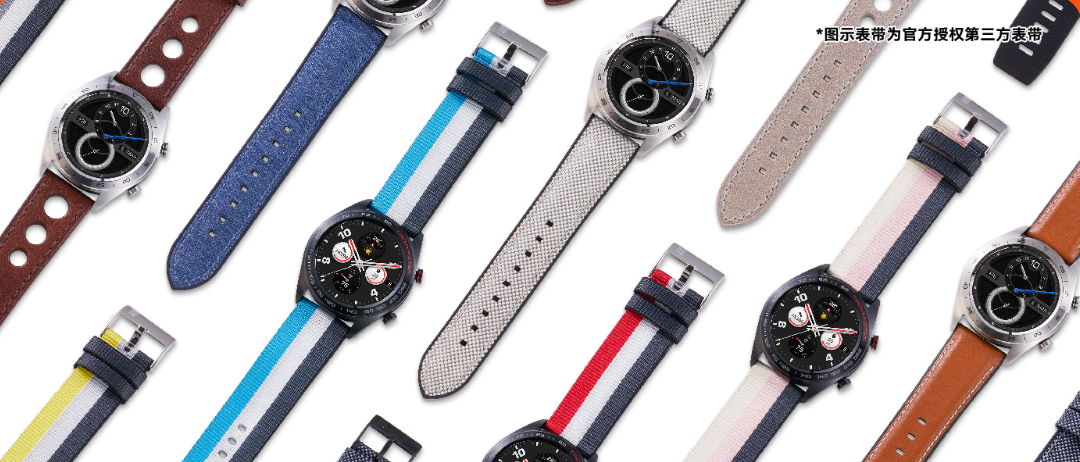
Huawei’s sub-brand Honor launched its new flagship Honor View 20 in the Indian market. Along with that, the company has also launched its two wearable devices — Honor Watch Magic and Honor Band 4 Running Edition.
As for the pricing, the Honor Watch Magic starts at Rs. 13,999 ($197) for the premium sports version while the Leather Band model is priced at Rs. 14,999 ($211). On the other hand, the Honor Band 4 Running Edition is priced at Rs. 1,599 ($22). Both the devices will be available for purchase in India through Amazon India and Honor’s official website.
Coming to the specifications, the Honor Watch Magic comes with a 1.2-inch HD AMOLED display with 390 x 390 pixels screen resolution which offers 326ppi pixel density. Under the hood, the device is powered by ARM M4 chipset, coupled with 16MB RAM and 128GB internal storage.
The display is housed in a 316L stainless steel frame that measures 9.8mm in thickness (11mm with the glass). It supports GPS, GLONASS, and GALILEO for precise positioning and also comes with Bluetooth 4.2, 5ATM Water-resistant up to 50 meters, NFC for Huawei Pay and a 178mAh battery which is claimed to offer up to 7 days worth of battery life.
As for the features, the Honor Watch Magic has Huawei’s TruSeen 3.0 technology for continuous heart rate monitoring. Also, with Huawei’s TruRelax technology and support from the Institute of Psychology of the Chinese Academy of Sciences, the watch provides 24-hour blood pressure monitoring and will suggest breathing exercises with real-time feedback.
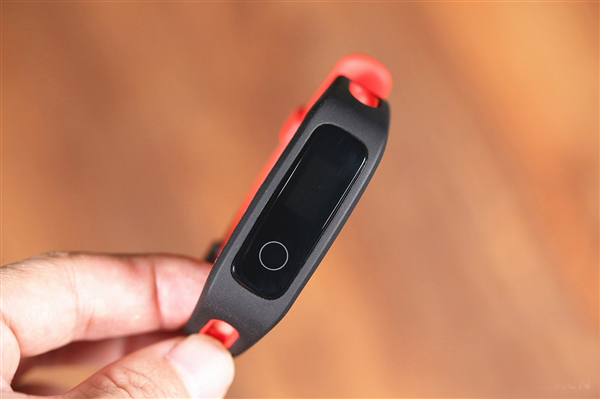
On the other hand, the Honor Band 4 Running Edition comes with similar specifications as that of the conventional Band 4 launched year along with some added features such as running posture monitoring, water-resistance up to 50 meters and two wearing modes.
The fitness tracker comes with a 0.95-inch OLED display and a 2.5D glass on top. Just like the Xiaomi’s Mi Band 3, the Honor Band 4 is also water resistant up to 50 meters and also recognizes Swim strokes. It supports functions such as sleep tracking, exercise tracking, pedometer, continuous heart rate monitoring with Huawei TruSeen 2.0 technology, and sedentary reminder.
In addition to tracking activities, the device also shows notifications on the OLED display and even offers an incoming call-mute function. The device also comes with built-in NFC support, meaning that it can also be used to make payments. Under the hood, the fitness tracker is powered by a 100mAh battery, which the company claims can deliver standby time of up to 14 days.
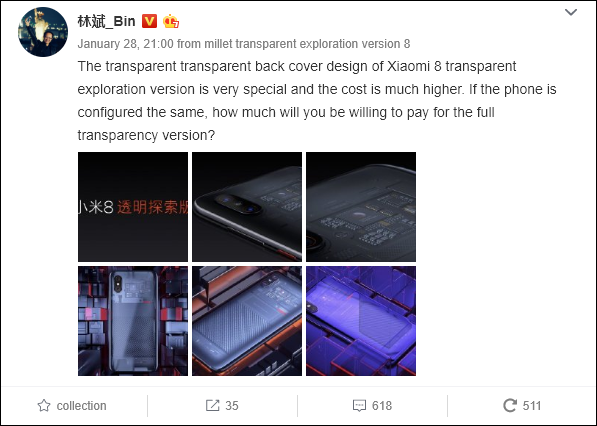
When Xiaomi launched the flagship Mi 8 last year, one of the models that stood out was the limited Explorer edition with a translucent body. The popularity, perhaps, outweighed Xiaomi’s expectation so it was a surprise they decided to launch the Mi 8 Pro with the same translucent body but a more robust availability. Xiaomi’s president Lin Bin, today asked a question on Weibo about the Mi 8 Explorer edition, after extolling the translucent back feature of the model. The question was to the effect that if the phone (apparently referring to Mi 9) is configured the same, how much buyers will be willing to pay.
The question very much suggests the company may be toying with the idea of replicating the Mi 8 Explorer’s translucent back design on the Mi 9 flagship. This isn’t a bad idea but according to Lin Bin, the design is not cheap to produce. Despite the pricing of the Mi 8 Explorer edition, the model was always sold out each time it goes on sale.
If the company finally decides on an Explorer edition for the Mi 9, the difference should lie only in the design. The model will utilise the same specification as the regular Mi 9. The flagship Mi 9 is expected to pack a Snapdragon 855 chipset. the device may likely feature the waterdrop notch design and triple rear cameras.
We use cookies on our website to give you the most relevant experience by remembering your preferences and repeat visits. By clicking “Accept”, you consent to the use of ALL the cookies.
This website uses cookies to improve your experience while you navigate through the website. Out of these, the cookies that are categorized as necessary are stored on your browser as they are essential for the working of basic functionalities of the website. We also use third-party cookies that help us analyze and understand how you use this website. These cookies will be stored in your browser only with your consent. You also have the option to opt-out of these cookies. But opting out of some of these cookies may affect your browsing experience.
Necessary cookies are absolutely essential for the website to function properly. This category only includes cookies that ensures basic functionalities and security features of the website. These cookies do not store any personal information.
Any cookies that may not be particularly necessary for the website to function and is used specifically to collect user personal data via analytics, ads, other embedded contents are termed as non-necessary cookies. It is mandatory to procure user consent prior to running these cookies on your website.



 Loaded with top-end specifications and awe-inspiring features that are usually found on phones carrying steep price tags, the DOOGEE Y8 is surprisingly easy on the pocketbook.
 You can even extend this 33 percent discount with the help of coupon code 19RDM5. The coupon can be applied at the time of checking out to bring the already lowered retail price of the phone further down to $148.73.
 While you’d normally end up spending a lot of money on earphones that offer comparable features, the QCY T1C can now be yours if you are willing to shell out just $24.99 on GeekBuying.