Huawei today held an MWC 2019 sensitization and 5G conference in Beijing. The company announced the industry’s first 5G base station core chip – Huawei Tianyi as well as the industry’s first single-chip multi-mode 5G Modem – Balong5000. The Chinese giant also announced that it will unveil the world’s first commercial 5G product during the MWC2019 period, a 5G foldable phone.
During the conference, Huawei’s consumer business CEO Yu Chengdong also talked about the development of the Honor brand. Yu Chengdong, who is also known as Richard Yu, hinted that in the face of a dwindling global phone market, the Honor brand not only saw some upgrade but also achieved strong growth. The Honor brand achieved a lofty growth of 170% year-on-year in the international market. While on the domestic scene, the brand ranked first in terms of online sales for the ninth consecutive quarter.
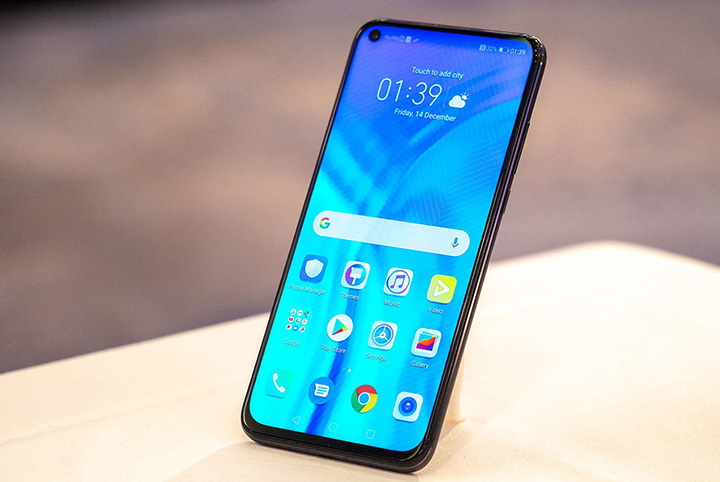
Honor recently launched the Honor View 20 for the global market in Paris, France. During the event, Honor’s president George Zhao had announced some statistical data of the company’s progress in some countries where it has a strong presence such as France, Britain, Germany, Russia and India. The Honor president hinted that GfK data shows that Honor is ranked among the top 2 brands in the Russian market, and is in six countries in Europe and the Middle East including Germany, Finland and other countries. In addition, he hinted that Honor’s overseas sale accounted for more than 25% of the brand’s entire revenue.
If you have been waiting for Xiaomi’s own Android Go phone, then you are in luck as it seems a launch is happening very soon. The phone already got certified in a number of markets and now it appears it is ready to launch with The Philippines being the first market to get it.
The official Facebook account for Xiaomi Philippines shared a post a few hours ago teasing the launch of a new phone. The post also has the hashtag #GoSmartDoMore.
Ready. We're about to introduce something very special just for you! Here's a first hint of what's coming. 😁#GoSmartDoMore
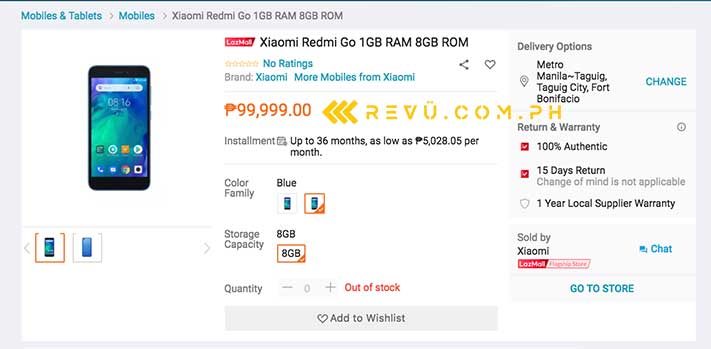
Philippino blog Revu.com.ph got a tip that the phone is already listed on online store Lazada and the listing includes a poster with the full specs of the Redmi Go. The poster also has the tag line Go Smart, Do More which means it is the same device teased by Xiaomi on Facebook.
The Redmi Go can be said to be a redesigned Redmi 4A/Redmi 5A with a few changes and of course less RAM and storage. We are glad it doesn’t have the rear-facing speaker of both phones.
It has a 5.0-inch 1280 x 720 display with a 16:9 aspect ratio and 380 nits of brightness. There is a Snapdragon 425 processor under the hood and it is paired with 1GB of RAM and 8GB of storage. A dedicated MicroSD card slot will allow you to add up to 128GB of extra storage.
The Redmi Go has an 8MP f/2.0 camera with HDR and an LED flash on its back. The camera is positioned at the top left corner of the phone. It also has a 5MP f/2.2 front-facing camera.
There is Bluetooth 4.1, single band Wi-Fi, a MicroUSB port, and dual-SIM support. It also has support for 4G LTE bands 1, 2, 3, 4, 5, 7, 8, 20, and 28. Availability of these bands including dual VoLTE and dual 4G will vary between markets.
The Redmi Go packs a 3,000mAh battery and will come with a 5V/1A charger in the box. Unfortunately, it runs Android 8.1 Oreo (Go Edition) and not the latest Android 9 Pie (Go Edition). It will be available in black and blue when it launches.
There is no info on price yet. The one on Lazada is just a placeholder until the phone launches.
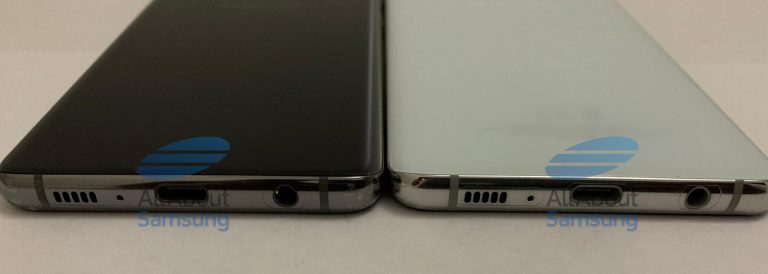
Samsung’s Galaxy S10 unpacked event draws nearer with each passing day. As expected, more details confirming new features of the phones have surfaced online and we expect it to continue this way right up until the launch. Today, live photos have been released on the web and they show the Galaxy S10 and Galaxy S10 Plus side by side.
These photos leave nothing to the imagination with respect to the design of both phones. They confirm the design of the displays as well as the rear of both phones.
The Galaxy S10 and Galaxy S10 Plus will both come with punch hole displays which Samsung has named Infinity-O Display. To be honest only the Galaxy S10’s display should be called Infinity-O as the hole in the Galaxy S10 Plus is shaped like a pill and not an “O”.
The holes in both phones are at the top right corner of the screen. The Galaxy S10 Plus has a bigger hole because it has dual front-facing cameras. Both the S10 and S10 Plus have their bezels shaved off but their chins are a bit thicker.
On the rear, the Galaxy S10 duo sport triple rear cameras arranged horizontally. They share the same housing along with an LED flash and what we believe is a blood pressure monitor. There is no fingerprint scanner visible which means they do have in-display fingerprint sensors as reported in earlier leaks.
[envira-gallery id=”233718″]
The Galaxy S10 in the photo is black while the Galaxy S10 Plus has a silver finish. The latter has slightly more curved edges and even its display appears to be more curved too.
The Galaxy A8s and Samsung W2019 have ditched the audio jack but Samsung is not yet ready to remove it from its S-series flagships. The audio port sits on the left of the USB-C port on both phones while the speaker grille is positioned on the right.
The live photos also show the phones powered on and we get to see the homescreen and what Samsung’s One UI looks like. The icons are large and there is a Google search bar sitting above them.
The Honor View 20 will be arriving as a worthy rival for the OnePlus 6T in India. The smartphone will be made official on Jan. 29 and it will be available for purchase exclusively through Amazon India. The specifications of the smartphone s already known through its launch in China. The price tag of the base model of the Honor View 20 has been leaked today.
Honor View 20 Price in India
Fresh leak reveals that the Honor View 20 will be costing Rs. 35,999 (~$506) for the variant featuring 6 GB of RAM and an inbuilt storage of 128 GB. The smartphone will be hitting the market in color such as Midnight Black and Blue Sapphire.
The 6 GB RAM + 128 GB OnePlus 6T with in-display fingerprint reader is priced at Rs. 37,999 (~$534). In China, the company is also selling a higher edition of the phone with 8 GB of RAM and 128 GB of storage which is priced at 3,499 Yuan (~$515). There is no confirmation on whether India will be receiving the 8 GB RAM + 128 GB Honor View 20 edition.
The Honor View 20 has a 6.4-inch punch-hole display that produces full HD+ resolution. The Kirin 980 chipset powers the phone. The rear shell of the phone features 48-megapixel Sony IMX586 sensor and 3D ToF stereo camera.
Placed on the front is a selfie shooter of 25-megapixel. The Magic UI 2.0 based Android 9 Pie OS is preinstalled on the View 20. It receives power from 4,000mAh battery that carries support for rapid charging.
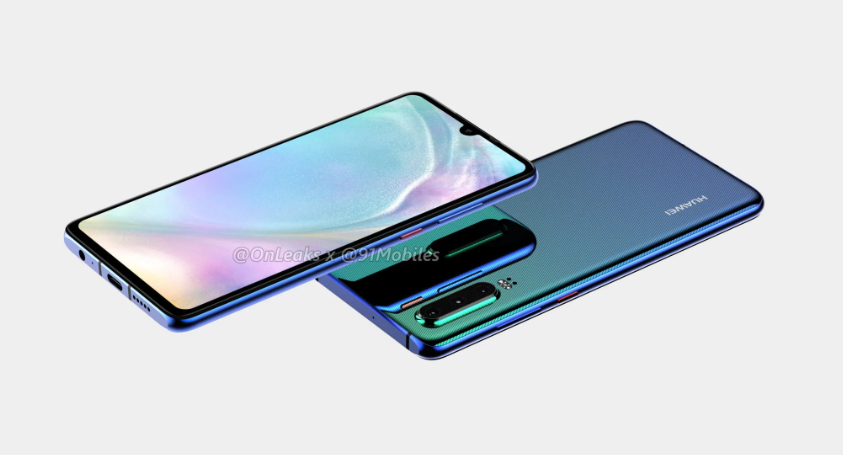
The Huawei P20 and P20 Pro phones from last year came with notched displays. Since then Huawei has launched a couple of phones with waterdrop notch screens. Hence, it is speculated that the upcoming Huawei P30 and P30 Pro phones will be equipped with waterdrop notch displays. Juicy details on the upcoming P30 series have been leaked by people who have tried the engineering samples.
The Huawei P20 series feature LCD panels, but the P30 and P30 Pro will be adopting OLED panels with waterdrop notch to offer bigger screen space. Both phones are expected to arrive with in-display fingerprint scanners. The P30 is expected to arrive with a 6.1-inch display whereas the P30 Pro may come with a 6.5-inch screen.
The Kirin 980 chipset will be powering the Huawei P30 and P30 Pro handsets. The P30 will come with 8 GB of RAM whereas the P30 Pro will be arriving with 12 GB of RAM. Huawei had 40W charging available on the Mate 20 Pro smartphone. Instead of using 40W charging, the P30 series is expected to support 22.5W rapid charging. The P30 won’t be featuring a 3.5mm audio jack, but there is no information on whether the P30 Pro will also feature it. The P30 series is expected to come equipped with EMUI 9.1 based Android 9 Pie OS.
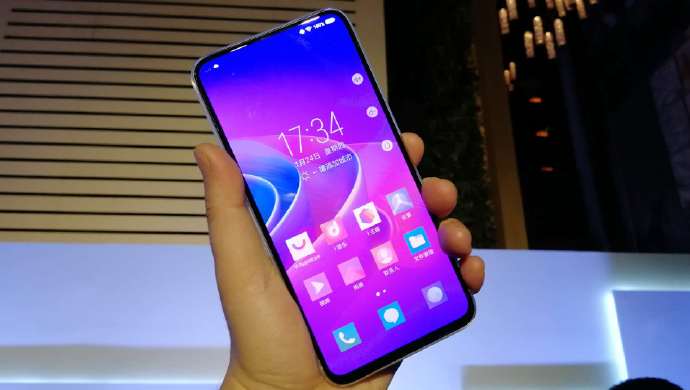
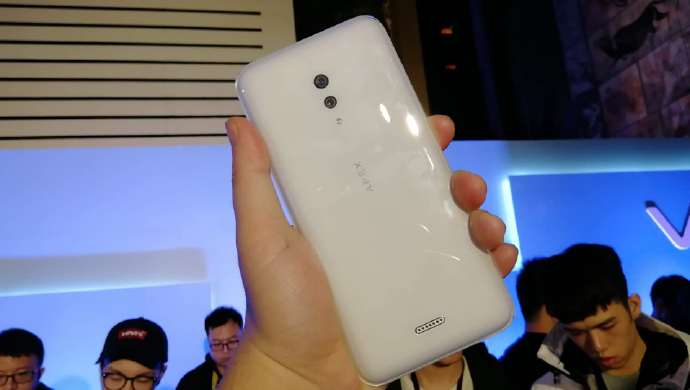
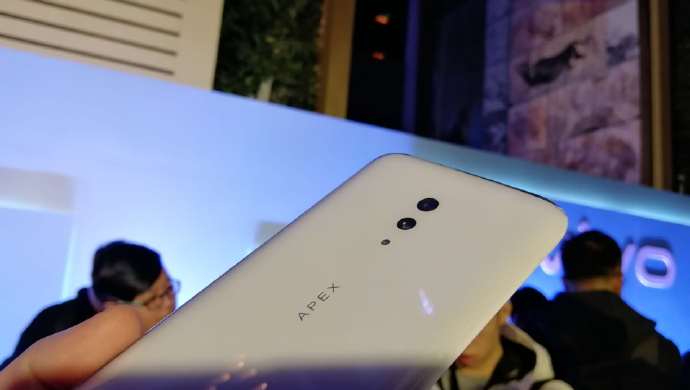
Vivo first took us on a beautiful journey last year when it unveiled the Vivo APEX concept smartphone in China. The flagship took the concept of full-screen display design to another level entirely as it comes with an amazing screen-to-body ratio. The company has taken things to an all new level with the APEX 2019 that has just been unveiled. We bring you some hands-on pictures of the APEX 2019, thanks to Chinese website Anzhou.
The Vivo APEX 2019 continues to explore new technology, heading into the next generation while featuring a minimalist design. It doesn’t feature a charging port instead, it has some metal grooves at the back which can be used to charge the phone wirelessly.
The design utilises a fully CNC-integrated glass body with a range of cutouts which provides a super integrated visual experience. The edges are well chamfered in order to provide a comfortable grip.
Despite the sleek build, Vivo also worked on providing the APEX 2019 with waterproof and dustproof properties. The device lacks physical buttons but instead, it features touch-sensitive ones. There is also a “high-definition” linear motor to provide haptic feedback when using the buttons. It also comes with a screen fingerprint technology that works on any part of the screen. Read Also: Vivo Y89 with Snapdragon 626, dual cameras and 1,598 Yuan (~$235) announced
On the specification, the Vivo APEX 2019 packs the latest Qualcomm Snapdragon 855 chipset which pairs with 12GB of RAM. The device will also be available in 512GB storage option. Since this is a concept phone, we may never see it launched officially. However, since the NEX was basically the Vivo APEX with a different name, the same pathway may be followed with the APEX 2019. Before then, do feast your eyes on more of the hands-on pictures from below.
Earlier this week HMD Global released a roadmap detailing its plans for updating all its phones to Android Pie. Today, it announced that the update has begun rolling out to the Nokia 5 (2017).
The roadmap did mention that the Nokia 5 will receive the update this month, and Juho Sarvikas, the Chief Product Officer confirmed in a separate tweet that the update will be released for the Nokia 5 and Nokia 3.1 Plus this week.
It gives me immense pleasure to announce that Nokia 5 (2017) has just been updated to Android 9 Pie! Nokia Phones truly get better over time! pic.twitter.com/HbwKxilXc8
So if you have a Nokia 5 (2017) you should check for the update. It brings a new system navigation, adaptive battery, adaptive brightness, predictive app actions, and January’s security patch.
The Nokia 5 launched in February 2017 with Android Nougat. It received an update to Android Oreo last year and has now been updated to Android Pie making it two major OS updates.
The phone has a 5.2-inch HD screen, a Snapdragon 430 processor, 2GB/3GB of RAM and 16GB of expandable storage. There is a single 13MP sensor on the back and an 8MP sensor in front for selfies. It also has a front-mounted fingerprint scanner, FM Radio, and packs a 3000mAh battery.
After weeks of waiting, Vivo has announced its latest smartphone – the Vivo APEX 2019. The phone not only has a unique design but also packs all the important specs worthy of a 2019 flagship and even some few tricks of its own.
Design
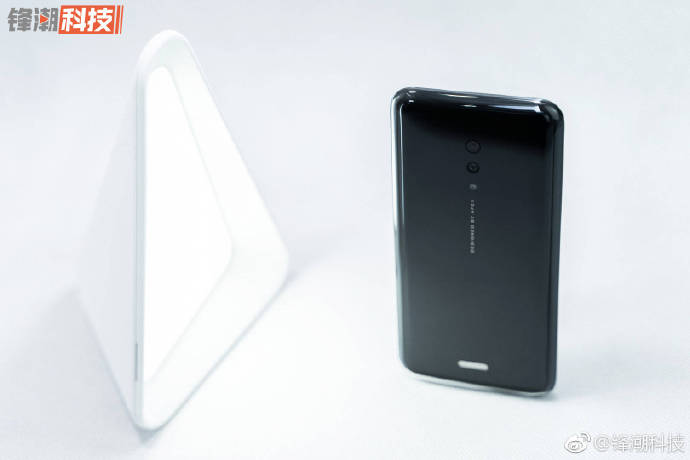
The Vivo APEX 2019 is all glass. No metal frame, just CNC machined glass much like some of Xiaomi‘s Mi MIX series which have an all-ceramic body. Vivo calls the design Super Unibody. The phone also doesn’t have physical buttons but touch-sensitive ones. There is also a “high-definition” linear motor to provide haptic feedback when using the buttons.
The APEX 2019 has no visible speaker too, so it uses screen-sound technology. The same thing is replicated on the back for the loudspeaker.
The phone also comes with the latest version of Vivo’s in-display fingerprint scanner which has a scanning area that covers the whole screen! So no matter where you put your finger on the screen, the phone unlocks. It also supports two-finger unlock!!
Since this is a phone with no holes, you might be wondering how it charges. Vivo has taken a path different from the Meizu Zero. Rather than wireless charging, the APEX 2019 has magnetic charging connector pins on the back similar to that of a smartwatch. These connector pins can also be used for data transfer.
The Vivo APEX 2019 comes in three color variants – silver, black, and white.
Specs
The phone has a 6.39-inch AMOLED display with a 2340 x 1080 resolution. It is powered by Qualcomm’s Snapdragon processor which is paired with 12GB of RAM and 512GB of storage.
The phone also has 5G with support for bands n41, n78, and n79. According to Vivo, 5G usage heats up the phone, so it used a combination of multi-layer graphite heat sinks and liquid-cooling technology to reduce the heat.
The phone has 12MP + 13MP dual rear cameras but there is no mention of the front-facing camera. Not only do we not know the front-camera details but Vivo also failed to show us there is one. There is also no mention of the battery capacity and OS version.
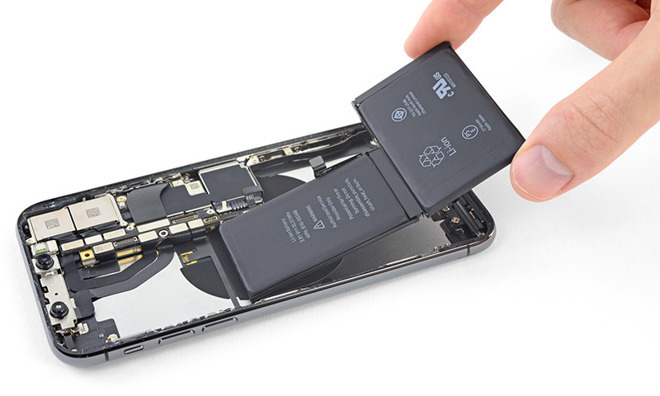
US smartphone manufacturer Apple has engaged the services of a former Samsung executive by name, Soonho Ann to serve as its new Global Head of Battery Developments. The new position further fuel speculations of plans to develop and ultimately produce first-party battery parts.
The former Samsung chief commenced work at Apple in December last year according to his LinkedIn profile. He is also reputed to have had a four-year stint Samsung’s battery arm, Samsung SDI. During his time at Samsung, Mr Ahn held three senior vice president roles. Along the line, he worked on next-generation battery cell materials and technology bound for a range of consumer devices including smartphones, power tools and electric vehicles. Before his stint at Samsung, Ahn worked at LG Chem for 17 years as a vice president in charge of battery development, after which he served a brief stint as a professor of energy and chemical engineering at the Ulsan National Institute of Science and Technology.
Samsung happens to be one of Apple’s major parts supplier despite their rivalry. The Korean company is listed as a top-200 supplier on Apple’s Supplier List as of February 2018. However, Apple has been trying to diversify over the past few years and that has brought multiple Chinese battery makers into the fold. This new hire suggests Apple is looking to reduce its dependence on third-party suppliers and may start developing its own batteries soon. Already, there are rumours that the Cupertino-based company is working on an in-house battery solution, Last year, Apple was reported to be in talks to secure cobalt, a key ingredient in lithium-ion batteries, directly from miners. One major area where Apple has found success in developing its parts is the A-series processors that fuel the iPhone, iPad and HomePod.
Gizmochina is introducing a new giveaway for its users in cooperation with BESTEK. Users will have a chance to win a vacuum cleaner or a $10 Amazon gift card. To enter the giveaway, users have to sign up with an email ID and follow instructions at the giveaway page on BestekMall. The giveaway will run from January 22 to February 15 2019.
There are some rules that you need to follow before entering the giveaway.
It is open to all the users in the US, Canada, UK, France, Germany, Italy, and Spain.
Irrespective of different entries, one person can only win one prize.
In total there will be 30 winners out of which 10 will get vacuum cleaners, and others will receive $10 Amazon gift card.
The Bestek cordless Vaccum Cleaner is a high-quality and portable premium looking machine. It makes vacuuming comfortable and more fun to clean your indoors and outdoors. It is a quite small and lightweight product from the Bestek. In order to improve the satisfaction among users, Bestek has developed the cordless Vacuum cleaner which can even clean corners with ease. It comes packed with an environment-friendly HEPA filter which has a higher filter density than the standard filters. The Vaccum has a strong suction power of 4500 PA which can absorb every kind of dust from different surfaces. It gives you ease to clean your rooms without worrying about cords. Its large lithium battery can survive for various cycles of cleaning.
You can know more about the giveaway and can enter by hitting the link below.
Steps to enter the Bestek Cordless Vacuum Cleaner giveaway?
Share the giveaway on your Facebook, Twitter and Reddit.
Wait till February 18 for the announcement.
The event will run from January 22 to February 15th, and winners will be informed via email on February 18th. Also, keep in mind that it is an international giveaway, so we are not responsible for any of loss of product in transit.
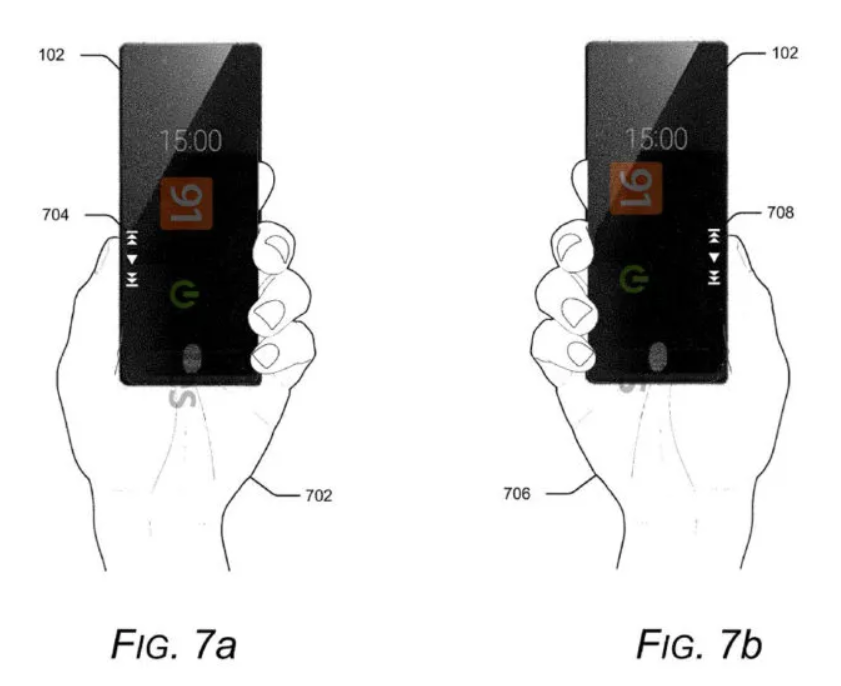
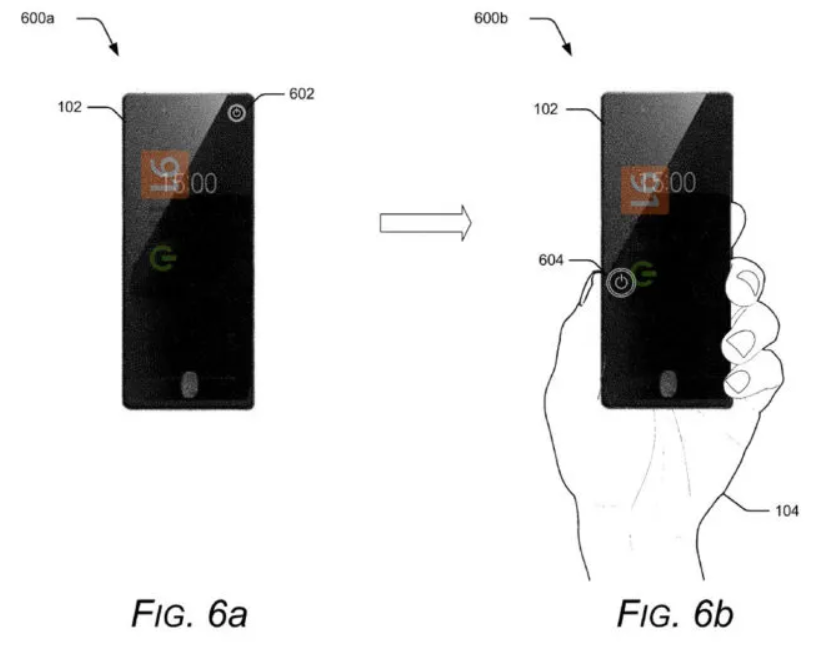
It seems Lenovo owned Motorola is experimenting with new technologies in the backyard. Recently, a new pressure gripping system patent has been published on the World Intellectual Property Organisation (WIPO) website. The new technology is believed to be a starting point for buttonless mobile devices. As like of HTC U12, Motorola is also testing a new system of pressure sensitive functions on smartphones.
As per the images attached to the patent documents, different modules such as a touchscreen, grip profile database, touch input analysis, and various other modules will be grouped together. It relates to pressure sensitive sides which can perform various functions depending upon the intensity. On the other hand, it can be an extended touch screen which is modded toward sides.
If we talk from buttonless smartphone theory, then it will work exactly as like of the standard phone but will rely on side smart sensors. The new technology could be placed along the sides of the smartphones, tablets and other smart devices. Currently, the real working of the patent is not confirmed, but we speculate that it would help users to assign different functions on the basis of how much pressure is applied.
There are many possibilities for the usage of new grip patent registered by Motorola. Another possibility is the squeeze feature to activate proposed function as like of HTC’s Edge sense. Even though, it could help in authenticating the users with the blend of fingerprint sensor along with the new patent. It would help the device to perform multiple functions at a single instance.
Currently, there’s no confirmation regarding the usage of new grip patent. Nevertheless, it will be quite useful if implemented in a much-refined way. Overall, nothing can be confirmed as of now all these are mere speculations. Well, what are your views regarding the pressure sensitive grip patent? Do you think it can help devices to become buttonless? Share your important thoughts via the comments below.
Redmi, the newly independent brand of Xiaomi, launched the Redmi Note 7 smartphone earlier this month in China. The phone has been well-received in China as it sold out within minutes in all three flash sales.
Now, it seems that the Redmi Note 7 is ready to make its debut in India as the company has teased the launch of Redmi Note 7 in India through its official Twitter account. The tweet contains text upside down, accompanied by a photo of Xiaomi India MD Manu Kumar Jain and Xiaomi CEO Lei Jun holding the Redmi Note 7.
While the launch date of the phone in India is not yet known, it is expected to launch next month. Earlier, we reported that the company is planning to launch Redmi Note 7, Redmi Note 7 Pro, and Redmi Go smartphones in India by the end of March this year.
The phone features a premium glass body design and comes with a massive screen-to-body ratio thanks to the waterdrop notch display. As for the specifications, the device sports a 6.3-inch Full HD+ display with 2340 x 1080 pixels screen resolution and 19.5:9 aspect ratio. The display carries support for 450-nits brightness, 1,500:1 contrast ratio, sun legibility, and eye protection mode.
Under the hood, the device is powered by Qualcomm Snapdragon 660 octa-core chipset with 3GB/4GB/6GB RAM and 32GB/64GB internal storage. It also comes with a dedicated microSD card slot allowing users to expand the storage capacity.
The company has focused on offering a premium photography experience with this budget smartphone. The device comes with an f/1.8 aperture 48-megapixel primary sensor and a 5-megapixel secondary camera with artificial intelligence technology. On the front side, there’s a 13-megapixel camera housed in the display notch for taking selfies. It is also equipped with features like AI Smart Beauty and AI face unlock.
As for the software, the smartphone is running Android 9 Pie-based MIUI 10 out-of-the-box. It is equipped with a 3.5mm audio jack and features an infrared blaster as well as a back-mounted fingerprint sensor. The phone is powered by a 4,000mAh battery with support for Quick Charge 4.0 fast charging technology.
As the 5G technology is set to go mainstream this year, many smartphone manufacturers have already announced that they are working on developing devices which are 5G-compatible. While Samsung and OnePlus are said to be among the first companies to launch a 5G-enabled smartphone, LG is not far behind. The South Korean company is also working on a 5G smartphone which will be launched later this year.
LG Electronics has already scheduled a launch event on 24th February in Barcelona, a day before the Mobile World Congress officially kicks-off. Now, the company has revealed that it will launch its 5G smartphone at CCIB in Barcelona on 24th February.
Right after the launch, the LG 5G smartphone will also be showcased during the Mobile World Congress (MWC 2019) from 25th February to 28th February in Barcelona. The company is also looking to partner with major network operators, especially in Korea, North America, and Europe where 5G service is scheduled to be commercially available later this year.
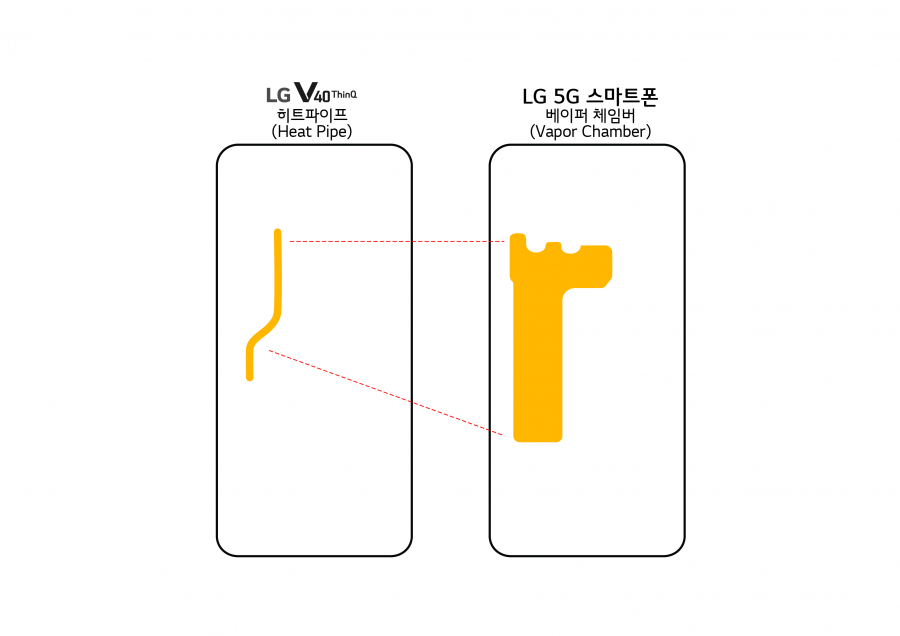
The smartphone will be powered by Qualcomm’s latest Snapdragon 855 processor, which is claimed to offer 45 percent better performance. It will also come with a ‘Vapor Chamber’ which is 2.7 times bigger heat pipe (heatsink) than the one in LG V40 ThinQ and the liquid is also more than double the amount. Further, the phone is confirmed to pack 4,000mAh battery and we expect it to have fast charging support.
Despite the company raking up huge losses, the South Korean company believes that things will get better. The company’s hope lies on the 5G revolution. Earlier, president of LG’s mobile division, Hwang Jeong-Hwan, said that LG is one of three manufacturers ready to launch a 5G-ready smartphone when 5G roll-out begins.
A handset launch roadmap from LG reveals that the LG G8 won’t be the company’s first 5G smartphone. The company will be launching its 5G smartphone under new branding. This will enable the company to position the device appropriately and design a targeted marking campaign.
The company believes that the headstart in the 5G market should increase the company’s sales in the first half of 2019. LG already has a contract with Sprint which will see it release the carrier’s first 5G “shiny and distinct” smartphone in the first half of 2019. Apart from LG, smartphone manufacturers including Samsung, OnePlus, Xiaomi, and Oppo among others are set to launch their 5G-compatible smartphones later this year.
Earlier today in China, Huawei Consumer Business Groupe CEO Richard Yu announced the Balong 5000 as the world’s most powerful 5G modem that can deliver up to 6.5 Gbps of 5G speeds. At the same conference, Richard Yu confirmed that Huawei will be launching its 5G phone at the Mobile World Congress (MWC) 2019 tech expo in Barcelona, Spain in the coming month. He confirmed that the 5G device launching next month will be a foldable device with Kirin 980 chipset and Balong 5000.
Qualcomm Snapdragon X50 LTE modem can offer peak download speeds of 5 Gbps. It does not support Standalone (SA) and FDD frequencies that are supported by Balong 5000 5G modem. The Balong 5000 also supports Non-Standalone (NSA) architecture along with 3G, 4G and 5G networks and consumes less power.
The Kirin 980 chipset that powers the current lot of Huawei and Honor flagship phones features the world’s first Cat. 21 LTE modem which makes it possible to achieve download speeds of up to 1.4 Gbps. Theoretically, the modem offers 4.5G connectivity. Since Kirin 980 is a 5G-ready chip, Huawei will be swapping its Cat. 21 LTE modem with the more powerful Balong 5000 5G modem.
Balong 5000 is the first 5G modem to achieve industry’s benchmark 5G peak download rate by achieving 4.6 Gbps in the sub-6GHz low frequency band and China’s main 5G frequency band along with 6.5 Gbps in the millimeter wave which is the highest frequency band and 5G extended band. To put it in simpler words, the Balong 5000 5G modem can deliver 10 times faster experience than 4G LTE.
Rumors surrounding Huawei’s foldable phone reveals that it will be sporting fold-out design and it will be fitted with flexible OLED panels by China’s BOE display maker. When unfolded, it may offer a screen area of around 8 inches and when folded, it will offer a display of 5 inches. A two-month old report had claimed that the company is considering names like Mate F, Mate Flex, Mate Flexi and Mate Fold names for its foldable smartphone.
Huawei’s chairman Hu Houkun (Ken Hu) had addressed at the World Economic Forum recently that the company has deployed 5G networks in 10 countries and it will be soon made available in 20 additional nations. He also confirmed that the company will be launching its 5G smartphone in June. Probably, he could be either referring to release date of the Huawei’s 5G foldable phone or the arrival of some other smartphone with 5G connectivity.
Realme, which has already launched five smartphones in the Indian market so far, is now gearing up to launch a new smartphone which seems to be focusing on the entertainment aspects.
The company has teased its upcoming smartphone as ‘Entertainment Ka Baap’, which translates to something like ‘Boss of Entertainment’. While the phone’s launch date is not yet known, the smartphone is confirmed to be sold exclusively through Flipkart.
Flipkart has also created a landing page for the upcoming smartphone on its platform. While no actual features or specifications have been listed on Flipkart, the landing page indicates that the smartphone will come with an impressively high onboard storage space and a display with a wide notch.
Realme 2 Pro and Realme U1, the most recent smartphones from the company features a waterdrop notch while the Realme C1 — the entry-level phone of Realme comes with the regular rectangular notch. As the upcoming phone has a wider notch, it seems that it’ll be positioned below the Realme U1 and Realme 2 Pro.
The company is also reportedly working on its Realme 3 smartphone, which is expected to launch by the end of March this year. However, nothing else if known related to the smartphone at this time. There were rumors about Realme’s 48MP camera smartphone but the company’s CEO denied it.
After expanding its offline presence in India, Realme is also looking to open exclusive experience stores. Madhav Sheth recently said that the company is currently working on the company’s structure and principles and is yet to finalize the location for its first experience store. However, we should expect such store in the second half of this year.
Realme is a new smartphone brand launched last year after splitting from Oppo and has already made its mark in the budget smartphone segment in India — one of the biggest smartphone markets globally. The company has even expanded to six other geographies — Malaysia, Vietnam, the Phillippines, Indonesia, Thailand, and Egypt.
Through the 5G conference and MWC 2019 pre-communication meeting in Beijing, Huawei consumer business CEO Richard Yu announced the Balong 5000 as the most powerful 5G modem that can deliver maximum 5G speeds of up to 6.5 Gbps. The Balong 5000 5G modem was first announced alongside the 7nm Kirin 980 chip at the IFA 2018 event.
Balong 5000
The Balong 5000 is the first ever 5G modem that is compatible with Non-Standalone (NSA) and Standalone (SA) 5G network architecture. The 5G modem by Huawei can support 2G, 3G, 4G and 5G connectivity.
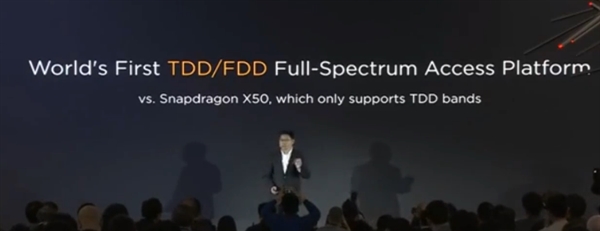
At the unveil event, Huawei claimed that the Balong 5000 is the world’s first TDD/FDD full-spectrum access platform. The Snapdragon X50 LTE modem by Qualcomm that peaks at 5 Gbps does not support Standalone (SA) architecture and FDD. Balong 5000 is the first to achieve industry’s benchmark 5G peak download rate by achieving 4.6 Gbps in the sub-6GHz low frequency band and China’s main 5G frequency band along with 6.5 Gbps in the millimeter wave which is the highest frequency band and 5G extended band.
In simpler terms, it delivers in offers tenfold better experience than 4G LTE. Balong 5000 is also the first multimode chip in the world to support V2X (vehicle-to-everything) communication that offers a highly reliable car networking solution with low latency.
Huwaei 5G CPE Pro
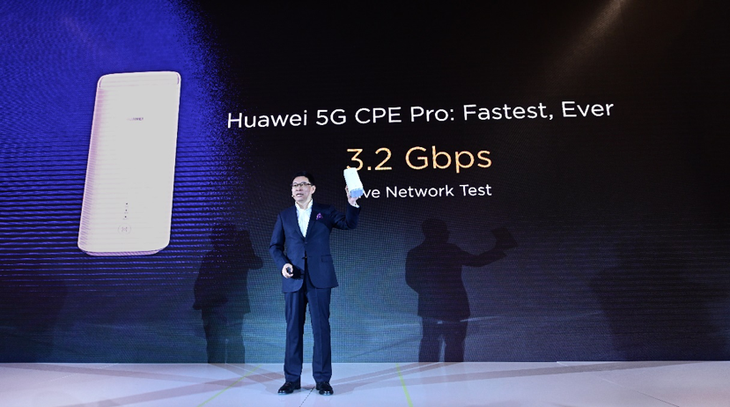
At today’s event, the company also revealed Huawei 5G CPE Pro router. With Balong 5000 onboard, it can support 4G and 5G networks. It can download 1 GB HD video file in just 3 seconds through 5G.
The Huawei 5G CPE Pro is designed for home as well as medium-sized enterprises to provide high quality broadband access. With Wi-Fi 6 technology, it can achieve up to 4.8 Gbps speeds. Also, it is the first CPE router from the company to support HiLink, a smart home interconnection platform developed by Huawei.
The Balong 5G modem along with Kirin 980 will be present inside the Huawei’s 5G phone that will debut at the Mobile World Congress (MWC) 2019 event that will be held in Barcelona, Spain in the coming month.
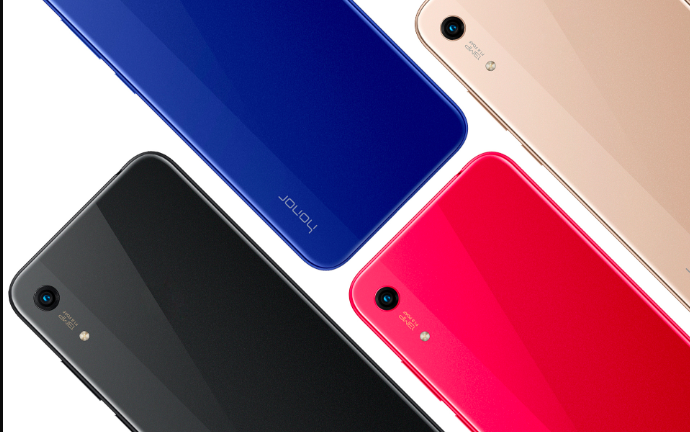
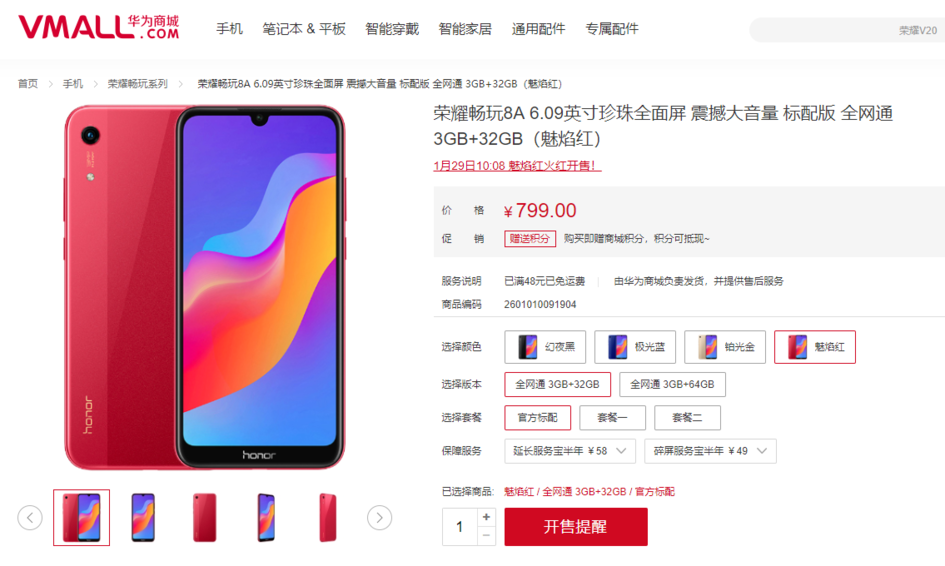
It is sort of a custom in China for phone manufacturers to release a special red variant of a few of their models during the Spring festival. That is what Huawei’s Honor has just done. The company has released a Flame Red variant of the Honor Play 8A. This is coming barely two weeks after the model was initially launched in China in three different colours of Magic Night Black, Aurora Blue and Platinum Gold.
The new Flame Red variant comes as the fourth colour options the Play 8A is now available in. The variant looks elegant in red but the paint job wasn’t enough for Honor to change the retail price. The pricing of the new variant will start at 799 yuan (around $116) and it will go on sale at 10.08AM on January 29. For now, the Honor Play 8A is only available in China but there are speculations it will be launched in India soon. The four colour options of the budget Honor phone may likely be unleashed at once in India.
As a recap of the specifications, the Honor Play 8A features a polycarbonate body along with a metal frame. The device packs a big 6.09-inch waterdrop notch screen with HD+ resolution of 720 x 1560 pixels. The Play 8A is the second model after Xiaomi’s Mi Play to feature a MediaTek Helio P35 chipset. It comes in 3GB+32GB and 3GB+64GB combo with microSD card slot for expanding the storage. The device equally packs a single 13-megapixel rear camera with LED flash and autofocus while there is an 8-megapixel camera with f/2.0 aperture at the front. The device is fueled by a 3,020mAh battery and carries support for 5V/1A charging. Other connectivity features that are included on the Honor 8A are dual-SIM support, 4G VoLTE, Wi-Fi 802.11 b/g/n, Bluetooth 4.2, GPS, microUSB 2.0 and 3.5mm audio jack. Unfortunately, there is no fingerprint scanner.
Redmi Note 7, the first smartphone from the newly independent Redmi brand, was launched earlier this year. The phone comes with a 48-megapixel Samsung GM1 camera sensor to offer stunning photography experience.
Earlier, the company had announced that the phone will soon get the Night Scene Mode, which will further improve the phone’s low-light photography experience. Now, the Redmi Note 7 has received a new update that brings Super Night Scene Mode.
The Night Scene mode was first introduced on the Mi Mix 3 and later on the Mi 8 Pro, and the Mix 2s. The feature allows users to take HDR photos at night that appear super bright even if lighting is poor. The Night Scene mode takes several photos at different exposures and combines them into a single image that is bright and with as less noise as possible.
The Redmi Note 7 comes with a 48MP main camera which has Samsung ISOCELL GM1 Ultra Clear sensor with a 1/2-inch size. The super-sensing area is second only to the SonyIMX600 sensor used in the Huawei P/Mate series flagship. It is said to be on par with the Sony IMX586 sensor used on the Nova 4.
The ultra-high pixels provides more detailed performance for Samsung GM1 products. Samsung GM1 sensor also adopts Quad Bayer pixel arrangement, which can combine four 0.8μm pixels into one by four-in-one pixel technology. A large pixel of 1.6 μm increases the amount of light entering the camera.
The Redmi Note 7 comes with a premium glass body and a massive screen-to-body ratio thanks to the waterdrop notch display. It features a 6.3-inch Full HD+ display with 2340 x 1080 pixels screen resolution and 19.5:9 aspect ratio. The display carries support for 450-nits brightness, 1,500:1 contrast ratio, sun legibility, and eye protection mode.
Under the hood, the device is powered by Qualcomm Snapdragon 660 octa-core chipset with 3GB/4GB/6GB RAM and 32GB/64GB internal storage. It also comes with a dedicated microSD card slot allowing users to expand the storage capacity.
The device comes with an f/1.8 aperture 48-megapixel primary sensor and a 5-megapixel secondary camera with artificial intelligence technology. On the front side, there’s a 13-megapixel camera housed in the display notch. It is also equipped with features like AI Smart Beauty and AI face unlock.
The phone is equipped with a 3.5mm audio jack and features an infrared blaster which makes it possible to use it as a remote control. A fingerprint scanner resides of the backside of the smartphone. It runs Android Pie-based MIUI 10 and is powered by a 4,000mAh battery with support for Quick Charge 4.0 fast charging technology.
DOOGEE made its long-awaited Y8 smartphone available to the public earlier this month. As expected, the recently launched smartphone became an instant hit among DOOGEE fans. The DOOGEE Y8’s skyrocketing success can be attributed to its top-end specifications and awe-inspiring features. We usually associate such high-end specs and features with steeply-priced smartphones.
Much to the relief of those living on a tight budget, the DOOGEE Y8 will not set you back a pretty penny. In fact, you can get your hands on this feature-laden smartphone if you are willing to shell out just $69.99 on DealExtreme (dx.com).
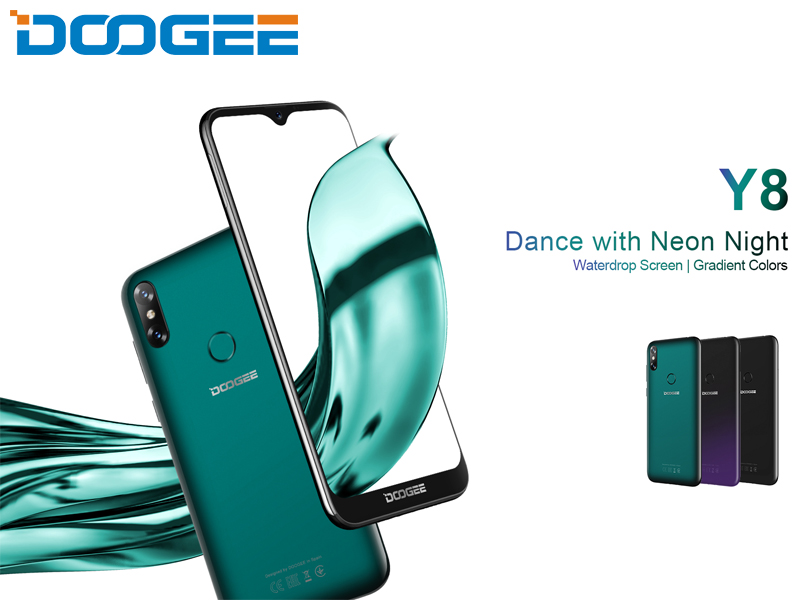
The Y8 comes in three appealing color versions including Midnight Black, Phantom Purple, and Emerald Green.
The phone will grab your attention with its extra large, water drop 6.1-inch full-screen display that boasts an HD screen resolution of 600×1280 pixels at a pixel density of 270ppi (pixels-per-inch).
Under the hood, the phone packs a powerful MT6793 quad-core processor that ensures a superior system operating experience. Aside from that, it uses a highly competent IMG GE8100 graphics processing unit for advanced multitasking.
Moreover, the DOOGEE Y8 ships with 3GB of RAM and offers 16GB of onboard storage capacity that can be expanded up to 128GB using a microSD card.
On the photography front, the dual-SIM smartphone houses an 8.0MP+5.0MP dual-camera set up with F/2.2 auto-focus LED Flash on the back. Up front, there’s a 5.0MP front shooter with F/2.2 80 degree wide-angle.
The phone runs Android 9.0 Pie OS and draws its juices from a built-in 3400mAh polymer battery.
The DOOGEE Y8 features a slew of useful sensors including a rear-mounted fingerprint sensor. Aside from that, it offers a face unlocking alternative for added protection.
You can head straight to this link to check out the full specifications of the DOOGEE Y8 smartphone and buy it at a modest price on DealExtreme.
Note that there were 9972 pieces available at the time of writing.
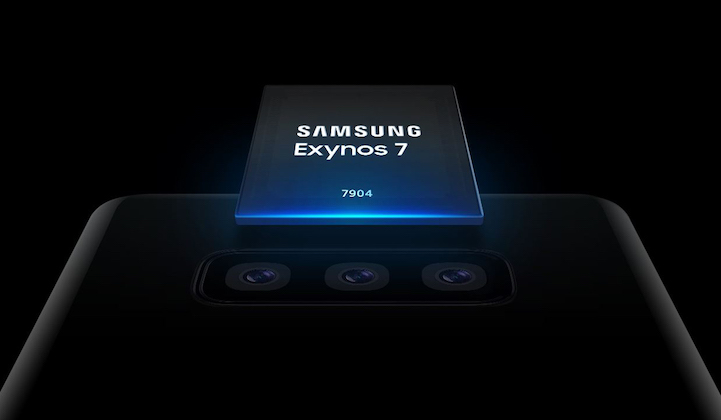
Over the past few years, Samsung has solidified its position as a chipset manufacturer with its ARM-based Exynos series chipsets. These processors take on the big players like Qualcomm and MediaTek, even in the mid-range market. Earlier this week, Samsung released its brand new Exynos 7 series 7904 processor. So, let’s take a closer look at where this processor stands among the competition.
Before we move on to the actual specifications of the processor, first let’s agree that Samsung has a messed up processor nomenclature. You can’t really make out where each processor stands in the lineup just by looking at their names. Unfortunately, this is a trend among various semiconductor companies. Both Qualcomm (I have tried to explain their mid-range chipsets here) and Intel have been criticized for their naming scheme and I guess, we can’t do much about it at the moment.
One thing we know for sure is that the new Exynos chipset is tailored for the Indian market. According to recent information, the new Samsung Galaxy M20 will most likely carry this chipset. However, we don’t know whether we’ll see this chip outside of India.
Exynos 7904 has a weaker CPU than the 7885
Coming back to the Exynos 7904, it should be seen inside mid-range smartphones from Samsung. It features 2 x ARM Cortex-A73 high-end cores clocked at 1.8GHz for heavy duty tasks and 6 x ARM Cortex-A53 power efficient cores clocked at 1.6GHz for basic activities. Seeing this specs sheet, we can say that the 7904 is not really built for power-hungry applications.
The A73 cores should be able to handle most moderate to high intensive tasks, but it will start to struggle if you try to multi-task. Even the Mali-G71MP2 GPU doesn’t instill confidence in its graphics processing capabilities. It might have a large core (similar to the 1.2GHz Mali-G71 MP1 on the Exynos 7885) but don’t expect it to handle heavy games like a Qualcomm SD660.
Honestly, when you look at the specs, the Exynos 7904 naming doesn’t look very appropriate. This might be a personal opinion, but the new Exynos chipset feels like an extension of the Exynos 7885 rather than a brand new chip. Here’s why:
Exynos 7904 vs Exynos 7885
Features
Exynos 7904
Exynos 7885
Node
14nm
14nm
CPU
2 X A73 @ 1.8GHz
6 x A53 @ 1.6GHz
2 x A73 @ 2.2GHz
6 x A53 @ 1.6Hz
GPU
Mali-G71 MP2
Mali-G71 MP2
RAM / Storage
LPDDR4X / eMMC
LPDDR4X / eMMC
Camera
Rear – 32MP + Front – 32MP
Dual 16+16
Triple Cam Support
Rear – 21.7MP + Front – 21.7MP
Dual 16+16
Video
4K @ 30fps
FHD @ 120fps
4K @ 30fps
FHD @ 120fps
Modem
Cat 12 (3xCA) / 13
600Mbps Download
150Mbps Upload
Cat 12 (3xCA) / 13
600Mbps Download
150Mbps Upload
There is one particular area where the Exynos 7904 is better than the 7885 — ISP. The new chip upgrades its ISP adding support for 32MP + 32MP (Front+Rear) or Dual 16MP + 16MP or triple cameras. Yes, the new chipset boasts of being capable enough to handle three cameras at the back. The third camera can reportedly function as a wide angle sensor or a bokeh sensor.
Now that we’ve established the Exynos 7904 is better than the 7885 only in some aspects, let’s take a look at where it stands among its competition.
At present, the Snapdragon 636 is considered as the standard mid-range offering from Qualcomm. The SD630/632 are lower mid-range offerings while the SD670/710 are for upper mid-rangers.
Considering its specs, the Exynos 7904 would be better placed between the Snapdragon 636 and the Snapdragon 632. Snapdragon 636 is more powerful with its 4 x Cortex A73 Kryo cores. Even the Adreno 509 GPU and support for UFS storage gives it an edge over the new Exynos chip.
Snapdragon 636
Exynos 7904
Snapdragon 632
14nm
14nm
14nm
4 x Kryo 260G (A73) @ 1.8GHz
4 x Kryo 260S (A53) @ 1.8GHz
2 X A73 @ 1.8GHz
6 x A53 @ 1.6GHz
4 x Kryo 250G (A73) @ 1.8GHz
4 x Kryo 250S (A53) @ 1.8GHz
Adreno 509
Mali-G71 MP2
Adreno 506
LPDDR4X / UFS
LPDDR4X / eMMC
LPDDR3 / eMMC
24MP Single
Dual 16+16MP
Rear – 32MP + Front – 32MP
Dual 16+16MP
Triple Cam Support
24MP Single
Dual 13+13MP
4K @ 30fps
FHD @ 120fps
4K @ 30fps
FHD @ 120fps
4K @ 30fps
FHD @ 120fps
X12 LTE
Cat 12 (3xCA) / 13
600Mbps Download
150Mbps Upload
Cat 12 (3xCA) / 13
600Mbps Download
150Mbps Upload
X9 LTE
Cat 7 (3xCA) / 13
300Mbps Download
150Mbps Upload
When compared to the SD632, the Exynos 7904 should be close to its performance. But even here, the Qualcomm chip should have an edge. The SD632 has four performance cores while the Exynos chip has just two. However, overall, when you look at CPU and GPU together, the Exynos 7904 should go head to head with this Qualcomm chip on paper. But there are a few areas where the Exynos model is clearly better. For example, the chip supports LPDDR4X and Cat 12 / 13 (downloads/uploads). Even the ISP is better than the SD632. So, the Exynos 7904 should ideally be placed between the SD636 and SD632.
Latest rumors suggest that the Galaxy M20, which is expected to feature the Exynos 7904 will be sold somewhere around $180. At this price, the new chip would offer pretty good value to customers.
But in general comparison, it’s still a lower mid-range processor. In terms of performance, both the Snapdragon 636 and Snapdragon 660 should do much better than the new Exynos model.
We use cookies on our website to give you the most relevant experience by remembering your preferences and repeat visits. By clicking “Accept”, you consent to the use of ALL the cookies.
This website uses cookies to improve your experience while you navigate through the website. Out of these, the cookies that are categorized as necessary are stored on your browser as they are essential for the working of basic functionalities of the website. We also use third-party cookies that help us analyze and understand how you use this website. These cookies will be stored in your browser only with your consent. You also have the option to opt-out of these cookies. But opting out of some of these cookies may affect your browsing experience.
Necessary cookies are absolutely essential for the website to function properly. This category only includes cookies that ensures basic functionalities and security features of the website. These cookies do not store any personal information.
Any cookies that may not be particularly necessary for the website to function and is used specifically to collect user personal data via analytics, ads, other embedded contents are termed as non-necessary cookies. It is mandatory to procure user consent prior to running these cookies on your website.






















 The DOOGEE Y8’s skyrocketing success can be attributed to its top-end specifications and awe-inspiring features. We usually associate such high-end specs and features with steeply-priced smartphones.