Advertisement

ASUS Zenfone Max Pro M2 goes on sale in Europe while the M1 gets price cut

ASUS first unveiled the Zenfone Max Pro M2 in Russia in November last year and one month later, the model was launched in India and Indonesia. The phone has since gone on sale in those markets. In addition, ASUS has expanded its sales network as the models are now on sale in Europe via the companies official store in France, Italy, Spain, and Russia. In addition, the release of the Zenfone Max Pro M2 has affected the pricing of its predecessor, the Zenfone Max Pro M1 which is now cheaper.Asus-ZenFone-Max-Pro-M2 (2)

Both the Zenfone Max Pro M2 and M1 are defined by their affordable prices, pure Android OS and massive 5,000mAh batteries. As for their pricing, the Zenfone Max Pro M1’s base version with 3GB of RAM and 32GB storage is listed for €200 in France while the 4GB+64GB version is 11% off (€250). On the other hand, the M2 is on sale for €300 and if you buy one over the next 6 months, you’ll get an €80 voucher to spend on Asus.com (valid for 3 weeks). This isn’t applicable in Italy where the M2 is on sale for €300. However, the M1 comes in cheaper at  €180. The price of the Zenfone Max Pro M1 in Spain is still a huge €300 which isn’t in any way a bargain. In the Netherlands, the M2 is already out of stock but it has a retail price of €220. Finally, in In Russia, the M1 starts at RUB 14,000, the M2 at RUB 18,000.

Asus-Zenfone-Max-Pro-M1
M1

Read Also: Newly launched Asus Zenfone Max Pro M2 gets its first firmware update

To recall, the ZenFone Max Pro M2 features a 6.2-inch Full HD+ screen giving a resolution of 2280×1080 pixels on 19:9 aspect ratio screen and 450 nits brightness. It is powered by  Qualcomm Snapdragon 660 Mobile Platform which works together with 3GB/4GB of RAM and 32GB/64GB of internal storage. On the camera end, the device comes with a vertically-stacked dual camera setup, featuring a 12-megapixel Sony IMX486 primary sensor with f/1.8 aperture. It is accompanied by 5-megapixel depth sensor with f/2.4 aperture. On the front side, there’s a 13-megapixel selfie camera with an LED flash that supports Face Unlock. The device runs Android 8.1 Oreo out of the box.

(via)
Ticwatch E2 and Ticwatch S2 go on sale for $159 and $179 respectively

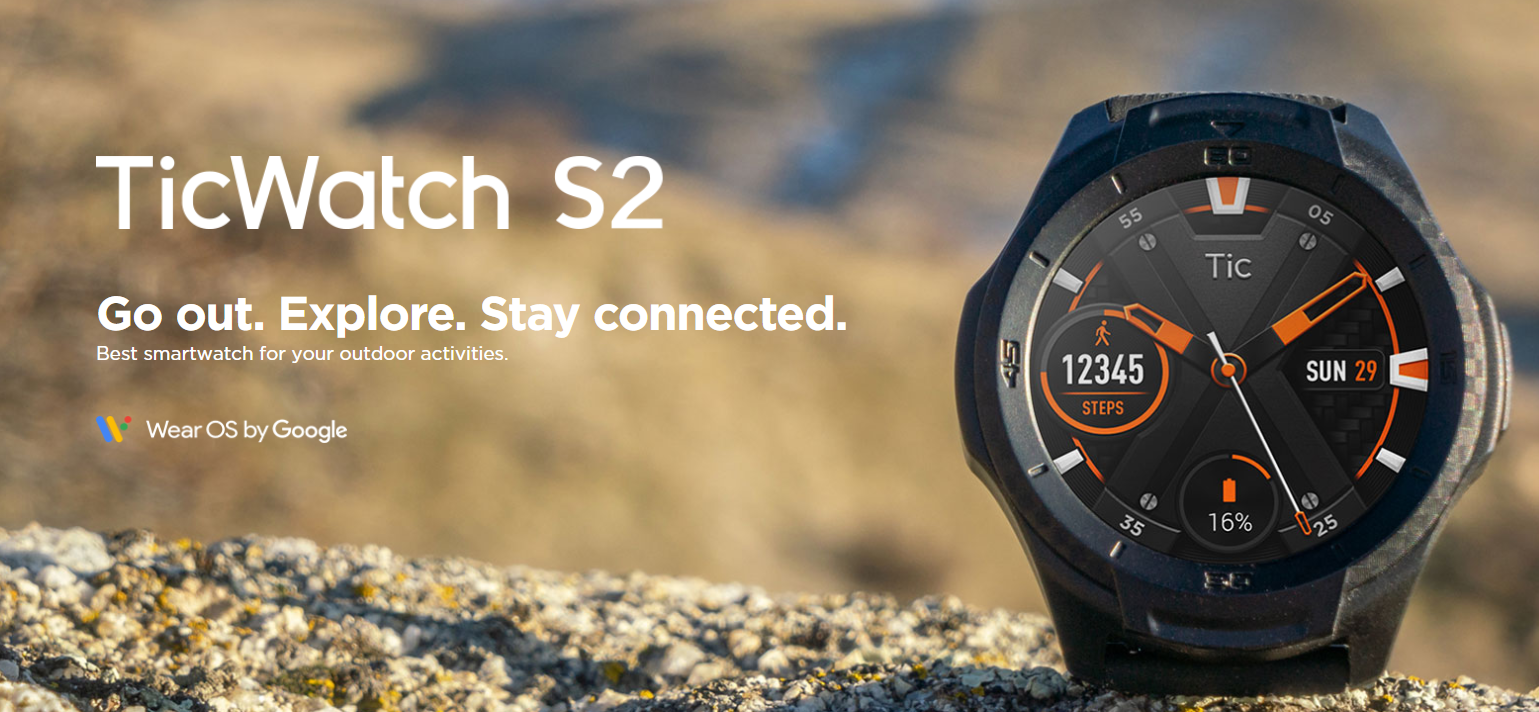
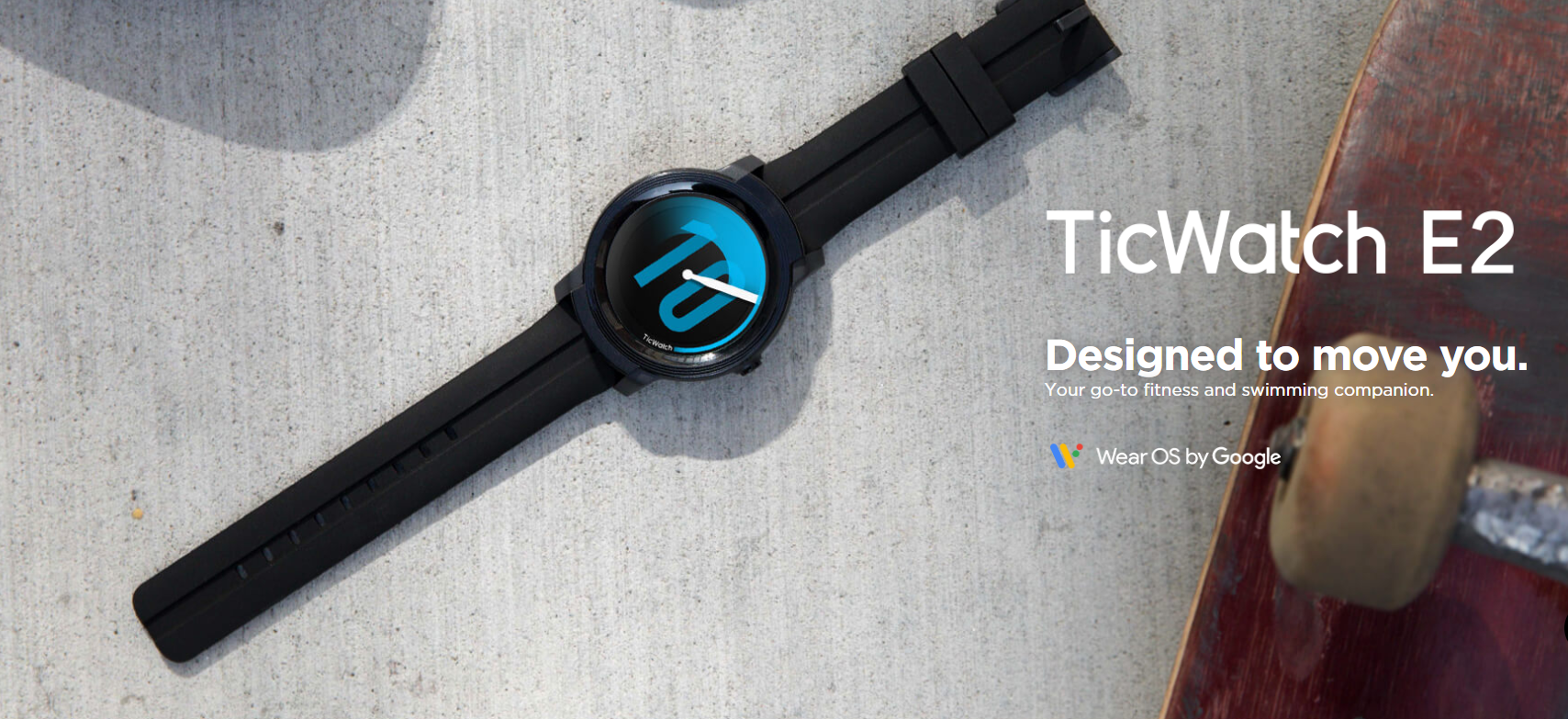
Mobvoi announced two new smartwatches at CES 2019, however, it didn’t reveal the price for the Wear OS-powered watches. Today it announced the Ticwatch E2 and Ticwatch S2 will sell for $159 and $179 respectively and both can be purchased right away.

Ticwatch E2

While both watches share the same specs, Mobvoi is selling the sports-like Ticwatch S2 for $20 more. That extra amount is for the watch’s MIL-810G compliance which means it can survive extreme temperatures, shock, water, and dust, unlike the E2 which is only waterproof up to 5ATM.

Other than the difference highlighted above, both watches have a 1.39-inch AMOLED screen with a 400 x 400 resolution, a Snapdragon Wear 2100 processor, and a 415mAh battery that is said to last up to 2-days on a charge. They both have built-in GPS, Bluetooth 4.1, a 24-hour heart-rate monitor, and run Google’s Wear OS.

Ticwatch S2

Mobvoi has also announced a new feature called TicMotion 1.0 which is a suite of AI algorithms that proactively detect any physical activity you are involved in and record them without you doing anything. So there is no need to set either of the watches to swimming mode or running mode before it begins tracking. TicMotion will also include sleep tracking but it will arrive as a future OTA update.

READ MORE: Mobvoi’s Ticpods Free wants to take on the AirPods, already wins with price

Xiaomi Redmi Note 7 vs Lenovo S5 Pro GT vs Honor View 10 Lite: Specs Comparison

Xiaomi Redmi Note 7 is definitely one of the superstars in the smartphones world at the beginning of 2019. Despite not being a flagship, the handset catalyzed the attention of millions of people through its amazing specs sheet and its incredibly affordable price. Nowadays, it is very rare that a well-established company releases a so powerful device with a price tag under $150, but Xiaomi did, even though it is currently the world’s 4th smartphone brand. Here, we will compare it with two other outsiders in the midrange segment: the surprising Lenovo S5 Pro GT and the Honor View 10 Lite.


Xiaomi Redmi Note 7 vs Lenovo S5 Pro GT vs Huawei Honor View 10 Lite

Xiaomi Redmi Note 7 Lenovo S5 Pro GT Huawei Honor View 10 Lite
DIMENSIONS AND WEIGHT 159.2 x 75.2 x 8.1 mm, 186 grams 154.5 x 75.5 x 7.7 mm, 170 grams  160.4 x 76.6t x 7.8 mm, 175 grams
DISPLAY 6.3 inches, 1080 x 2340p (Full HD+), 409 ppi, IPS LCD 6.2 inches, 1080 x 2246p (Full HD+), 402 ppi, 18.7:9 ratio, LTPS IPS LCD  6.5 inches, 1080 x 2340 pixels, 396 ppi, 19.5:9 ratio, IPS LCD
PROCESSOR Qualcomm Snapdragon 660, octa-core 2.2 GHz Qualcomm Snapdragon 660, octa-core 2.2 GHz Huawei Hisilicon Kirin 710, octa-core 2.2 GHz
MEMORY 3 GB RAM, 32 GB – 4 GB RAM, 64 GB  – 6 GB RAM, 64 GB – micro SD slot 4 GB RAM, 64 GB – 6 GB RAM, 64 GB – 6 GB RAM, 128 GB – micro SD slot  4 GB RAM, 64 GB – 6 GB RAM, 64 GB – 6 GB RAM, 128 GB – micro SD dedicated slot
SOFTWARE Android 9 Pie, MIUI Android 8.0 Oreo, ZUI  Android 8.1 Oreo, EMUI 8.2
CONNECTIVITY Wi-Fi 802.11 a/b/g/n/ac, Bluetooth 5.0, GPS Wi-Fi 802.11 a/b/g/n/ac, Bluetooth 5.0, GPS  Wi-Fi 802.11 a/b/g/n/ac, Bluetooth 4.2, GPS
CAMERA Dual 48 + 5 MP f/1.8 and f/2.4
13 MP front camera
Dual 12 + 20 MP f/1.8 and f/2.6
Dual 20 + 8 MP f/2.0 front camera
Dual 20 + 2 MP f/1.8
16 MP f/2.0 front camera
BATTERY 4000 mAh, fast charging with Quick Charge 4.0 3500 mAh  3750 mAh, Fast Charging
ADDITIONAL FEATURES Hybrid Dual SIM slot Hybrid Dual SIM slot  Dual SIM slot

Design

Probably in order to cut costs, Lenovo decided not to focus so much on the design and materials of the S5 Pro GT. It is a classic full metal unibody device with a big notch, but there is a reason for that big notch: it is one of the few midrange devices to feature 3D facial recognition thanks to its IR sensor. However, if you want the most beautiful and solid device, then you should go for the Xiaomi Redmi Note 7. Besides having an amazing rear side available in gradient colors, as well as a small waterdrop notch, it has a stunning build quality. Its display is protected by Gorilla Glass 5 and its rear glass is very resistant. The phone is also water resistant. Honor View 10 Lite is beautiful as well, but its dimensions are not the top due to its bigger display.


Display

If you are looking for the best multimedia experience, Lenovo S5 Pro GT is your best choice. It has a wonderful LTPS display with high brightness and good image reproduction, as well as loud stereo speakers. If you need more comfort while using your device for productivity, then maybe Honor View 10 Lite is better due to its huge 6.5-inch display. What about Xiaomi Redmi Note 7? It has deep blacks and pretty nice colors, but in my opinion, it is inferior to the Lenovo S5 Pro GT.


Specs & Software

The most suitable phone for people looking for the best performance in heavy scenarios is Lenovo S5 Pro GT, even though it has just marginal differences compared to the Xiaomi Redmi Note 7. It has exactly the same chipset and the same amount of RAM, but it comes with more internal storage in its most expensive variant (128 GB). However, Xiaomi Redmi Note 7 should soon hit the shelves in a new 128 GB version, in that case, it will be a draw. I excluded Honor View 10 Lite because it has a slightly inferior chipset due to its worse GPU, but it is still a very good midrange device in terms of performance. All the devices run a customized Android version.


Camera

These devices are all great camera phones that is something not so easy to find in the midrange segment, but Xiaomi Redmi Note 7 is the most interesting one when it comes to rear cameras. It has an excellent 48 MP sensor on the back which is able to capture a huge detail in many conditions, paired with an efficient depth sensor. But Lenovo S5 Pro GT is another outstanding camera phone and unlike most of the midrange devices, it supports 2x optical zoom. Talking about the front cameras, Lenovo S5 Pro GT is the best with its dual setup able to capture depth info in a very accurate way.


Battery

The biggest battery is the one found on the Xiaomi Redmi Note 7, and it is also the one that lasts more thanks to the great hardware and software optimizations. Honor View 10 Lite comes right after as it features a slightly smaller battery, but Lenovo S5 Pro GT is still able to achieve a full day of intensive usage.


Price

Xiaomi Redmi Note 7 debuted in China with a price of just $147/€129 in the base variant, Lenovo S5 Pro GT costs about $227/€200 in China and Honor View 10 Lite is sold in the global market for about $272/€240 (street price). Xiaomi Redmi Note 7 wins the comparison thanks to its bigger battery, better build quality, and more affordable price. But Lenovo S5 Pro GT remains one of the most interesting and unique mid-rangers with its 3D face recognition, great cameras and stereo speakers.


Xiaomi Redmi Note 7 vs Lenovo S5 Pro GT vs Huawei Honor View 10 Lite: PROs and CONS

Xiaomi Redmi Note 7

PROs

  • Great design
  • Affordable price
  • Great camera
  • Bigger battery
  • Good build quality

CONS

  • Nothing particular


Lenovo S5 Pro GT

PROs

  • Good hardware
  • Nice cameras
  • Stereo speakers
  • 3D face recognition

CONS

  • Design


Huawei Honor View 10 Lite

PROs

  • Great aesthetics
  • Big display
  • Big battery
  • micro SD dedicated slot

CONS

  • Higher price


Honor View 20 with 6.4-inch AllView punch-hole display, Kirin 980 chipset, and 48MP Sony IMX586 sensor officially launched

Last week, Huawei’s sub-brand Honor launched its flagship smartphone — Honor V20 in its home market, China. Now, the same phone is making its way to the global markets as Honor View 20.

As expected, at a launch event in Paris today, Honor has officially launched its Honor View 20 smartphone which packs several advanced features, including a 48-megapixel primary camera, a 25-megapixel front-facing camera inside the display, and Link Turbo technology.

Built with the combination of metal and glass, the smartphone boasts a premium appeal. It is also the company’s first V-series smartphone that sports a 3D glass with V-shaped texture which is prominent when light reflects on it.

Honor View 20

The phone has a punch-hold display which has a small cut-out in the top-left corner for the front-facing camera. The cut-out hole is only 4.5mm in diameter, allowing the phone to have slimmer bezels around the display.

As for the specifications, they are pretty much the same as the Honor V20. It boasts a 6.4-inch IPS LCD AllView display that supports 2310 x 1080 pixels Full HD+ screen resolution, offering a screen-to-body ratio of 91.82 percent and a pixel density of 382ppi.

Under the hood, the phone is powered by the company’s own Kirin 980 octa-core chipset with Liquid Cooling technology, coupled with 8GB RAM and 256GB of internal storage. There’s also a microSD card slot that allows users to further expand the phone’s storage capacity.

Honor View 20 Blue

For photography, the Honor View 20 comes with a unique horizontal arrangement for its dual camera setup which includes Sony IMX586 48-megapixel primary sensor and a 3D ToF (Time of Flight) stereo lens. The 48-megapixel AI Ultra Clear primary sensor that is assisted by powerful image processing capabilities of the dual NPU unit of the Kirin 980 can capture even better shots with AI HDR.

The camera also carries support for AIS handheld super night view mode, super slow-motion HD quality video recording at 960 fps and 4-into-1 pixel binding technology. The 3D ToF can be used for Augmented Reality which brings support for depth measurement, bone recognition, motion capture, 3D body shaping and 3D somatosensory games on the Honor V20.

At the front, the smartphone features an AI-powered selfie camera of 25-megapixel with f/2.0 aperture. As per the company, the phone can also be turned into a supercomputer by connecting a large display, a mouse and a keyboard.

Honor V20 Moschino Edition Phantom Red

In the software department, the Honor View 20 runs Android Pie-based EMUI 9 and comes with improved GPU Turbo 2.0 technology for accelerated GPU performance. The company claims that the GPU performance of the Honor V20 is 20 times better than mainstream smartphones. It also has NINE liquid cooling system offers comprehensive heat dissipation for core heating sources of different components for the camera, CPU and charging IC.

Coming to the connectivity, the smartphone comes equipped with dual-band GPS technology. It also has the Link Turbo technology that aggregates LTE and Wi-Fi connections offers uninterrupted internet connectivity on Honor V20. Other features include Dual 4G VoLTE, Wi-Fi 802.11ac, Bluetooth 5.0, NFC and USB Type-C. The phone is powered by a 4,000mAh battery which supports 4.5V/5A rapid charging.


Read More: Honor 10 Lite with a 6.21-inch display, Kirin 710 SoC and dual rear cameras launched in India, pricing starts at Rs. 13,999 ($197)


The Honor View 20 will be available in four colors — Midnight Black, Sapphire Blue, Phantom Red, and Phantom Blue. The 6GB RAM and 128GB storage model is priced at 569 Euros (approx. $647) while the Moschino co-designed 8GB RAM and 256GB storage model is priced at 649 Euros (approx. $738). The phone will be available for purchase from 23rd January.

Huawei may launch a triple camera phone with liquid lens technology this year

Ever heard of Liquid Lens Technology? No? That’s fine. We will explain. Liquid lens technology was developed more than two decades ago by French physicist Bruno Berge. Unlike a lot of cameras that use either a mechanical lens or software to change the focus, a camera with a liquid lens focuses by charging the liquid in the lens. This liquid which can be a mixture of oil and water changes shape when charged. The video below explains how it works compared to a traditional zoom lens.

Huawei Liquid Lens Patent

There are lots of advantages it has over the lens found in a digital camera or a motorized mechanical lens. First is the speed and accuracy at which it changes focus. It is extremely fast and whatever object it focuses on is sharp. Second, because all it needs is a liquid, there is no need for moving parts. It also occupies a small area, so there are no bulky add-on lens or camera bumps. A liquid lens is also said to be cheap to make. And finally, it can achieve a large zoom range as all you have to do is change the voltage of the charge which determines the shape the liquid takes for the desired zoom range.

Liquid lenses have actually been used mainly in industrial cameras but latest report says Huawei has found a way to use it in mobile phones and even applied for a patent for it back in November 2018. According to the source, Huawei is developing a triple camera module that includes an RGB sensor, a monochrome sensor, and a TOF sensor. The insider who revealed the info added that the camera module has a liquid inside which points at it having a liquid lens. This camera module is also said to be arranged vertically along with the LED flash. Sadly, he wasn’t able to take pictures of the said camera module.

READ MORE: Huawei Mate 20 Pro is now leading DxOMark along with P20 Pro with 109 score

It is believed that the liquid lens camera module will appear in a Huawei phone this year and the guess is the Mate 30 Pro and not the P30 Pro. If the Huawei Mate 30 Pro does come with a liquid lens, it could be a breakthrough for the mobile industry and help cement Huawei’s position as one of the biggest innovators in the industry.

(Via)

Motorola teases February 7 event in Brazil; Moto G7 expected to be launched

Barely nine months after Motorola last unveiled the Moto G6 lineup, the company is already sending out invitations for an event that would hold on February 7 in Brazil. The teaser wasn’t explicit on the model the company would unveil but there are speculations that the Moto G7 series would make its debut on that day.Moto g7

The Moto G7 lineup, comprising four models, have been making the rounds in rumours and leaks. Right from the days of the Moto G4 lineup, the G7 is expected to be the most expensive alongside the Moto G7 Plus. While the Moto G7 Play will be at the lower end of the pricing table. Motorola will add a new model which will be known as Moto G7 power.

According to earlier rumours, the Moto G7 Play and Moto G7 Power will be powered by Qualcomm’s Snapdragon 632 processor which places the models in the same category as the Nokia 6.2. Apart from the mammoth 5000mAh battery expected to feature on the Moto G7 Power, there isn’t any special feature on both models. On the other hand, the more expensive Moto G7 and Moto G7 Plus, are both rumoured to utilise the more powerful Snapdragon 660 chipset. Both devices equally pack dual rear camera setups and small waterdrop notches.Moto G7

Read Also: Motorola RAZR to be revived as a $1500 foldable phone

We can’t be so sure, though, that the G7 lineup will be unveiled but since the brand is popular in that region, it is highly possible that would happen. We expect the sales to commence in no distant time after the launch event. While the global debut could happen at MW  2019 in late February. A recent report tip the Moto G7 Play and Moto G7 Power to be priced at around €149 ($169)  and €209 ($238) respectively in most European markets. On the other hand, the Moto G7 and G7 Plus are rumoured to retail at €249 ($283) and €299 ($340) respectively. The prices in the US are expected to be lower due to the increased taxes and import tariffs applied to European products.

(source)

Xiaomi’s 70Mai Car Air Purifier Pro launched, priced at 299 yuan ($44)

Xiaomi ecological chain company 70Mai is dedicated to the manufacture of smart products for the car. The brand has products such as car DVR, smart rear mirror, tire pressure monitors and car chargers/wireless music player. The company has now launched the 70Mai Car Air Purifier Pro with a retail price tag of 299 yuan ($44).xiaomi 70mai dashboard camera

The 70Mai Car Air Purifier Pro is said to be inspired by Van Gogh’s masterpiece “Starry Night” but we can’t see how. The gadget comes with a compact body made from aluminium alloy. It has a CADR value of up to 52m3/h which means it can efficiently purify the air inside a conventional sedan family car in 3.3 minutes.

Read Also: Xiaomi Launches Mi Rearview Mirror Recorder For ¥399 (~$62)

The Air Purifier Pro uses a more complex rear-tilt centrifugal fan with an improved impeller cut. When the air output is increased by 15%, the noise is reduced by 5db while the clean air continues to stream out steadily. The gadget also comes with a built-in Cubic Optoelectronics photoelectric dust sensor that can detect the level of PM2.5 in the car in real time.  The sensor will then adjust the working pattern of the purifier. The air purifier uses the highly efficient E&HH11 filter paper which can easily intercept invisible particles such as dust, smoke, PM 2.5, and pollen. The filer can also filter out formaldehyde.

(source)

DxOMark begins rating selfie cameras, Pixel 3 and Galaxy Note 9 top the list

DxOMark is known for its camera comparisons. However, for smartphones it has always been limited to just the rear cameras, leaving users to find out themselves which phone takes better selfies. Now, they have begun rating front-facing cameras and have released a list of the phones with the best selfie cameras.

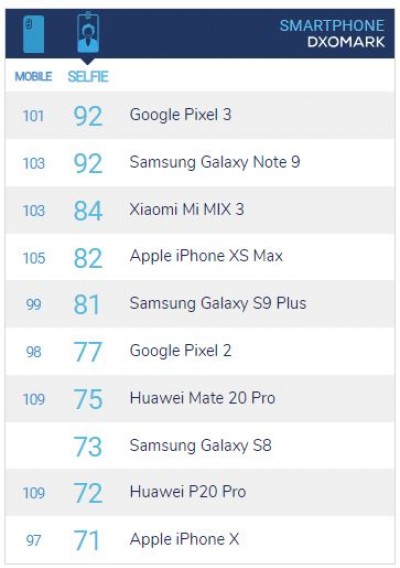
According to the ranking, if you want to take the absolute best selfies, the Google Pixel 3 is the device you should go for. If you don’t like the Pixel 3, then you should choose the Samsung Galaxy Note9 as it has the same selfie camera score as the Pixel 3.

DxOMark Smartphone Selfie Camera Ranking

Xiaomi’s Mi MIX 3 comes in at the third spot with 84 points, a significant distance from the Pixel and Note, but if it is any consolation, it beats the iPhone XS Max and the Galaxy S9 Plus which come after it in that order. The second gen Pixel is sixth and DxOMark says it takes better selfies than Huawei’s 2018 flagships – the Mate 20 Pro and P20 Pro. The Galaxy S8 and the iPhone X also make the list of the top 10 selfie camera phones.

DxOMark says the rating is based on how well the phones perform while taking solo selfies, group selfies,  indoor and outdoor selfies, video recording, under natural light and much more before. So this isn’t just about pictures alone. So for example, the Galaxy Note9 is better at recording videos with the front camera than the Pixel 3.

READ MORE: Huawei Mate 20 Pro is now leading DxOMark along with P20 Pro with 109 score

Moto G7 live shots of Black, Red variants leaked with full specifications

Motorola has scheduled a Feb. 7 launch event that will take place in Brazil. Rumors are rife that the Moto G7 series will be announced through the upcoming unveil event. The G7 series includes smartphones such as Moto G7, Moto G7 Plus, Moto G7 Power and Moto G7 Play. The specifications and pricing of these phones have surfaced in recent reports. The leaked live shots of the Moto G7 Power had appeared int he previous week. Today, an Indian publication has shared the live shots of the Moto G7 live smartphone.

Moto G7 live photos
The Moto G7 live shots reveal that the smartphone could be heading to India in Black and Red color variants. The company may release the phone in other color options. A leaked render of the phone (shown below) that had cropped last week revealed that it will be also available in White.

The smartphone can be seen sporting a waterdrop notch display. The side bezels and the chin of the device is quite thick. The rear shell of the phone seems to be made out of glass which curves towards the left and right edges. The Motorola batwing logo on the rear is embedded with a fingerprint reader. Above it is a round-shaped camera module.

Moto G7 Black and White
Moto G7 Black and White 

Through another leak, the entire specifications of the Moto G7 smartphone has been revealed. The smartphone will be arriving with a 6.24-inch IPS LCD display that will produce Full HD+ resolution of 2270 x 1080 pixels and it will be fueled by Snapdragon 632 chipset and 4 GB of RAM. It will have an internal storage of 64 GB and it will also feature a microSD card slot.

The dual camera setup of the Moto G7 includes a primary sensor of 12-megapixel with f/1.7 aperture and a 5-megapixel secondary sensor with f/2.2 aperture. For capturing selfies, it will have a frontal shooter of 8-megapixel. A 3,000mAh battery will be included in the phone. Like the predecessor models, the phone will be shipped with TurboCharger. It will come loaded with Android 9 Pie OS. In Europe, the Moto G7 could be priced at 249 euros (~$284).

Samsung Galaxy A8s FE with gradient design to launch in China on 14th February

Last month, Samsung launched its Galaxy A8s smartphone in China — the company’s first device to feature a punch-hole or Infinity-O display, as the company likes to call it. Now, the company is working to launch another variant of the phone dubbed as Samsung Galaxy A8s FE.

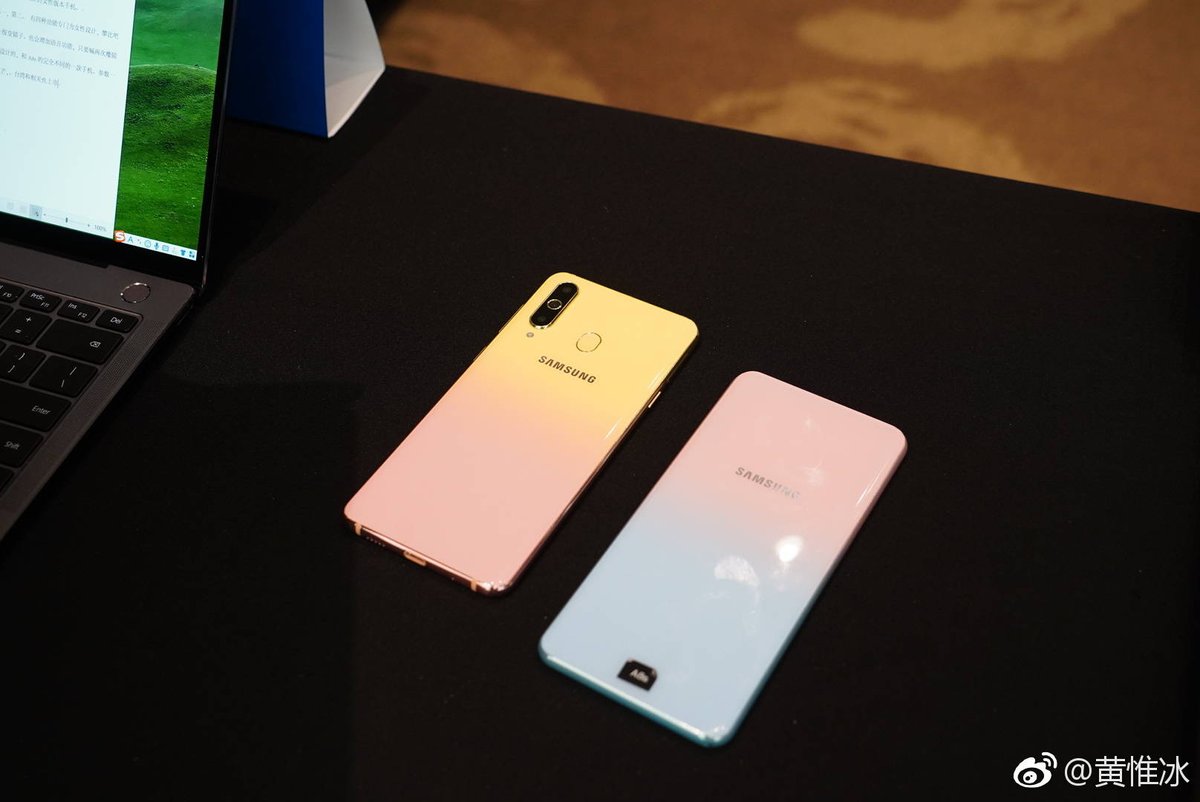
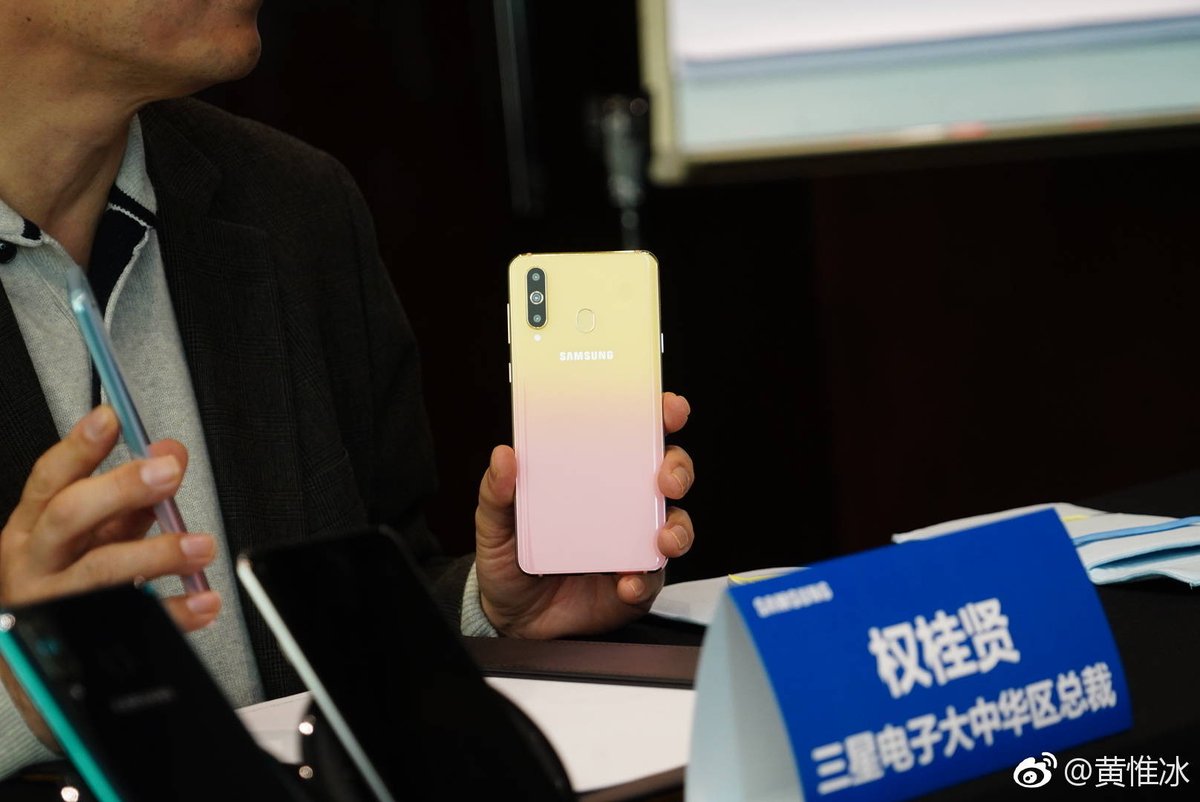
According to the reports, the Galaxy A8s FE will be launched in China on 14th February and the phone will come it two different finish having gradient colors to attract more female buyers given that the ‘FE’ in the phone’s name stands for ‘Female Edition.’

Samsung Galaxy A8s FE Leak

Looking at the leaked images of this upcoming smartphone, it seems that one model will come with a gradient of yellow and pink while the other model will gradient of light-blue and light-pink. The phone will first debut in China and will later make its way to South Korea. There’s no information available if the phone will be made available to other regions.

It’s not yet known if the Galaxy A8s FE will have the same specifications as the Galaxy A8s but the phone’s design is pretty much the same. To remind you, the Galaxy A8s boasts a 6.4-inch display with a 19.5:9 aspect ratio.

Samsung Galaxy A8s FE Leak

The phone is powered by Qualcomm Snapdragon 710 10nm octa-core upper mid-range processor, paired with either 6GB or 8GB RAM and 128GB internal storage. For photography, the device is equipped with three cameras on its back — a 10MP telephoto lens with 2x optical zoom, a 24MP f/1.7 main sensor, and a 5MP f/2.2 sensor for real-time portrait effect. It also features a 24MP front-facing snapper for taking selfies.

The Samsung Galaxy A8s comes with a rear-mounted fingerprint sensor for added security. There’s also a dedicated Bixby button on the side. The device runs Android 8.1 Oreo operating system out-of-the-box with the company’s own custom interface and is powered by a 3,300mAh battery.


Read More: Samsung rumored to announce Exynos 9825 processor in H2 2019, may power the Galaxy Note 10


To know what the phone will pack in terms of specifications, as well as its pricing and availability information, we’ll have to wait till 14th February when the company officially launches the Galaxy A8s FE in China.

(Via)

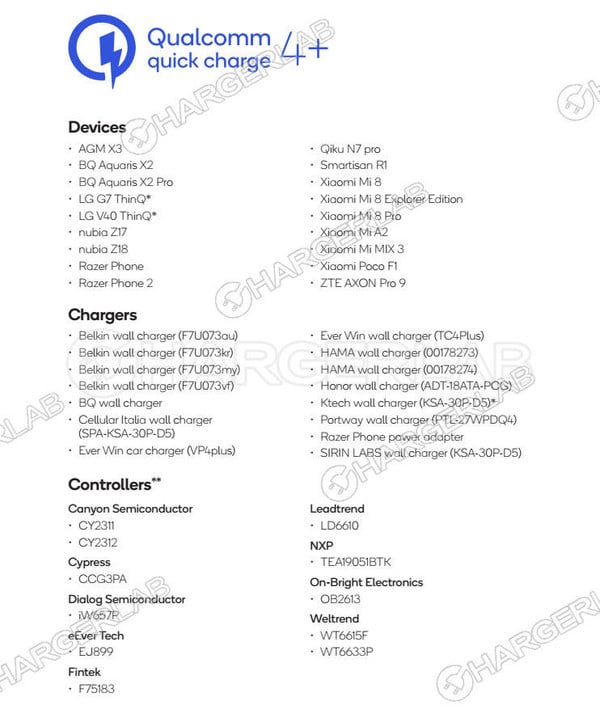
Xiaomi phones dominate list of phones with Quick Charge 4+ support

After more than a year since its announcement, there are still just a handful of devices that support Qualcomm‘s Quick Charge 4+ fast charging technology. The list of certified phones and chargers have been updated again and Xiaomi phones make up a third of the list.

If you want a phone that supports Quick Charge 4+, you should consider any of the phones below:

Although Xiaomi phones dominate the list, it doesn’t ship any of the phones with a Quick Charge 4+ charger. We guess the reason for this is to not drive up the cost of the phone.

Quick Charge 4+ Supported Devices

Quick Charge 4+ is faster and more efficient than Quick Charge 3.0 but it likely still won’t get a lot of adoption for the following reasons. First, a number of manufacturers have their own fast charging technology – OPPO has VOOC and Super VOOC, OnePlus has Warp Charge, and Huawei and Honor have SuperCharge.

READ MORE: Xiaomi CEO hints that flagship smartphone Mi 9 will have better fast charging technology

Redmi Note 7 sold out in 2 minutes and 50 seconds in its third flash sale in China

Redmi Note 7, the first smartphone from the Redmi brand after it split from the parent company Xiaomi to operate as an independent brand, is being well received in China. In its first sale a couple of weeks ago, the company revealed that all the units sold out within 8 minutes and 36 seconds.

Last week, during the second flash sale, the company announced that all the units sold out within minutes. Before the second flash sale started, online retailer JD.com alone witnessed over 410,000 registrations to purchase the newly launched smartphone.

Now, the Redmi Note 7 went on flash sale today for the third time and the company has announced that more than 100,000 units sold out in just 2 minutes and 50 seconds. The company has also announced that the first bath of the orders, which were delayed because of a production accident, has also been shipped.

Redmi Note 7 Third Flash Sale China

The next flash sale for the Redmi Note 7 will now take place on 25th January at 10:00 AM China time. As for the pricing, the 3GB RAM + 32GB storage costs 999 Yuan (approx. $147), 4GB RAM + 64GB storage model costs 1,199 Yuan (approx. $177) while the top-end model with 6GB RAM + 64GB storage is priced at 1,399 Yuan (approx. $206).

The Redmi Note 7 comes with a premium glass body and a massive screen-to-body ratio thanks to the waterdrop notch display. It features a 6.3-inch Full HD+ display with 2340 x 1080 pixels screen resolution and 19.5:9 aspect ratio. The display carries support for 450-nits brightness, 1,500:1 contrast ratio, sun legibility, and eye protection mode.

Under the hood, the device is powered by Qualcomm Snapdragon 660 octa-core chipset with 3GB/4GB/6GB RAM and 32GB/64GB internal storage. It also comes with a dedicated microSD card slot allowing users to expand the storage capacity.

Redmi Note 7

Redmi has focused on offering a premium photography experience with this budget smartphone. The device comes with an f/1.8 aperture 48-megapixel primary sensor and a 5-megapixel secondary camera with artificial intelligence technology.

On the front side, there’s a 13-megapixel camera housed in the display notch. It is also equipped with features like AI Smart Beauty and AI face unlock. The Redmi Note 7 is equipped with a 3.5mm audio jack and features an infrared blaster which makes it possible to use it as a remote control. A fingerprint scanner resides of the backside of the smartphone.


Read More: Redmi’s upcoming Android Go-powered smartphone — Redmi Go gets certified by NBTC in Thailand, launch imminent


As for the software, the smartphone is running Android 9 Pie-based MIUI 10 out-of-the-box. The phone is powered by a 4,000mAh battery with support for Quick Charge 4.0 fast charging technology. With an 18W fast charger, which needs to be purchased separately, the phone can be fully charged in just 1 hour and 43 minutes.

Vivo Y89 with Snapdragon 626, dual cameras and 1,598 Yuan (~$235) announced

A new Vivo smartphone Vivo Y89 has appeared on the official website of the Vivo China. The smartphone is already up for purchase trough AliExpress in the home market. The new budget-friendly smartphone from the company comes with a notched display and it is fueled by Snapdragon 626 chipset.

Vivo Y89 Aurora Purple

Vivo Y89 Specifications and Features

The Vivo Y89 weighs 149.3 grams and it has a thickness of 7.8mm. The smartphone is fitted with 19:9 aspect ratio display of 6.26 inches which produces full HD+ resolution of 2280 x 1080 pixels.

The Snapdragon 626 chipset powers the smartphone with 4 GB of RAM. The Vivo V9 that and Vivo Z1 Lite phones that were released last year were also powered by Snapdragon 626 mobile platform. The Vivo Y89 includes a 3,260mAh battery. The handset comes preinstalled with FunTouch OS flavored Android 8.1 Oreo OS. The internal storage available on the Vivo Y89 is 64 GB and it comes with a microSD card slot for expanding its storage.

Vivo Y89 Black Gold

The rear panel of the Vivo Y89 has a fingerprint scanner. At the top-left corner of the back panel is a dual camera setup features f/2.0 aperture 16-megapixel primary sensor and f/2.4 aperture 2-megapixel secondary sensor. For capturing selfies, it has a front-facing camera of 16-megapixel. The other features available on the Y89 includes rear-mounted fingerprint reader, face unlock, 4G VoLTE, Wi-Fi, Bluetooth, GPS, Bluetooth and 3.5mm audio jack.

Read More: Vivo Apex 2019 concept render showcases the phone’s bezel-less design

Vivo Y89 Price

The official store of the Vivo Y89 is yet to list the smartphone. On AliExpress, the handset is listed with a price tag of 1,598 Yuan (~$235). It comes in two color options.

The Aurora Blue model has a gradient color appeal whereas the Black Gold variant has gold accents around the rear camera module and fingerprint scanner. As of this writing, there are no details on the markets outside of China that will be receiving the Vivo Y89 phone.

Samsung announces ultra-slim ISOCELL camera sensor for punch hole smartphones

When it comes to advanced semiconductor technology, Samsung is an acclaimed leader and the company is putting efforts to continue to maintain that lead. The Korean tech giant has just announced another outstanding technology in the aspect of camera sensors. It is dubbed ISOCELL Slim 3T2 and is the company’s smallest high-resolution image sensor. At 1/3.4 inches (approximately 5.1-millimetres diagonally) and 0.8μm pixel size, the ISOCELL Slim 3T2 is the industry’s most compact image sensor.SAmsung

The sensor can deliver 20-megapixel resolution for both front and rear cameras in today’s sleekest mid-range smartphones. According to Jinhyun Kwon, vice president of System LSI sensor marketing at Samsung Electronics, the sensor is developed to meet the demand for advanced imaging capabilities in mobile devices in order to provide richer user experiences. With 20-million active 0.8μm-sized pixels, the ISOCELL Slim 3T2 not just provides excellent clarity and detail, it also offers high color fidelity by adopting Samsung’s ISOCELL Plus technology. The technology enables sensors to capture and absorb more light information for accurate color reproduction even with sub-micrometre-sized pixels.

Read Also: Samsung intros Exynos 7904 mobile processor with high-end features for mid-range phones

The sensor supports all full-screen phones such as the ‘hole-in display’ or ‘notch design,’ and to do this, the front-facing image sensors need to minimize their size while being able to capture high-quality images. The size makes it easy to fit into a tiny module thus creating more space for the display. Further, the sensor also utilises Samsung’s Tetracell technology which merges four pixels to work as one and allows the 3T2 take brighter and sharper pictures in low-light settings. The sensor’s application in rear-facing multi-camera settings for telephoto solutions require an RGB color filter array instead of Tetracell technology. The small size of the image sensor also reduces the height of the tele-camera module by around seven percent when compared to Samsung’s 1/3-inch 20Mp image sensor, allowing more elegant smartphone designs. Mass production of the Samsung ISOCELL Slim 3T2 is expected to commence in the first quarter of this year.

(source)

Meizu teases launch of world’s first holeless phone

Meizu took to Weibo today to announce that it will have an event tomorrow, 23rd of January. They also shared a poster with a text that says “World’s 1st ……….” with the rest of the words after “1st” redacted.

Meizu holeless phone teaser poster

A loose translation of the original post itself says “It’s time to show real technology” and also includes the hashtag #Meizu 16 Flagship mobile phone. This means whatever Meizu is unveiling tomorrow is related to the Meizu 16.

The blacked out text has gotten fans curious and since Meizu itself asked people to guess what it is, you can bet there are lots of predictions already.

However, someone was able to edit the poster to reveal the blacked out words and it says “World’s first holeless phone”. Going by this, we believe they mean the phone doesn’t have a notch or a punch hole. So what phone is it?

Meizu holeless phone teaser poster edited

Since there is a hashtag for the Meizu 16 series, we believe it might be one of the upcoming flagships which include the Meizu 16T which is said to be a gaming phone or the Meizu 16s or Meizu 16s Plus. Irrespective of the one it is, we can be sure it won’t have a “hole”.

READ MORE: Meizu releases Flyme 7.2 for beta testers: here are the improvements

Lenovo Z5 Pro GT records highest benchmarking score on AnTuTu

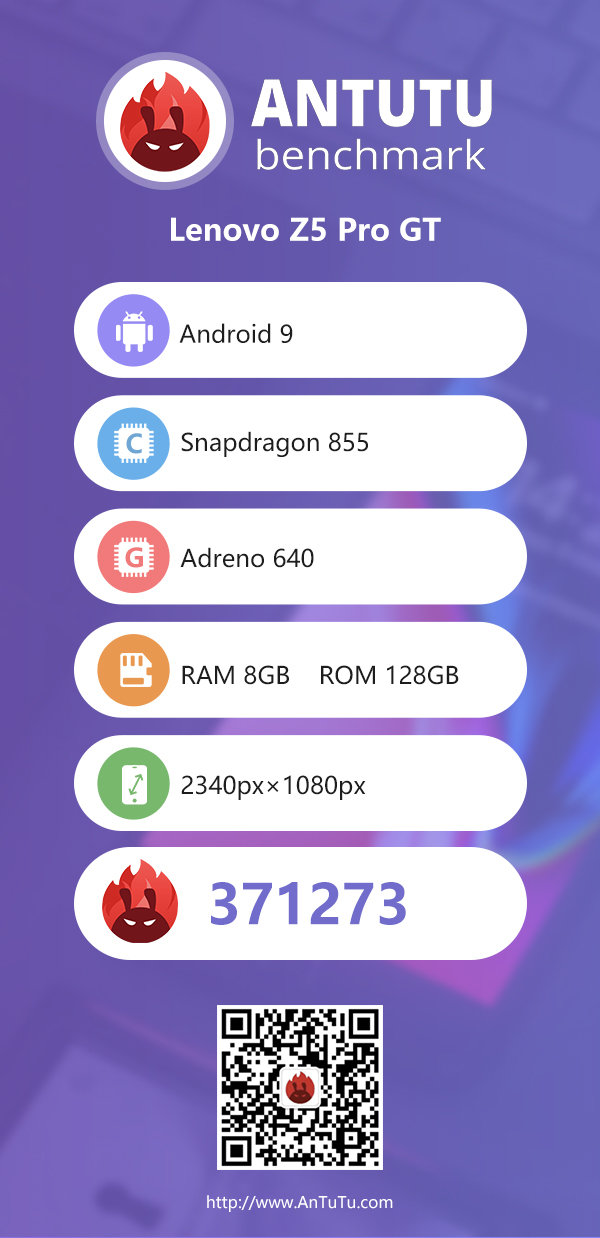
The Lenovo Z5 Pro GT was a surprise announcement at the launch event of the Lenovo Z5s in December 2018. Unexpectedly, Lenovo unleashed the Z5 Pro GT as the world’s first smartphone with Snapdragon 855 mobile platform. Another first from the Z5 Pro GT is the inclusion of 12 GB of RAM on the device. The Lenovo Z5 Pro GT with 8 GB RAM and 128 GB has been benchmarked on AnTuTu.

As it can be seen in the below screenshot, the Lenovo Z5 Pro GT with 8 GB RAM + 128 GB storage has scored 371,273 on AnTuTu benchmarks. Until the appearance of the Z5 Pro GT, most phones with either 7nm Kirin 980 chipset or the second-generation 10nm Snapdragon 845 chipset had recorded high scores of around 360k. Now that the Z5 Pro GT has score more than 370k, it is become the highest scoring smartphone on AnTuTu benchmarks.

Lenovo Z5 Pro GT AnTuTu
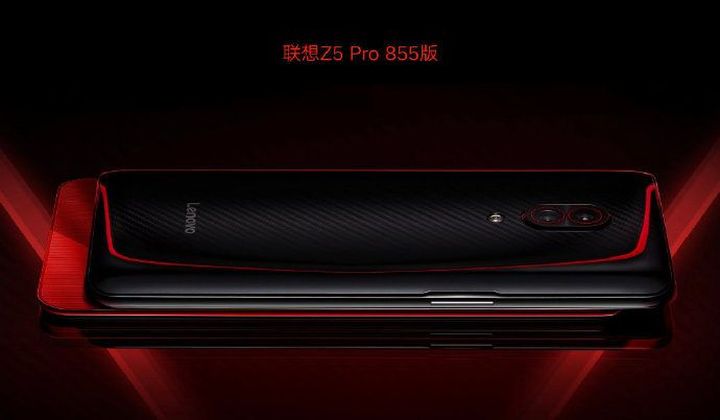
The Lenovo Z5 Pro GT is a slider phone like the Snapdragon 710 powered Lenovo Z5 Pro phone. The GT edition of the phone features a 6.39-inch AMOLED notch-less display with full HD+ resolution, 19.5:9 aspect ratio and in-display fingerprint reader.

The slider of the Z5 Pro GT has 16-mgeapixel + 8-megapixel dual camera module. The rear shell of the smartphone is fitted with 16-megapixel + 24-megapixel vertical dual camera setup. It is packed with 3,350mAh battery which is enabled with rapid charging technology. The phone lacks support for microSD card and 3.5mm audio jack. The smartphone is preinstalled with Android 8.1 Oreo OS that is customized with ZUI 10 user interface.

Lenovo Z5 Pro GT

The base model of the Lenovo Z5 Pro GT features 6 GB RAM + 128 GB storage and it carries an attractive price tag of 2,698 Yuan (~$396). The 128 GB and 256 GB storage editions of the smartphone with 8 GB of RAM are respectively priced at 2,998 Yuan (~$440) and 3,398 Yuan (~$499). The most powerful edition of the phone which includes 12 GB of RAM and 512 GB of native storage costs 4,398 Yuan (~$646).

(source)

Vivo Apex 2019 concept render showcases the phone’s bezel-less design

After showcasing its ‘Apex’ smartphone last year, Vivo — the China-based smartphone manufacturer, is now all set to showcase its successor — Vivo Apex 2019. The company has already scheduled a launch event on 24th January in China where it’ll unveil the Apex 2019.

While there’s a lot of buzz related to the phone’s design, no live leaks of the device have surfaced so far. However, Ben Geskin has shared the phone’s concept render through Twitter, which reveals the phone’s design.

The concept render of the smartphone shows its bezel-less display. While the bezels are minimal on the sides and top, it still has a slightly thicker chin at the bottom. Nonetheless, it could be the phone with the highest screen-to-body ratio.

Vivo Apex 2019 Concept Render

On the back side, the device features a dual-camera setup in the top-center position. The camera sensors are stacked vertically along with an LED flash. At the bottom, there’s a Vivo branding. As per the reports, the phone won’t come with any ports or buttons.

The no-buttons and no-ports design suggest that the phone will support wireless charging as well as wireless data transfer and the users will have to rely on the gesture-based and pressure-sensitive navigation system. The phone will come with an advanced in-display fingerprint sensor with a larger area and improved sensor for security.

Last year’s Apex smartphone had a unique pop-up front-facing camera, making the phone stand apart from the rest. However, it’s not yet known what Vivo has adopted for the Apex 2019 smartphone for the front-facing camera.

As for the memory configuration, the phone could come with 8GB RAM but there’s a possibility that the company could also announce 10GB RAM or 12GB RAM variant as well. We are expecting the device to be powered by Qualcomm’s latest Snapdragon 855 octa-core processor manufactured using 7nm process.


Read More: Vivo NEX Dual Display DeMarcus Cousin Limited Edition teased by the company


As said, the Vivo Apex 2019 is scheduled to get launched in China on 24th January. While the company has not yet confirmed this, we are expecting the Chinese company to showcase the Vivo Apex 2019 smartphone at the upcoming Mobile World Congress 2019 in Barcelona, Spain which will kick-off on 25th February.

(Source)

Redmi Go smartphone gets certified by NBTC in Thailand, launch imminent

Redmi recently launched the Redmi Note 7 budget smartphone — the company’s first device after it split from its parent company Xiaomi to work independently. The company is reportedly planning to launch two other smartphones — Redmi Note 7 Pro and Redmi Go.

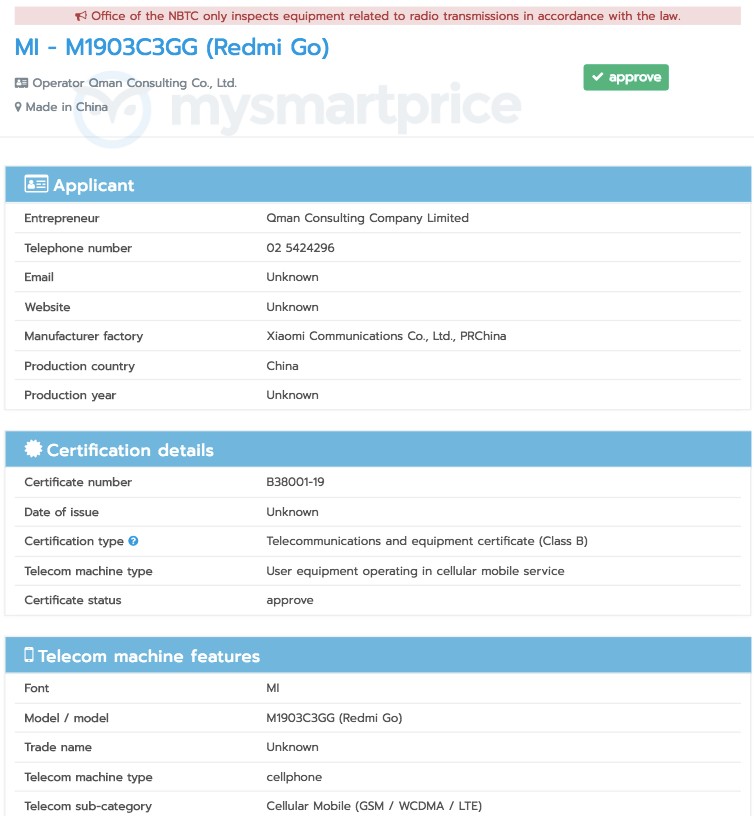
The Redmi Go is expected to be the company’s first Android Go-powered smartphone. A Redmi smartphone with mode number M1903C3GG has received NBTC certification in Thailand, which confirms that the smartphone will indeed carry the Redmi Go moniker. This also indicates that the phone’s launch is not far away.

Redmi Go NBTC Thailand

However, apart from the smartphone’s marketing name, the NBTC certification does not reveal anything related to the upcoming smartphone. The Android Go Edition smartphone had previously been certified by the EEC, IMDA, SIRIM certification agencies in Malaysia, and was also spotted on the FCC website last month.

According to the previous leaks, the smartphone could come with a 5.9-inch HD+ display with 18:9 aspect ratio. It could pack just 1GB RAM and 16GB internal storage with microSD card support. In the camera department, it is said to feature a single camera on the back and a 5MP front-facing snapper.

It will be running Android 9 Pie Go Edition out-of-the-box. For the uninitiated, the Android Go Edition is optimized specifically for entry-level smartphones with limited memory and storage space. It aims to offer better performance and the same security features as the standard Android Pie. Google has also created special apps for Go Edition, including Google Go, Google Assistant Go, Gboard, Files Go, and Maps Go.


Read More: Redmi Note 7 again proves its toughness as it survives when kicked down the stairs and used as a skateboard


We recently reported that the company is planning to soon launch three smartphones in the Indian market — Redmi Note 7, Redmi Note 7 Pro, and Redmi Go. While the exact launch dates are not yet known, the devices are slated to launch by the end of March this year in India.

(Via)

Honor V20 Moschino Edition in Phantom Red released in China

At the launch event of the Honor V20 in China in December 2018, Honor had also debuted the special edition of Honor V20 Moschino Edition in partnership with Italian fashion brand. The V20 Moschino Edition is now listed for purchase in China through Vmall. It can be bought in Phantom Red color.

Honor V20 Moschino Edition Phantom Red

The Honor V20 Moschino Edition has landed in China with a price tag of 3,999 Yuan. The handset features 8 GB of RAM and 256 GB of native storage. The Phantom Blue edition of the V20 Moschino Edition is yet to go on sale in China. The V20 is equipped with various exciting features such as punch-hole display, Link Turbo technology, 48-megapixel Sony IMX586 camera sensor and exciting V patterns etched with nanolithography on the rear.

The V20 Moschino Edition carries the same specifications as the Honor V20 handset. It features a 6.4-inch IPS LCD display that produces full HD+ resolution of 2310 x 080 pixels. The 7nm Kirin 980 chipset powers the phone with up to 8 GB of RAM. It comes with up to 256 GB of inbuilt storage. The handset lacks support for microSD card slot.

The rear side of the Honor V20 features 48-megapixel + ToF (Time of Flight) 3D stereo sensor. On the front is 25-megapixel selfie camera. The back panel of the phone is fitted with a fingerprint scanner. It receives power from 4,000mAh battery that is provided with support for 22.5W fast charging.

Honor V20 Moschino Edition Phantom Blue

The regular version of the Honor V20 is available in colors like Sea Blue, Red and Magic Night Black. The same phone is headed to international markets with Honor View 20 moniker. In India, the handset is available for pre-booking through Amazon India and the official HiHonor online store. The pricing of the phone for the Indian market is still under the wraps. It will be hitting the market on Jan. 29 in the country. The global launch of the View 20 will be held in Paris, France later today.

(source)

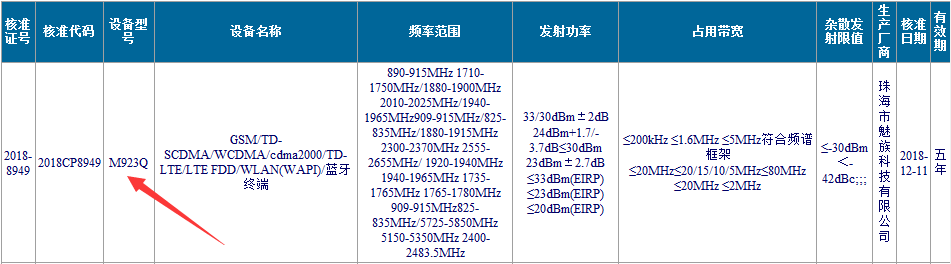
Meizu M932Q receives CMIIT certification, might be the Meizu Note 9

A Meizu phone with model number M932Q has been seen on the website of China’s CMIIT certification. The device is believed to be the Meizu Note 9, a successor to the Meizu Note 8 which launched back in October.

While the listing on the site doesn’t reveal any info that proves the phone is indeed the next Meizu Note phone, Meizu’s own founder himself already said that the Note 9 is on its way.

Meizu Note 9 3C

Some of the features confirmed to come with the Meizu Note 9 include a 48MP camera, in this case, the Samsung GM1 which is the same inside the Redmi Note 7. It will also have a water-drop notched screen, a first for Meizu and will be powered by the Snapdragon 675. It will also pack a 4,000mAh battery and is said to even run Android Pie out of the box.

The processor and battery are significant upgrades when compared to the Meizu Note 8 which is powered by the Snapdragon 632 and packs a 3,600mAh battery.

READ MORE: Meizu 16T (Turbo) gaming-focused phone to debut with Meizu 16s, 16s Plus this year