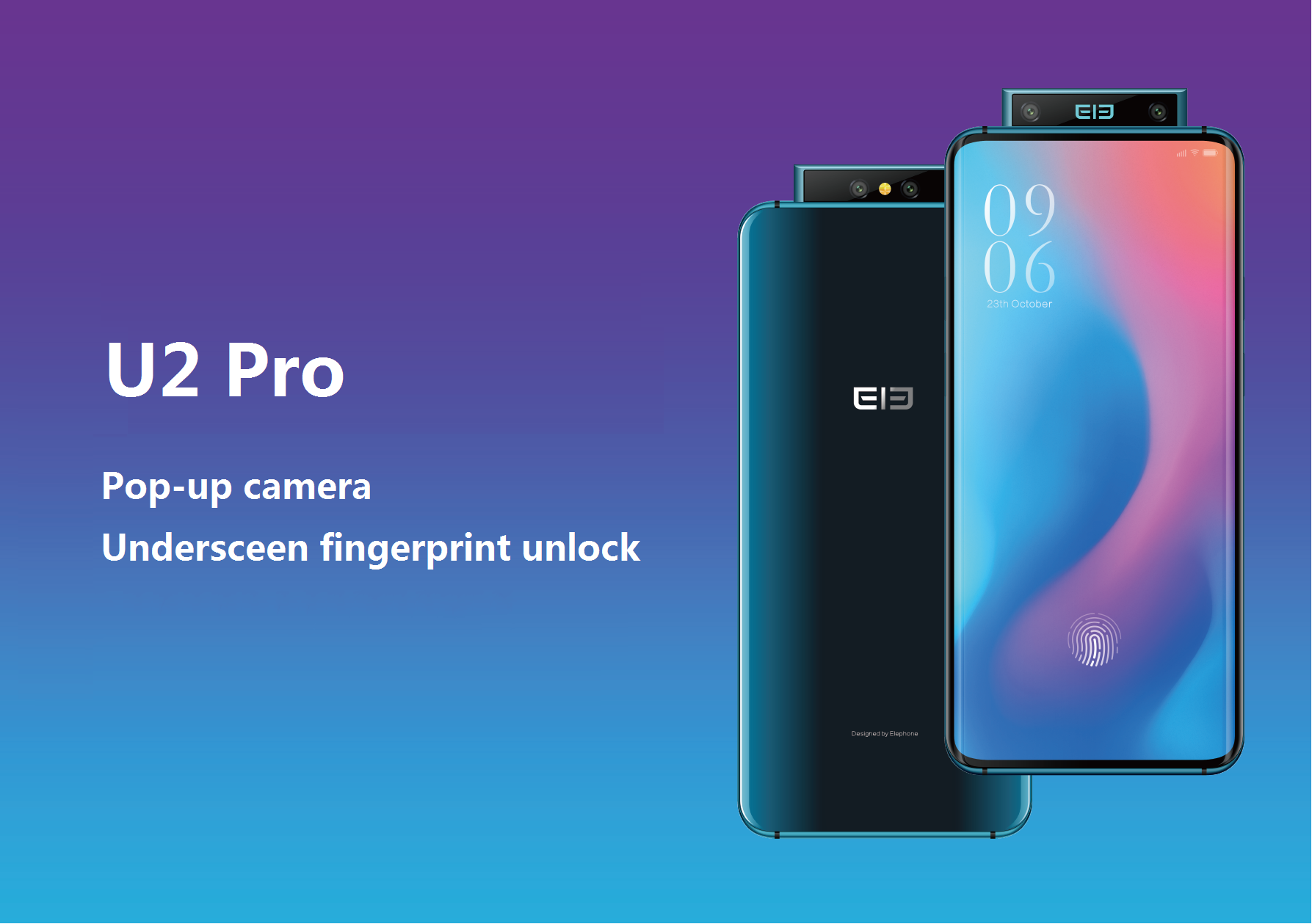
Elephone has already hinted that it would be attending the Hong Kong Tech expo and during the event, a couple of new models will be unveiled. The Chinese company had hinted that it plans to unveil the Elephone U2 and Elephone PX. Latest details indicate that the company will also launch the Elephone U2 Pro. Ahead of the conference commencing this week, a leaked video has now emerged to showcase the design of the U2 Pro alongside the Elephone PX.
The short video clip avails us of the opportunity to catch the first glimpse of both models which are coming with pop up front cameras. The Elephone U2 Pro has a more sophisticated hardware setup, consisting of an FHD+ display, in-display fingerprint sensor and pop-up camera.
On the other hand, the Elephone PX will sport a 6.34-inch HD+ display with an 18:9 aspect ratio. Elephone says both the PX and Elephone U2 will feature the company’s all-new ‘stealth camera’ technology which keeps the selfie cameras safely out of the way when not in use. The U2 Pro seems also destined to feature the same technology.
Apart from these three models, Elephone says it will also showcase several other innovative products at the Hong Kong tech expo. Check out Elephone’s range of cool products from its website.
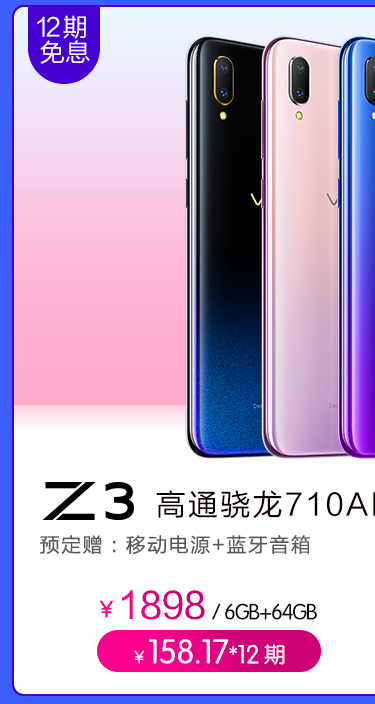
The Vivo Z3 launches tomorrow but we don’t have to wait till then to know how much it will cost. Pricing for the phone has been revealed on the website of China’s Bank of Communications along with some other details.
The website confirms the phone will be powered by a Snapdragon processor, have a 6.3-inch display with a water-drop screen, infrared face unlock, and its proprietary dual turbo technology which boosts system performance and gaming performance.
Based on the info on the site, the Vivo Z3 will be priced at ¥1598 (~$231) for the 4GB RAM + 64GB version and ¥1898 (~$275) for the 6GB RAM + 64GB variant. Apparently, buyers will also be able to pay in installments – ¥133.17 (~$19) for the 4GB version and ¥158.17 (~$23) for the 6GB version over a 12-month period.
The Vivo Z3 itself also appears on the site. It will have dual rear cameras, a rear-mounted fingerprint scanner and come in three color variants – two with a gradient finish and a third variant that is pink.
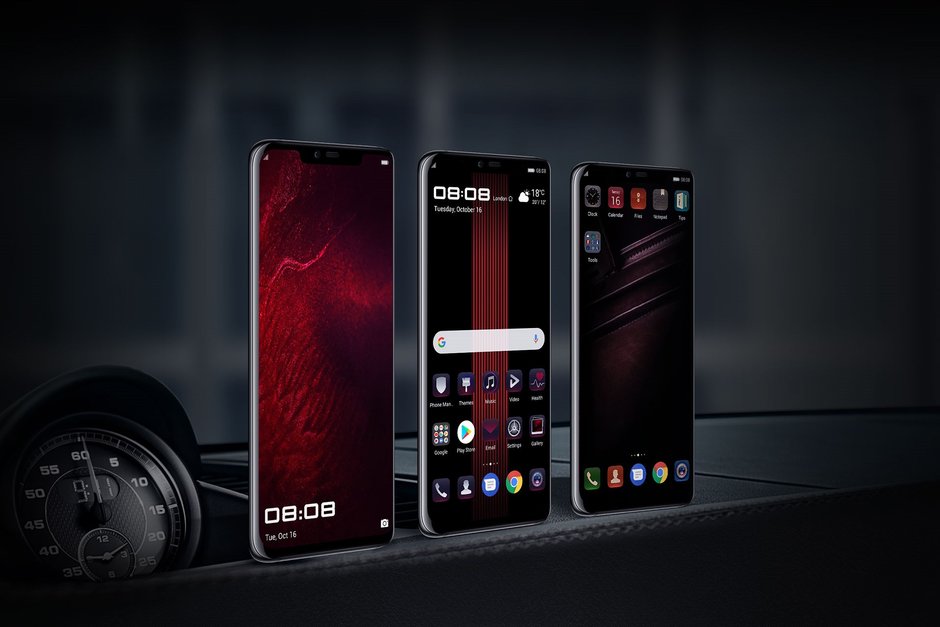
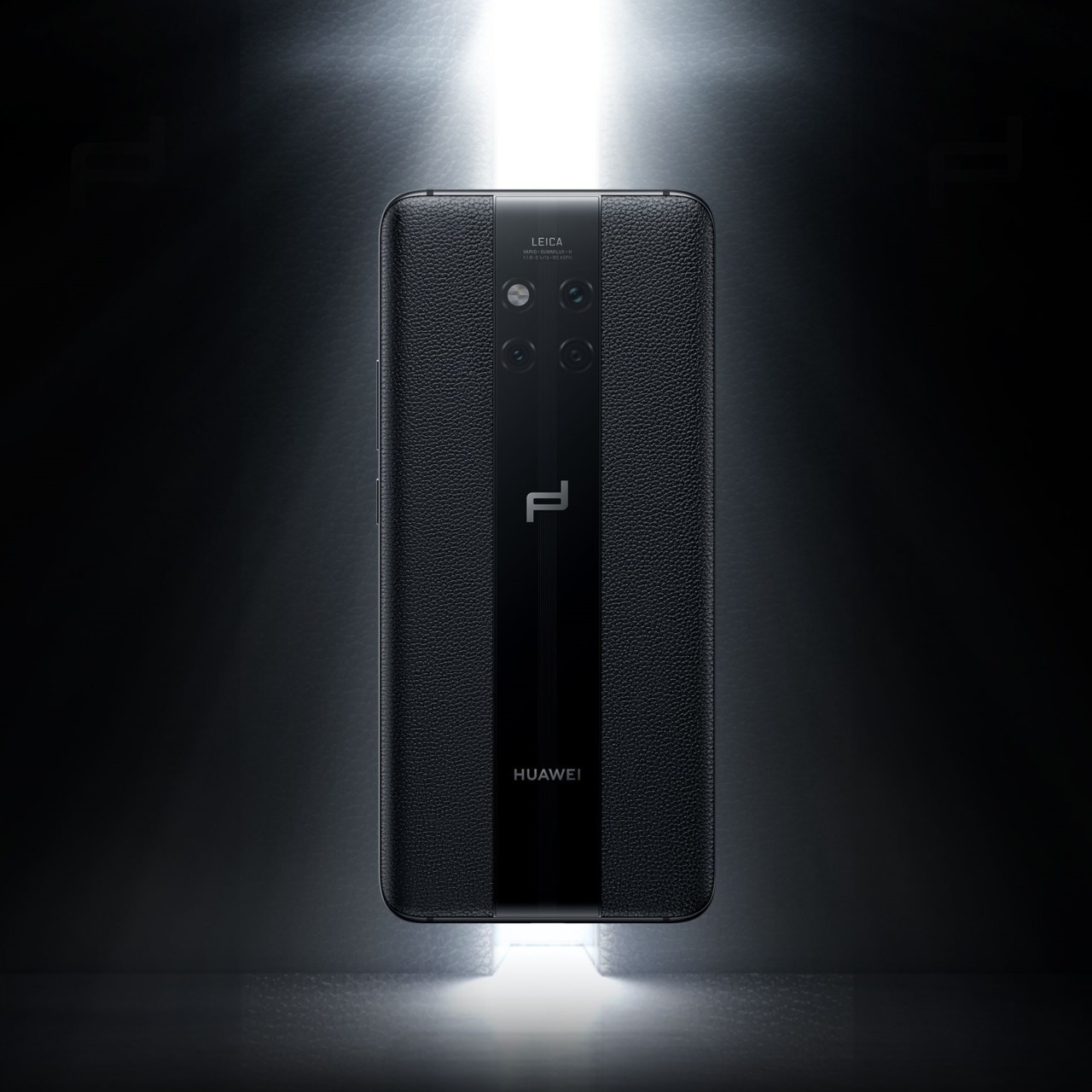
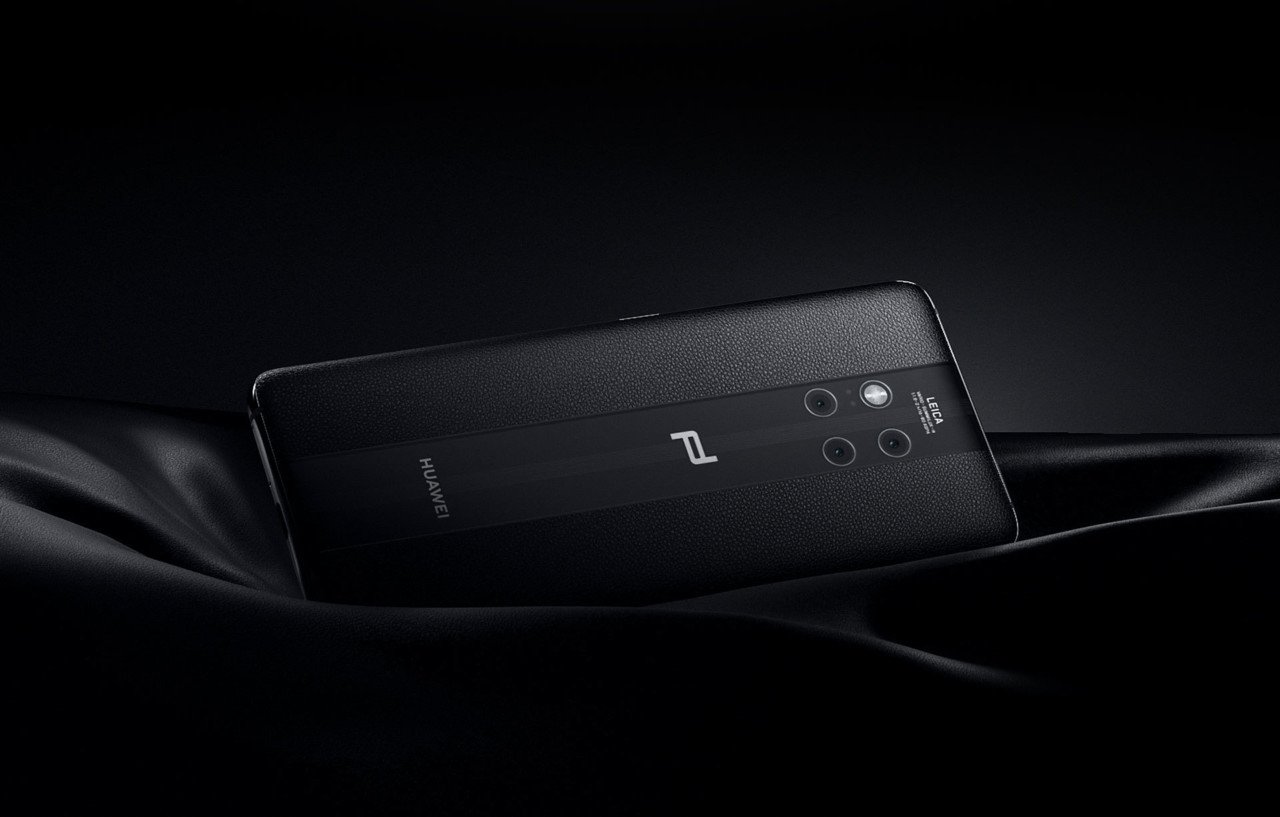
Apart from announcing the Mate 20, Mate 20 Pro, Mate 20X phones, Huawei also announce the Mate 20 Porsche Design premium smartphone. The latter is also being referred to as Huawei Mate 20 RS. In terms of specifications, it is not very different from the Mate 20 Pro.
Huawei Mate 20 RS Porsche Design Specifications and Features
As mentioned above, the Mate 20 Porsche Design borrows most of its specs from the Mate 20 Pro. Hence, the Porsche Design phone is equipped with 6.39-inch AMOLED screen. The notched display supports QHD+ resolution and 19.5:9 aspect ratio.
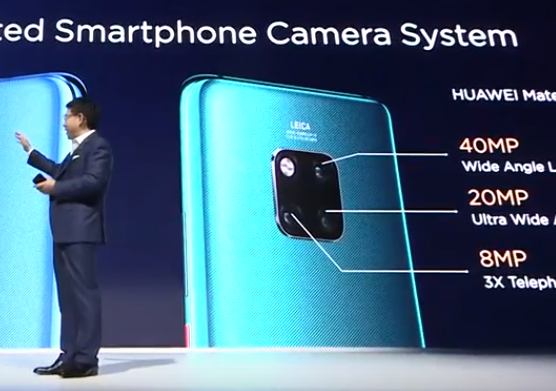
The Kirin 980 is at the helm of the Mate 20 Porsche Design. It is packed with a 4,200mAh battery that supports 40W SuperCharge fast charging and 15W wireless charging. When it comes to security, the Mate 20 Porsche Design offers both in-display fingerprint scanner and 3D face unlock. The 40-megapixel + 20-megapixel + 8-megapixel triple camera system of Mate 20 Pro is also available on the Porsche Design model.
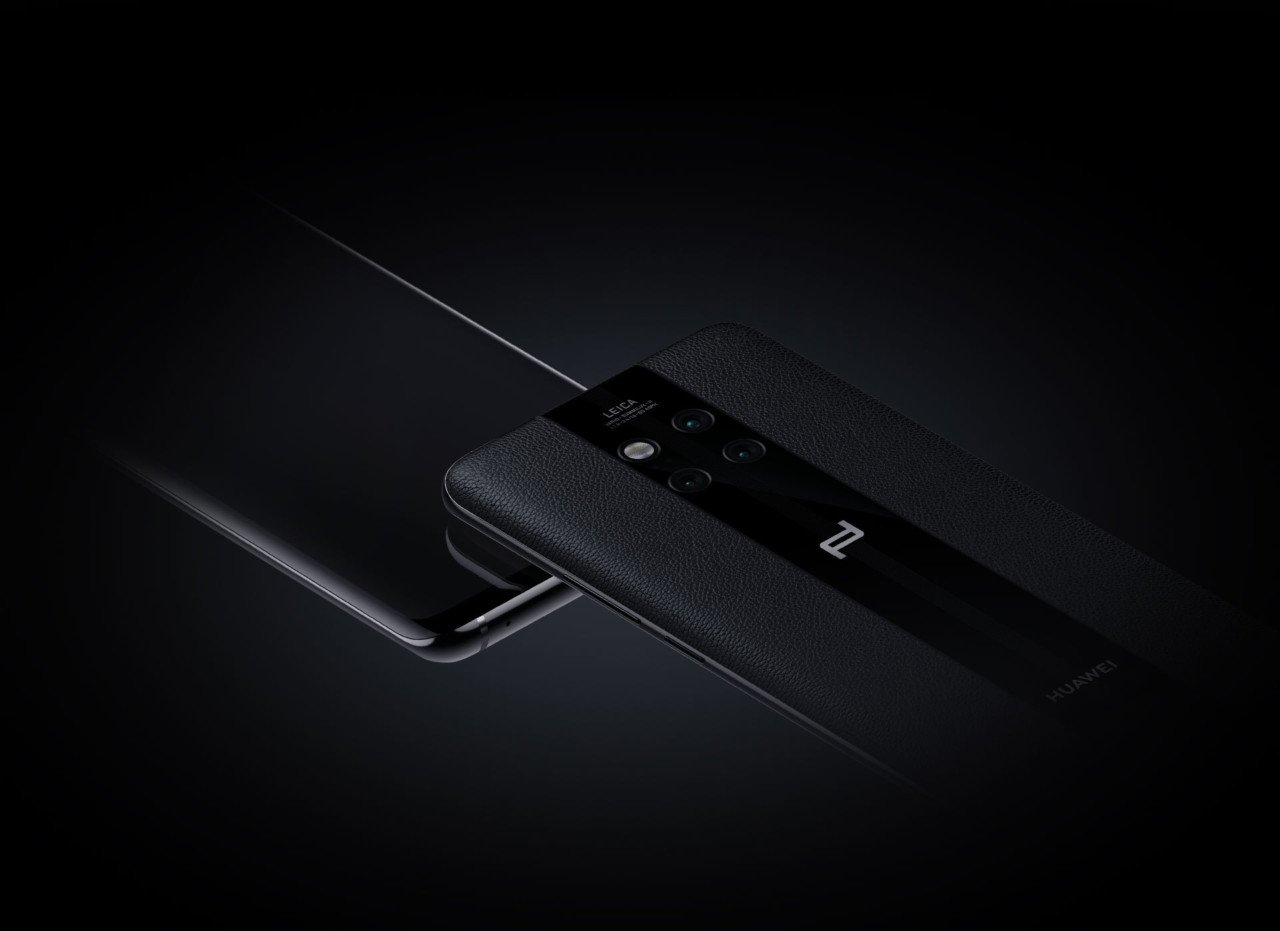
Here is what sets the Mate 20 RS apart from Mate 20 Pro smartphone. Instead of the glass rear, the Mate 20 RS has a premium leather. There is a vertical strip of glass at the center that runs from the top to the bottom of the back panel of the Mate 20 RS. The glass strip houses the triple camera module and the Porsche Design logo. There is no camera bump on the handset. It can be availed in two color choices of Black and Red.
Huawei Mate 20 RS Porsche Design Variants, Pricing and Release Date
The Mate 20 RS comes with 8 GB of RAM and its storage variants include 256 GB and 512 GB. The base model is priced at 1,695 euros (~$1,960) and the higher variant costs 2,095 euros (~$2,425). There is no confirmation whether Huawei will be receiving pre-orders for the Mate 20 Porsche Design. However, what’s confirmed is that its shipments will begin on Nov. 16.
Huawei launched another Mate 20 phone today. The Mate 20 X is the latest member of the Mate series and it is designed for gamers.
Mate 20 X Specs
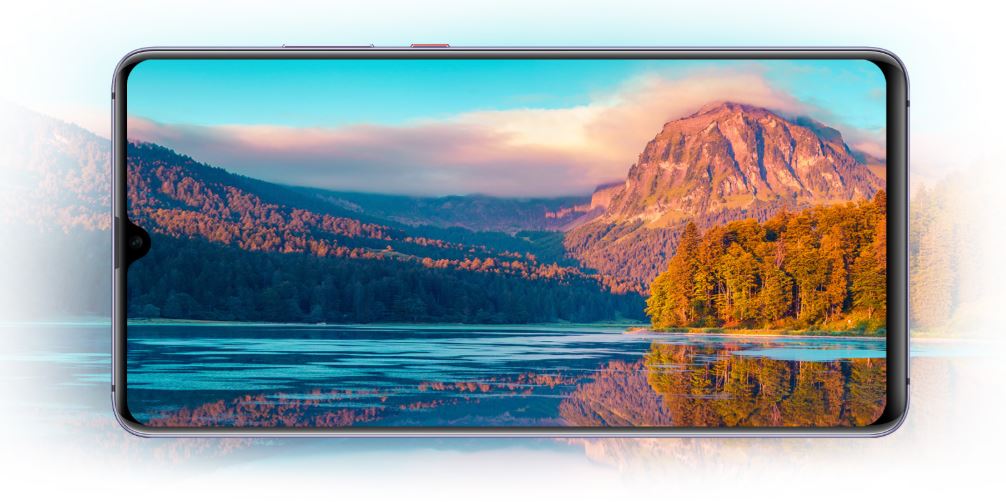
The Mate 20 X can be called a mix of the Mate 20 and the Mate 20 Pro as it has a number of features from both phones. Take for example its screen, it is much larger than both phones at 7.2-inches but it has the water-drop notch and 1080 x 2244 resolution of the Mate 20 and it is an OLED panel like the Mate 20 Pro.
The Mate 20 X is powered by the Kirin 980 with 6GB of RAM and 128GB of storage like the Mate 20 Pro. It also has triple rear cameras and they are the same configuration as the Pro’s (40MP + 20MP + 8MP). Its front-facing camera is a 24MP sensor.
The phone comes with GPU Turbo 2.0, so gaming performance should even be better. To solve heating issues, Huawei says the Mate 20 X uses Huawei Supercool – a cooling technology which consists of a vapor chamber and a graphene film cooling technology. We believe this is the same cooling technology that will surface in the Honor Magic 2 scheduled to launch at the end of the month.
Huawei has a couple of accessories for the Mate 20 X such as a gaming pad that attaches to the left of the device. The gaming pad has a D-pad and an analog stick. Reminds us of the Black Shark gaming phone’s gamepad but the Black Shark’s own is missing a D-pad.
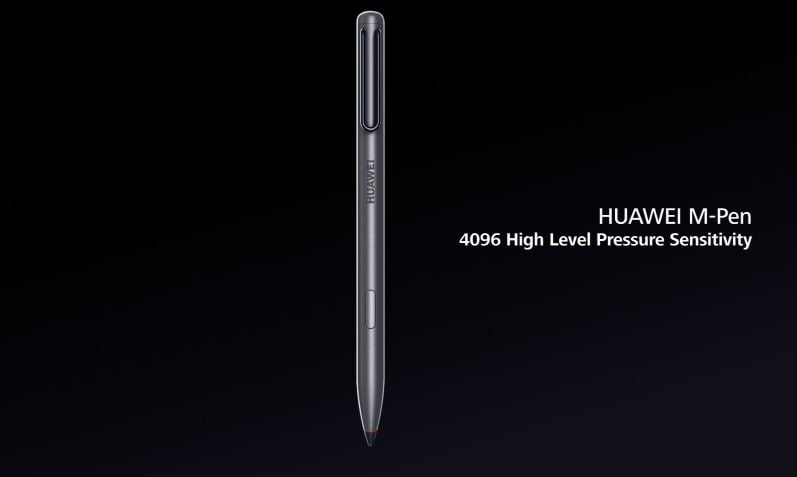
The Mate 20 X also has support for a stylus dubbed the M-Pen. The stylus has up to 4096 levels of pressure and can be used for note-taking right from the locked screen and for creating notes via the Easy Memo app. It has to be purchased separately and can’t be stored in the device like the S-Pen of the Samsung Galaxy Note series. Huawei says the Mate 20 X supports wireless projection to a larger screen.
The phone packs a 5,000mAh battery with support for SuperCharge, a USB-C port, a 3.5mm audio jack, dual-band GPS, a rear-mounted fingerprint scanner, and NFC. It also has an IR sensor, stereo speakers NFC, and an NM memory card slot for up to 256GB of extra space. It runs Android Pie out of the box.
HMD Global has just announced Nokia X7. It is the successor of Nokia 7 Plus, the handset which had the biggest success since the Finnish brand is back in the smartphones market with Android devices, and it will hit the global market as Nokia 7.1 Plus. Given the importance of this device, we compared it with the new Xiaomi Mi 8 Lite which is slowly expanding in the global market and Huawei Mate 20 Lite. All are perfect mid-range devices for you if you want to save some money, and here you will discover their differences.
Nokia X7 (7.1 Plus) vs Xiaomi Mi 8 Lite vs Huawei Mate 20 Lite
The device I like more for its look is definitely the Xiaomi Mi 8 Lite. It comes with a flagship-like design composed of a glass back with an (optional) gradient finish, and it has the highest screen-to-body ratio. It is definitely more attractive than Nokia X7 and Huawei Mate 20 Lite, even though Nokia X7 is a more compact phone due to its smaller display.
Display
Most of the midrange phones have an IPS display with a Full HD resolution and it is the same when it comes to these three handsets. But Nokia X7 has something more: the HDR technology. It is able to enrich the colors as well as converting content from SDR to HDR in real time. This display is the one with the best viewing quality but it is slightly smaller compared to Xiaomi Mi 8 Lite and Huawei Mate 20 Lite, and it allows the body of the phone to be smaller as well.
Specs & Software
Nokia X7 has the best display and also the best hardware department. It features the most powerful processor by Qualcomm if we do not count the 800 series. We are talking about the Snapdragon 710, an octa-core running at frequencies up to 2.2 GHz. It is the successor of Snapdragon 660 found on the Xiaomi Mi 8 Lite and it is way more powerful than Kirin 710. You will soon be able to get a Nokia X7 with up to 6 GB of RAM and 128 GB of internal storage.
Camera
Nokia X7 is the winner even in the camera comparison, at least for the paper and for the rear camera setup. It features a bright aperture and Carl Zeiss optics, it supports dual pixel autofocus and it even has optical stabilization. We could not expect more from a midrange-class camera. When it comes to the front camera, the winner is instead the Huawei Mate 20 Lite with its dual setup which should detect depth info in a better way. However, we will have to test Nokia X7 personally to confirm these assumptions.
Battery
With a capacity of 3750 mAh, Huawei Mate 20 Lite has the bigger battery, so it is supposed to last more than its opponents. But HMD Global is used to optimize the battery of their phones very well, so it might be that Nokia X7 will achieve similar results with its 3500 mAh unit. So, for now, we do not have a winner as Nokia X7 is still not on the shelves.
Price
Nokia X7 will soon land in China with a price starting from €212, Xiaomi Mi 8 Lite starts from €175 and Huawei Mate 20 Lite costs €300 (in the more powerful 6/64 GB configuration). Given its specs on the paper and its value for money, currently I would pick Nokia X7 and for me, it is the winner of the comparison.
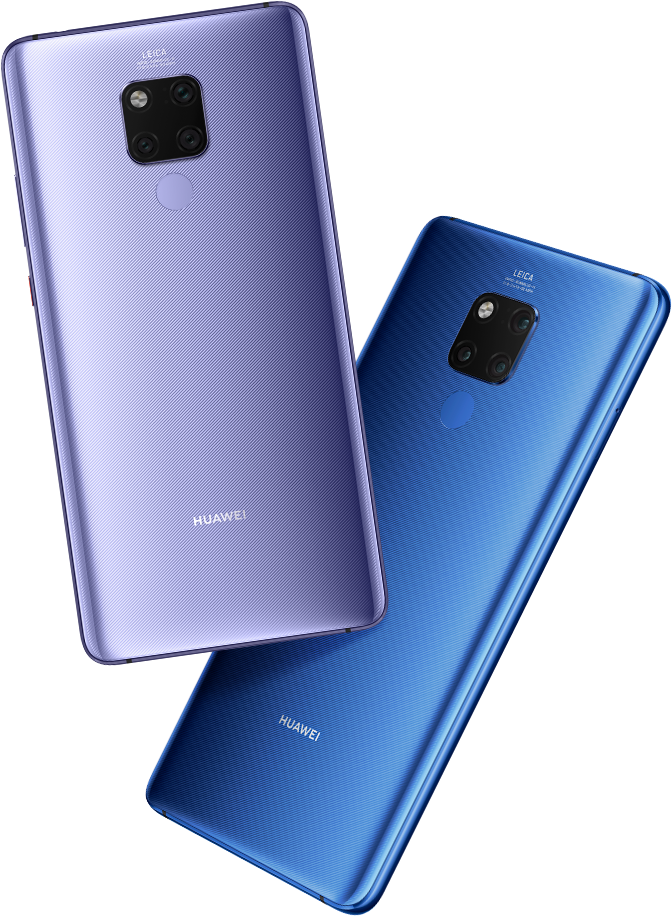
Huawei has announced its latest flagships – the Mate 20 and Mate 20 Pro. Like previous generation models, the two phones are strikingly different.
Mate 20 Specs
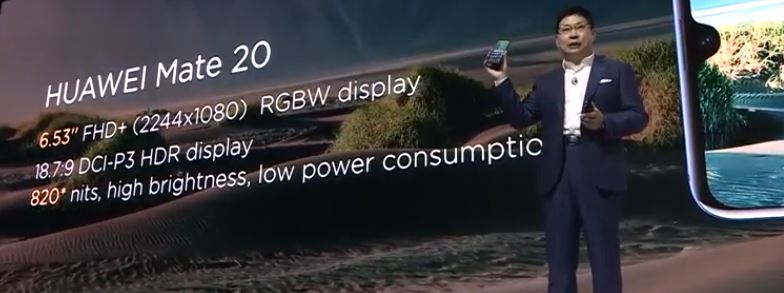
The Mate 20 has a 6.53-inch 2244 x 1080 RGBW DCI-P3 HDR LCD display with a water-drop notch and an 18.7:9 aspect ratio. The display has up to 820 nits of brightness and has a low power consumption. It also has a screen-to-body ratio of 88.08%.
The Mate 20 is powered by the Kirin 980 – the first 7nm SoC in the world. The new chipset brings a bunch of improvements and its dedicated dual NPU brings more than 150% increase in performance over last generation’s. The phone has 4GB or 6GB of RAM and 128GB of storage.
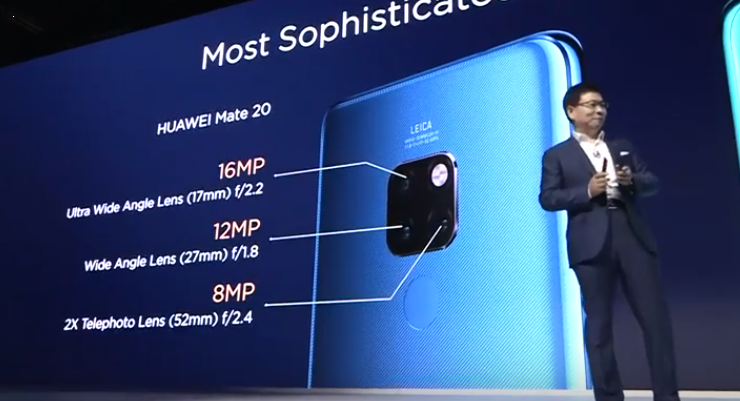
The Mate 20 has triple rear cameras which were co-developed with Leica. One is a 16MP ultra-wide angle 17mm lens, another is a 12MP wide-angle 27mm lens and the third is an 8MP 2x telephoto 52mm lens.
It has a 4,000mAh battery with 22.5W fast charging, a rear-mounted fingerprint scanner, an IP53 rating, and even has a 3.5mm audio jack. It runs Android Pie out of the box.
Mate 20 Pro Specs
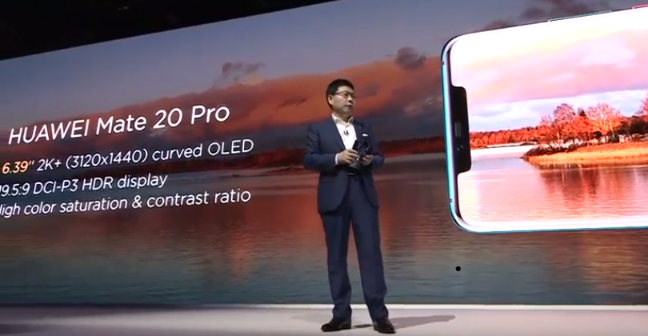
The Huawei Mate 20 Pro has a 6.39-inch 2K+ (3120 x 1440) curved OLED display with a 19.5:9 aspect ratio. Its 86.90% screen-to-body ratio is smaller than the Mate 20’s.
It is powered by the Kirin 980 which is paired with 6GB of RAM and 128GB of expandable storage. The Mate 20 Pro has a nano-memory card slot like the Mate 20, making them both the first phones to support the new memory card size.
Like the Mate 20, it also has triple rear cameras but in a different configuration- a 40MP f/1.8 wide-angle sensor, a 20MP f/2.2 ultra-wide angle sensor and an 8MP f/2.4 telephoto sensor with OIS. The cameras boast a number of interesting features such as Super HDR, AR features, macro photography and low-light photography.
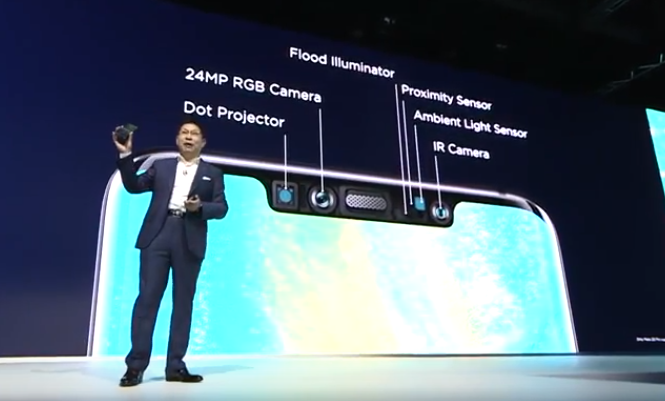
The front camera is a 24MP sensor and it works with a 3D face unlock system to keep your phone secure. The face unlock system is safe enough for transactions. It also has a 3D model scanning feature which allows it to scan objects which can be used in AR mode.
The Mate 20 Pro has an in-display fingerprint sensor and Huawei claims it is 30%. faster than that of the previous generation. Huawei has bumped the protection of the Mate 20 Pro to IP68, so you can dunk your phone in water for a limited time and not have to worry.
The Mate 20 Pro has a 4,200mAh battery, a little bump from that of its predecessor. The bigger battery isn’t the only new thing. Huawei wants you to be able to charge your phone in less time, so the Mate 20 Pro supports 40W SuperCharge fast charge technology.
With this, owners can charge their phone from empty to 70% in just 30 minutes. Huawei says the fast charging is TUV Rheinland certified as safe. The Mate 20 Pro also supports 15W wireless charging and is the first device to support wireless reverse charging. As Huawei has shown in the image above, you can charge your friend’s iPhone XS Max with your Mate 20 Pro.
The Mate 20 Pro will be available in five colors – Classic Black, Twilight, Pink Gold, Midnight Blue, and Emerald Green.
The Mate 20 will sell for €799 for the 4GB RAM version and €849 for the 128GB version. The Mate 20 Pro is priced at €1050. Both phones go on sale today.
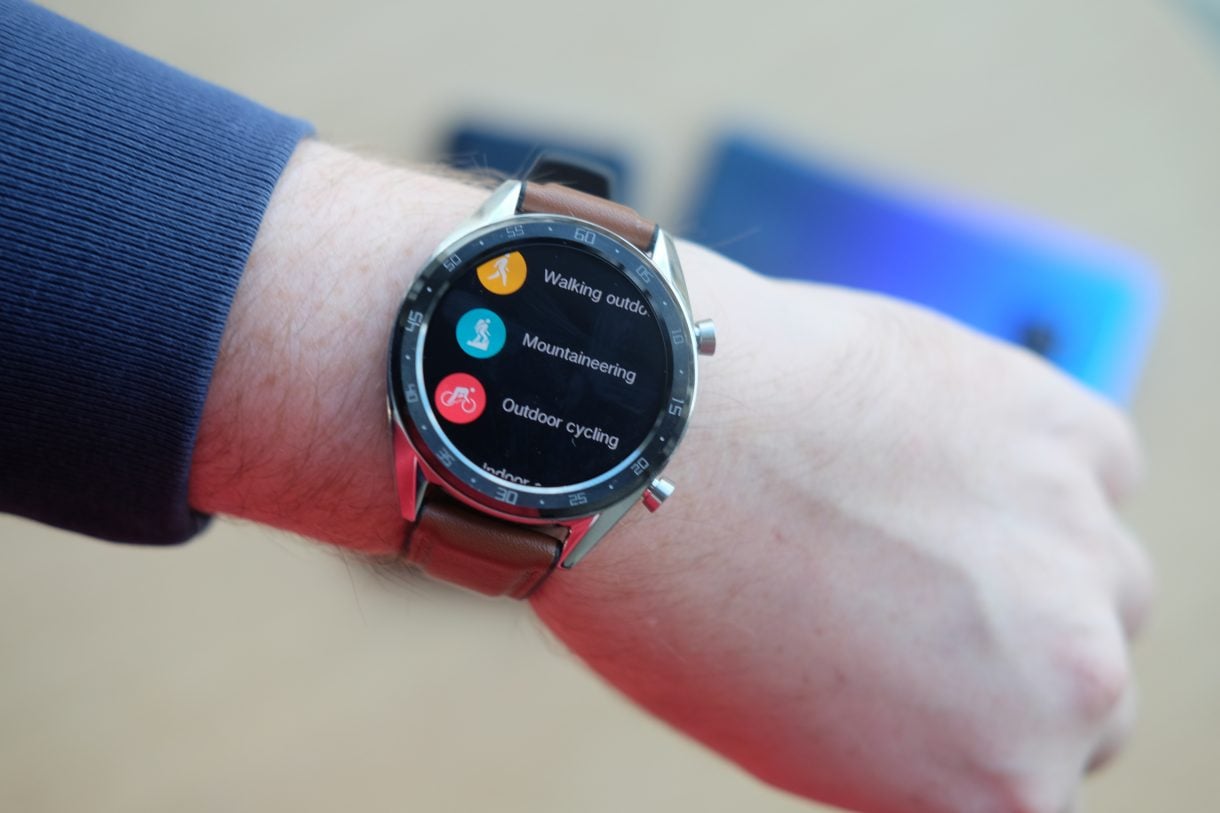
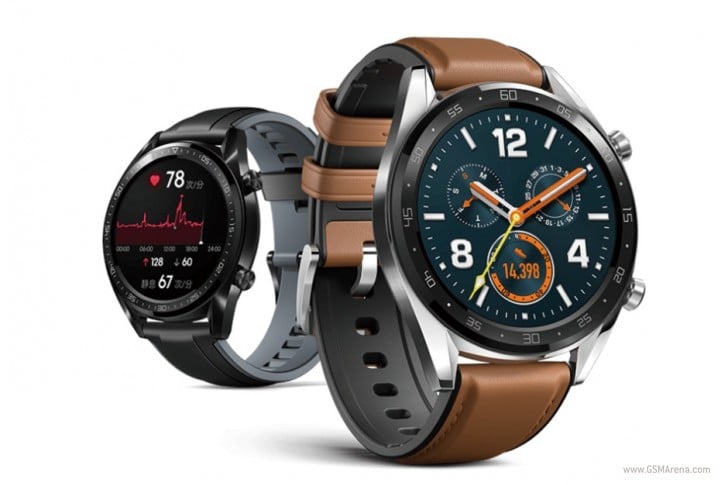
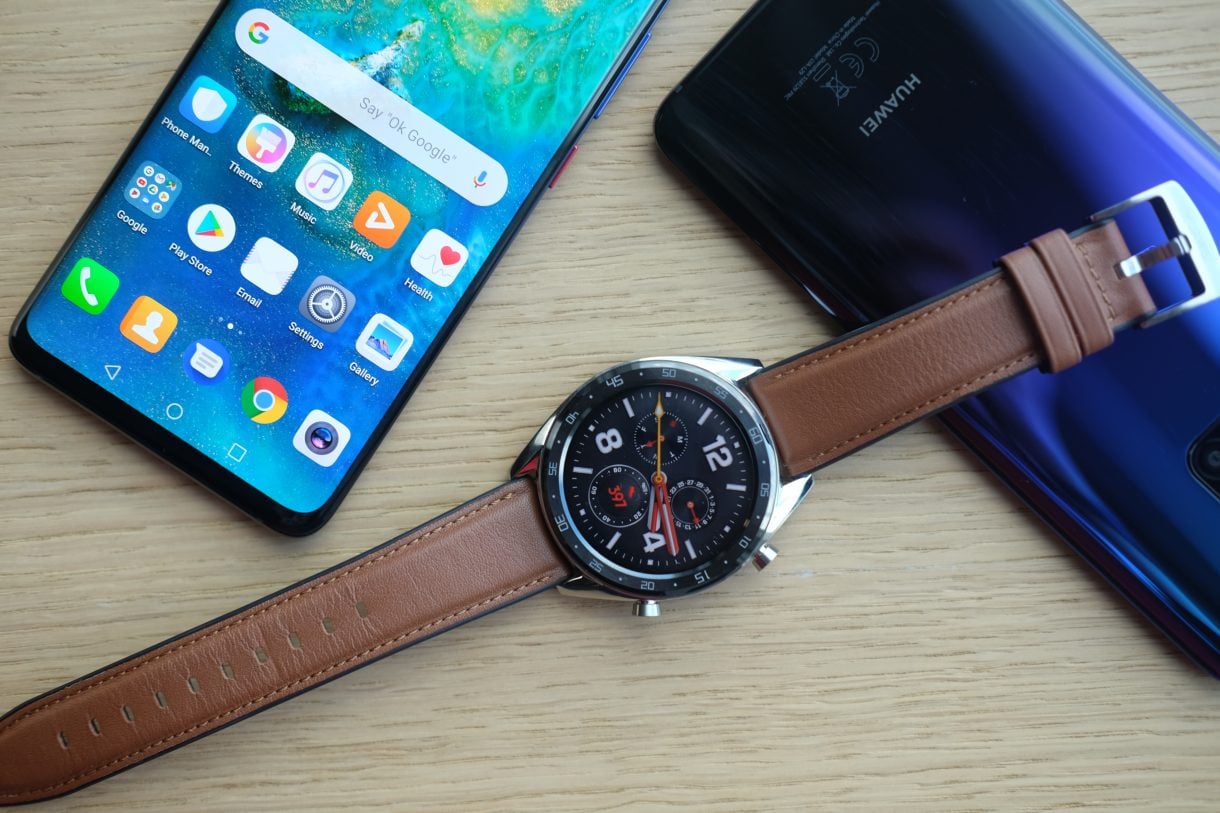
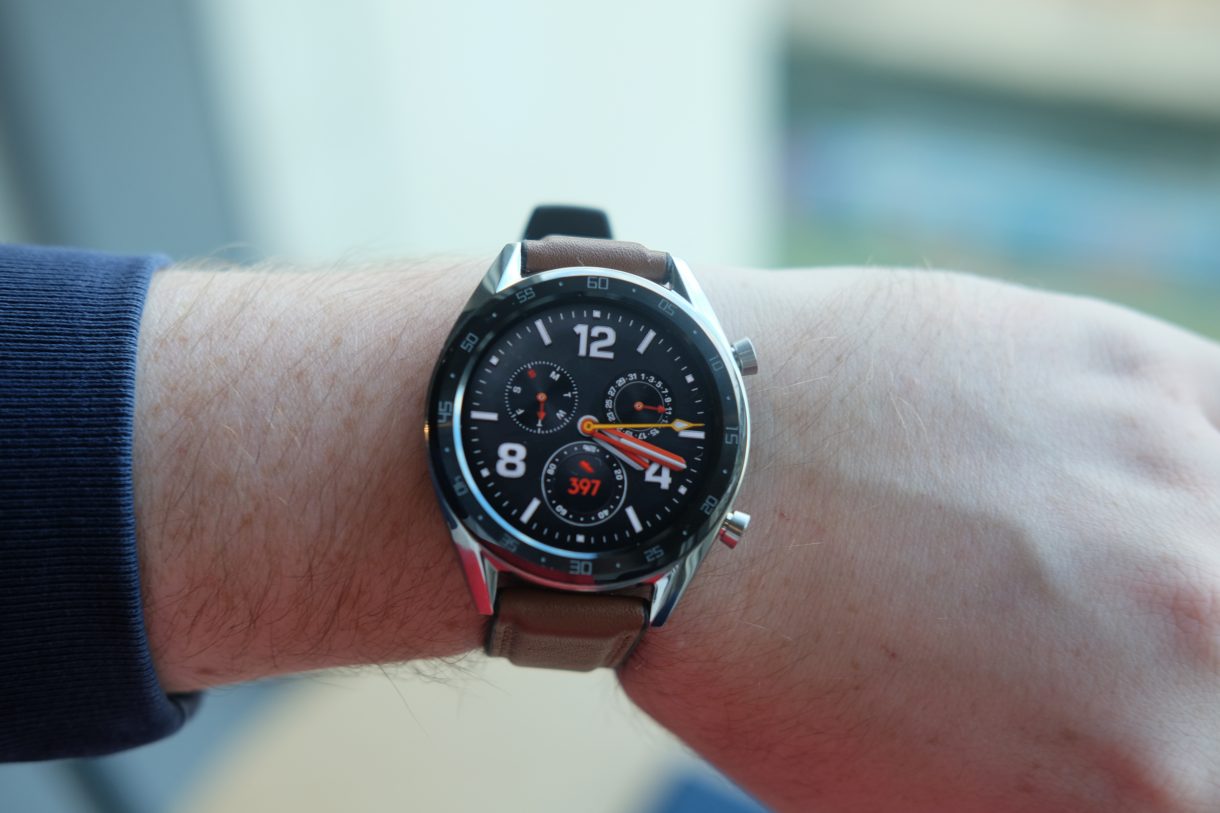
Huawei has finally unveiled its latest smartwatch – the Huawei Watch GT. The wearable device was announced alongside the Huawei Mate 20 series at an event held earlier today in London. The Watch GT isn’t really a successor of the Huawei Watch 2 as expected, but focuses on fitness tracking rather than being a complete watch studded with features like the Apple Watch 4 series. One interesting thing about the smartwatch is that it doesn’t run on WearOS rather, it runs on Huawei’s own LightOS. This is the first watch to feature the LightOS, by the way.
Huawei Watch GT comes with a classic design and is made of 316L stainless steel with ceramic bezels. It features a 1.39-inch OLED screen with a resolution of 454x454pixels. The watch is powered by a Cortex-M4 chipset with low power and high power processors. Thus, the device has a very durable battery life. Huawei says the battery can last up to 30 days if you only receive notifications (no heart rate tracking or GPS), 2 weeks if you use heart rate tracking and exercise for 1:30 hour per week and 22 hours of continuous GPS, heart rate sensing and always on screen. It’s rated at 5ATM water resistance.
Embedded under the smartwatch is an optical heart rate sensor on its bottom which uses 6 LEDs. The sensor is backed by Huawei’s Truseen 3.0 technology which promises to be more efficient in reading your heart rate and also learn it over time. The watch also comes with GPS that can be used to track your daily activity and training in conjunction with Huawei’s Health Assistant app. Oher features include a built-in altimeter as well as step and sleep tracking features.
Huawei is yet to release the price of the Watch GT. We’ll keep you updated when that is done.
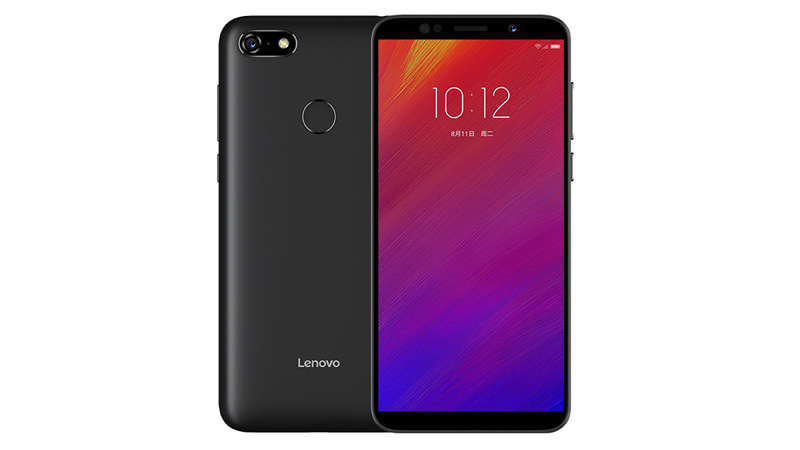
At a launch event in New Delhi, along with the Lenovo K9 mid-range smartphone, the China-based company also launched an entry-level device, dubbed as Lenovo A5. The phone was originally launched in China earlier this year.
The phone comes with a 5.45-inch HD+ display with 18:9 aspect ratio. Just like the Lenovo K9, this one too doesn’t feature a notch on top. Under the hood, the device is powered by MediaTek MT6739 quad-core 64-bit processor, clocked at 1.5GHz.
The device comes in two variants — one with 2GB of RAM and 16GB of internal storage and another with 3GB of RAM and 32GB of internal storage. There’s also a dedicated microSD card slot for expanding the phone’s storage capacity up to 256GB.
Coming to the camera department, it features a 13-megapixel rear camera along with f/2.2 aperture and an LED flash, and an 8-megapixel front-facing snapper with f/2.2 aperture. The phone also has a rear-mounted fingerprint sensor.
Connectivity options on the device include 4G VoLTE, Wi-Fi 802.11 b/g/n, Bluetooth 4.2, and GPS. It runs Android 8.1 Oreo operating system out-of-the-box with Lenovo’s custom user interface on top, and is powered by a 4,000mAh battery.
The Lenovo A5 will be available in two color options — Black and Gold. The 2GB RAM model is priced at Rs. 5,999 (approximately $82) while the 3GB RAM model costs Rs. 6,999 (approximately $95).
The phone will be available for purchase exclusively through Flipkart. At this price point, the Lenovo A5 will compete against the likes of Realme C1 and Xiaomi Redmi 6A, among others.
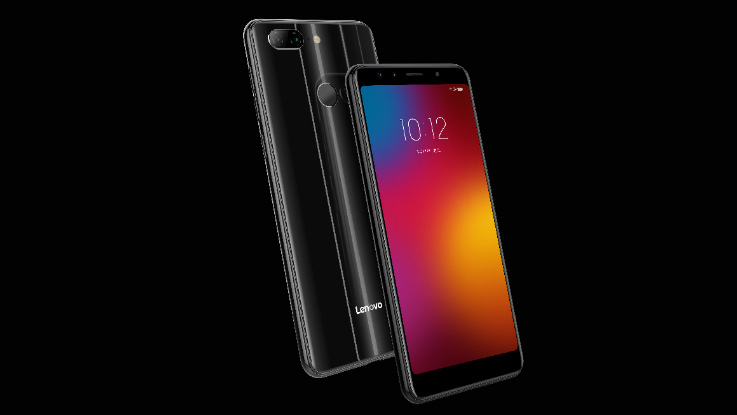
Lenovo has launched a new lower mid-range smartphone in the Indian market at an event in New Delhi — Lenovo K9. The phone comes with a 2.5D curved glass on both sides — front as well as back.
The smartphone features a 5.7-inch HD+ display with 18:9 aspect ratio without any kind of notch. Under the hood, the device is powered by MediaTek‘s Helio P22 octa-core processor clocked at 2GHz, which is manufactured using the 12nm process.
It comes with 3GB of RAM and 32GB of internal storage, which can be further expanded thanks to the Hybrid SIM card slot. There’s also a rear-mounted fingerprint sensor for added security.
In terms of camera, the device comes with four camera sensors — two on the front side and two on the back. There’s a 13-megapixel primary sensor and a megapixel secondary sensor on the back, along with an LED flash. On the front side also, it comes with the same camera configuration, something that’s not found in this price segment.
Connectivity options on the device include Dual 4G VoLTE, WiFi 802.11 b/g/n, Bluetooth v5.0, GPS, and USB Type-C. The phone runs Android 8.1 Oreo operating system out-of-the-box with some customisations from Lenovo. It is powered by a 3,000mAh battery and comes with support for 10W fast charging.
The Lenovo K9 will be available in two color options — Black and Blue. Priced at Rs. 8,999, which roughly converts to $123, the phone will be available for purchase exclusively through Flipkart. At this price range, it will compete against the likes of Realme 2, Xiaomi Redmi 6, among others.
Xiaomi is all set to launch the flagship Mi Mix 3 on October 25 in Beijing, China. Since the launch date has been officially released, we expect loads of teasers that would give us some more details about the smartphone. Xiaomi’s Global spokesperson, Donovan Sung today shared a teaser on his official Twitter account which suggests that the Mi Mix 3 will come packing 10GB of RAM!
The tweet contains a picture of two notebooks with 5G and 10G written on their covers. We can guess 5G refers to the next-generation 5G cellular network which is already gaining momentum ahead of its official rollout. Even if Xiaomi launches the Mi Mix 3 with 5G support, it will be unuseful at the moment as there are no 5G infrastructures yet. On the other hand, we can’t think of anything else that 10G represents than 10GB of RAM. This doesn’t sound realistic, anyway, because that’ll be sort of an overkill.
Mr Sung had earlier released a teaser which hinted that the Mi Mix 3 will be available in three different colours. The Mi Mix 3 is also expected to feature a slider design and will feature a Qualcomm Snapdragon 845 chipset. The RAM size and storages will vary. The device will also come with several innovations like an almost completely bezel-less design, high screen ratio, in-display fingerprint sensor among others.
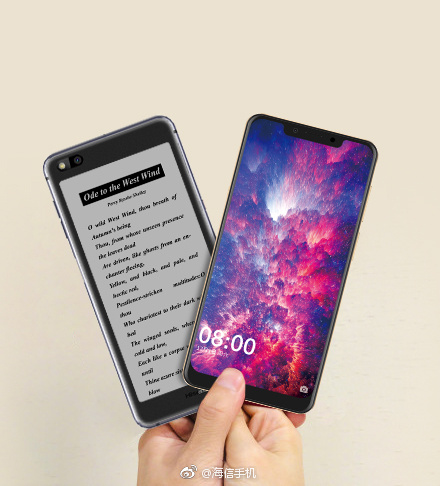
When it comes to phones with dual displays, the YotaPhone series gets a mention because of its approach to the design. One side of the phones has a color display while the other side is home to an E-ink display. However, Yotaphone isn’t the only manufacturer to adopt this design. Chinese electronics company and smartphone maker, Hisense, also has phones with this design and it is set to announce a new one next week.
A live photo of the phone was shared on the manufacturer’s official Weibo account. The phone has the same candy bar design of its predecessors with a screen on each side. The rear of the phone which houses the E-ink display seems to be the same as that of the Hisense A6, its last phone with a similar design. But the big change is in front.
With the notch being the trend this year, Hisense is adopting it for the new phone. As you can see, the screen, which should be AMOLED by the way, now stretches to the top, eliminating the top bezel in the process. The lower bezel is still there but with the forehead gone, the phone can fit a bigger display in the same body as its predecessor.
The image also shows that the phone will come with a single camera on both sides. There isn’t a fingerprint scanner visible but based on the design of its predecessor, we are sure it is on the side where it doubles as a power button. We also expect it to have face unlock and a dedicated AI button. Don’t expect an audio jack – the A6 doesn’t have one, so the chance of this having one is slim.
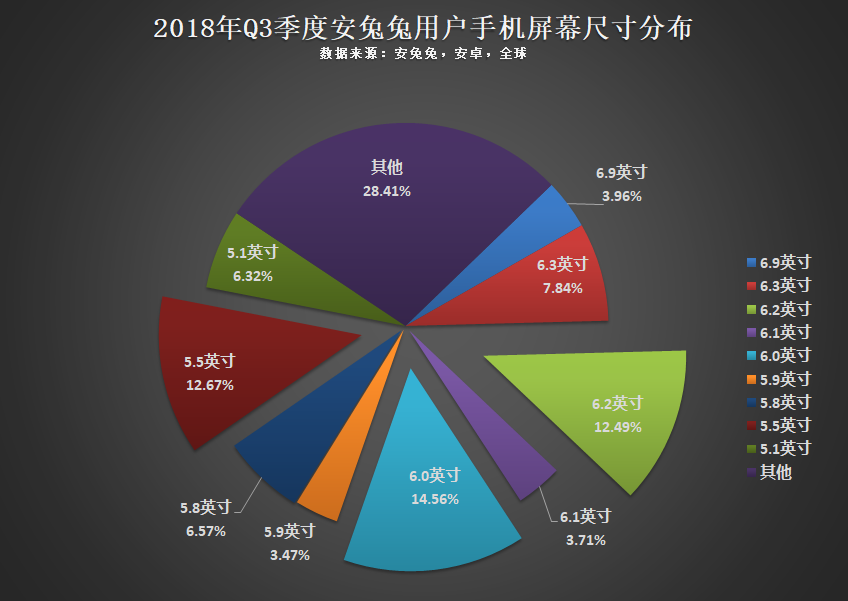
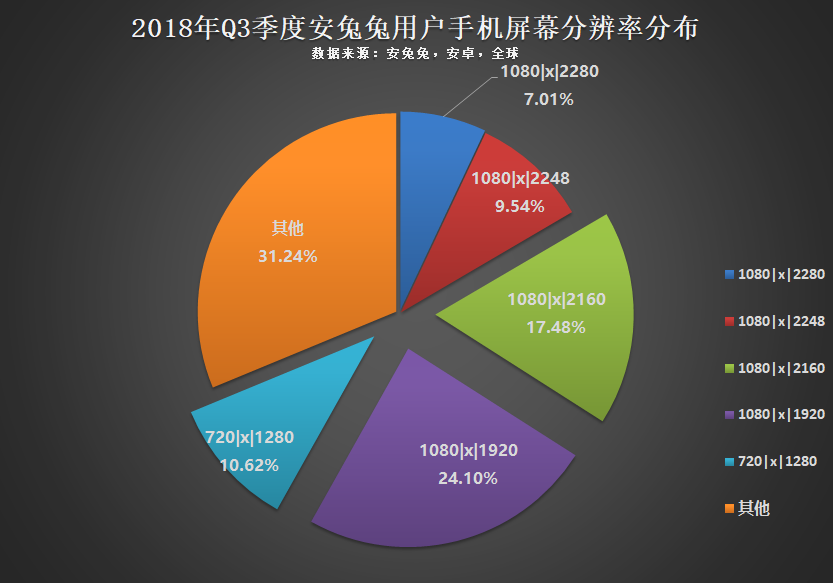
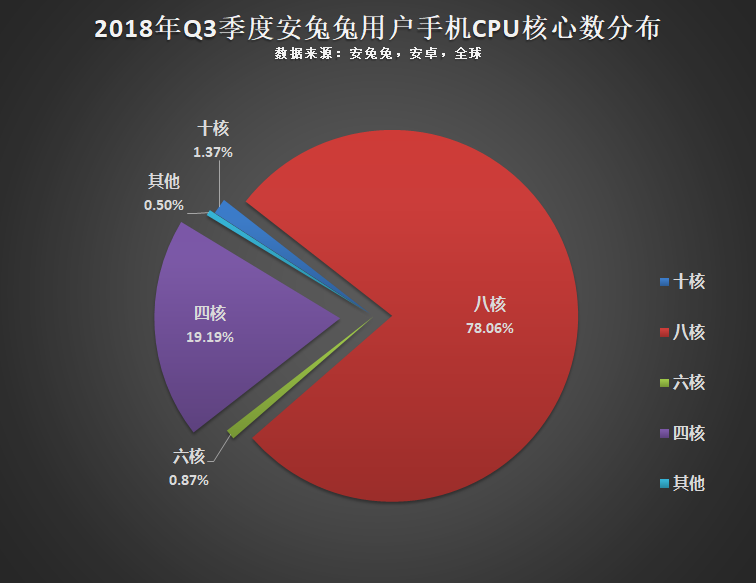
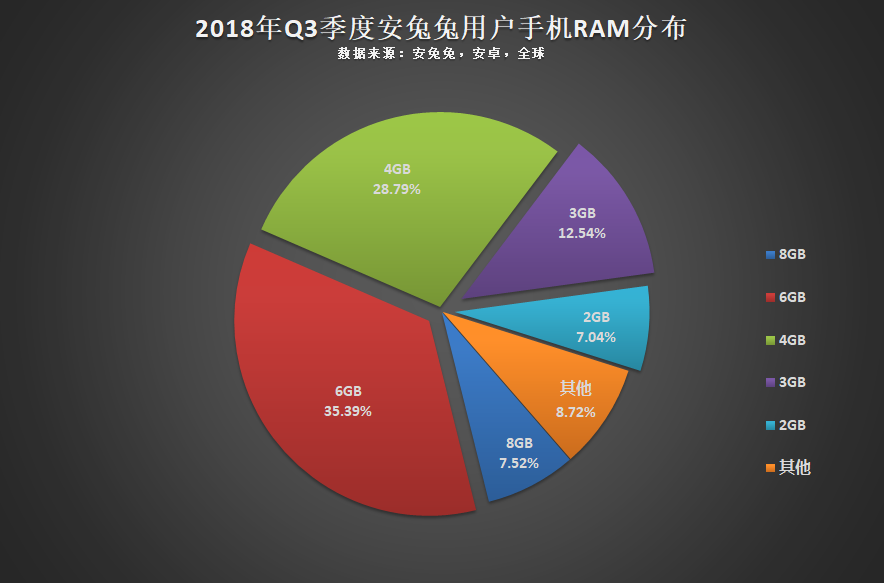
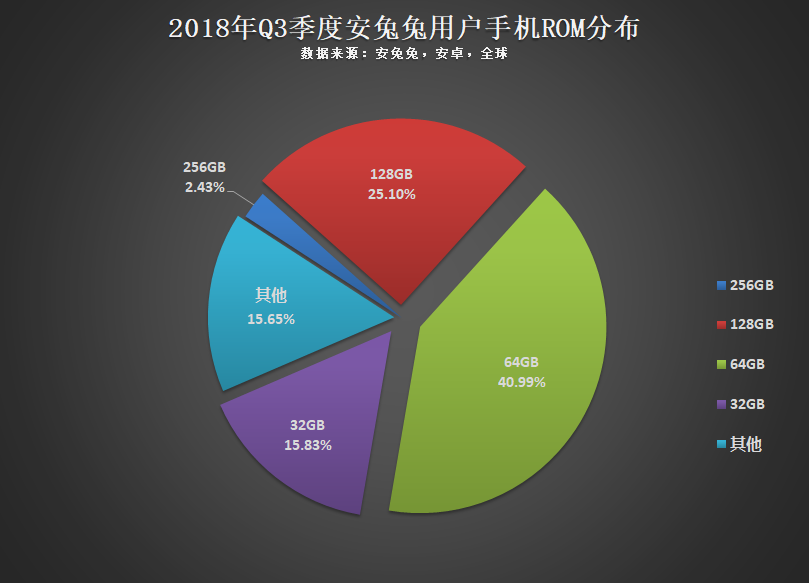
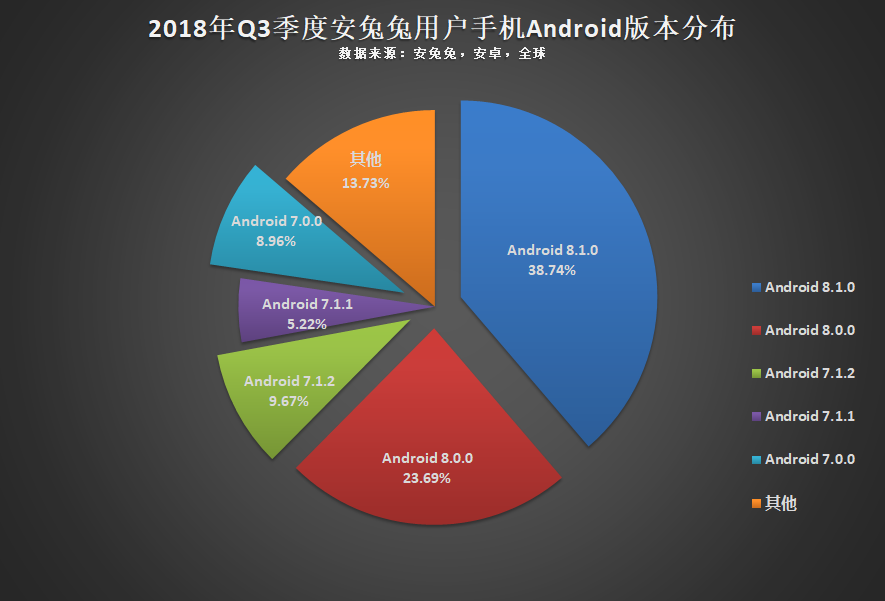
Apart from the top 10 best performing smartphone models for September, benchmark outfit AnTuTu also released a series of charts showing the distribution of Android phone users based on key features such as screen resolution, screen size, chipset, RAM, storage and Android version.
Screen Size
The advent of full-screen phones with thin bezels have led to the prominence of phones with bigger screen sizes. Big screen phones have even become more comfortable to use as a result of the aspect ratios in use today. This has made it possible to operate phones with 6 inches screen or more with one hand.
The screen size distribution for the third quarter of the year saw phones with 6 inches screen or more dominating. 6-inch display accounted for 14.56% of the market, 6.2 inches accounted for 12.49%, 6.1 inches accounted for 3.71%, 6.3 inches accounted for 7.84%, and even 6.9 inches has a share of 3.96%. At the same time, phones with 5.5-inch and 5.8-inch screen sizes are still waxing strong even though the spread is not as it was in the past. 5.5-inch phones have a 12.67% share and 5.8-inch phone usage stood at 6.57% in the third quarter. In addition, the popular 5.1-inch screen size only has 6.32% usage spread.
There is no doubt that the shift to large screen size phones is a good development for the mobile phone industry. The larger body space has opened up the prospect of having a bigger battery, better heat dissipation, and overall, a better user experience for consumers. There are still phones with small displays of 4-inch and lower but that size on a smartphone may soon cease to exist.
Screen Resolution
This quarter, 1920 × 1080 resolution still occupies the largest single share, but the proportion has been in a downturn in recent months. There is no doubt that phones with 16:9 aspect ratio will continue to reduce as fullscreen design continues to rise. At present, in the full-screen phone aspect, the three resolutions of 2160×1080, 2248×1080 and 2280×1080 account for the highest proportion, which are 17.48%, 9.54% and 7.01% respectively. In addition, these three resolutions are all notch design models which shows how much this trend is catching on. The resolution of the water drop screen which has just begun to enjoy wide usage is yet to enter the list.
Chipset
Octa-core chipset may soon become the most dominant in the industry. The proportion of phones running Octa-core chipsets in the industry continues to increase and is now approaching 80%. MediaTek’s deca-core chips really didn’t receive the expected attention. Also, hex-core and quad-core processors usage continues to dwindle. So, the proportion of Octa-core chipset usage is likely to exceed 90%. Its usage in the high-end and low-end mobile phone is still popular and as at the third quarter, the usage stood at 73.8%. Quad core chipsets are still in use in the low-end category but some of these products will rarely be subjected to AnTuTu test. The usage is put at 21.9%.
RAM
A large proportion of Android phone users have phones with 6GB of RAM and that represents a 35.39% share. On the other hand, 4GB RAM phones continue to go strong with a 28.79% market share. 8GB RAM phone usage accounts for 7.52% of the share. As for 2GB RAM and 3GB RAM phones, they have a cumulative share of 20%.
ROM
Just as 6GB of RAM occupies the largest share in RAM size, the standard for most of the flagships around is 6GB+64GB storage. In the mid-range segment, 4GB+64GB storage is basically the standard for the current mid-range mobile phone. Specifically, 64GB storage models account for 40.99% of the distribution, followed by 128GB, which accounted for 25.1%, while 32GB users accounted for 15.83%.
Android Version
The distribution of phones running through AnTuTu benchmark having Android 6.0 Marshmallow and lower accounts for only 13.73%. This figure also includes phones with Android Pie. At the moment, Android 8.1 Oreo is the most widespread Android operating system version in use with a 38.74% market share. Android 8.0 version accounts for a 23.89% spread. Android 7.0 Nougat versions (Android 7.0, 7.1 .1 and 7.1.2) also have a considerable user base but that is declining rapidly. The market spread among AnTuTu users is cumulatively at about 23%.
So, from the various pie charts, full-screen phones with octa-core CPU, 6GB RAM and 64GB memory are the most popular among users.
Qualcomm has been working on new chipsets for portable laptops to counter Intel-based Windows 10 notebooks. Few months ago, popular tipster had claimed that Qualcomm is readying a powerful chipset Snapdragon 1000 chipset. Rumors surrounding had claimed that it would be hitting the market with a different moniker. Fresh information that has appeared on WinFuture.de states that the same SoC would be arriving in December with Snapdragon 8180 name and it would be a 7nm chipset. The publication has also shared some key details of the Snapdragon 8180.
The Snapdragon 8180 SoC is being internally referred to as SCX8180. It is an octa-core processor with four Gold ARM Cortex A76 cores that work at 3.0 GHz and four Silver ARM Cortex A55 cores that clocks at 1.8 GHz. The SoC will be also equipped with an NPU-130 NPU unit for handling AI tasks.
The Snapdragon 8180 chipset is equipped with Adreno 680 graphics. The SoC will be equipped with LPDDRX RAM up to 2133MHz frequencies. The SD8180 will be relying on 8.5 billion transistors and its Thermal Design Power is said to be 15 watts.
The report also reveals that the ASUS could be the first manufacturer to launch Snapdragon 8180 powered notebook. Previous leaks have revealed that the device could be hitting the market as ASUS Primus. After getting announce at the end of this year, the ASUS device may release in the market in early 2019.
The Black Shark was one of the first gaming smartphones that launched this year and seven months after its release, it is set to get a successor. The successor which is expected to be called the Black Shark 2 was seen on TENAA back in September. Now a poster has surfaced which reveals the launch date of a new Black Shark product some say might be the successor.
The poster has a green-theme just like the manufacturer’s official color. It states the device is named Black Shark Hela and it is a new device which will launch on October 23 at 1800 hrs local China time.
There are speculations that the launch is for the Black Shark 2 gaming phone. The device already surfaced on TENAA and while there doesn’t seem to be a big change under the hood, the Black Shark 2 looks much better than its predecessor based on the hands-on video that surfaced recently.
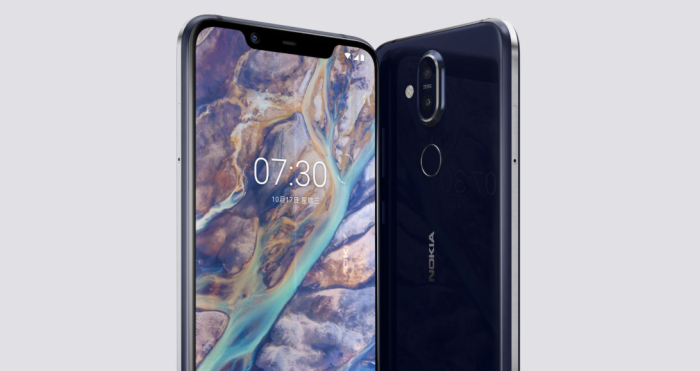
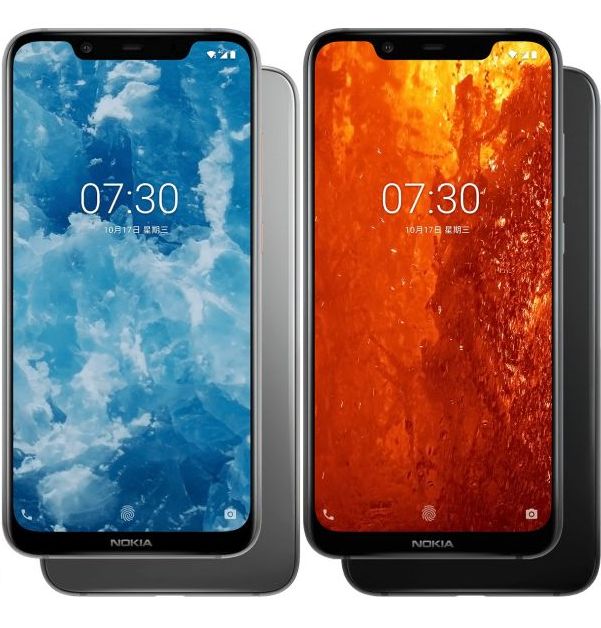
HMD Global has taken off covers from the all new Nokia X7 smartphone through a launch event in China. The Nokia X7 smartphone is equipped with a notched screen and it is fueled by Snapdragon 710 chipset. The ZEISS branded dual cameras at the backside of the smartphone. It has arrived in China with a starting price of 1,699 Yuan (~$245) .
Nokia X7 Specifications and Features
The Nokia X7 that measures 154.8 x 75.7 x 7.97mm features a series-6000 magnesium alloy frame sandwiched between glass panels on the front and rear sides. The handset possesses a 6.18-inch IPS LCD screen. The notched display offers 18.7:9 aspect ratio and FHD+ resolution of 2246 x 1080 pixels. The other features of the display of the Nokia X7 are 86.5-percent screen space, 96-percent NTSC color gamut, DCI-P3 color gamut, HDR video playback, 1500:1 contrast ratio and 500nits of brightness. The Nokia brand name can be seen on the bottom bezel of the device.
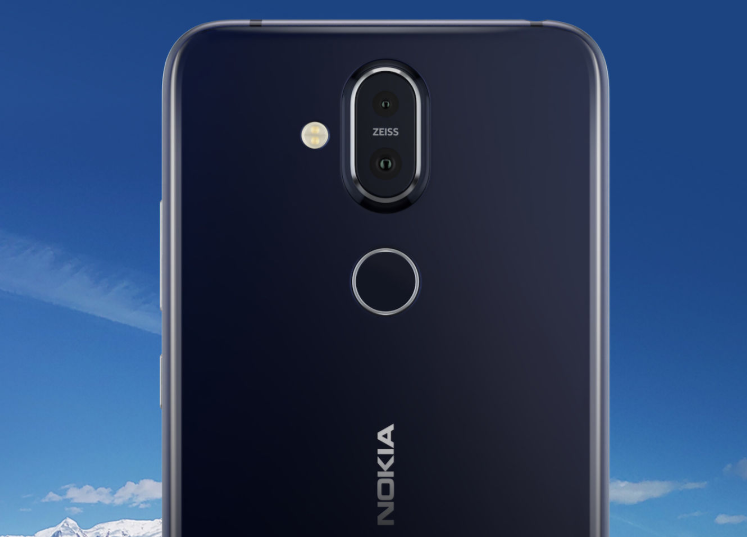
The notch of the smartphone houses a 20-megapixel selfie camera, an earpiece and other sensors. Moving to the backside of the phone reveals its vertically aligned dual camera system. The ZEISS branding is imprinted between the Sony IMX363 12-megapixel primary sensor and 13-megapixel secondary sensor. The dual cameras are equipped with features like Optical Image Stabilization, dual PD autofocus, AI scene detection and optimized low-light photography. The front camera is blessed with AI features like beauty mode, portrait mode and studio lights. A fingerprint scanner is available below the dual camera module.
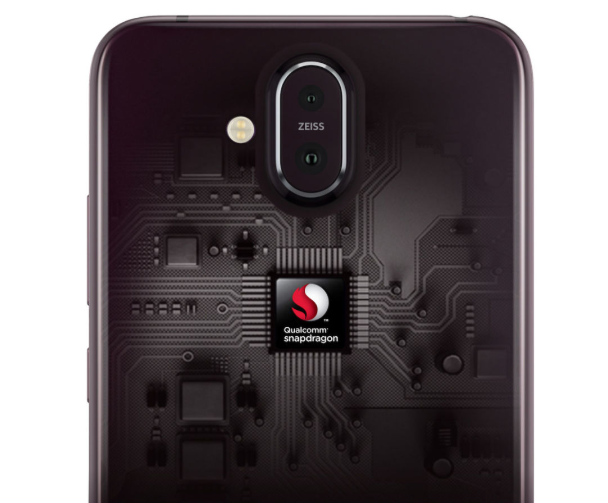
The Nokia X7 is the first smartphone from the Finnish firm to feature 2.2 GHz Snapdragon 710 chipset. The handset comes in three variants such as 64 GB storage + 4 GB RAM, 64 GB storage + 6 GB RAM and 128 GB storage + 6 GB RAM. The hybrid SIM slot can be used for adding a microSD card on the smartphone.
The smartphone is driven by a 3,500mAh battery. It is equipped with support for Quick Charge 3.0. When it comes to connectivity, the handset offers features like dual-SIM support, 4G VoLTE, Wi-Fi 802.11ac, Bluetooth 5.0, GPS, USB-C and 3.5mm audio jack. The handset is loaded with the latest Android 9 Pie OS. Like the other Nokia phones, the Nokia X7 is also an Android One device which makes it eligible to receive faster OS updates for two years along with security updates for three years.
Nokia X7 Pricing and Availability
Here is the pricing of the Nokia X7 variants:
64 GB storage + 4 GB RAM – 1,699 Yuan (~$245)
64 GB storage + 6 GB RAM – 1,999 Yuan (~$289) and
128 GB storage + 6 GB RAM – 2,499 Yuan (~$361)
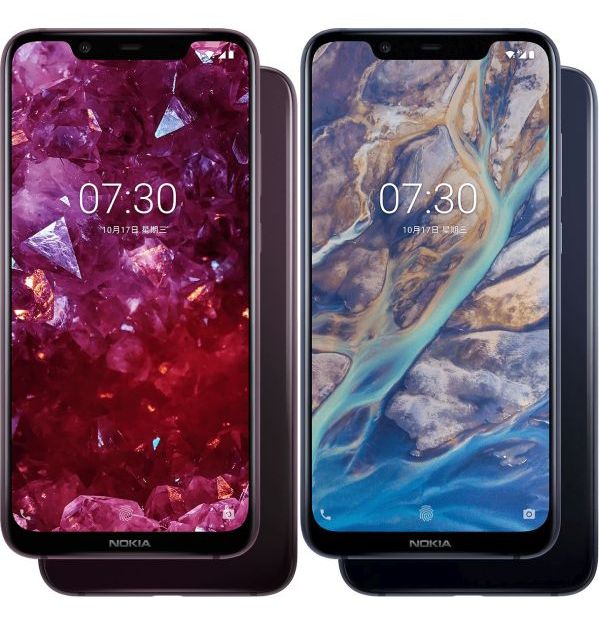
It can be bought in colors like Dark Blue, Night Red, Magic Night Silver and Magic Night Black. The pre-orders of the Nokia X7 have begun through various platforms like Nokia’s official online store and JD in China. The handset will be available for purchase from Oct. 23 in the home market.
There is no confirmation on the internal availability of the Nokia X7. Outside of China, the handset is pegged to carry Nokia 7.1 Plus moniker.
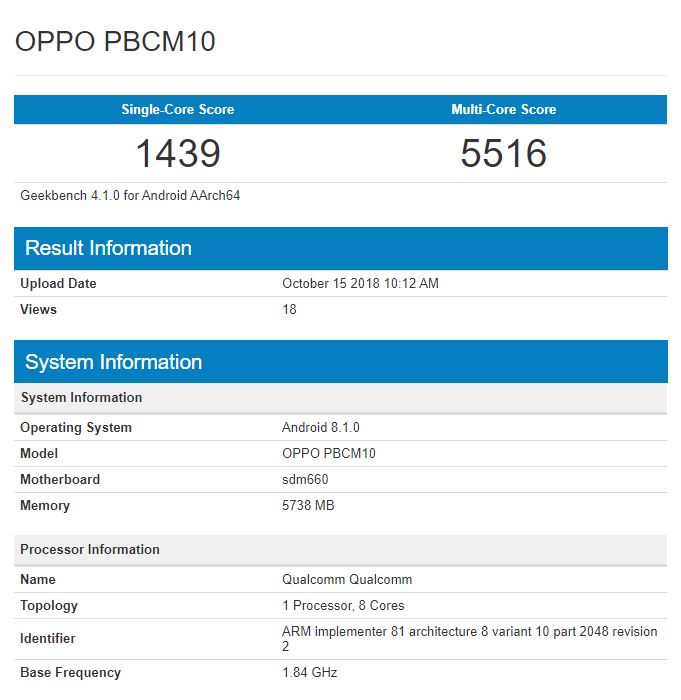
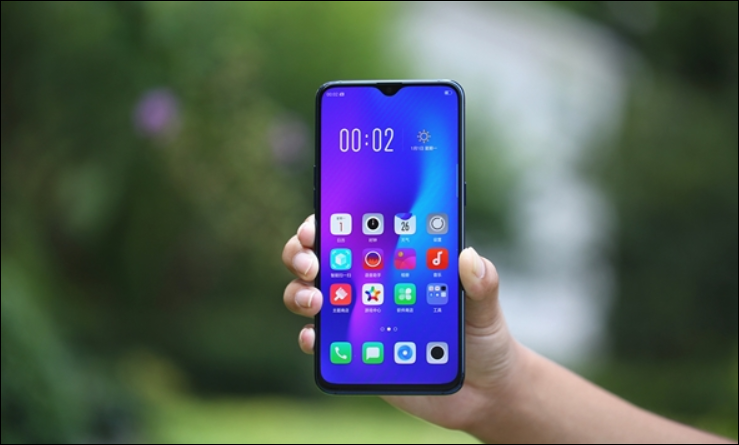
OPPO has been on a roll in recent weeks and it has no plans of stopping. A new device called the OPPO R15X was seen on the website of China Telecom along with its full specs and design. The phone has now been seen on Geekbench and the benchmark result confirms some of the specs we already know.
The OPPO R15X appears on the benchmark site as the OPPO PBCM10. It runs Android 8.1 Oreo and is powered by the Snapdragon 660 chipset which is paired with 6GB of RAM. Its benchmark scores are 1439 and 5516 for the single-core and multi-core tests.
The Snapdragon 660 may already have a more powerful sibling in the case of the Snapdragon 670, however, it is still very capable and will definitely still appear in more phones even those scheduled to be released next year.
The OPPO R15X should launch soon and when it does, it will come with a 6.4-inch AMOLED screen with a water-drop notch and a 1080 x 2340 resolution. It will also have an in-display fingerprint scanner, dual rear cameras (16MP + 2MP), a 25MP selfie camera, 4GB/6GB of RAM, and 128GB of storage. It will also have a 3500mAh battery.
In August, OPPO had launched the OPPO R17 and R17 Pro smartphones in China. Fresh information reveals that the company is prepping up to launch a new smartphone called OPPO R17 Neo. The leaked specifications of the smartphone suggest that it could be a toned-down version of the OPPO R17 smartphone.
According to My Smart Price, the OPPO R17 Neo will be arriving in colors like Mocha Red and Astral Blue and it will be measuring 158.3 x 75.5 x 7.4mm and weighing 156 grams. The handset is fitted with a 6.41-inch AMOLED screen that produces 1080 x 2340 pixels. Since the screen resolution of the phone is same as OPPO R17, it seems that the Neo model will also feature a waterdrop notch screen.
The OPPO R17 is powered by Snapdragon 670 SoC and the OPPO R17 Pro includes Snapdragon 710 chipset. The upcoming R17 Neo is rumored to be driven by Snapdragon 660 chipset. The smartphone is expected to arrive with 4 GB of RAM and a native storage of 128 GB. The handset will be supporting the usage of microSD card through its hybrid dual SIM slot. The R17 Neo is fueled by 3,600mAh battery.
For photography, the OPPO R17 Neo features a selfie shooter of 25-megapixel with f/2.0 aperture. The back panel of the phone could be equipped with f/1.75 aperture 16-megapixel + f/2.4 aperture 2-megapixel dual camera system. The other features that are expected to be available on the R17 Neo are 4G VoLTE, Wi-Fi 802.11ac, Bluetooth 5.0 and GPS. The smartphone is likely to arrive with ColorOS 5.2 based Android 8.1 Oreo OS.
The aforementioned details match with the specifications of the OPPO R15x smartphone that had surfaced on the website of China Telecom in the last week. Probably, the OPPO R15x and R17 Neo could be the very same device that may arrive in different markets with different names.
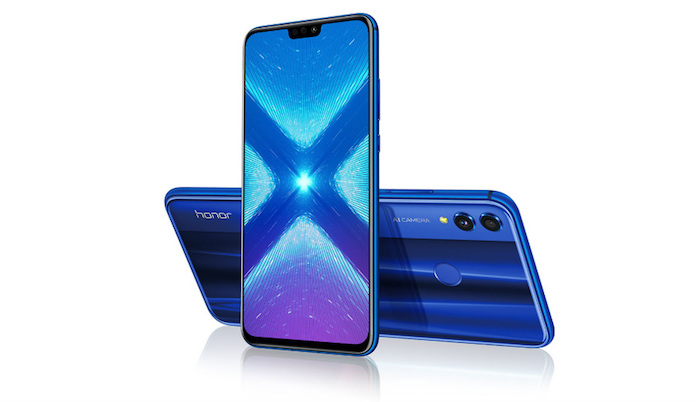
Honor has today launched a new mid-range smartphone in India — Honor 8X. As the name suggests, the phone, launched in China last month, is the successor to Honor 7X that was launched last year.
As for the phone’s design, it comes with a back panel that’s made from 15 layers what the company calls a “2.5D double texture aurora glass body with a grating effect.”
The Honor 8X features a big 6.5-inch Full HD+ notched display with an impressive 91 percent screen-to-body ratio. Under the hood, the device is powered by the company’s own Kirin 710 octa-core processor manufactured using the 12nm process.
It comes in two variants based on memory configuration — 4GB of RAM with 64GB of internal storage and 6GB of RAM with either 64GB or 128GB of internal storage. There’s also a microSD card slot enabling you to further expand the phone’s storage capacity.
Coming to the camera department, it features a 20-megapixel primary sensor and a 2-megapixel secondary sensor on the back, along with an LED flash and support for AI-based scene recognition that can identify up to 500 different scenes. On the front side, the device features a 16-megapixel snapper for taking selfies. It comes with 4-in-1 pixel binding to to improve overall pixel size and has support for AI beautify features.
It also features a back-mounted fingerprint sensor for added security. Connectivity options on the device include Dual 4G VoLTE, Wi-Fi 802.11 ac (2.4GHz / 5GHz), Bluetooth 5, and GPS + GLONASS. It runs Android 8.1 Oreo operating system with the company’s custom EMUI 8.2 interface on top and is powered by a 3,750mAh battery.
The Honor 8X will be available in two color options — Black and Blue. The 4GB RAM model is priced at Rs. 14,999 ($204), while the 6GB RAM + 64GB storage model costs Rs. 16,999 ($231). On the other hand, the 6GB RAM + 128GB internal storage variant is priced at Rs. 18,999 ($258). It will go on sale exclusively through Amazon India from 24th October.
Realme smartphones have been well-received in the Indian market, thanks to its aggressive pricing strategy. Last month, the company had revealed that it had hit the one million sales mark in just four months after it started selling Realme 1 and two weeks of Realme 2 launch.
The company, which started off as a sub-brand of Oppo and recently split from its parent company to operate as an independent brand, recently launched Realme 2 Pro and Realme C1. The devices were available for purchase in Flipkart’s Big Billion Days sale, during which , the company claims to have sold over one million phones.
Along with that, the company also claims that it managed to sell 110,000 units of Realme C1 entry-level smartphone in just one second during Flipkart’s sale. With such sales record, the company claims to have become the number two smartphone brand during the sale, just behind Xiaomi.
In a press statement, Realme India Chief Executive Officer Madhav Sheth said:
Realme has secured No. 2 position on Flipkart but still we think we underestimated the love and expectations our fans have shown. I’m also happy to announce that Realme 2 has even crossed 1 million sales in just 40 days and even now ranked the highest rating in 10K segment. I’m proud to say there is truly a Realme for every Indian.
During the Flipkart sale, two devices from Realme were made available for purchase — Realme 2 Pro and Realme C1. While the Realme 2 Pro takes on the likes of Asus ZenFone Max Pro M1, Motorola One Power, Nokia 6.1 Plus, and Xiaomi Mi A2, among others, the Realme C1 competes against the likes of Xiaomi Redmi 6A.
The Realme C1 is priced at Rs. 6,999 that roughly converts to $95, while the pricing for Realme 2 Pro starts at Rs. 13,990 (approximately $189) for the base model that packs 4GB RAM. It is also available in two other variants, packing 6GB RAM and 8GB RAM, costing Rs. 15,990 (~$216) and Rs. 17,990 (~$243) respectively.
Last week, OPPO had announced is software acceleration engine called Hyper Boost for significantly improving the performance its smartphones. Hyper Boost is all about optimizing the device’s performance in three areas namely, system, games and apps. The OPPO R17 and R17 Pro were confirmed as the first devices to receive Hyper Boost through a software update. Today, the Chinese manufacturer has confirmed a list of OPPO phones that will be upgraded to Hyper Boost through the latest ColorOS 5.2.1 update.
The OPPO Find X is scheduled to receive the Hyper Boost engine in this month. In November, the Chinese manufacturer will be making it available to devices like OPPO R11, R11 Plus, R11s, R11s Plus, A83 and A1.
Hyper Boost is OPPO’s version of GPU Turbo technology that is available on Huawei and Honor smartphones. Hyper Boost’s Behavior Aware Scheduling (BAS) feature can arrange the frequency of hardware in 0.2 milliseconds on a smartphone against Linux kernel of Android that adjusts hardware frequency in 20 milliseconds. This will allow the company to significantly boost the system performance on the aforementioned devices. The Chinese manufacturer had also claimed that Hyper Boost powered devices will offer up to 31.9 percent shorter loading times.
For optimized gaming experience on OPPO phones, the company has teamed up with Tencent, Netease, Unreal, Unity and others to ensure lag-free gaming on the top 100 mobile games. OPPO will be working on improving the Hyper Boost engine by adding AI features to it.
We use cookies on our website to give you the most relevant experience by remembering your preferences and repeat visits. By clicking “Accept”, you consent to the use of ALL the cookies.
This website uses cookies to improve your experience while you navigate through the website. Out of these, the cookies that are categorized as necessary are stored on your browser as they are essential for the working of basic functionalities of the website. We also use third-party cookies that help us analyze and understand how you use this website. These cookies will be stored in your browser only with your consent. You also have the option to opt-out of these cookies. But opting out of some of these cookies may affect your browsing experience.
Necessary cookies are absolutely essential for the website to function properly. This category only includes cookies that ensures basic functionalities and security features of the website. These cookies do not store any personal information.
Any cookies that may not be particularly necessary for the website to function and is used specifically to collect user personal data via analytics, ads, other embedded contents are termed as non-necessary cookies. It is mandatory to procure user consent prior to running these cookies on your website.