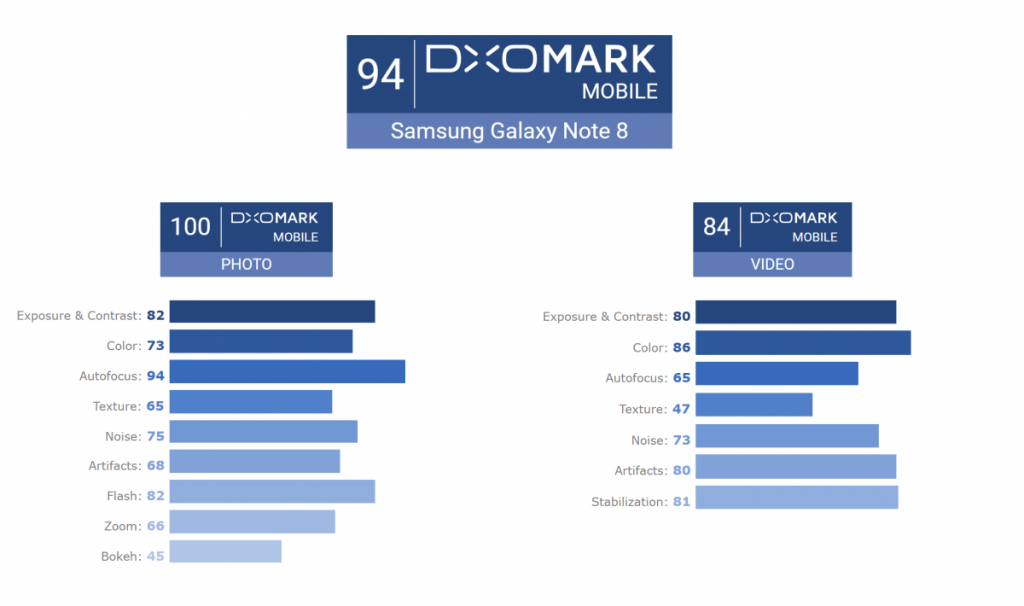
DxOMark is a benchmarking platform for smartphone cameras. Last year, the Google Pixel had achieved the highest score of 89 on it. Its record was broken by HTC U11 this year when it scored 90. In September, DxOMark had revised its tests and scores for smartphone cameras. The Google Pixel and HTC U11 now have a revised score of 90. The iPhone 8 has a DxOMark score of 92. Until the arrival of Samsung Galaxy Note8, the iPhone 8 Plus enjoyed the numero uno position on the smartphone camera benchmarking platform with a score of 94. Now, Galaxy Note 8 has joined iPhone 8 Plus with a highest score of 94.
The Galaxy Note 8 has recorded a score of 100 in still photography tests because of its brilliant zoom at up to 4x, stellar low light photography with very low noise, fast and accurate autofocus, rich and detailed photography at outdoor and indoor conditions. The mobile camera benchmarking platform has called the Galaxy Note 8 as the best smartphone for zoom.
Some of the drawbacks that were noticed in still photography are limited dynamic range, rapid white balance casts while shooting photos indoors or in bright conditions. Sometimes the dual cameras could not shoot photos with bokeh effect even after enabling the mode.
The video capture test brought down the overall camera rating of the Note 8 as it managed to score only 84 points in this segment. The default mode of video shooting does not have autofocus tracking capability. Residual motion can be seen when the camera is held still while shooting videos. Highlight clipping was also observed in high-contrast scenes.
The cameras of Google Pixel 2 and Pixel 2 XL are expected to soon undergo testing in the forthcoming weeks. The iPhone 8 and Galaxy Note 8 that are tied at the first position on DxOMark are equipped with dual rear cameras. However, the Pixel 2 duo are enabled with single cameras on their back panel. Hence, we will have to wait a bit more to see whether the Pixel 2 with its single camera can score higher than the iPhone 8 Plus and Galaxy Note 8 on DxOMark.
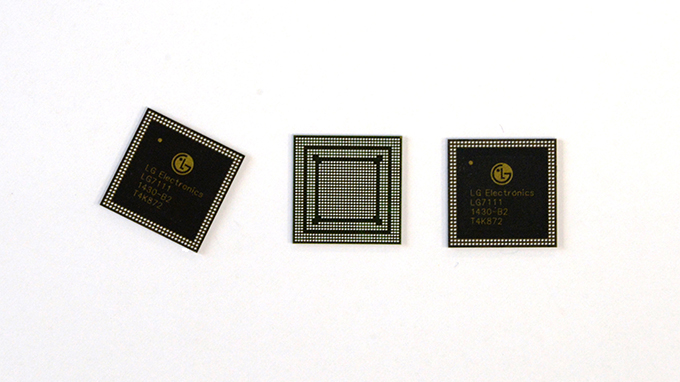
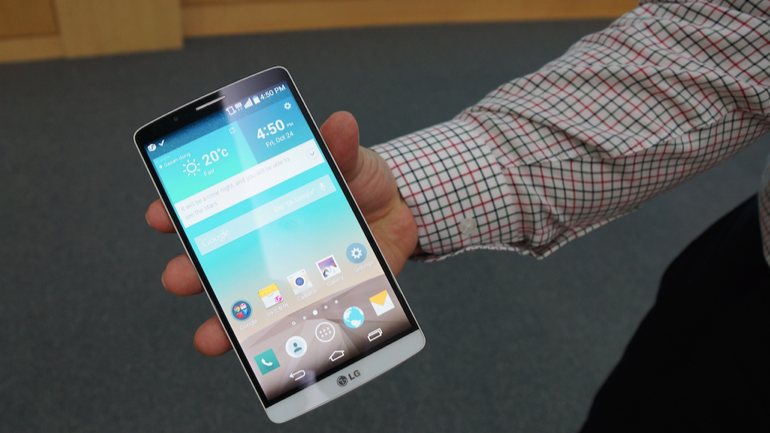
LG‘s latest trademark applications at the European Union Intellectual Property Office have shown that the Korean tech giant is once again working on its own chipset, following the footstep of fellow Korean rival Samsung as well as Huawei. Xiaomi recently joined the list of smartphone makers with its own chipset. This isn’t the first time LG is working on its own smartphone processor, the tech giant first unveiled its mobile phone SoC in 2014 with the chip adorning the LG G3 Screen which was exclusive to South Korea.
That the LG G3 was launched in 2014 packing a LG-developed NUCLUN is as stale as the fate of the G3 Screen. The phone was a flop and that may not have been solely due to the chipset but the phone’s failure ended the journey of LG’s first chipset. The Nuclun processor didn’t receive positive reviews, either. The chip was described to be “one generation” behind “Chinese entry-level processors” from the likes of MediaTek and smartphone competitor Huawei. Also, the Nuclun processor reportedly downclocks its clock speed very aggressively under high operating temperatures, resulting in sluggish performance. These problems contributed to the poor sales growth for the LG G3 Screen.
The latest trademarks, however, show these are entirely new and different processors with one having the name, “LG KROMAX Processor” and the second one named “LG EPIK Processor.” Both trademark listings are classified as “Chips [integrated circuits]; Multiprocessor chips,” which points to the fact that they are processors. Apart from this, the trademark filings offer no description of the processors.
We’re not betting entirely on these being smartphone processors, though, they could possibly be for integration into IoT gadgets. But they are more likely to be smartphone SoCs. It could be recalled that Intel officially confirmed last year that it will manufacture LG-designed ARM smartphone chips in its factories. According to the same report, the chips will use the current industry standard 10 nm technology, which is also expected to remain in use in next year’s flagship processors as well. If they are actually smartphone chipsets, we don’t expect them on LG’s flagship models as that would be too big a risk to take since they are untested.
In a few hours, Google will take the wraps off its 2nd gen Pixel smartphones. Over the last six months or more, we have seen countless leaks about the design and specification details. Right now, everyone knows what both phones will look like already. However, there are still a few specification details that aren’t known yet. A full specification sheet surfaced online yesterday revealing all there is to know about the larger Pixel 2 XL.
The Pixel 2 XL is made by LG and just like the new V30, the Pixel 2 XL will have a 6.0-inch P-OLED display. The screen will have a 1440 x 2880 resolution (538 ppi) and an 18:9 aspect ratio. The display will be protected by Gorilla Glass 5 (3D arc).
The Google Pixel 2 XL is a dual SIM phone with a single SIM slot. Confusing? That’s because the second SIM is an eSIM (electronic SIM) embedded in the phone.
The spec list doesn’t mention an audio jack but there have been confirmations from trusted sources that it has been removed. There are three microphones and Wi-Fi calling is supported. Bluetooth 5.0, NFC, and a rear fingerprint scanner are also present.
While the spec sheet doesn’t mention the rear camera, it does state that the front camera is an 8MP f/2.4 sensor. There is also a mention of a Pixel Visual Core which some say is a dedicated image processing chip.
The Pixel 2 XL will be powered by the Snapdragon 835 clocked at 2.35GHz and will be available in 64GB and a more than likely 128GB version. It will come with Android 8.0 Oreo but an update to 8.1 should not be far off after launch.
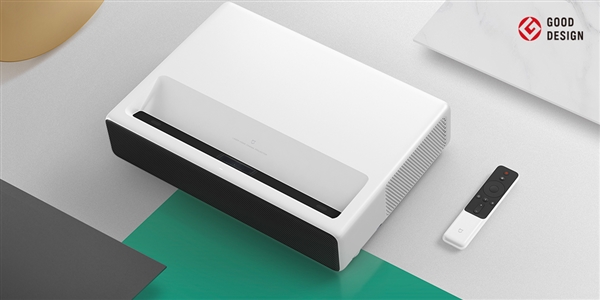
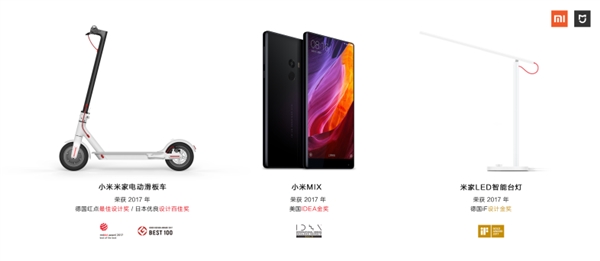
Xiaomi has continued to blaze the trail in the aspect of exception designs for its products and these innovative skills have not gone unnoticed. The company’s products have garnered several awards in the past like the German Red Dot award won by the Mi Band 2 and the Mi Electric Scooter. Xiaomi’s tech gadgets have once again shone brighter by getting recognised as winners of the Good Design awards. The award recipients include the Mi Scooter, Mi Laser Projector, Mi Walkie-Talkie, Mi TV 4, Mi Mix, Mi VR headset as well as the app interface for the Mi Water Purifier and the Mi LED Desk Lamp
The most spectacular of the lot is the Mi Electric Scooter which was voted among the top 100 best designs for 2017, with the likes of the Tesla’s Model X electric car and other innovative products. The Mi Electric Scooter is one of Xiaomi’s best selling product which comes with a minimalistic yet beautiful design. The main body employs a styling element of track shape in neutral colours with red hints adding to the personality. The scooter can hit a speed of 25km/h and has a range of 30km on a single charge. Its front wheel is outfitted with electronic braking & regenerative braking system, and the rear one with disc braking.
The Mi electric Scooter is only one of two products from China to be among the Good Design Best 100, the other being he SmartMi Inverter Air Conditioner. The award page for the electric scooter also reveals its designers as Zhou Tuo, Li Ningning, and Zhao Ziran, with Ningning being the director of the team. In addition, Good Design gave their evaluation of the product thus; “An overall very intelligently designed and executed scooter smartly incorporating all essential considerations from various safety devices to accommodation for the required battery. The way the scooter is folded is very carefully considered and very user-friendly to operate. The way it hints the association of the classic image of a skateboard is highly commended. The colour scheme is also very smartly coordinated, resulting in a minimalistic yet very vividly defined statement And indeed it is surprisingly powerful during the operation“.
We mustn’t fail to point out that the Mi Mix also won the Good Design award, making it one of Xiaomi’s most decorated product till date. The device had earlier won the German Red Dot award as well as the iF Design Award and the International Design Excellence Award (IDEA) Gold award. The device also won multiple awards after it was showcased at CES 2017, including the Best of CES 2017 award by TechAdvisor.
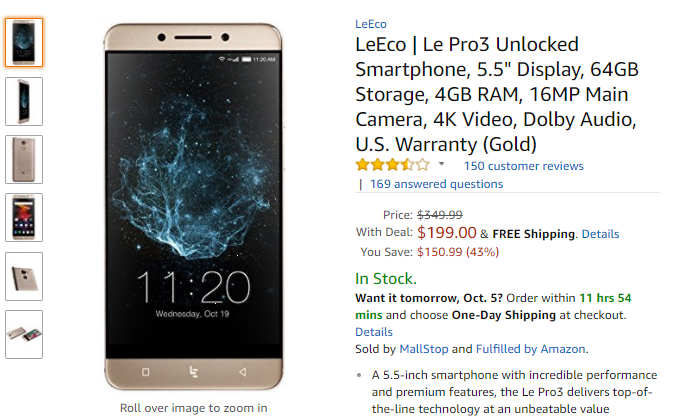
The LeEco Le Pro 3 was released last year as the company’s flagship phone. It is powered by the Snapdragon 821 and unlike some other manufacturers, the chip isn’t under-clocked. When it launched, the Le Pro 3 cost over $300 for the 4GB RAM + 64GB variant but if you head to the Amazon US website, you can pick it up for just $200!!!
Yes, $200 will get you a 2016 flagship that can compete with the OnePlus 3T, first gen Pixels and even the Mi 5S and Mi 5S Plus. The LeEco Le Pro 3 packs a 5.5-inch FHD display, a 16MP f/2.0 1.12 µm rear camera that can record in 4K. The front facing camera is an 8MP sensor which takes decent selfies.
You also get a 4070mAh battery with Quick Charge 3.0 support via a USB Type-C port. The Le Pro 3 doesn’t have a 3.5mm audio jack but you can be assured of an impressive audio experience with its award winning CDLA USB type-C earphones that are included in the box.
There is a fingerprint scanner on the back, an IR blaster, NFC, Bluetooth 4.2, Dolby Atmos Audio, and even FM Radio. The only downside is that it comes with EMUI 5.8 based on Android 6.0 Marshmallow. And since the manufacturer’s financial problem began there has been no software support for its devices.
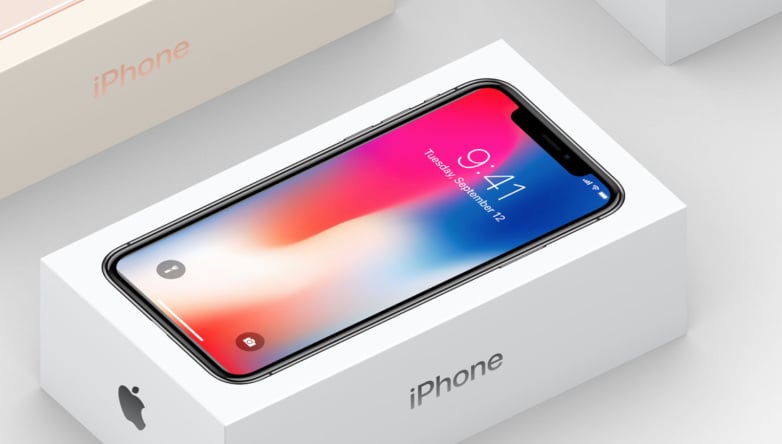
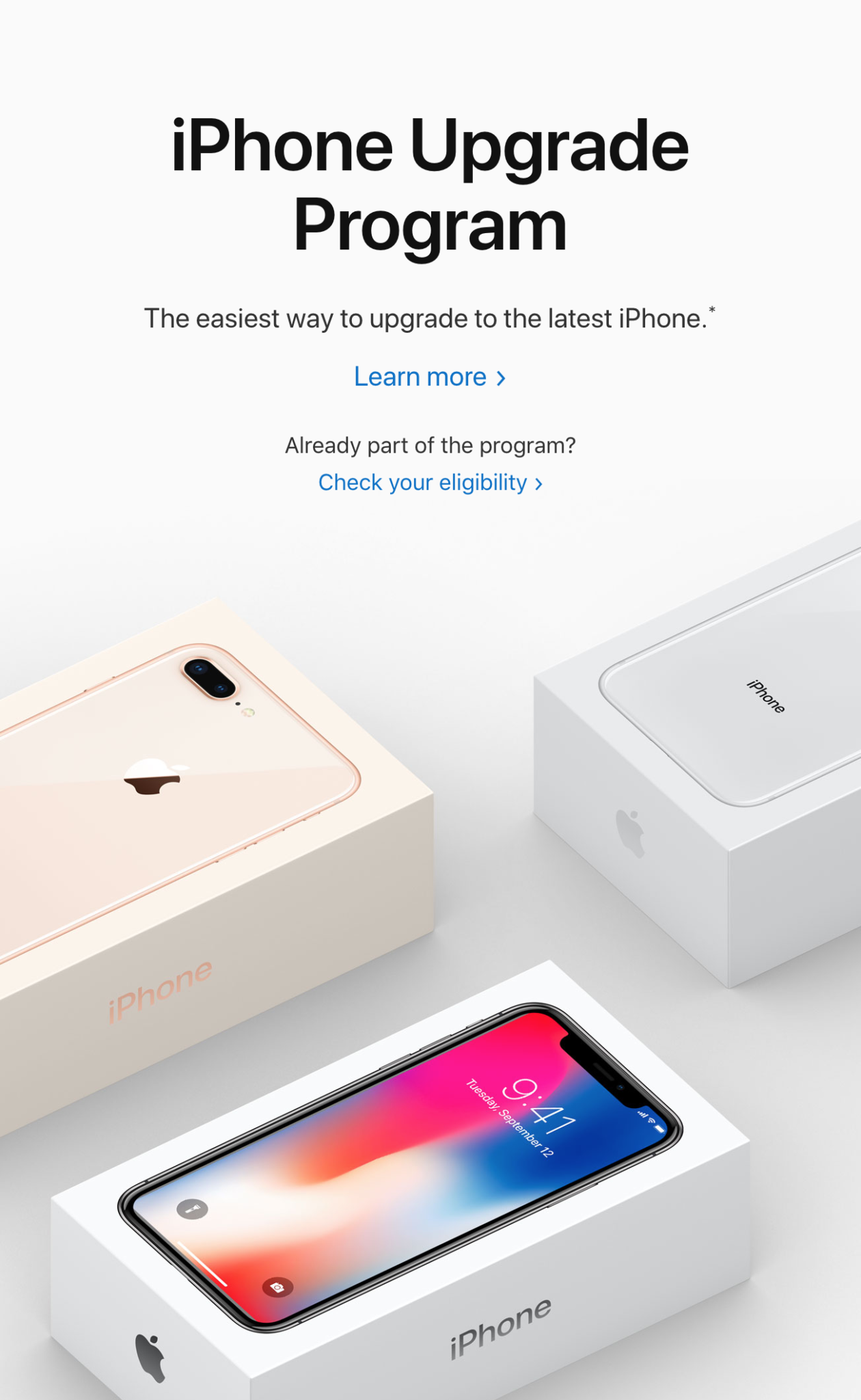
Apple’s iPhone X is no doubt the most spectacular product the company among the trio of smartphones the tech giant announced last month. A lot is already known about the iPhone X but usually, Apple doesn’t reveal the retail box of its iPhones before they go on sale. Not in this case, though, as the tech giant seems to have revealed the iPhone X’s packaging. The iPhone X’s retail box was included as part of the iPhone Upgrade Program imagery.
This isn’t very spectacular but it may be a bit interesting that Apple chose to show what the packaging looks like now, as that’s usually something that’s kept under wraps. The packaging itself shows that the main image at the top of the box is the iPhone X’s front view instead of the back view as is the case with the iPhone 8 and iPhone 7 series. The box for the iPhone 6 featured an embossed outline of the phone, while the iPhone 6s box showed the front of the phone in a similar fashion, but that is in order to highlight Live Wallpapers which the device features.
This isn’t too surprising considering that most of the changes which differentiates the iPhone X from other models were effected in the front aspect. Apple perhaps aim to highlight the bezel-less design without a physical home button and other features the iPhone X comes with.
It isn’t 100% certain that Apple will utilize this design for the iPhone X retail box but we can take it that this is the packaging box for the 2017 flagship iPhone X since it is coming out directly from Apple.
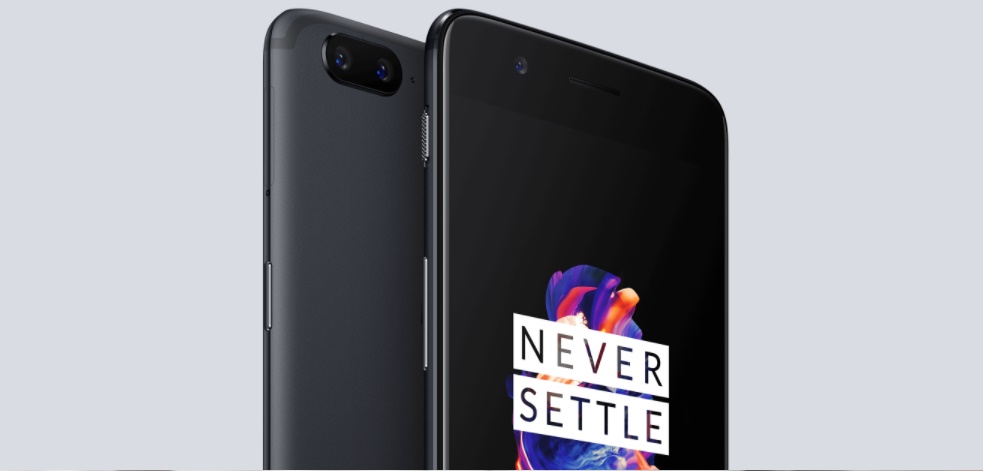
At the end of the previous month, OnePlus had released OxygenOS 4.5.0 update for OnePlus 3 and 3T smartphones. The Chinese manufacturer has now released OxygenOS 4.5.11 update for OnePlus 5. Even though many users in Canada have received the update, there was no official announcement on its arrival. In the previous month, the company had released OxygenOS 4.5.10 to bring camera improvements and system optimizations.
The OxygenOS 4.5.11 is a big fixing update that has been released to fix some issues that OnePlus 5 users have reported since its launch. Some users had claimed that while using YouTube, the video lagged behind the audio while others had reported about poor 4G+ network strength in some areas. The update has been rolled out to resolve these issues.
Some OnePlus 5 users have complained about adaptive brightness issue. This issue has also been fixed by the new update. The OxygenOS 4.5.11 also fixes display issues of some UI elements. However, there is no precise information to know what those issues are.
The OxygenOS 4.5.11 update also brings along security patches for the September month. These patches would be able to protect OnePlus 5 from the recent Blueborne vulnerability. After installing the update, users have also noticed that the apps are launching faster than before. The update also brings the ability to customize the notification ringtone.
As mentioned above, the update is currently available in Canada and is being gradually rolled out in phases. Hence, it may take couple of weeks for all the OnePlus 5 devices to receive OxygenOS 4.5.11.
As far as Android 8.0 Oreo update is concerned, OnePlus has confirmed recently that the new firmware will be brought to OnePlus 5 before the end of this year. OnePlus 3 and 3T are the other smartphones from the company that are eligible to receive Android 8.0 Oreo upgrade. The Chinese firm is expected to begin beta testing of its Oreo update before making it widely available to its users.
Have you received the new OxygenOS update on your OnePlus 5? Share us your experience by posting your comments below.
A survey has been conducted which is aimed at getting an idea of the number of iPhone users who would go for any of Apple‘s latest iPhone models. The research determined that fewer consumers want to buy one of the new iPhones compared to last year. The research conducted by RBC Capital Markets showed a decline in the percentage of possible iPhone buyers who would want either of the iPhone 8, 8 Plus or iPhone when compared to last year.
The survey was conducted among 4000 respondents and the findings indicated that 64% of possible iPhone buyers want one of the Apple iPhone 8, or iPhone 8 Plus or an iPhone X, as against last year’s survey findings which showed that 71% of prospective iPhone buyers wanted an Apple iPhone 7 or Apple iPhone 7 Plus. That doesn’t in any way mean the iPhone 7 is more popular than its successors but RBC offered an explanation that Apple has kept too many options available for possible iPhone buyers to choose from, by failing to eliminate 2015’s Apple iPhone 6s.
Despite the lesser number of interests in the new iPhones, this is one time when less is more. Because of the higher price of the iPhone X, Apple will likely rake in more profits from its latest models than previous editions. RBC remains positive and bullish about the prospects of the models in the market. More than half of the potential buyers in the survey indicated that they will purchase the highest storage variant of the iPhone X and with its higher price tag, that would be a huge boost to Apple’s revenue, as well as its profits. The iPhone X with 64GB storage has a retail price of $999 while the higher storage version with 256GB storage costs $1,149. With so much hype surrounding the product, it still isn’t available to buy. Pre-orders will commence on October 27th while the iPhone X is expected to go on sale from November 3rd.
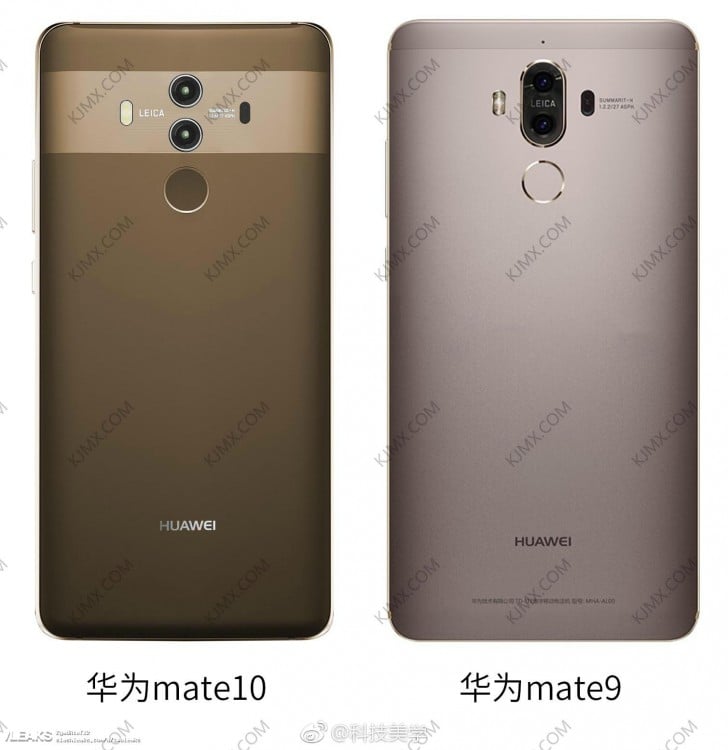
The Huawei Mate 10 series are slated to get unveiled in the third week of this month. Speculations have revealed that the Mate 10 series will include four smartphones such as Mate 10, Mate 10 Pro, Mate 10 Lite and Mate 10 Porsche Design. A new image of the Mate 10 Pro that compares it with Mate 9 from last year has surfaced. The image shows the design changes that the Chinese manufacturer has introduced on Mate 10 Pro.
Even though the dimensions of the Mate 10 Pro are not available, the above image does reveal that the handset is slightly slimmer and shorter than the predecessor model. This could be because the Mate 10 Pro is speculated to feature a 6-inch display with an aspect ratio of 18:9. The Mate 9 features a 5.9-inch display with an aspect ratio of 16:9.
The Huawei Mate 9 has a metallic unibody chassis. However, the Mate 10 Pro is speculated to come with a glass back. The design of the dual rear cameras has been modified on the Mate 10 Pro. The Mate 9 has a single housing for both the Leica branded camera sensors, but the two sensors can be seen sitting separately on the Mate 10 Pro. Rumors have it that the Mate 10 and 10 Pro would be equipped with a pair of f/1.6 aperture lenses. The dual camera system is equipped with features like dual-LED flash and laser autofocus.
Also, the dual camera system is placed on a patterned texture on the Mate 10 Pro. There seems to be no change in position of the fingerprint scanner and Huawei branding.
The Huawei Mate 10 Pro is expected to come preinstalled with Android 8.0 Oreo that will be skinned with EMUI skin. It is rumored to feature a 4,000mAh battery. The Mate 10 and Mate 10 Pro are going to feature the in-house Kirin 970 SoC that includes a dedicated a neural processing unit (NPU) for handling AI features.
Recent reports have revealed that the Mate 10 Pro will be coming in four models such as 6GB RAM/64GB storage, 6GB RAM/128GB storage, 6GB RAM/256GB storage, and 8GB RAM/256GB storage. These models are speculated to be respectively priced at 5,499 Yuan (~$827), 6,199 Yuan (~$933), 6,899 Yuan (~$1,038), and 7,499 Yuan (~1,129).
What do you think of the new design of the Huawei Mate 10 Pro? Share us your thoughts by adding your comments below.
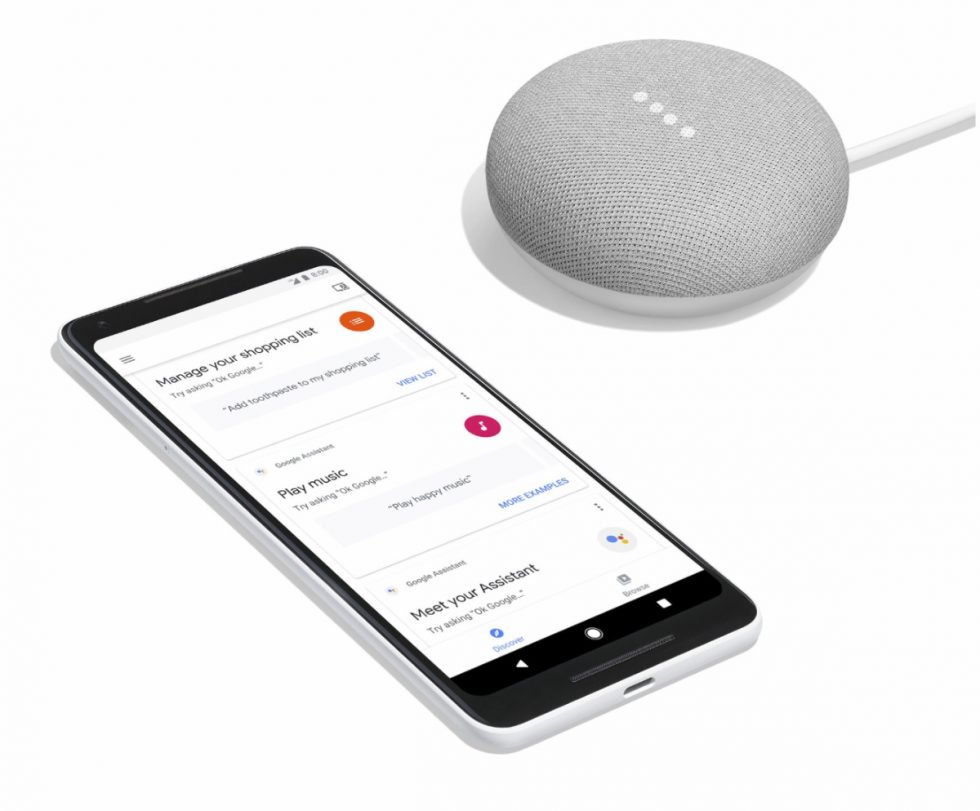
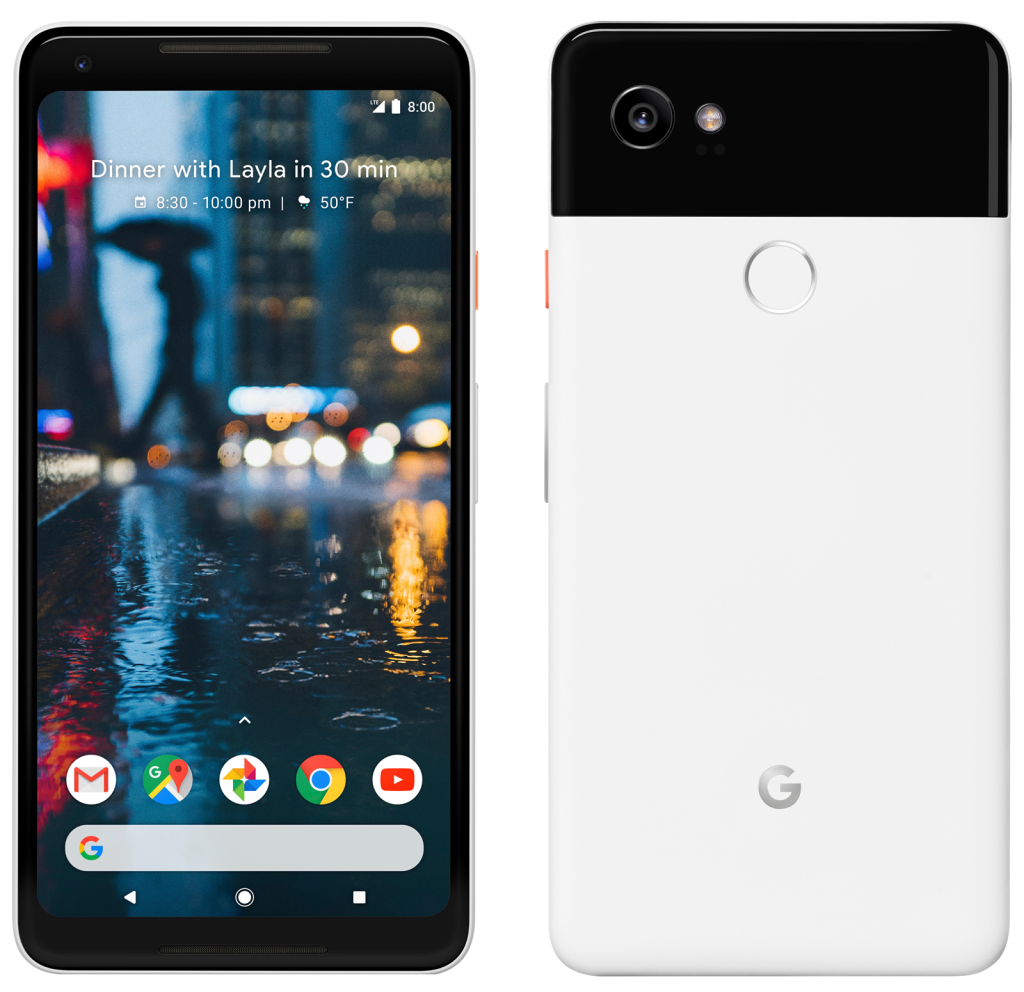
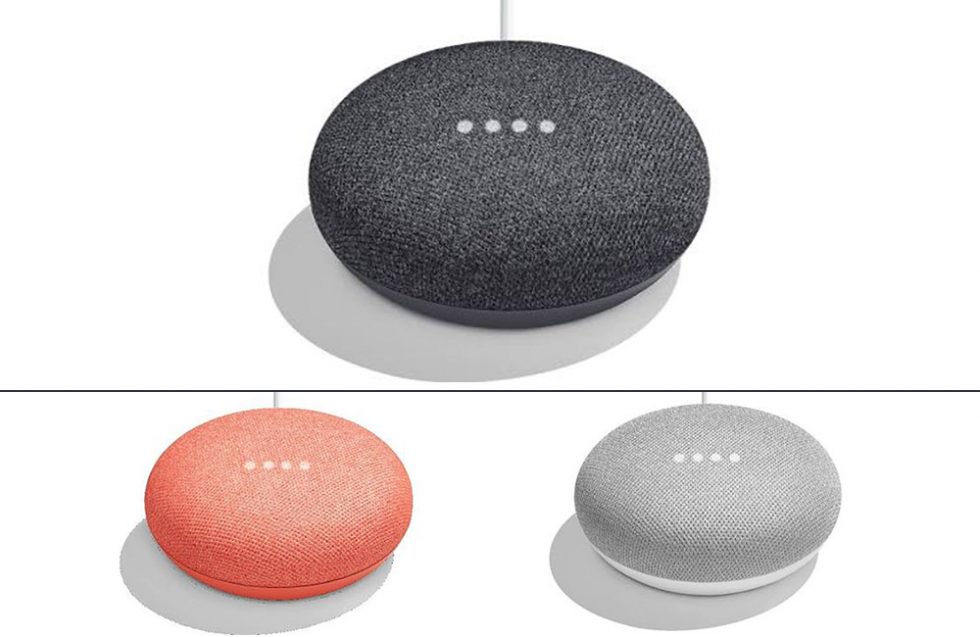
Google had done a good job of keeping the upcoming Pixel 2 and Pixel 2 XL smartphones under the wraps throughout the year. However, the entire specifications of both phones have surfaced in the past few weeks. The leaked press renders of Pixel 2 duo have also surfaced earlier in this week. Few hours ago, the Google Home Mini smart speaker that is expected to get unveiled on Wednesday was made available on pre-orders on Walmart. The listing not only contained images of the Home Mini but also it featured an image of the Pixel 2 XL. The pre-order listing on Walmart was taken offline quickly, but 9to5Google was able to download the images of both devices.
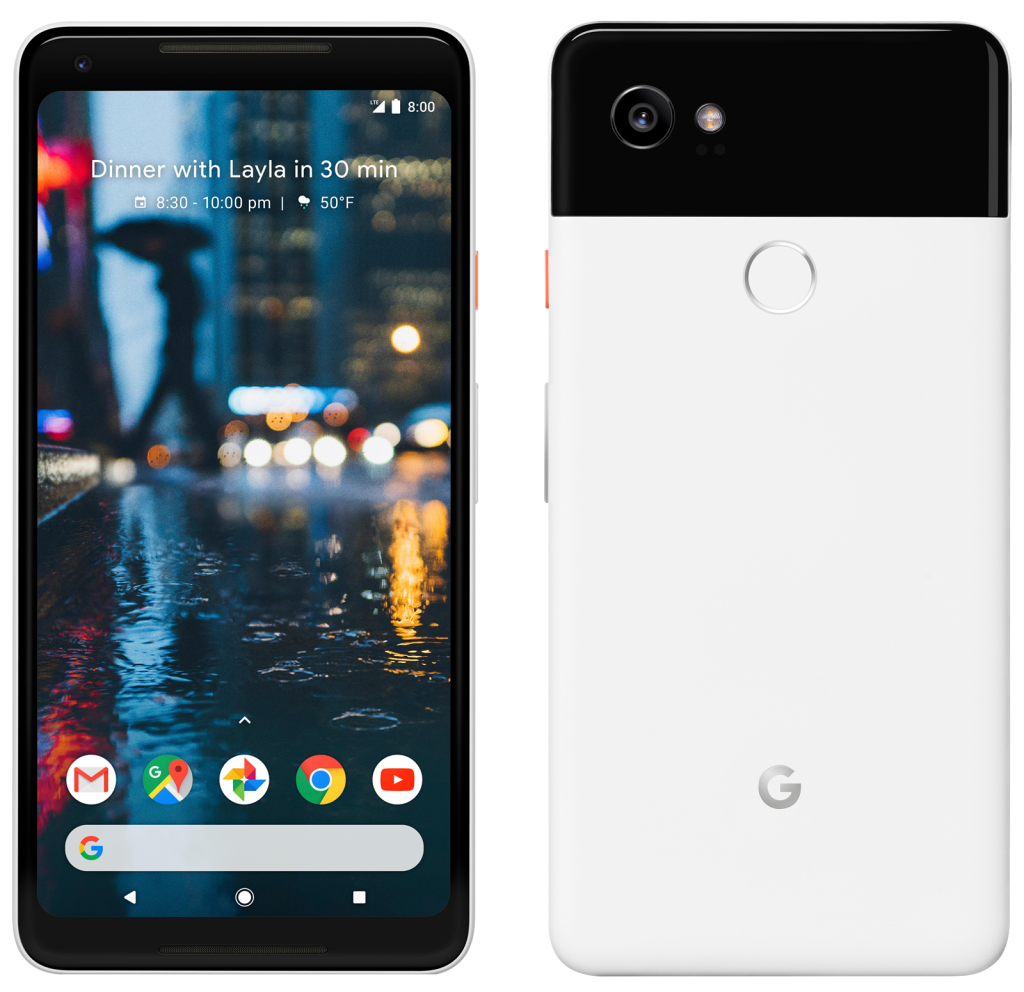
The above image of the Google Pixel 2 XL that has surfaced through Walmart shows that it features a white rear and a black colored front. The glass that is laid on top of the display seems to a bit curved at the edges.
The bottom side of the phone features a USB Type-C port and its front-facing dual speakers are also visible. The screen has rounded corners. Even though the side bezels do not appear very slim, they seem to be thinner than the bezels of the predecessor phone. Rumors have revealed that the Pixel 2 XL is an LG-made device that features a 6-inch display that supports QHD+ resolution and an aspect ratio of 18:9.
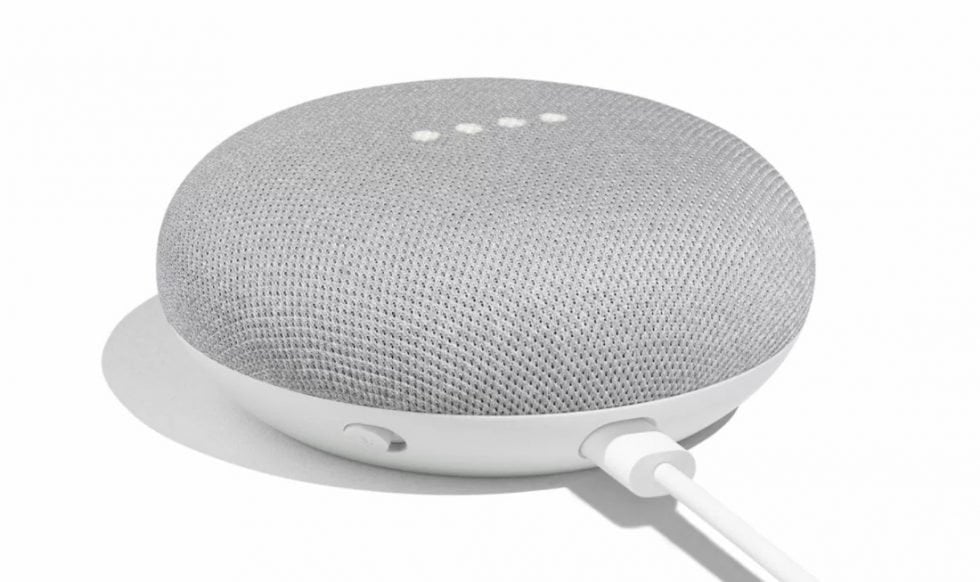
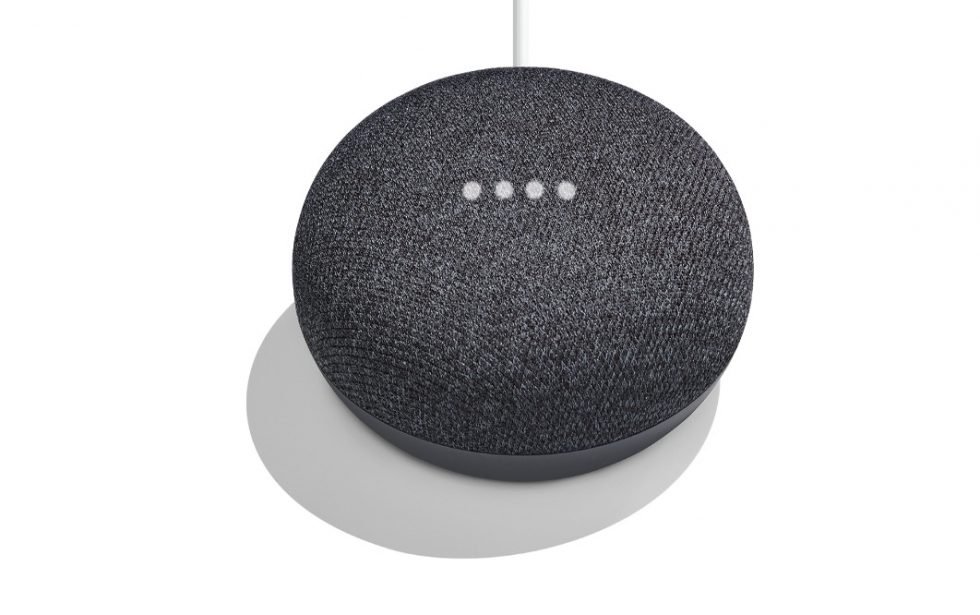
As previous reports have revealed, the Google Home Mini is a smaller edition of Google Home smart speaker. It was listed with a pricing of $49 on Walmart.
The Home Mini that is powered by Google Assistant can answer queries, control the smart home, play music and share weather info. It measures 4.53 x 4.53 x 4.72 inches. The pre-order page of Google Home Mini had revealed that its shipping will begin on Oct. 19.
As far as Google Pixel 2 XL is concerned, recent reports have revealed that its 64 GB and 128 GB models will be respectively priced at $849 and $949. Even though the Pixel 2 XL will be unveiled on Wednesday, its shipments are rumored to begin on Nov. 15. The Google Pixel 2 is rumored to be respectively priced at $649 and $749 for 64 GB and 128 GB storage models. Its shipments are rumored to begin on Oct. 19.
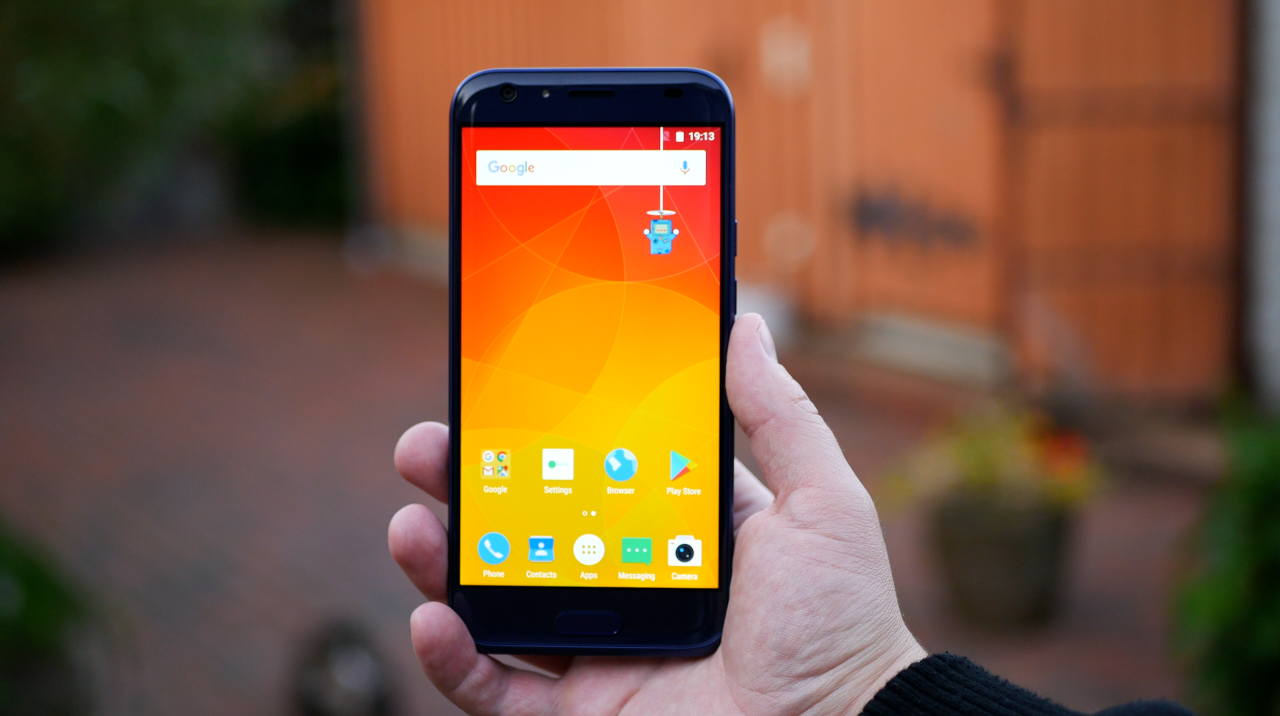
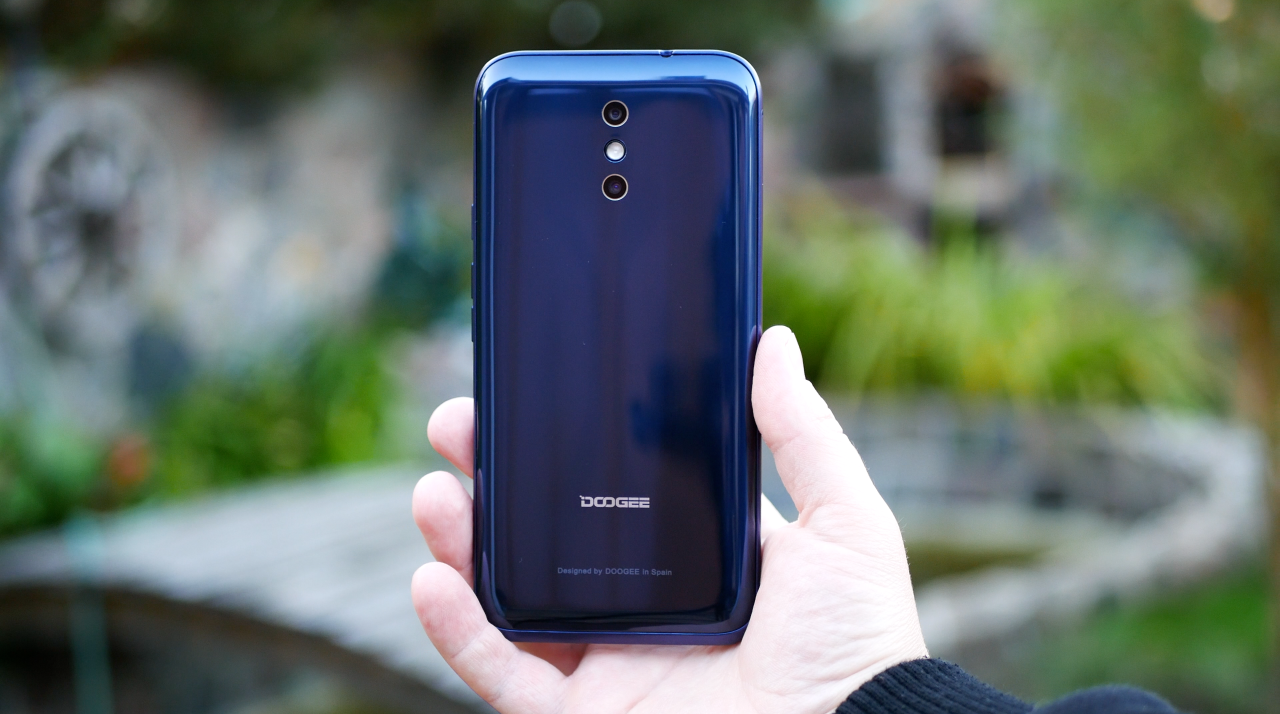
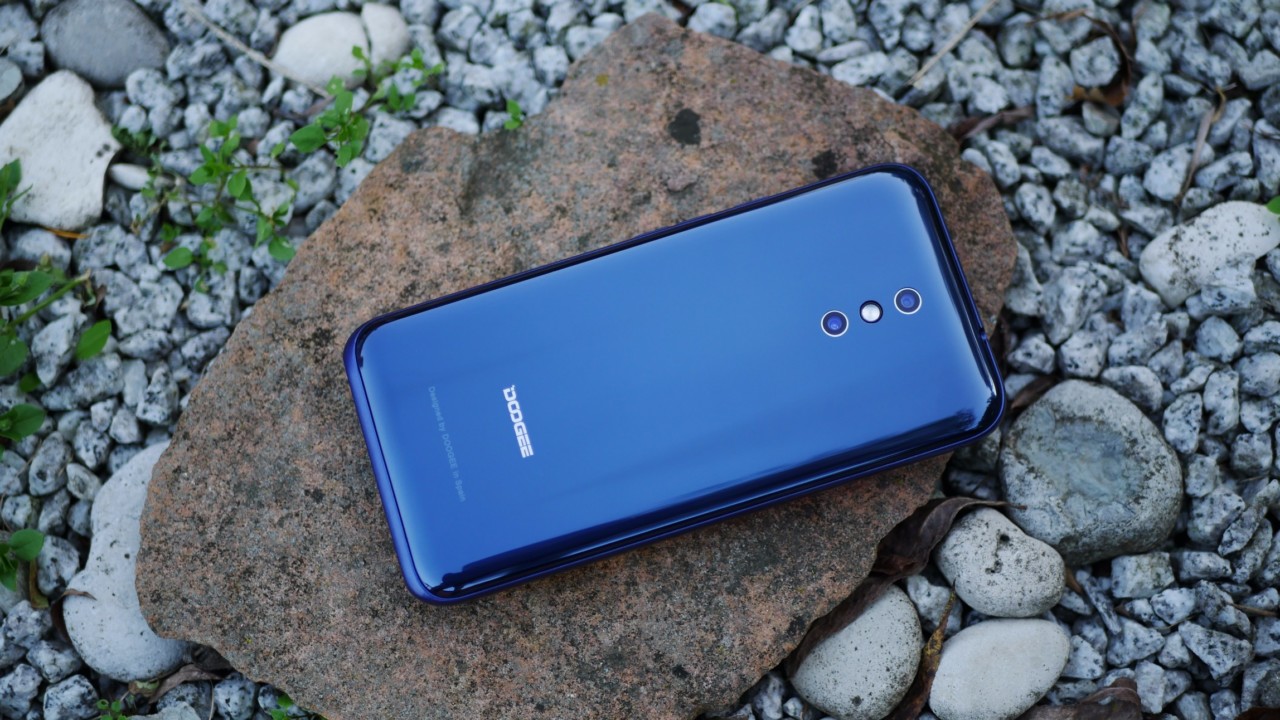
Doogee has made quite a few phones over the time and the BL5000 offers a huge 5050mAh battery, awesome design, and great specs for less than $150. Learn more in the full Doogee BL5000 review.
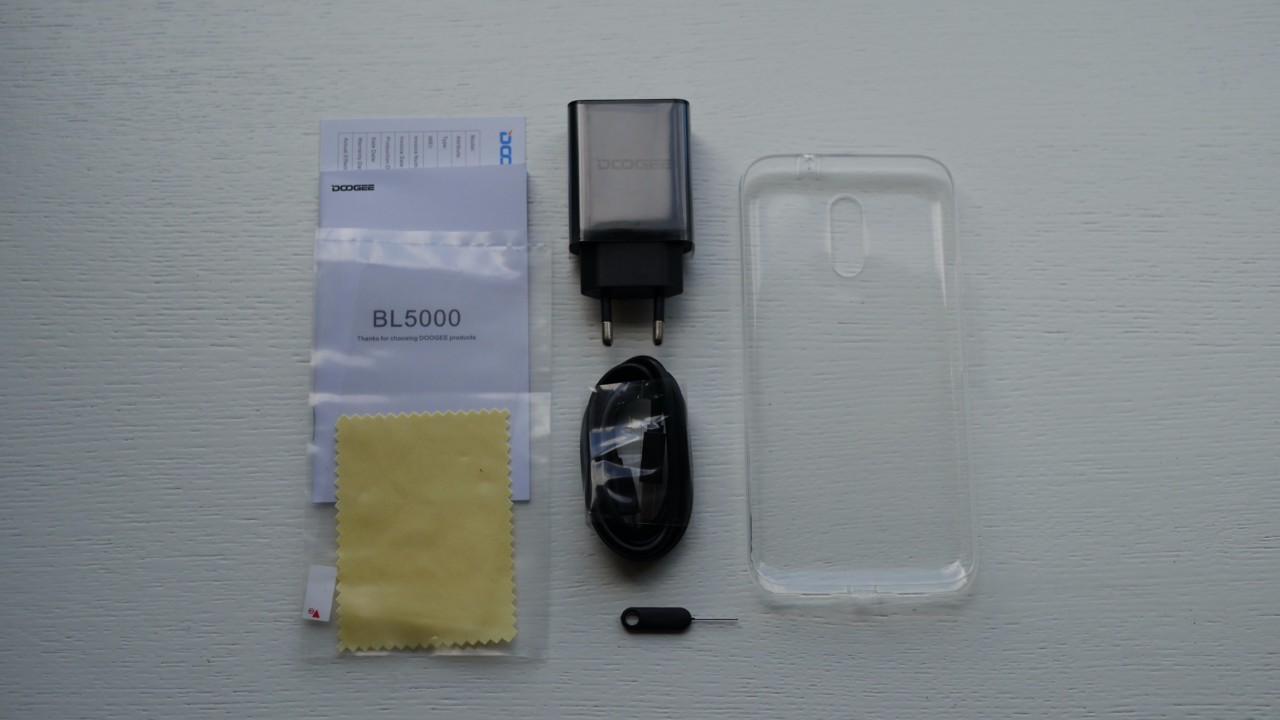
The phone ships with all the usual stuff and some extras include a TPU case and a screen protector.
DESIGN and DISPLAY
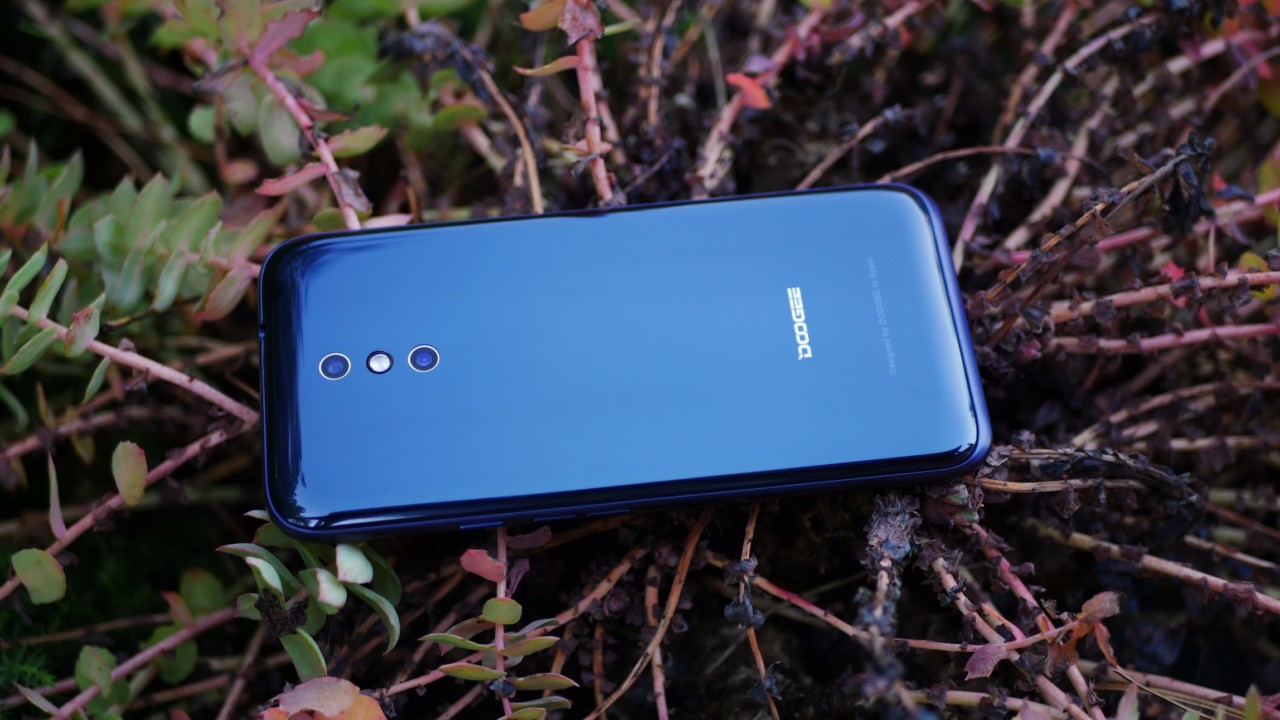
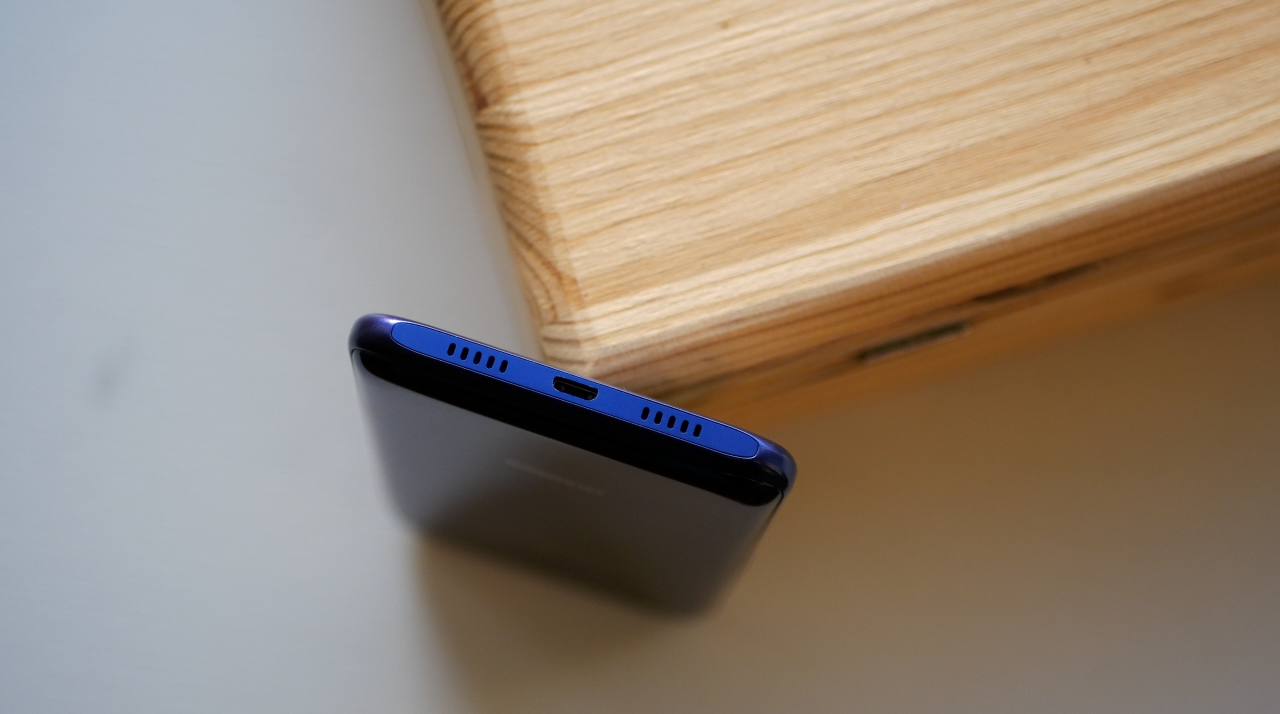
For $150, you get a phone that looks just beautiful. It is curved on all 8 sides for aesthetics and better grip, it has a quality metal frame and a glass panel, which, however, feels more like a plastic to me. The button placement is quite terrible. I always keep pressing volume keys instead of a power button.
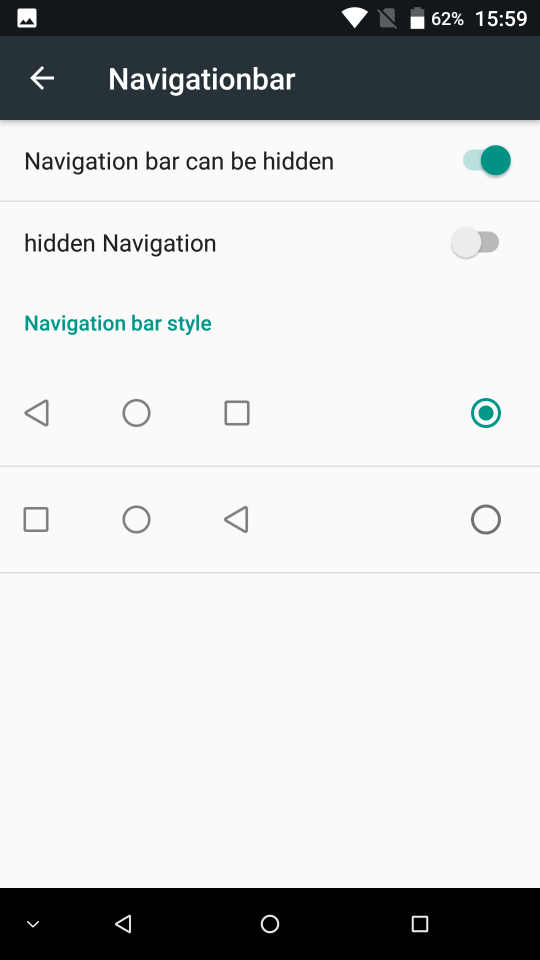
The 5.5” 1080p display is very good for a budget phone and it can get really bright for a better outdoor visibility. Also, it is said to be covered with the Gorilla Glass 5. The home key has an integrated touchpad for convenient navigation but you can also choose on-screen keys. The fingerprint scanner is accurate but there is a slight delay between the recognition and the time when the display lights up.
The BL5000 is advertised as a dual-camera phone that has two 13MP shooters for pictures with a blurred background. Make sure to stick till the end of the review to find out if it is true.
Now little things: there is no LED notification light but there is an 8MP selfie camera and LED flash. The loudspeaker quality is average. It definitely lacks depth and clarity.
HARDWARE and PERFORMANCE
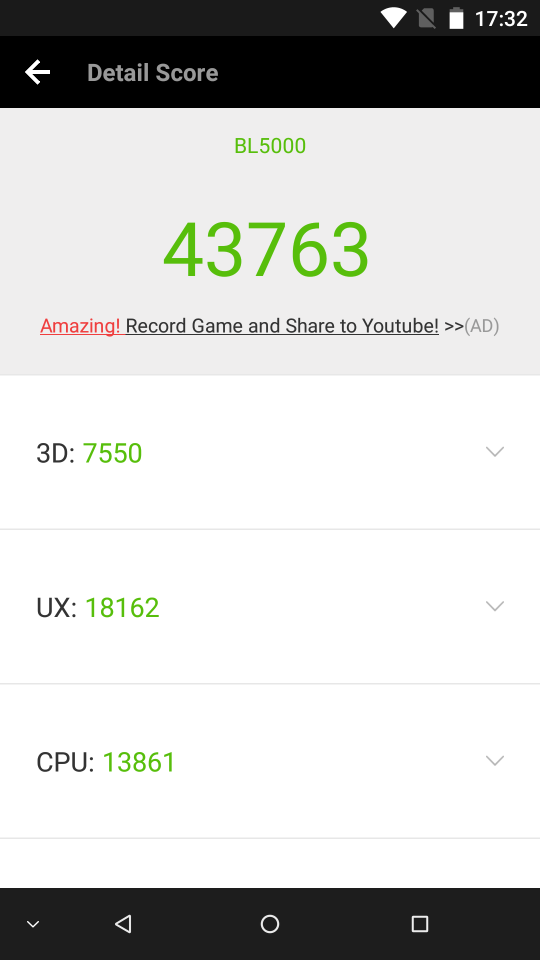
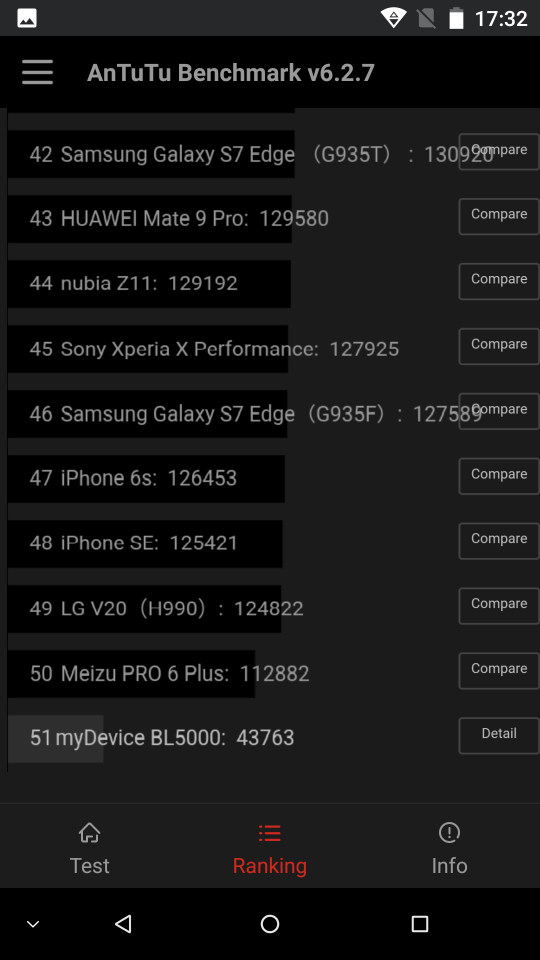
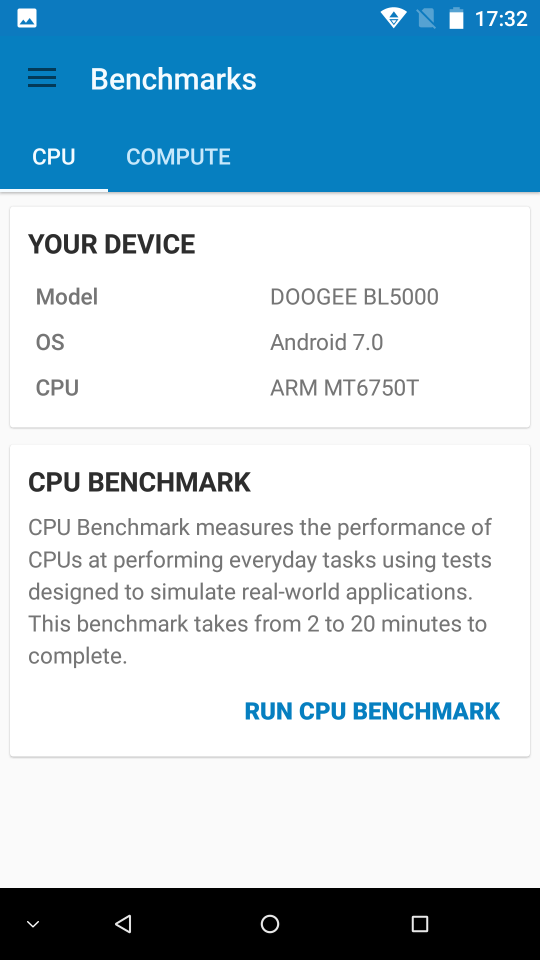
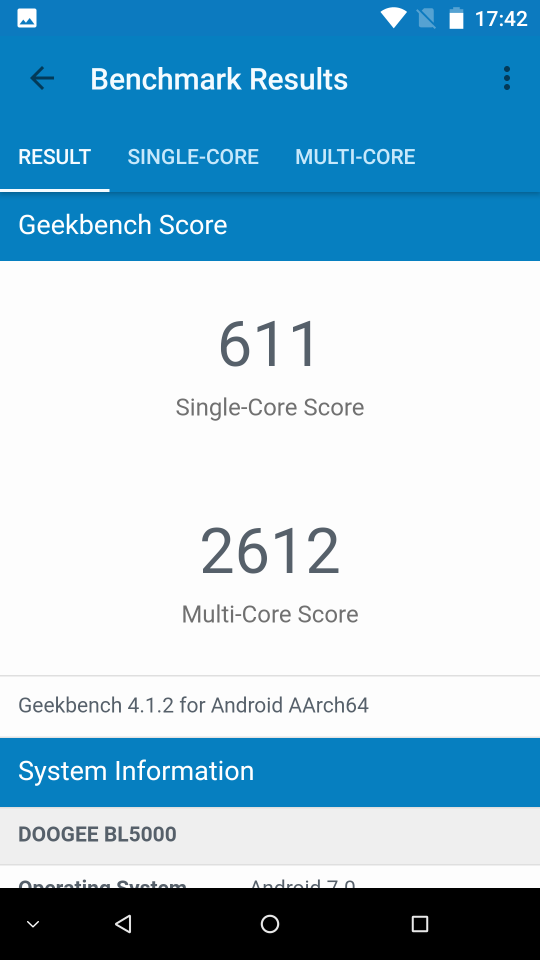
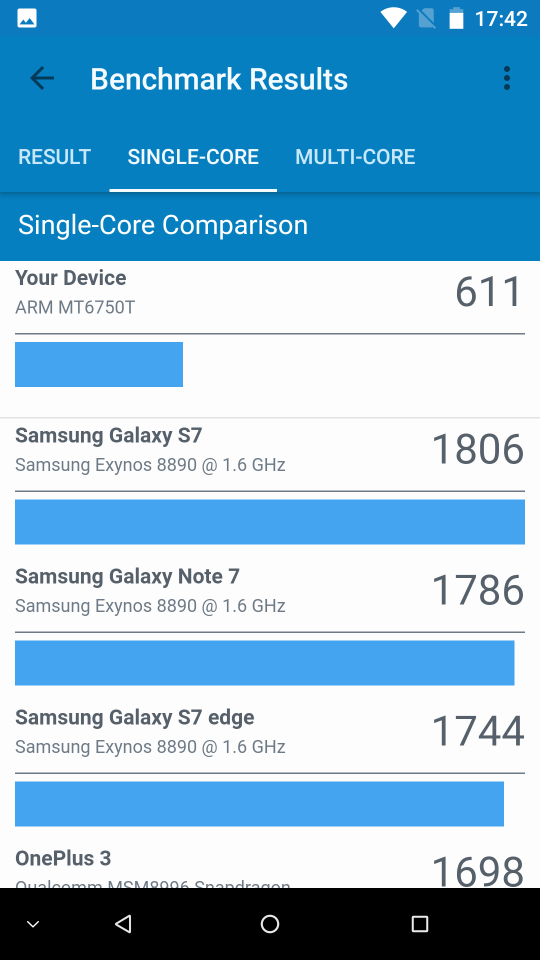
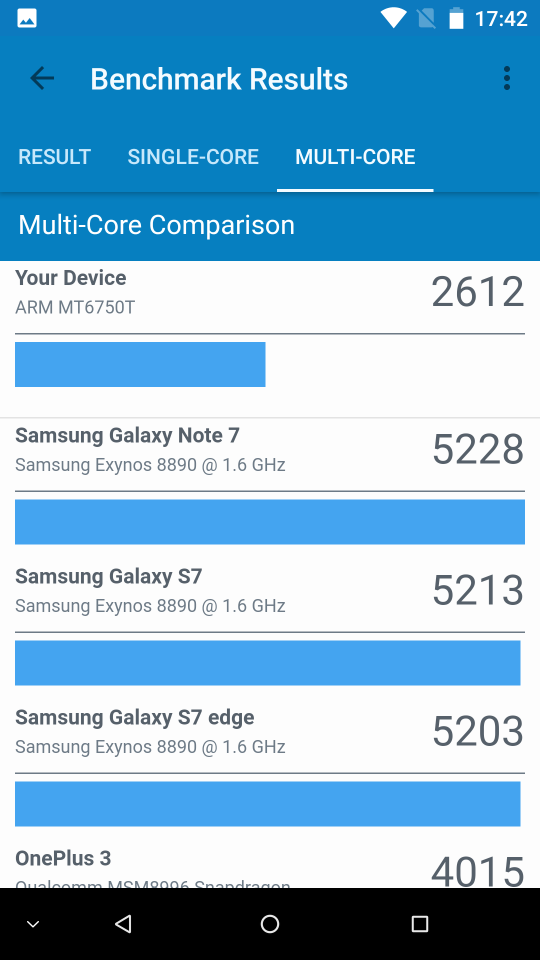
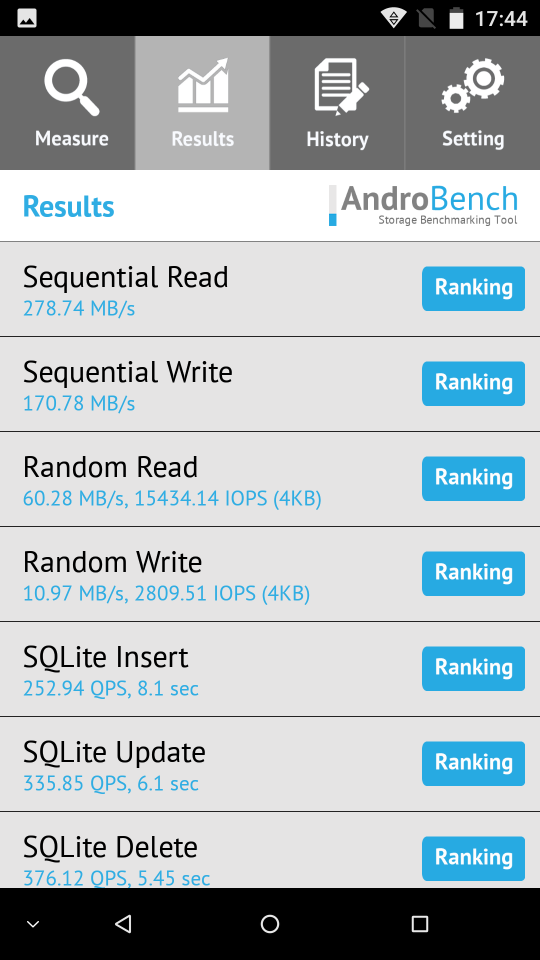
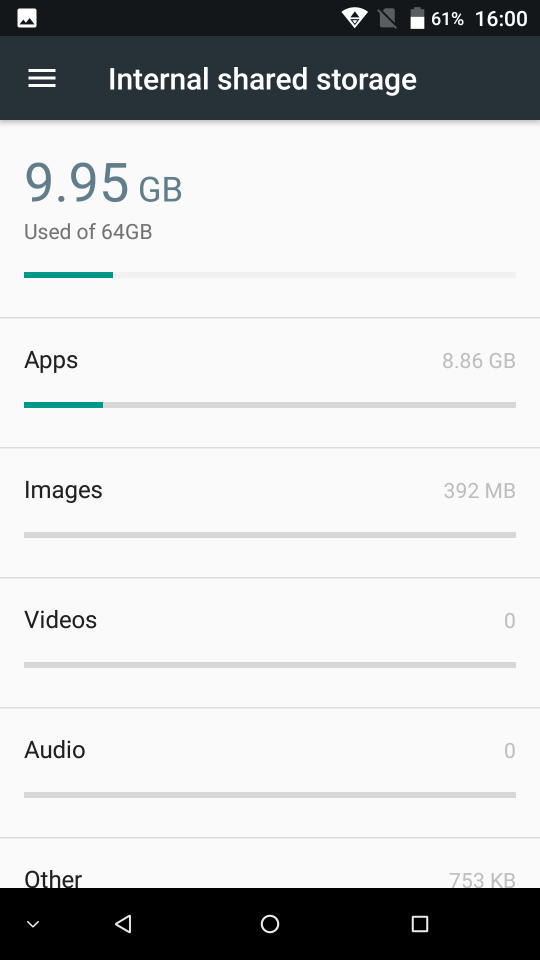
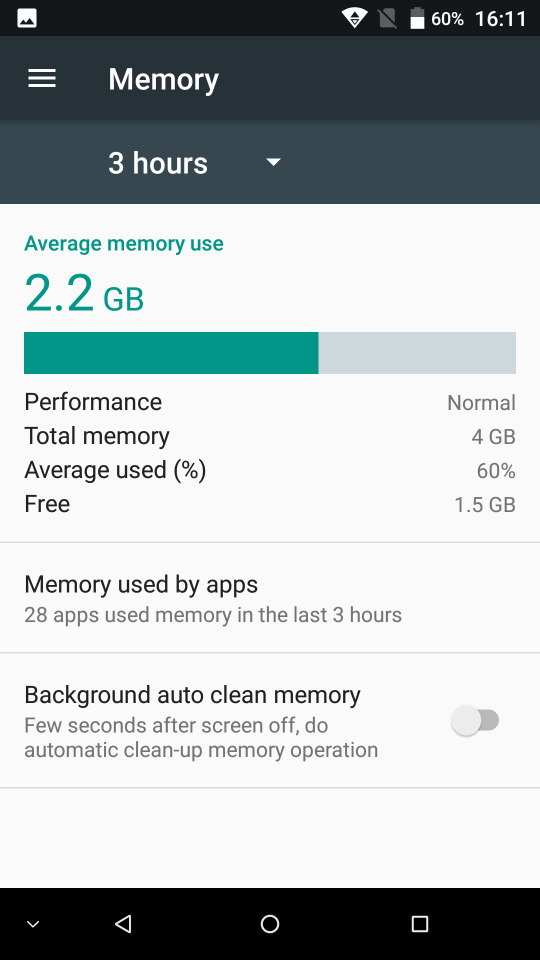
As far as hardware goes, the Doogee phone has pretty good specs for the price. The device ships with an octa-core MTK6750T chip, 4GB of RAM and 64GB of expandable storage.
The gaming performance is not bad but you should expect some skipped frames on graphically-intensive 3D games on the highest graphics settings. Changing graphics settings to medium definitely helps solve this issue.
BENCHMARKS
USER INTERFACE
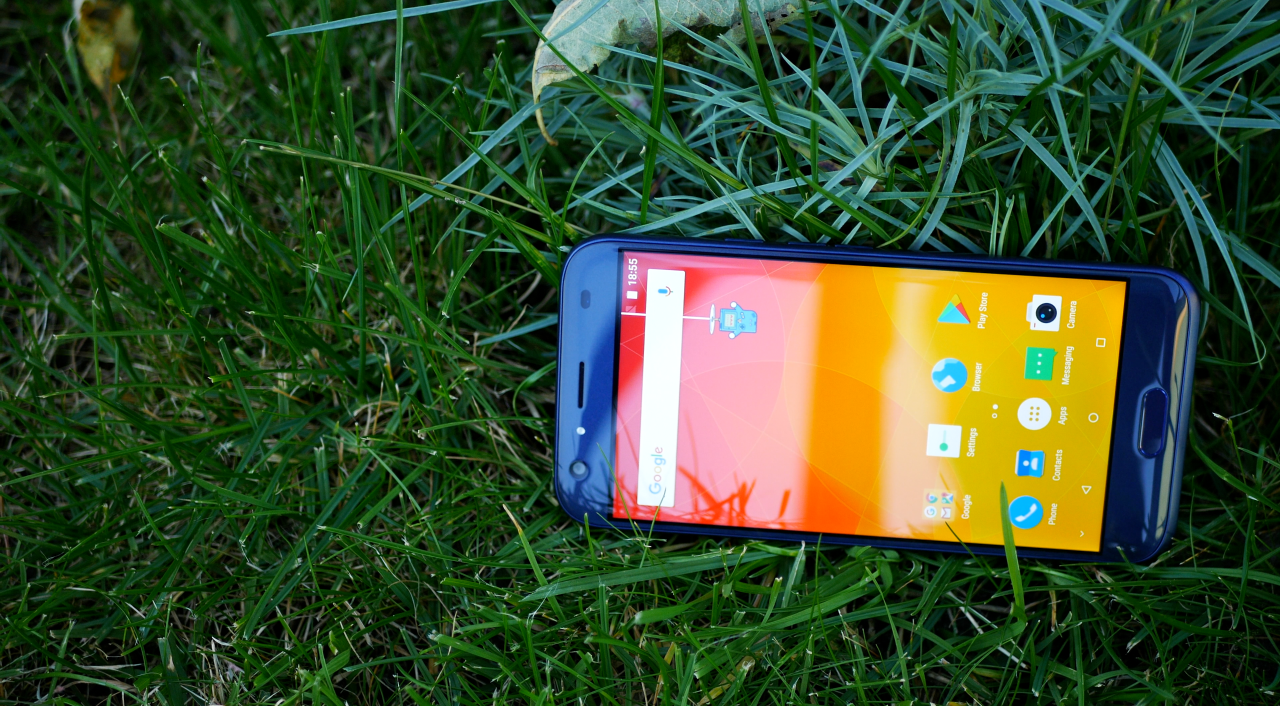
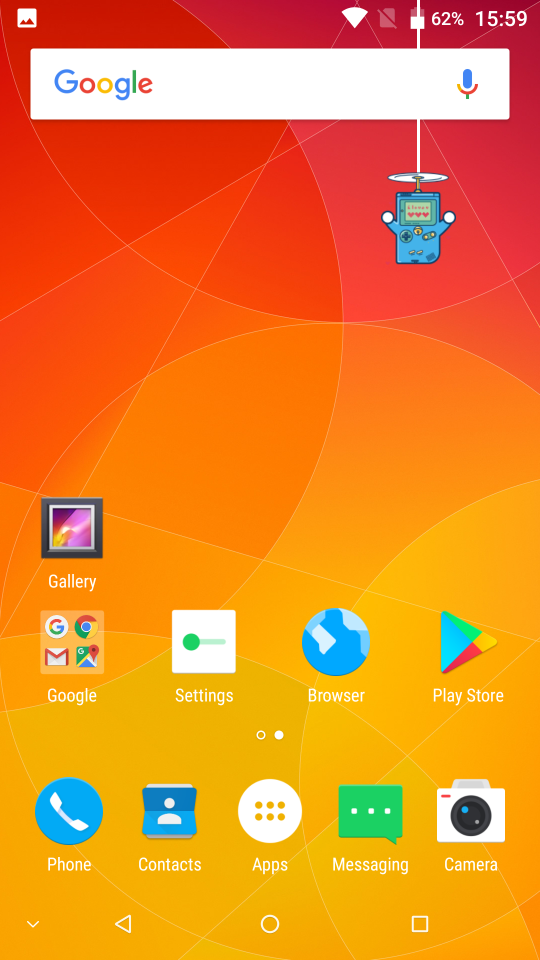
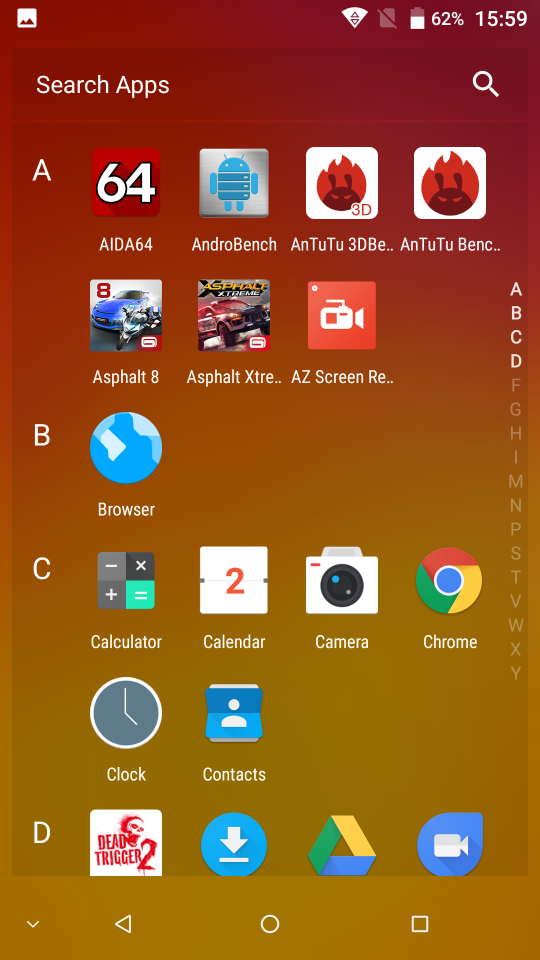
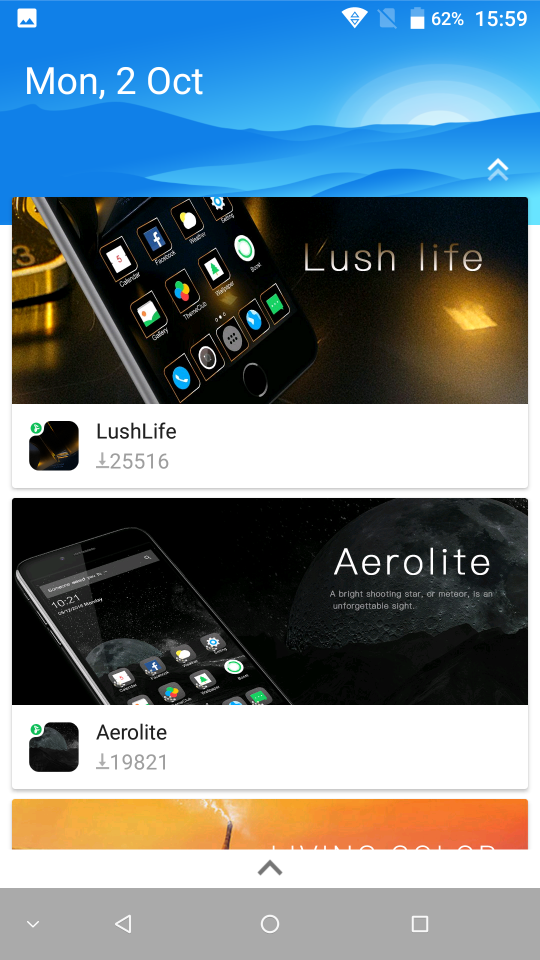
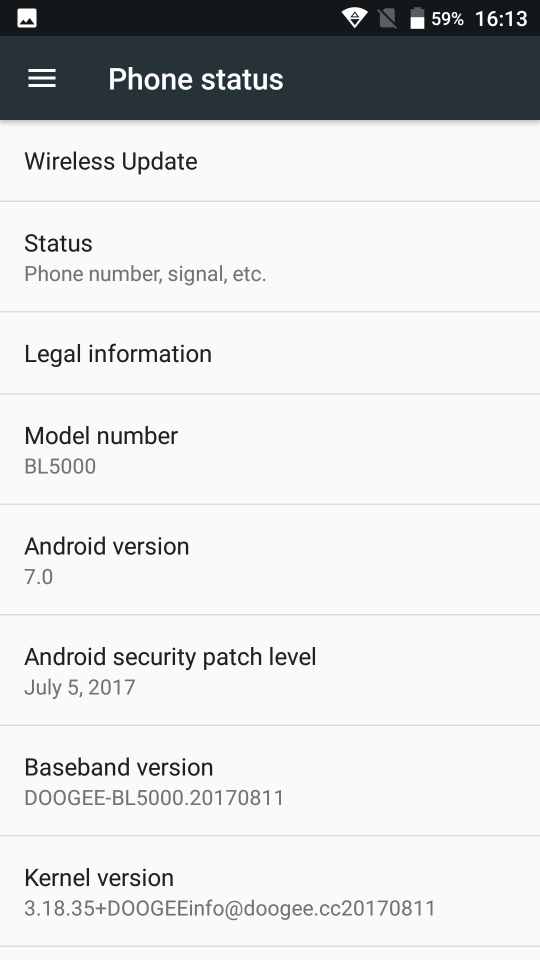
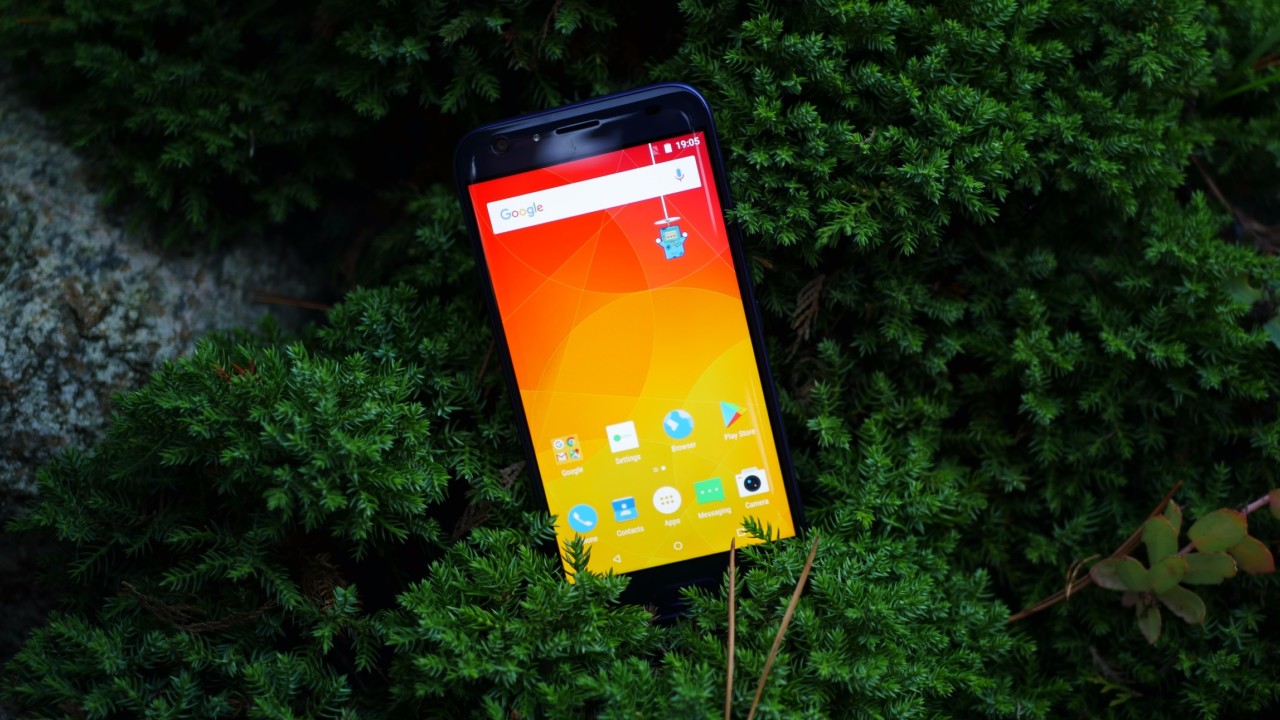
Doogee built their custom skin on top of Android 7.0. The UI looks kind of cartoonish to me but you can always throw in a custom launcher.
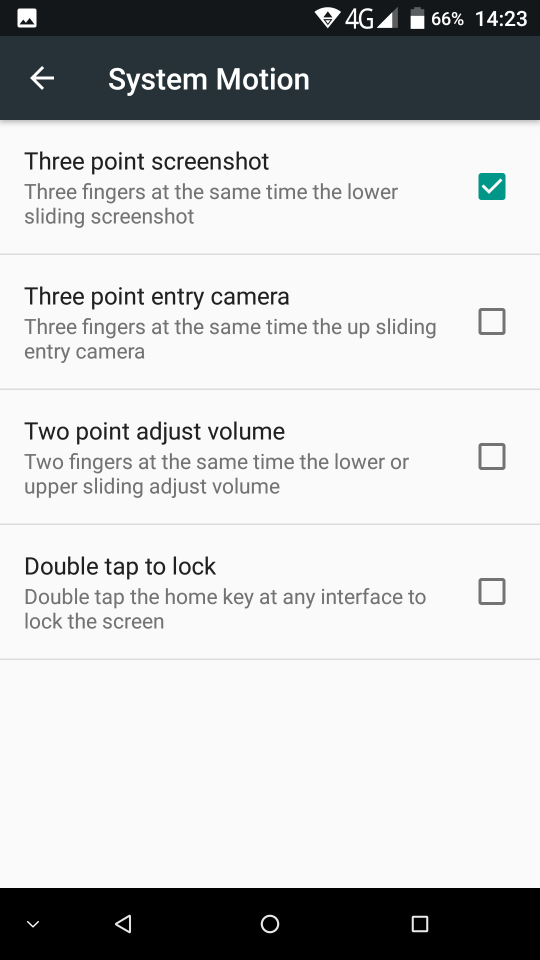
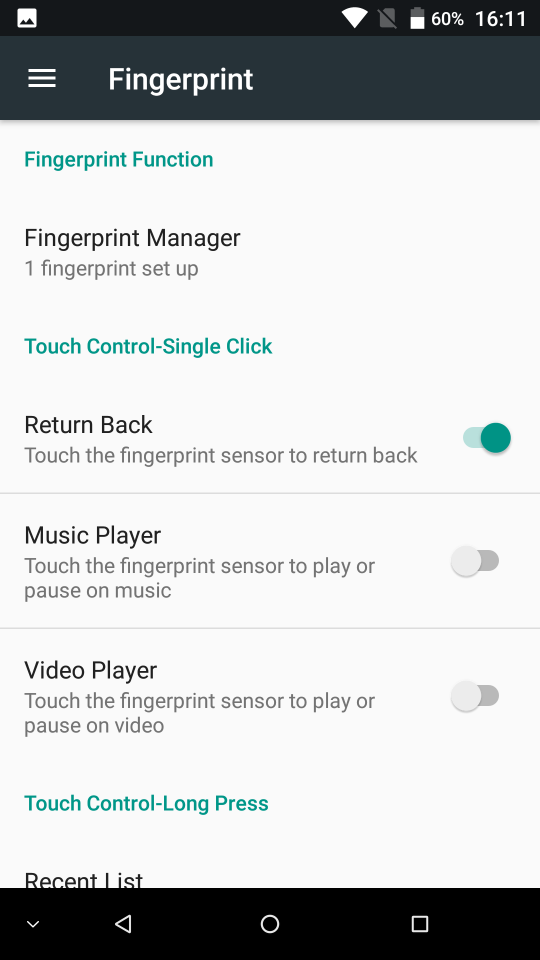
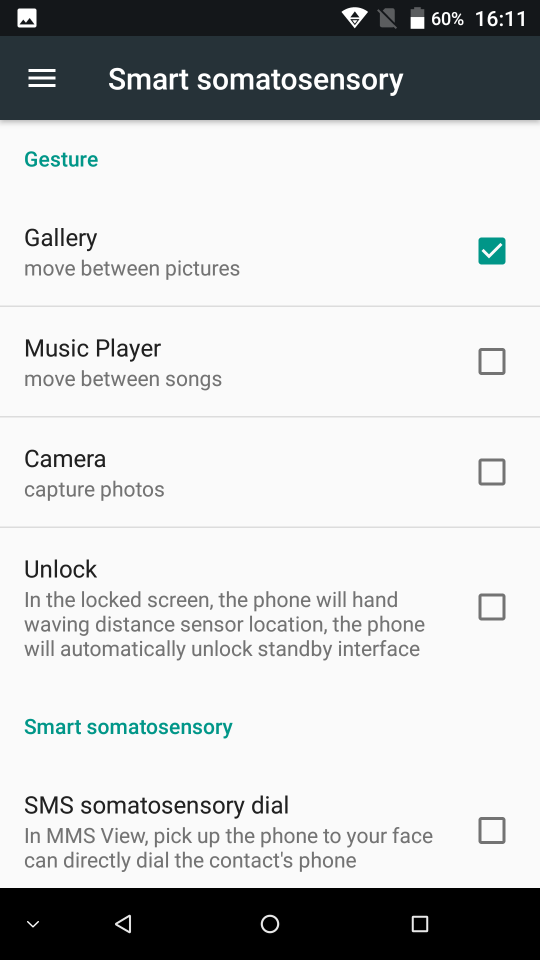
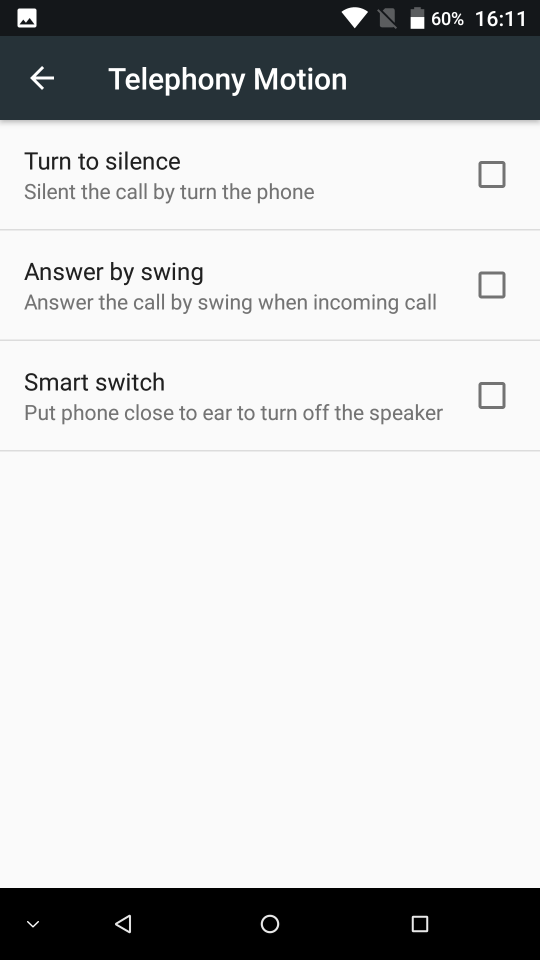
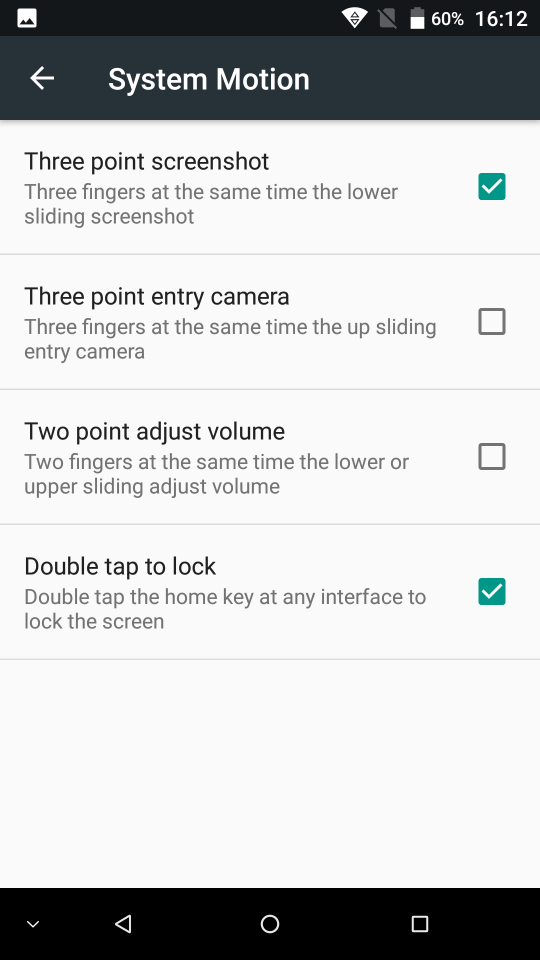
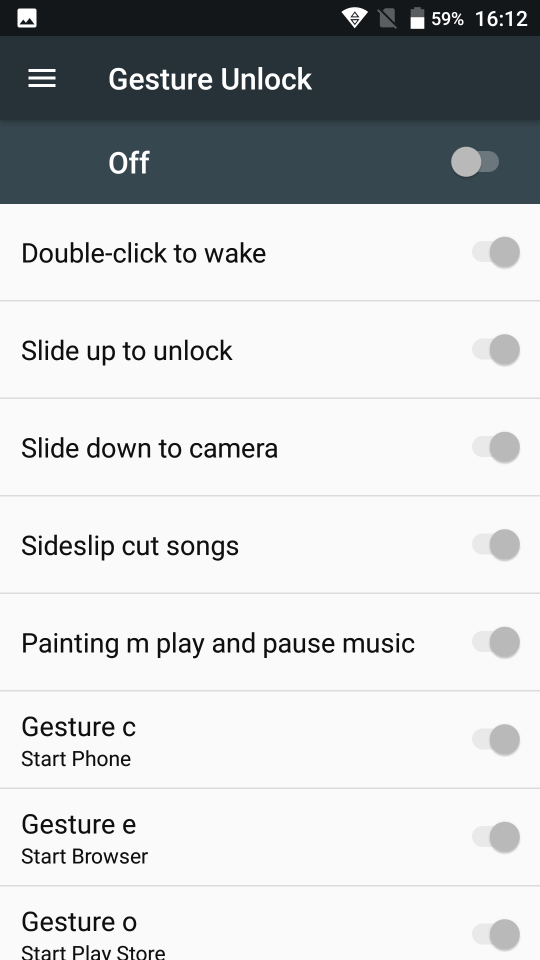
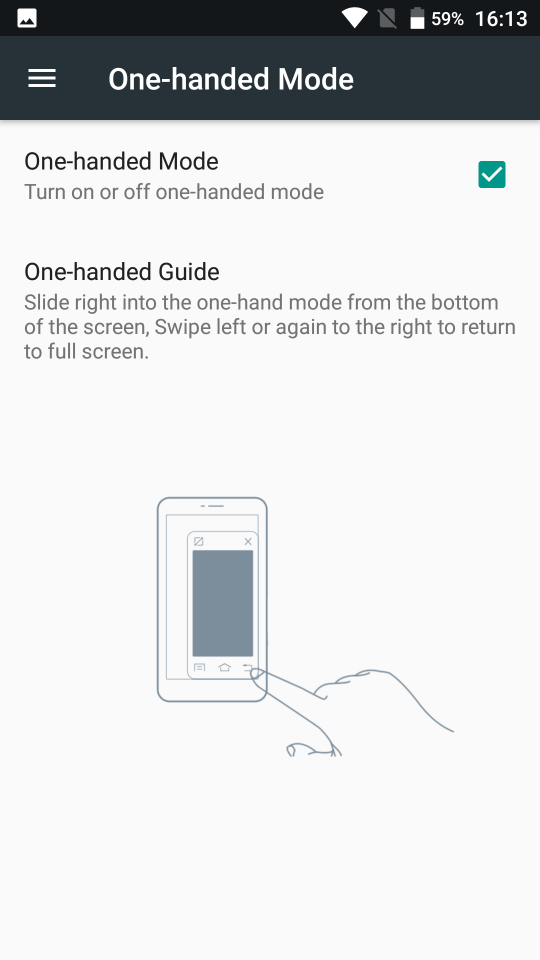
There are quite a few added features like a news center, integrated theming engine, and some gesture and motion controls that work fine but I don’t really use them. Besides other features, there is a fast capture option that allows recording a video straight from the standby mode. What is more important to me is that the phone is fast and responsive even after installing a lot of apps that usually run in the background.
IMAGE QUALITY
The image quality is decent but it could be better. As usual to this category of budget phones, you can get some nice pictures but some of them could be more detail, the colors could be more accurate and the dynamic range adjustment is average.
The pictures taken in the bokeh mode will look pretty cool on Instagram but this is more of a software trick rather than quality dual-camera implementation.
The low-light shots are kind of mediocre or poor.
Selfies could definitely have more detail and the front-facing flash does not really help at night.
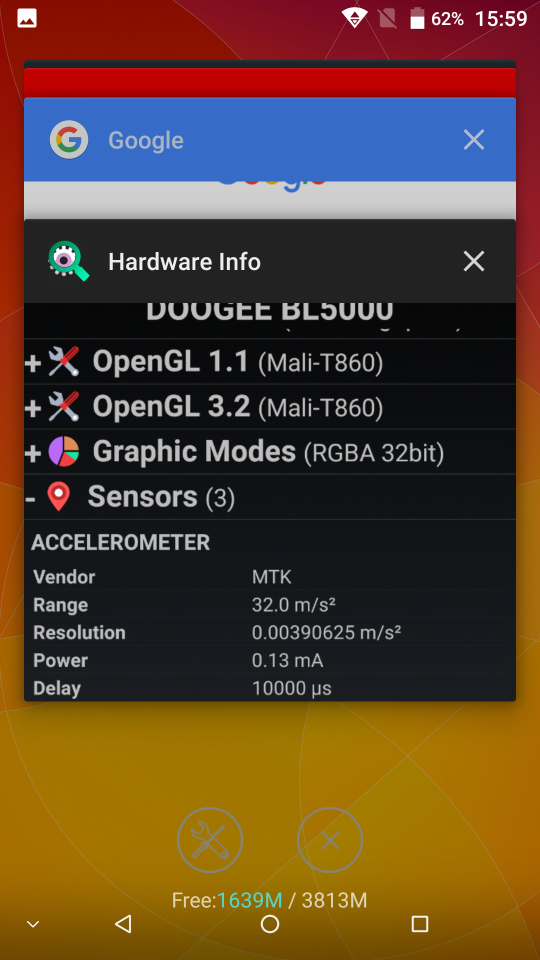
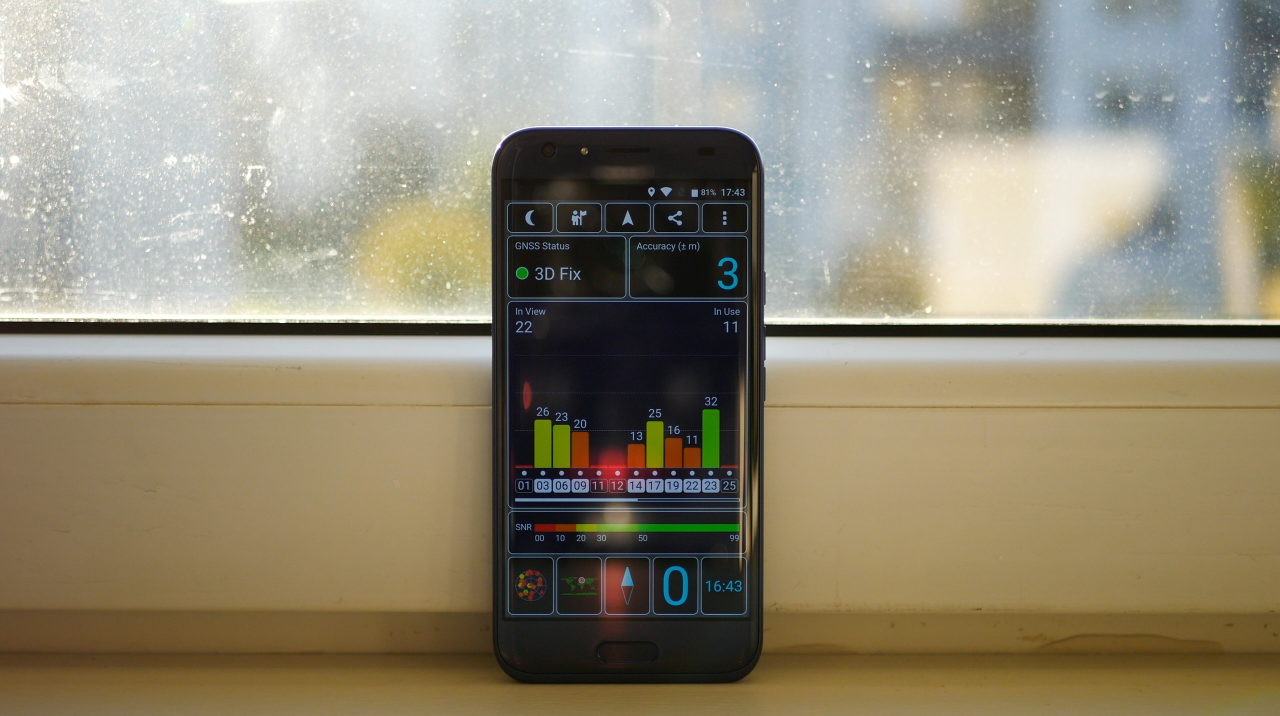
The call quality is not the best but it is pretty good. Other connectivity options, including Wifi, Bluetooth, and GPS, work fine. Unfortunately, there is no gyroscope sensor, so you won’t be able to use this phone with VR headsets.
BATTERY LIFE
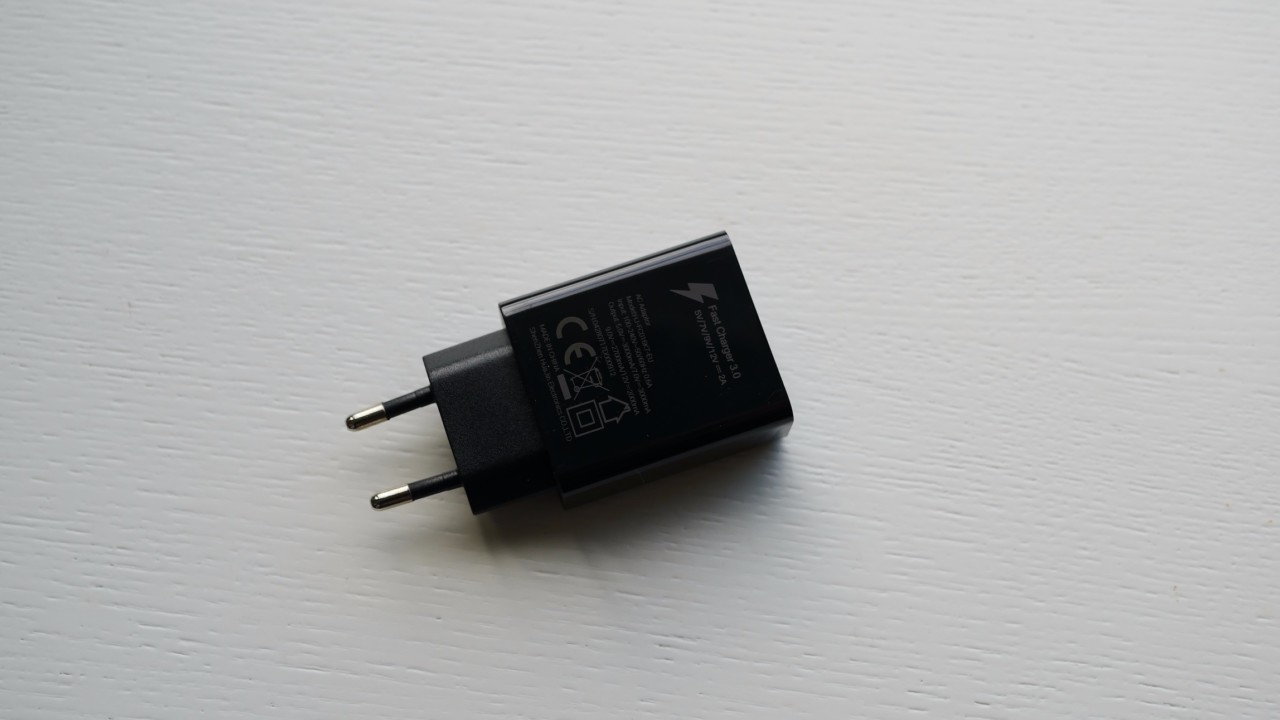
A 5050mAh battery is definitely one of the key selling points of this phone. You should expect to use the device for at least a couple of days and that translates to about 9 hours of SOT when using the phone quite intensively. The phone ships with a fast charger that fully charges the phone in about 1.5 hours.
CONCLUSIONS
The Doogee BL5000 is a nice-looking phone that has a sharp display, decent specs, great battery life and pretty good overall performance.
As usual to most of the budget phones, the camera could be better. Also, the button placement is inconvenient, there is no gyroscope sensor and LED notification light.
All in all, the Doogee BL5000 still offers quite a lot of value for the price but I hope this review will be useful for you as I’ve mentioned all the pros and cons of the device.
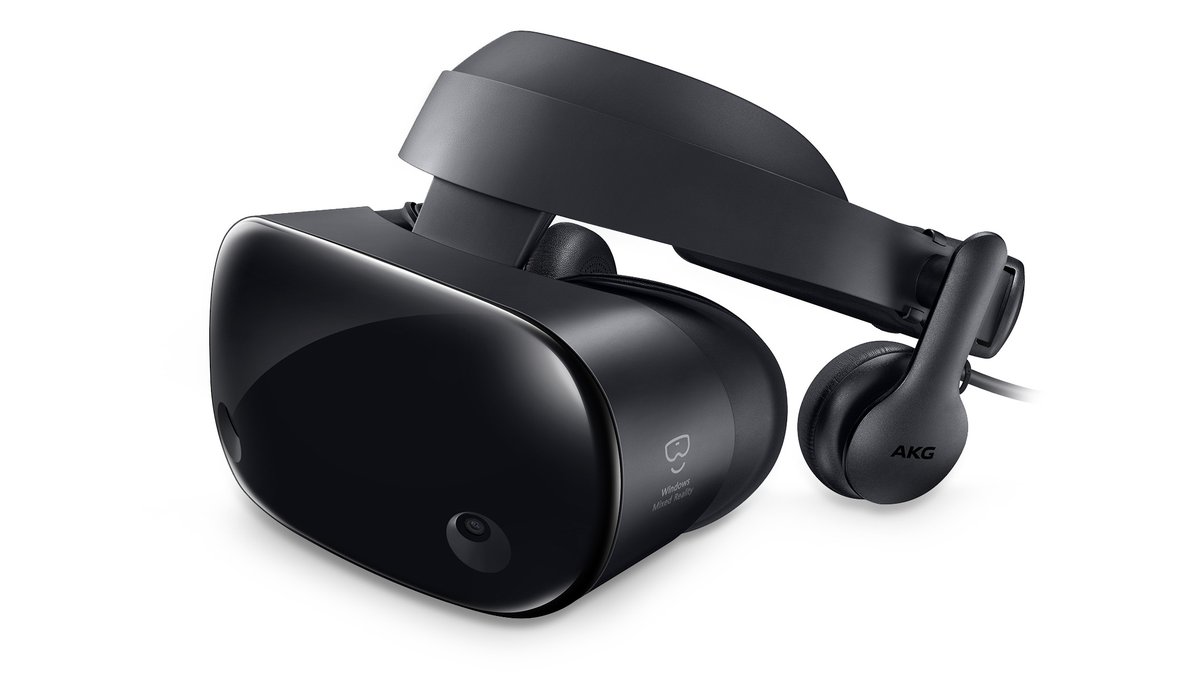
Microsoft announced the Samsung HMD Odyssey Mixed Reality headset at an event in San Francisco today. Images of the headset leaked about a week ago and today it is now official and available for pre-order.
The Samsung HMD Odyssey joins the already announced MR headsets like the Lenovo Explorer, the Dell Visor, Acer MR headset, and the HP Windows MR headset.
The Odyssey is different from the other four headsets in multiple ways. It has two OLED displays each with a resolution of 2880 x 1660 compared to the LCD displays of the others (1440 x 1440). It also has a 110° FOV which is more than the 105° FOV of the other headsets.
Another main difference is that the Samsung HMD Odyssey comes with built-in AKG headphones for spatial audio and a dual microphone array. The other headsets require you to plug in headphones and a microphone through the 3.5mm jack. However, refresh rate is 90Hz on all headsets.
The additional features of the Samsung HMD Odyssey makes it the most expensive of them all with a price tag of $499. The Dell Visor and the HP MR headset are priced at $449, while the Acer and Lenovo Explorer will sell for $399.
All the headsets come with the same motion controllers. Pre-orders have started but it won’t be available until November 6. The other MR headsets can also be pre-ordered now and they will be available on October 17.
Microsoft also announced that it has acquired AltspaceVR, a pioneer in immersive communications best known for organizing social VR events such as concerts, meetups, and comedy shows.
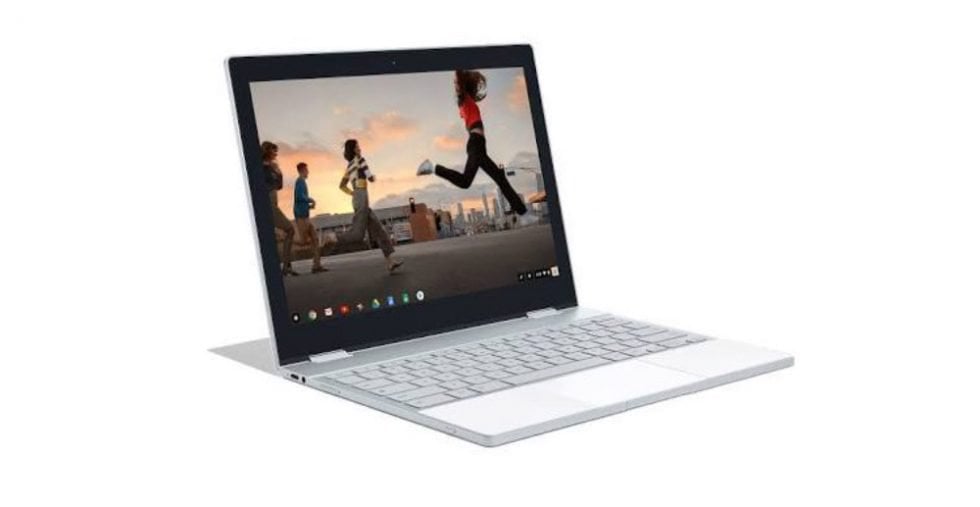
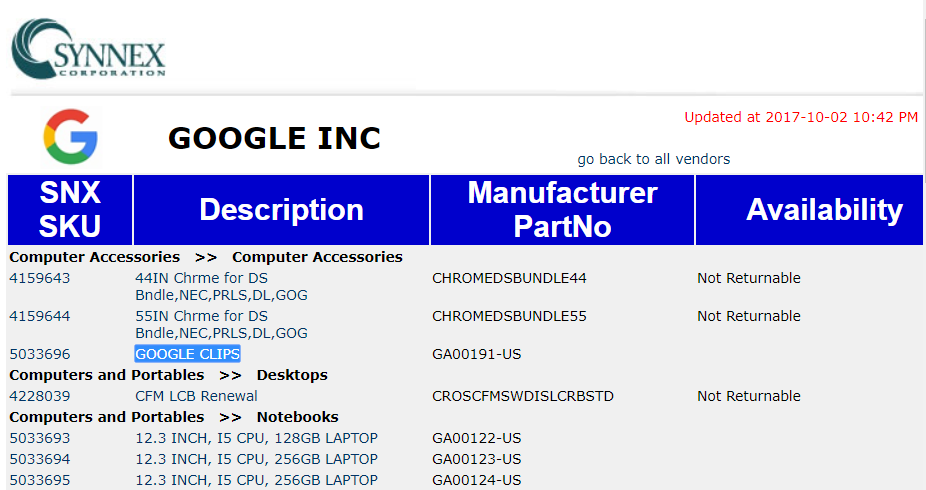
The Pixel 2 and Pixel 2 XL may be the highlight of the Google event tomorrow, but those are just two of the products Google will announce tomorrow. A new Chromebook called the Pixelbook is also expected to launch and details of the device have been seen in a reseller’s inventory listing.
The Pixelbook which will be convertible will come with a 12.3-inch display. This is a smaller than the 12.85-inch 2560 x 1700 displays of the 2013 and 2015 Chromebooks.
There will be three storage configurations – 128GB, 256GB, and 512GB. There is no info on if they will also differ with respect to RAM but all three will have an Intel Core i5 processor.
The Pixelbook will start at $1,199 and go up to $1,749. Those prices do not include a stylus Google is calling the Pixelbook Pen which has tilt support and no lag with a $99 price tag.
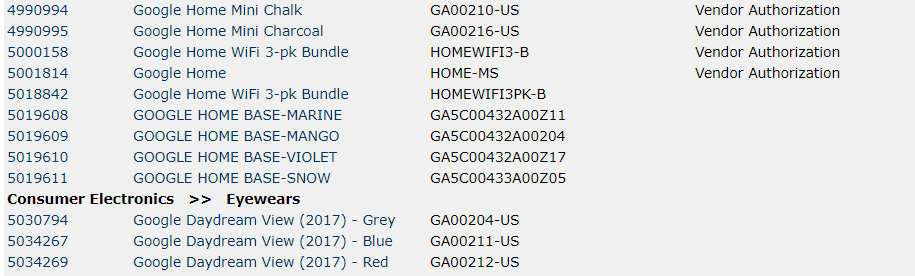
Another device seen on the inventory list is one that is pretty much unknown at this time save for the name “Google Clips”. As you can see in the image above, the device’s product number follows that of the Pixelbooks.
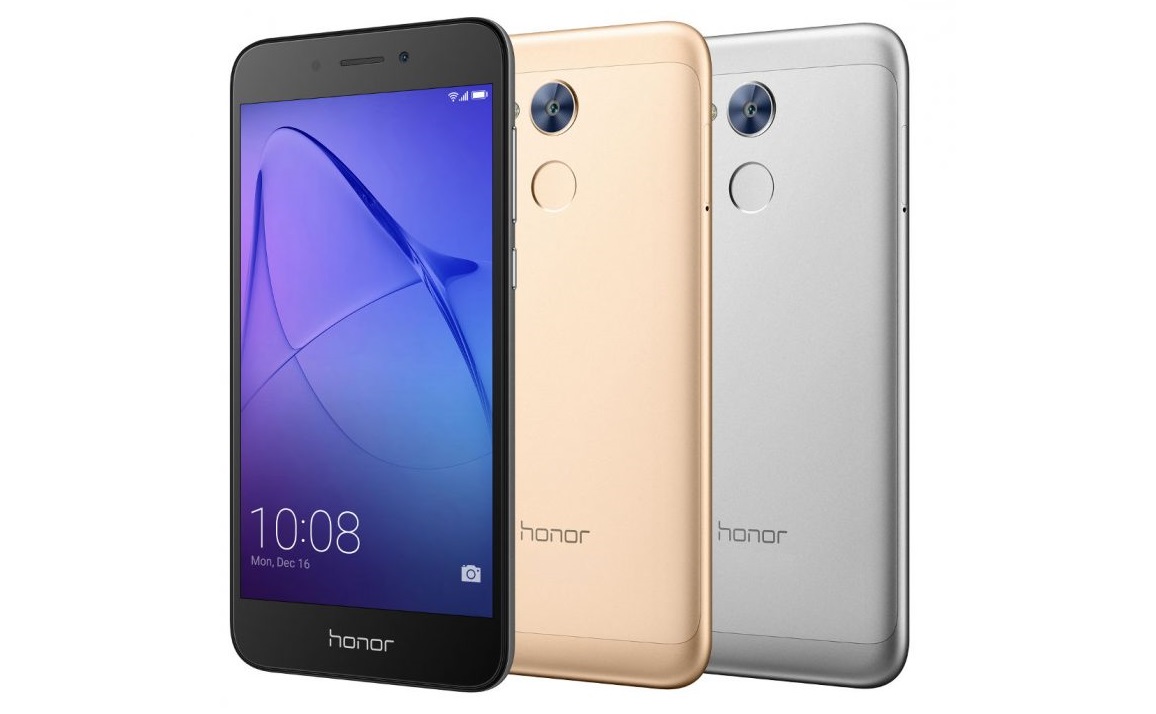
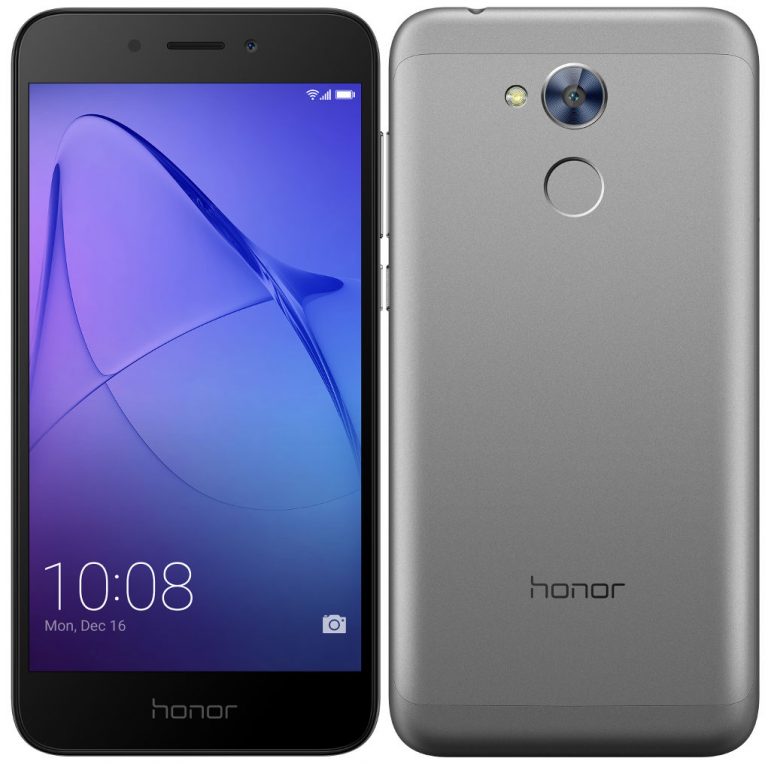
Huawei has announced a new smartphone under the Honor brand which it christened Honor Holly 4 and is the successor to last year’s Honor Holly 3. The Honor Holly 4 has been announced for the Indian market with a recommended retail price of Rs. 11,999, which is about $183. It is interesting to note that the Holly 4 is exactly the same as the Huawei Honor 6A which was announced in Europe and China earlier this year. This isn’t the first time we will be seeing such, the Honor V9 was launched as the Honor 8 Pro in some regions.
Talking about the specifications, the Honor Holly 4 sports a 5-inch HD display and equally comes in two memory configurations. Unlike the Honor 6A, though, the Honor Holly 4 is available in a 3GB RAM + 32GB ROM version with the storage being an expandable one up to 128GB The device is also powered by the Snapdragon 430 processor which supports more LTE bands than Huawei’s Kirin 65x series.
The Honor Holly 4 packs a 13MP Sony IMX278 sensor with a LED flash at the rear, and up in front is a 5MP sensor. The device also packs arear-mounted fingerprint scanner. It also runs Android 7.1 Nougat with Huawei’s EMUI 5.1 overlay. Keeping the light on is a 3020mAh battery. Overall, the smartphone measures 143.7 x 70.95 x 8.2mm while weighing 144 grams.
The device comes in Grey, Gold and Silver colors, and will be available across all Honor partner stores across India. We don’t know if the variant with 2GB of RAM and 16GB of on-board storage as found on the Honor 6A will also be released in India or remain exclusive to the Honor 6A in other regions.
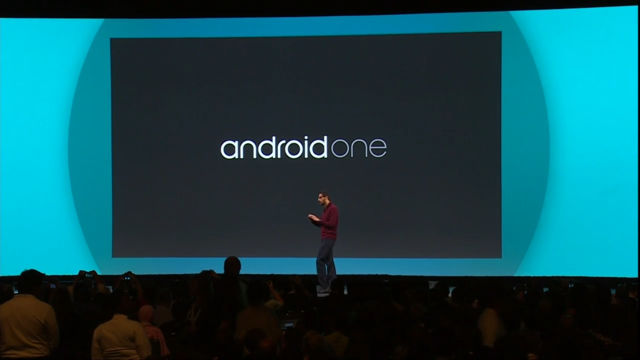
HTC is joining the Android One program. The phone is expected to launch as the HTC U11 Life and its full specifications have leaked online. The specs were posted on Twitter by @LlabTooFeR and they point at a mid-range device with some flagship features just like the Moto X4.
HTC will join the Android One program with the U11 Life
The HTC U11 Life will have a 5.2-inch 1080p display. There will be two variants available – a 3GB RAM +32GB ROM version and a 4GB RAM + 64GB ROM variant. Both models will be powered by the Snapdragon 630 mobile platform.
U11 Life (AndroidOne program) SD630 RAM/ROM 3/32gb or 4/64gb 5.2' 1080p Cameras 16/16mp Battery 2600mah Edge Sense, USonic IP67 Android O
For cameras, the U11 Life will have a 16MP shooter on both sides. Details about the aperture and pixel size were not provided. The HTC U11 Life packs a 2600mAh battery which is pretty small. But considering the fact that the HTC U Play which shares nearly the same specs as mentioned above save for the processor, has a 2500mAh battery, we are not surprised.
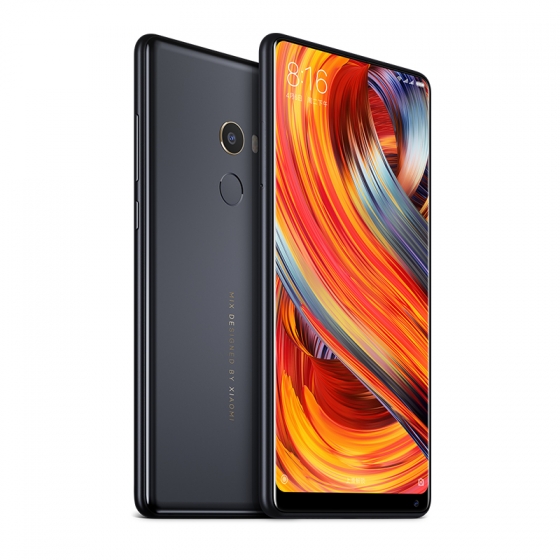
When Xiaomi announced the Mi MIX last year, it generated a lot of buzz and spawned several imitations. For its successor, Xiaomi took a different route with respect to the design but still kept certain features. While some are happy about the design of the Mi MIX 2, others are not.
The Mi MIX 2 is already available for purchase and some folks already received their units. So it is not a surprise that a teardown treatment has showed up online just in case one might need to replace a part or just for the sake of seeing what the internals are like.
The Mi MIX comes in two variants – one with a ceramic back but a metal frame and a full ceramic version. The one taken apart here is the former. The teardown process is fairly easy but if you are not sure about doing a good job, its best you take it to a professional.
The tools you will need include a Philips screwdriver, tweezers, a prying tool, and a suction cup. The suction cup will be used to separate the ceramic back from the rest of the phone.
First, power off the device and proceed to use the cup to remove the back. You have to be careful not to completely pull it apart as the cable from the fingerprint scanner is attached to the rest of the phone. Use the prying tool to gently complete the separation.
Use the screwdriver to remove the screws (ten screws in total) to gain access to the other components. When you remove the top plate, you should be able to disconnect the cable from the fingerprint scanner. The rest is easy from there. Use tweezers where necessary to remove unscrewed components.
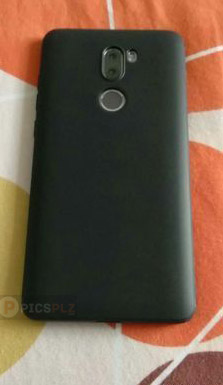
This year has so far been a successful year for Xiaomi and the company would want to continue riding on that wave of success. As the year draws to an end, the Redmi series will likely get some new models launched under it and one of the models is the Redmi Note 5. Although, news has been sketchy surrounding the Redmi Note 5, a newly leaked image purported to be that of the Note 5 has appeared online. The image shows some details of the Redmi Note 5 but unfortunately, we can’t verify its authenticity.
The leaked image only shows the rear view of the purported Redmi Note 5 but even at that it is encased in a protective casing, thus shielding the Mi logo from view which could have authenticated if this really is a Xiaomi model. However, we can still grab a thing or two from the rear aspect and one of such thing is the dual camera setup the device packs at its rear. The dual cameras are aligned in a vertical direction with the LED flash located at the side of the camera. Earlier rumours had tipped the main camera to be composed of a 16MP main shooter and a 15MP secondary sensor. There is also a rear-mounted fingerprint sensor situated just beneath the rear cameras.
We must point out that the image looks nothing like the Redmi Note 5A or the Redmi Note 4 which the device will take the reins from. We can’t guarantee the authenticity of the leaked image , though, so take it with a pinch of salt.
Google has a big launch event scheduled for tomorrow at San Francisco. Apart from unveiling Pixel 2 and Pixel 2 XL smartphones, the search engine giant will be also showcasing other devices. Here is what our readers can expect from Google Pixel 2 launch event:
How to Watch Google Pixel 2 Launch Event?
As mentioned above, the event will take place at San Francisco and it will begin at 9 AM PST in the U.S. The event will be also livestreamed on the official “Made by Google” YouTube channel.
Viewers in the U.K. can view the livestream at 5 PM BST. In India, it will be viewable at 9:30 PM IST. In China, the Pixel 2 launch event livestream will be viewable at 12 AM on Oct. 5.
Google Pixel 2 and Pixel 2 XL
Plenty of information on the Google Pixel 2 duo have been revealed ahead of its launch. Readers can visit the Pixel 2 and Pixel 2 XL rumor roundup article to known everything on their expected specifications, features, and pricing. Earlier today, reliable tipster Evan Blass has revealed the leaked press renders of the Pixel 2 and 2 XL. The 64 GB and 128 GB Pixel 2 and Pixel 2 XL are rumored to carry respective pricing of $649/$749 and $849/$949.
Google Pixelbook and Pixel Pen
The rumored Pixelbook is a convertible device that can be used as a laptop as well as a tablet. It is speculated as a premium device that will be running on Chrome OS. Its 128 GB, 256 GB, 512 GB models are tipped to arrive with respective pricing of $1,199, $1,399 and $1,749. Google is rumored to sell an optional Pixel Pen stylus worth $99 for the Pixelbook.
Google Home Mini and Daydream View VR
A smaller version of Google Home smart speaker dubbed as Home Mini is also pegged to debut tomorrow. Unlike the regular Google Home, its mini version may not be a wireless device. The Google Assistant driven miniature smart speaker is expected to cost $49 and it is likely to come in multiple color options.
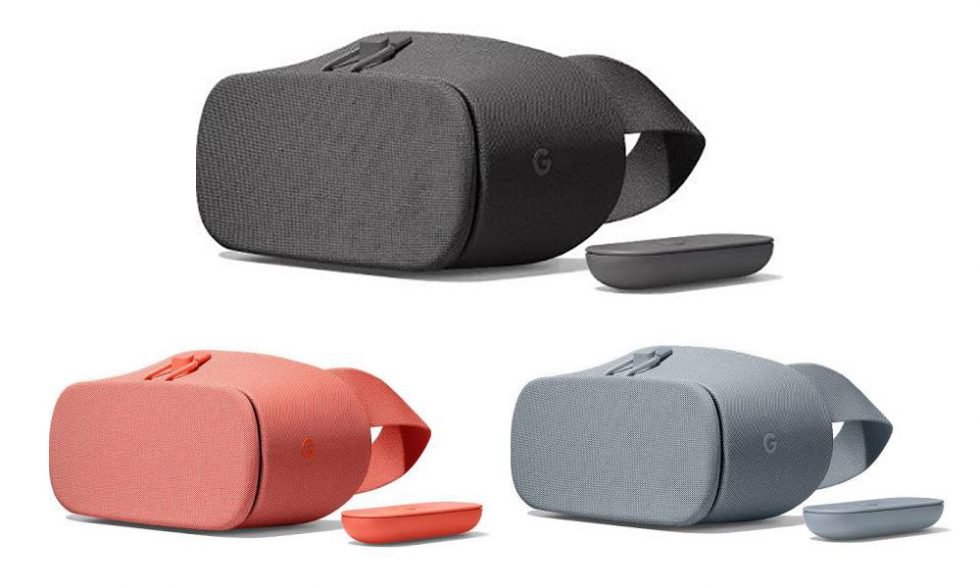
The Daydream View VR will be enhanced version of the original model that was launched in the previous year. It Is expected to arrive in multiple colors along with a motion controller. The device is expected to be priced at $99.
On Wednesday, Google will be holding its launch event to unveil new hardware devices including the Pixel 2 and Pixel 2 XL smartphones. Fresh information that has surfaced today has revealed that Google will reportedly announce a “Made for Google” program for third party accessories. This certification program will be similar to Apple’s MFi (Made for i) plan.
A source that is aware of the Made for Google initiative and another source that is associated with the upcoming hardware announcement has confirmed to 9to5 Google that the search engine giant will be starting a certification program for third party accessories.
Apple’s MFi certification program allow third party accessories manufacturers to make use of Apple’s logo and branding apart from providing them with hardware components, specifications and technical support. Previously, the Cupertino company used to charge a fee for each certified device. However, the requirement was later dropped by Apple. It is likely that Google may adopt a similar strategy through “Made for Google” in order to promote Google and Pixel brand names among the consumers.
Google’s new program could result in certified products like USB-C enabled chargers, battery packs, USB cables and so on for the upcoming Pixel 2 and Pixel 2 XL smartphones. The USB Implementers Forum Inc. has already laid out a standard that all cables are expected to follow. However, is has been found that the cables provided by Android OEMs do not meet the required Type-C standard. Using low quality cables that do not meet the specifications can be potentially harmful to devices.
Hence, customers looking to purchase a third-party accessory will certainly feel confident in buying a product with a “Made for Google” stamp on it.
The latest version of Whatsapp Beta sees the popular messaging app bring its own emoji set. Prior to that, the emojis available on the platform were those available on iOS and worked on other operating systems. This made it possible for emojis to be interpreted the same way irrespective of the device the sender or the receiver was using.
The new emoji set is still similar to that of iOS but you sure would know it has seen some changes. The eyes and mouths of the smileys are one of the differences. The animal emojis are different or and are facing a different direction. Others are just a different color. Another addition is the support for Emoji 5.0, the latest version approved by Unicode. Below are sample images – the old emoji set on the left and the new ones on the right.
[envira-gallery id=”151669″]
The update is available in the Android beta version 2.17.364 but until a stable version is available will we be able to confirm if there are no further changes to the emoji set.
We use cookies on our website to give you the most relevant experience by remembering your preferences and repeat visits. By clicking “Accept”, you consent to the use of ALL the cookies.
This website uses cookies to improve your experience while you navigate through the website. Out of these, the cookies that are categorized as necessary are stored on your browser as they are essential for the working of basic functionalities of the website. We also use third-party cookies that help us analyze and understand how you use this website. These cookies will be stored in your browser only with your consent. You also have the option to opt-out of these cookies. But opting out of some of these cookies may affect your browsing experience.
Necessary cookies are absolutely essential for the website to function properly. This category only includes cookies that ensures basic functionalities and security features of the website. These cookies do not store any personal information.
Any cookies that may not be particularly necessary for the website to function and is used specifically to collect user personal data via analytics, ads, other embedded contents are termed as non-necessary cookies. It is mandatory to procure user consent prior to running these cookies on your website.