Samsung seems to be on a roll with its dual rear camera smartphones. Less than two weeks after announcing the Galaxy Note8, it launched the Galaxy J7+, its second dual camera smartphone. Now it appears a third dual camera smartphone called the Galaxy C8 is on the way.
We first heard of the Galaxy C8 a short while ago when it was seen on the official website of Samsung China. That was followed by promotional images from a demo app and an appearance on TENAA confirming it will have dual cameras.
Official renders of the C8 were posted on Twitter earlier today by Roland Quandt who was also the source for the promotional images last week. These new images show us what to expect when the Galaxy C8 officially launches.
The Galaxy C8 shares a similar design to the Galaxy J7+. The cameras are positioned vertically with a LED flash below the setup. The body is all-metal with curved corners and antenna lines that run across.
Up in front is a fingerprint scanner that doubles as a home button with capacitive buttons flanking it on both sides. The Galaxy C8 also has a LED flash in front just like the Galaxy J7+. Some folks believe the Galaxy C8 and Galaxy J7+ are the same device but with different names for different markets.
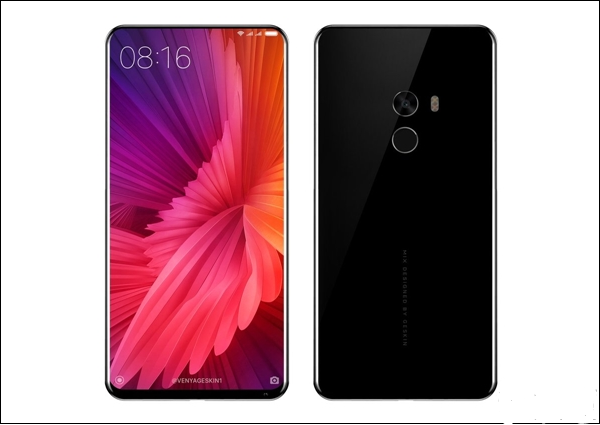
The Mi Mix 2’s details continue to get more and more interesting as more leaks and teasers come out ahead of its launch next week Monday. World renowned designer Philippe Starck was featured in the latest teaser for the Mi Mix 2 shared on Chinese video sharing website Miaopai. The video gives us what could be said to be our first glimpse of the flagship device even though it isn’t a very clear view. In the video, Starch does a James Bond like shooting spree but with the Mi Mix 2 as the gun.
From the video, we can grab that the Mi Mix 2 will indeed have a slightly different design from the Mi Mix. The edges are well curved which would indeed aid gripping the phone. Starck was able to hold the phone with only his right hand and was even tossing it up and down while firing some imaginary shots, still with one hand and it looked seamlessly easy. This was clearly meant to pass across the message that the Mi Mix 2 will be easy to use with one hand and also, it would be super light.
We really couldn’t make out much from the video regarding the design but it looks slightly smaller than the first-gen Mi Mix,. It also looks like we’ll be seeing a metal body which would be easy to mass produce. Apart from the edges, the body all looks like what are going to be rounded. The teaser also touts the Mi Mix 2 as coming with a bezel-less, full-screen display. We already know the flagship will be powered by a Snapdragon 835 processor, Qualcomm has confirmed that and we’ll be having a Sony IMX386 sensor at the rear. The device will also come with 6GB of RAM on one of its variants. You can watch the video teaser from here.
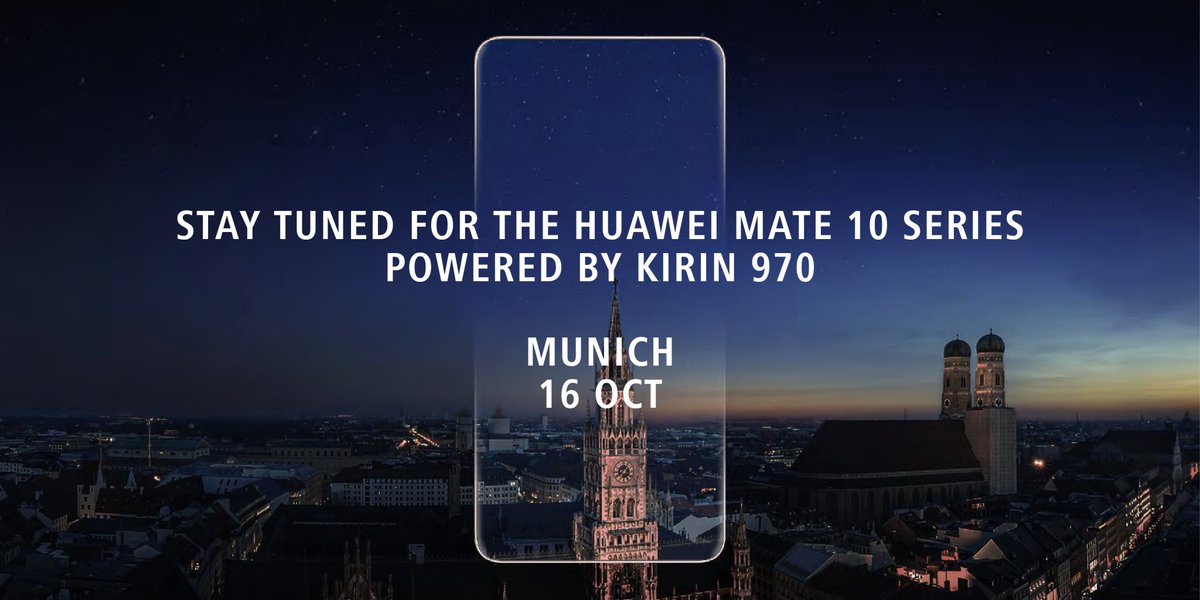
Huawei has confirmed that its next flagships, the Mate 10 series which includes the Mate 10 and Mate 10 Pro, will be unveiled in Munich come 16th of October. The devices have also been confirmed to feature the new Kirin 970.
Over the past couple of weeks, we have seen a bunch of leaks about both devices. Yesterday a fresh new leak surfaced online for the Mate 10 Pro confirming what we have heard about its design.
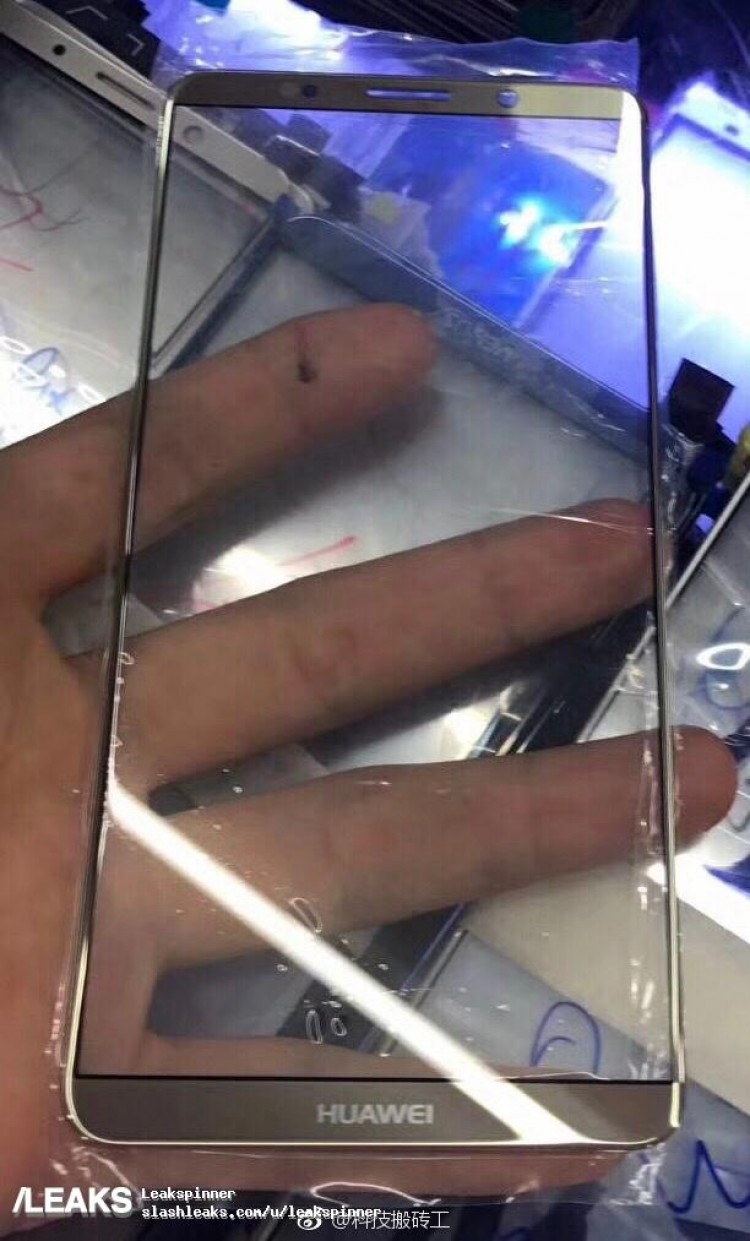
The Mate 10 Pro is said to launch with an 18:9 screen Huawei is calling EntireView Display, which is their own version of LG’s FullVision Display or Samsung’s Infinity Display. A live image of the front panel of the phone leaked yesterday, adding credence to the rumor.
The front panel has very thin side bezels and reduced top and bottom bezels compared to the Mate 9 Pro. There is a cut-out for the front camera and proximity sensor at the top as well as the earpiece. The bottom bezel does nothing more than hold the manufacturer’s name.
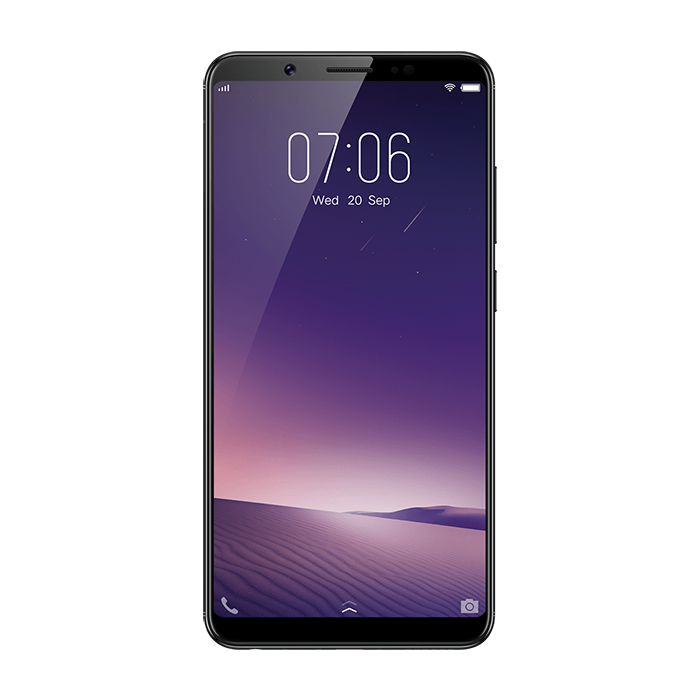
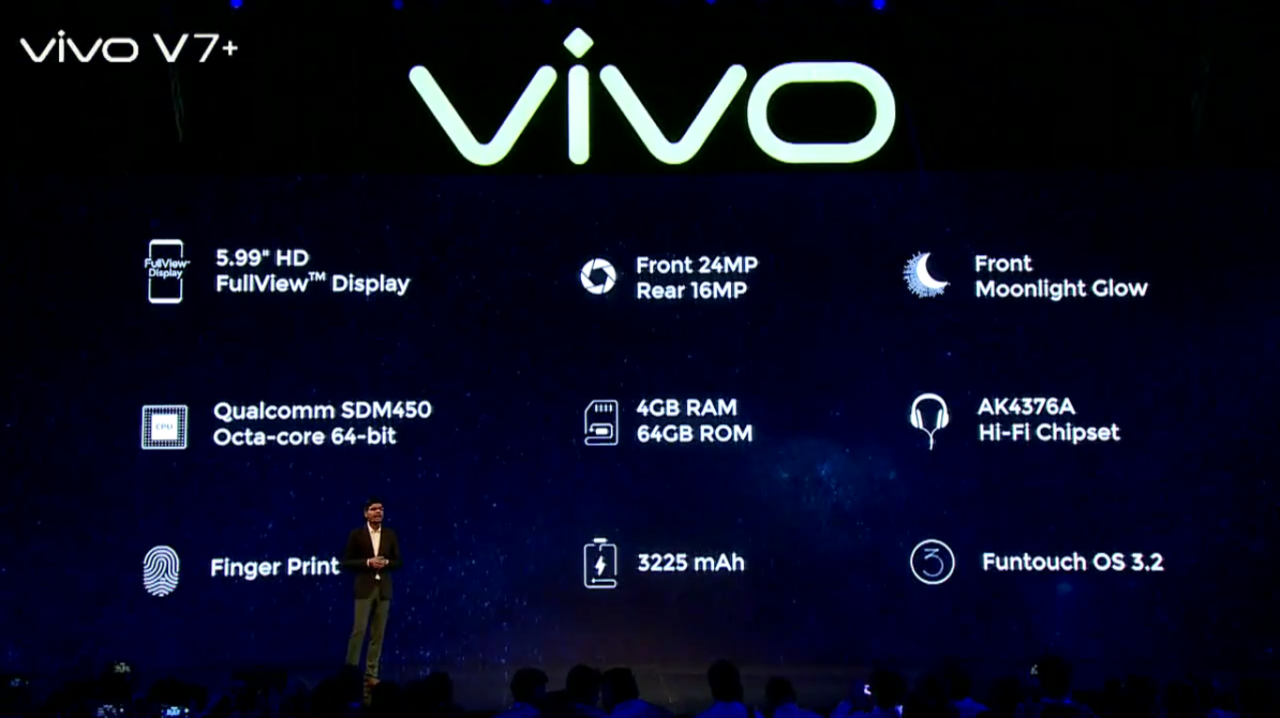
Vivo V7+ is the newest smartphone from the Chinese manufacturer that was unveiled today through a launch event in Mumbai, India. It comes with the world’s selfie camera of 24-megapixel with wonderful features and a stellar 16-megapixel camera. It is also enabled with Hi-Fi audio chip for amazing music experience. Here is all the information on the newly unveiled Vivo V7+
Design and Display
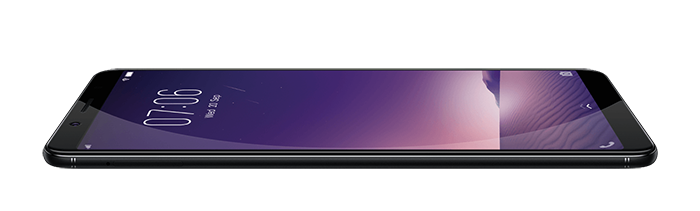
The Vivo V7+ features a plastic unibody design with curved edges on all the four sides of the back panel. The U-type antenna bands can be seen at the top and bottom sides of the back panel. Matte Black and Champagne Gold are the color variants of the Vivo V7+. It measures 155.87 x 75.74 x 7.7mm and its weight is 160 grams.
The Vivo V7+ features an impressive 5.99-inch FullView display that offers an aspect ratio of 18:9. It offers a screen-to-body ratio of 84.4percent. Compared to a conventional 5.5-inch phone, the upper and lower bezels have been respectively reduced by 44 percent and 47 percent. It features very slim side bezels of 2.15mm. The FullView Display produces a resolution of 720 x 1,440 pixels and it offers 12.5 percent more screen space than traditional displays
Cameras and Music
The Vivo V7+ is fitted with 24-megapixel Moonlight selfie camera that features a LED flash, a customized 1/2.78 image sensor and f/2.0 aperture. Even with 4x zoom, the selfie shots carry all the details.
It can shoot optimized selfies thanks to the Face Beauty 7.0 that studies the features of face and captures all the details. The Group Selfie feature can allow users to capture wide-angle selfies with ease. The selfie camera also offers beautifying features during video calls. The Portrait Mode feature can blur the background by focus fully on the subject. The new Face Access is the new biometric feature to unlock the device by scanning the face.
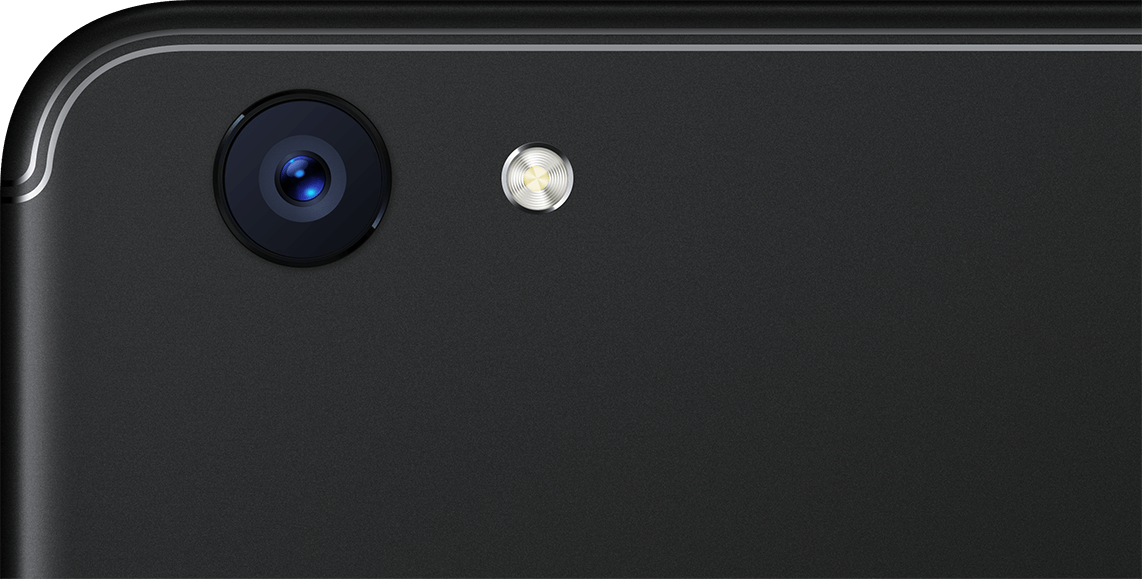
The rear camera side features a f/2.0 aperture 16-megapixel rear camera with PDAF and optimized algorithm. It is capable of capturing of 64-megapiel Ultra HD photos with topnotch clarity.
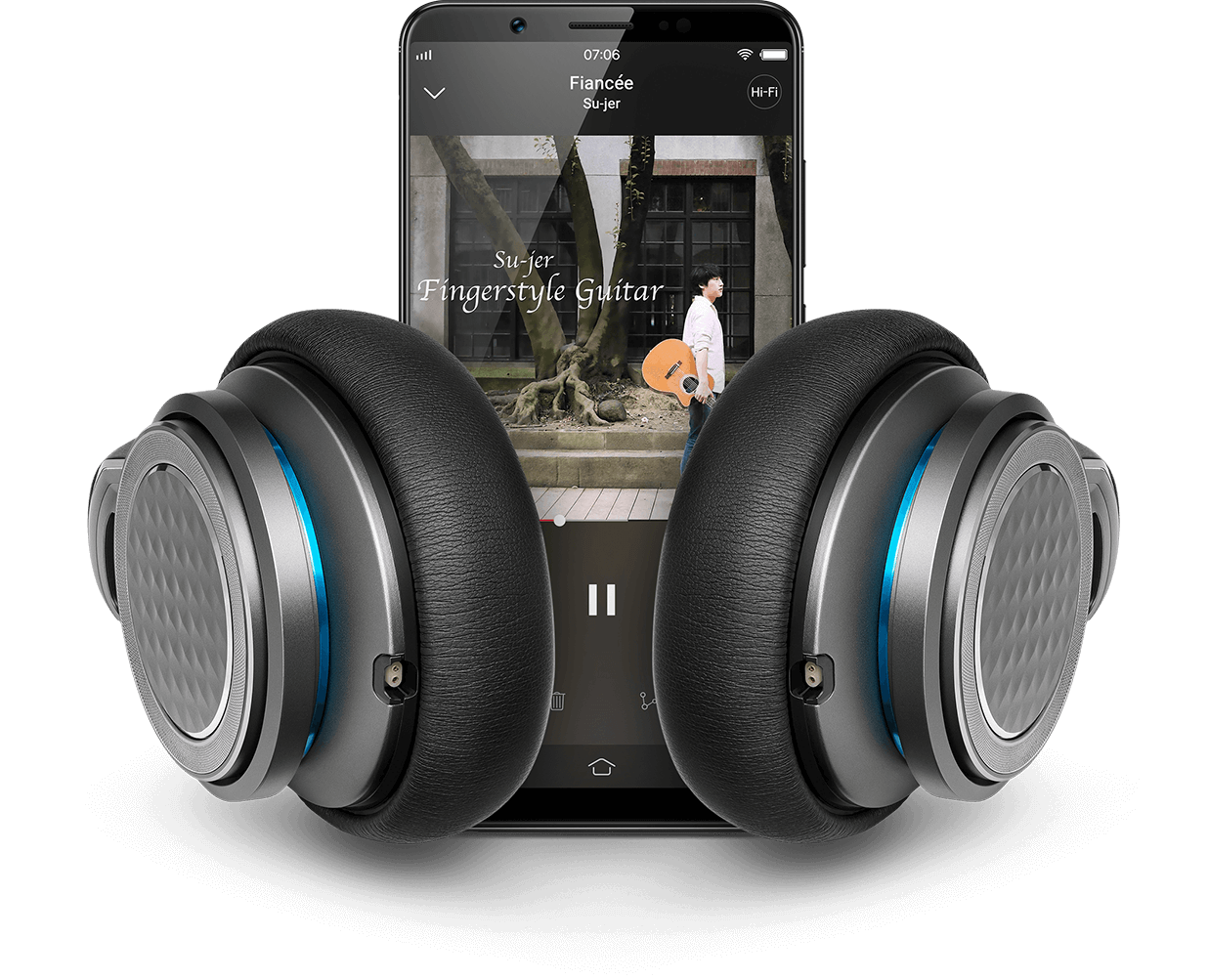
For immersive music experience, the Vivo X7 Plus is fitted with a Hi-Fi AK4376A audio chip. It can smartly play music for different kinds of moods such as happy, sad, travel and so on.
Chipset, RAM and Other Features
The Vivo V7+ is powered by Snapdragon 450 chipset and 4 GB of RAM.The Snapdragon 450 chipset was introduced by Qualcomm in June this year. It is a 14nm FinFET processed chipset. It delivers up to 25 percent higher CPU and GPU performance. It offers up to 25 percent lower battery consumption and it also features Hexagon DSP. It is a dual-SIM phone that comes with a dedicated slot for microSD card.
It has an internal storage of 64 GB. It includes a 3,225mAh battery. The smartphone is running on FunTouch OS 3.2 which is a customized edition of Android Nougat. The Smart Split 3.0 allows users to run two apps simultaneously by sliding down three fingers on the same screen on each of the two desired apps. It also features Game Mode to play games without interruptions like incoming alerts. App Clone feature lets users to run two instances of same apps to manage personal and professional lives easily. It features a rear-mounted fingerprint reader.
Vivo V7+ Pricing and Availability
The Vivo V7+ will be available for pre-booking from Sept. 7 with the price tag of Rs. 21,990 (~$343) on Amazon and Flipkart in India. The first sale of the smartphone will begin on Sept. 15.
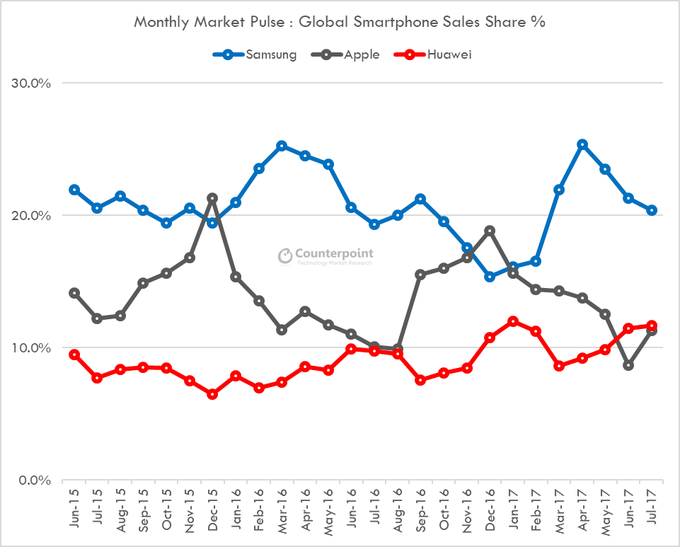
Market research firm, Counterpoint has released its monthly Market Pulse research for the month of July 2017 and it comes with a stunner. The research showed that Huawei has for two consecutive months – June and July, surpassed Huawei has surpassed Apple in global smartphone sales. With August sales looking strong for the Chinese vendor, a hat-trick for Huawei could be on the cards but that may be short-lived as the launch of the iPhone 8 billed for this month could see Apple regaining its position with greater vigor.
The report shows that Samsung, Apple, and Huawei are still the top three smartphone vendors in the world. Samsung still retains its position as the global leader with a stronger showing in the month of June. Huawei moved up to the second position in June while Apple experienced a decline in its smartphone shipment. This may be due to fans waiting for the upcoming flagship models before making their purchases.
Despite a decline in overall sales, Apple still had the best-selling models which are the iPhone 7 and 7 Plus. They are closely followed by the OPPO R11 and A57 which came in third and fourth. Other devices that made it to the list include the Galaxy S8, Xiaomi Redmi Note 4X, Samsung Galaxy S8+ and others.
The equilibrium will likely shift this September after Apple release the iPhone 8 and other models it has got in the works. But this latest result is an indication that Huawei’s efforts in ramping up its global smartphone sales are yielding results gradually.
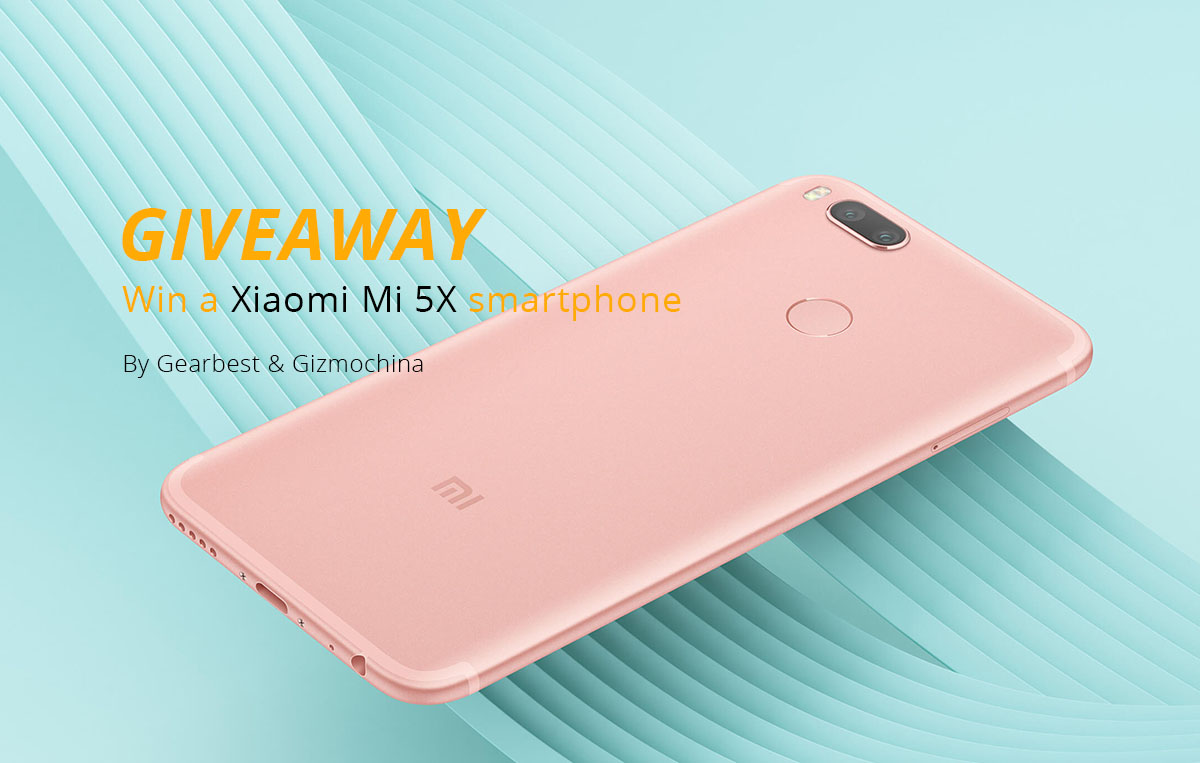
Gizmochina along with Gearbest is conducting a Xiaomi Mi 5X phone as Giveaway gift to one of our lucky readers. Like always, you just have to follow the steps mentioned on the Gleam widget to get a chance to win this amazing phone.
GearBest is launching the biggest promotion this year, it called the Autumn Bumper Harvest which puts many of the products available in their store on sale.
1. The giveaway is an international giveaway.
2. We are not responsible for lost shipments.
3. We are not responsible for any duties, import taxes that you may incur.
4. We reserve all rights to make any changes to this giveaway.
5. The prize will be shipped in a week when the giveaway end.
Just follow the steps mentioned in the Gleam widget to participate in the giveaway.
Apple has confirmed that it would be holding a launch event on Sept. 12. The company is rumored to announce at least three new iPhones. A fresh information coming from Germany suggests that the 2017 iPhones would be available on pre-orders three days after the official launch.
Speculating on the recent rumors, it appears that Apple would be unveiling the next generations like iPhone X, iPhone 8 and iPhone 8 Plus (previously rumored as iPhone 8, iPhone 7S and 7S Plus) on Sept. 12. Three days later i.e. on Sept. 15, Apple is likely to start the pre-orders of these phones. These devices will hit the retail stores on Sept. 22.
The iPhone X that is rumored to be a special edition smartphone is expected to be available in limited numbers at launch. Well-known analyst, Ming-Chi Kuo has claimed that Apple would be selling around two to four million units of the iPhone X at launch.
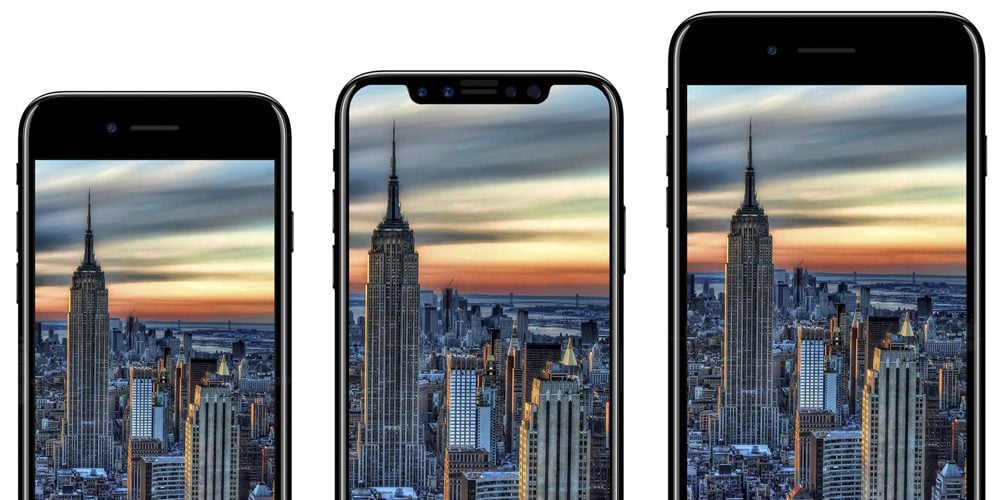
As rumors have revealed that the iPhone X would be coming with a premium design that will be packed with a full-screen display. Instead of the Touch ID sensor, the smartphone is expected to house a 3D facial recognition feature. The new biometric recognition feature is expected to accurately authenticate payments on Apple Pay. The Cupertino company is also speculated to introduce wireless charging feature on it as well as on iPhone 8 and 8 Plus smartphones.
The iPhone X is expected to come in three storage choices such as 64 GB, 256 GB and 512 GB. These models are rumored to be respectively priced at $999, $1,099 and $1,199.
Ming-Chi Kuo has said that the reason behind such a high pricing of the iPhone X is it features a very costly OLED panel from Samsung. These panels are purchased at a price that twice more than what Apple is paying for LCD panels for iPhone 8 and iPhone 8 Plus. Each OLED panel is rumored to be priced around $130. However, the Cupertino company is paying around $55 for each LCD panel.
Hence, the company is speculated to be looking for a second supplier of OLED panel like LG. Having a second supplier would provide Apple with steady supply of OLED panels. Also, it would make it possible to get the OLED panels at a discounted price because of competition between two suppliers.
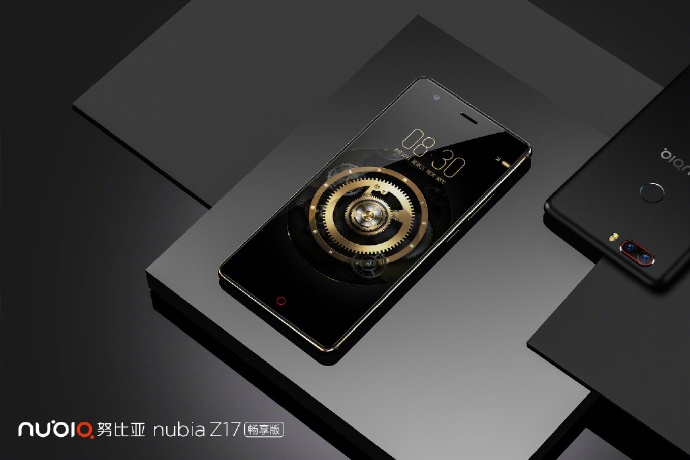
Nubia announced the Nubia Z17 Lite last week and it was billed to go on sale this September. The device has finally gone up for its first sale in China. The Nubia Z17 Lite is a trimmed down version of the flagship Nubia Z17 which was released in July. The new smartphone has a hardware lineup which places in a mid-range category but its design is very much similar to that of the Z17. The sales commenced simultaneously on Nubia’s official shop, Tmall, and Suning Tesco and the product is still up for grabs on all three channels.
As a result of the trimmed down specs, the Z17 Lite comes with a reduced price tag from its flagship counterpart. The Nubia Z17 Lite 6GB + 64GB version has a price tag of 2,499 Yuan (~$378) while the 6GB + 128GB version sells for 2,799 Yuan (~$455) and it is available in Aurora Blue. While these prices are affordable, they are strikingly close to the retail price for the Z17. For instance, the 6GB + 64GB Nubia Z17 version retails at 2799 Yuan ($411) and that is just a difference of 300 Yuan. While the 6GB + 128GB variant comes in at 600 Yuan higher with a retail price of 3399 Yuan ($500).
As a reminder, the Nubia Z17 Lite features a 5.5-inch Full HD display and is powered by a Qualcomm Snapdragon 653 processor backed by 6GB of RAM while the storage varies between a 64GB model and a higher version with 128GB storage. The device uses a metal body and is also ultra-thin at 7.6mm in thickness. The Z17 Lite also packs a 13MP Mono + 13MP RBG dual rear camera setup while at the front there is a 16MP selfie camera. The camera also comes with Nubia’s NeoVision 7.0 software which uses a bunch of smart algorithms to improve dual camera performance, zoom, scene recognition as well as video recording.
In addition, the lights are kept on by a 3200mAh battery and the Z17 Lite is available in Black Gold, Obsidian Black, and Aurora blue colors. Other features include NFC, Bluetooth 4.1 and dual-band Wi-Fi ac and more.
The launch of Google Pixel 2 and Pixel 2 XL are almost a month away as both smartphones are expected to debut on Oct. 5. The Pixel 2 that will be sold by Google branding is reportedly being manufactured by HTC. The smartphone has already received FCC certification and today several details on its features have surfaced.
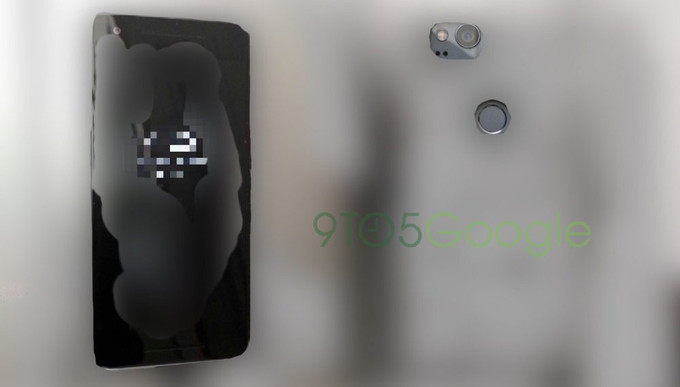
9to5 Google has obtained some images of the Google Pixel 2 from a reliable source. However, the publication has revealed a vague image of the phone to protected the identity of its source. It has revealed that the rear shell of the Google Pixel 2 is made of aluminum. However, the upper one-third of the back panel is made up of glass and the fingerprint reader is present below the glass portion. The frontside of the smartphone is black.
The rear panel features a single camera on its top-left corner. Below the LED flash of the camera are two black dots that appears to be “send” and “receive” sensors of the laser autofocus system. It is also rumored to be equipped with Electronic Image Stabilization (EIS) instead of OIS. However, there is no information available on the configuration of the front and rear cameras of the Pixel 2.
As far as the design of the Pixel 2 is concerned, it seems to be similar to the original Pixel phone. Also, both Pixel 2 and Pixel 2 XL are now tipped to feature IP68 certified water and dust resistant chassis. Like the original Pixels, the successor models are expected to come with identical specs, but will feature different-sized displays. The Pixel 2 duo are also rumored to arrive in 64 GB and 128 GB storage choices. A recent report reveals that the Snapdragon 835 chipset will be powering both phones.
It is unlikely to feature a 3.5mm audio jack. There is a possibility that the search engine giant may introduced Google Assistant powered headphones with Pixel 2 duo. The box package of the Pixel 2 duo is expected to include a USB-C to 3.5mm dongle.
The handset that is codenamed as “walleye” is rumored to feature a 4.97-inch display that will carry support for full HD resolution of 1,920 x 1,080 pixels. The ambient display of the phone will come with Always-on Display feature.
Evan Blass has said that Google would be debuting the Pixel 2 and Pixel 2 XL on Oct. 5. The publication has claimed that both phones will be preinstalled with Android 8.1 at launch. The company is now rumored to introduce Google Lens alongside the Pixel 2 and Pixel 2 XL. The source has also revealed that Google has imposed PR embargoes on accessory manufacturers so that Pixel 2 duo details are not leaked before official launch.
A leaked video showcasing the alleged Vivo X20 that only last for few seconds has surfaced on China’s social networking site, Weibo. The video is now also available on YouTube. The quality of the video is not good, but it certainly confirms some of the leaked information of the Vivo X20.
The video begins by showing the large-sized display of the phone with slim bezels on its left and right sides. The screen seems to have black borders on all the four sides. The top and bottom bezels are a bit thick but they are quite slim compared to conventional smartphones. The smartphone can be seen sporting full metallic chassis.
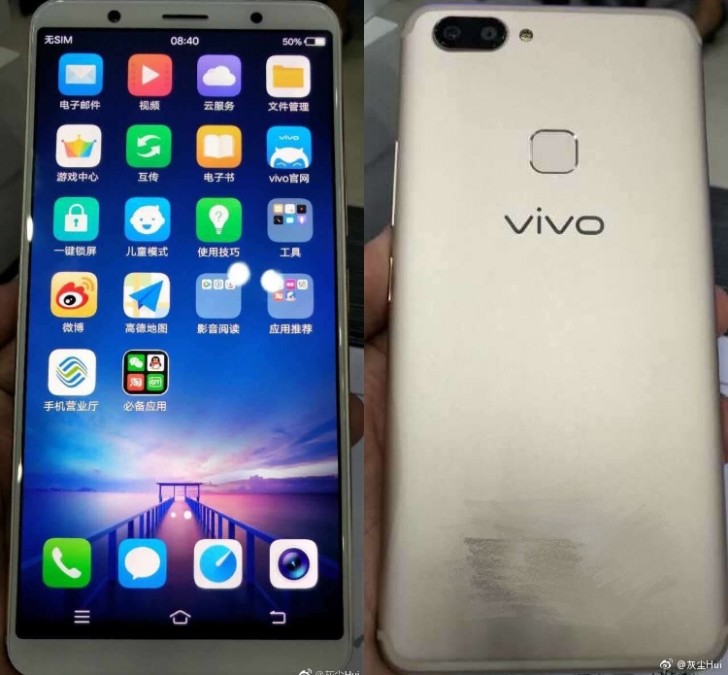
The rear side of the phone can be seen only for a second. At the top-left corner of the back panel is the dual camera module and its LED flash. This contradicts previous reports that have claimed that the Vivo X20 would be featuring a single camera on its rear. The fingerprint scanner and the company’s logo are also present on the rear. The following image shows a better view of the front and rear sides of the Vivo X20.
Above the display of the phone is the selfie snapper, an earpiece and a sensor. The handset features on-screen buttons. The antenna lines are present on the upper and bottom edges of the back panel of the phone.
The Vivo X20 has already appeared alongside Vivo X20A on TENAA. Speculations have it that the Vivo X20A could be the Vivo X20 Plus phone. Recent rumors have revealed that the Vivo X20 and Vivo X20 Plus would be sporting 18:9 aspect ratio screens. The Vivo X20 is expected to arrive with a 5.2-inch display whereas the X20 Plus is speculated to arrive with a 5.5-inch screen.
The Vivo X20 is speculated to come with Snapdragon 630 chipset, 6 GB of RAM and 64 GB of storage. On the other side, the Vivo X20 Plus is rumored to be powered by Snapdragon 660 SoC, 6 GB of RAM and 128 GB of storage. Both phones are rumored to house 3,500mAh batteries.
The Chinese manufacturer is holding a launch event in India on Thursday to unveil the Vivo V7+. Reports have revealed that the Vivo X20 and X20 Plus would be coming to markets outside of Chinas as Vivo V7 and V7+
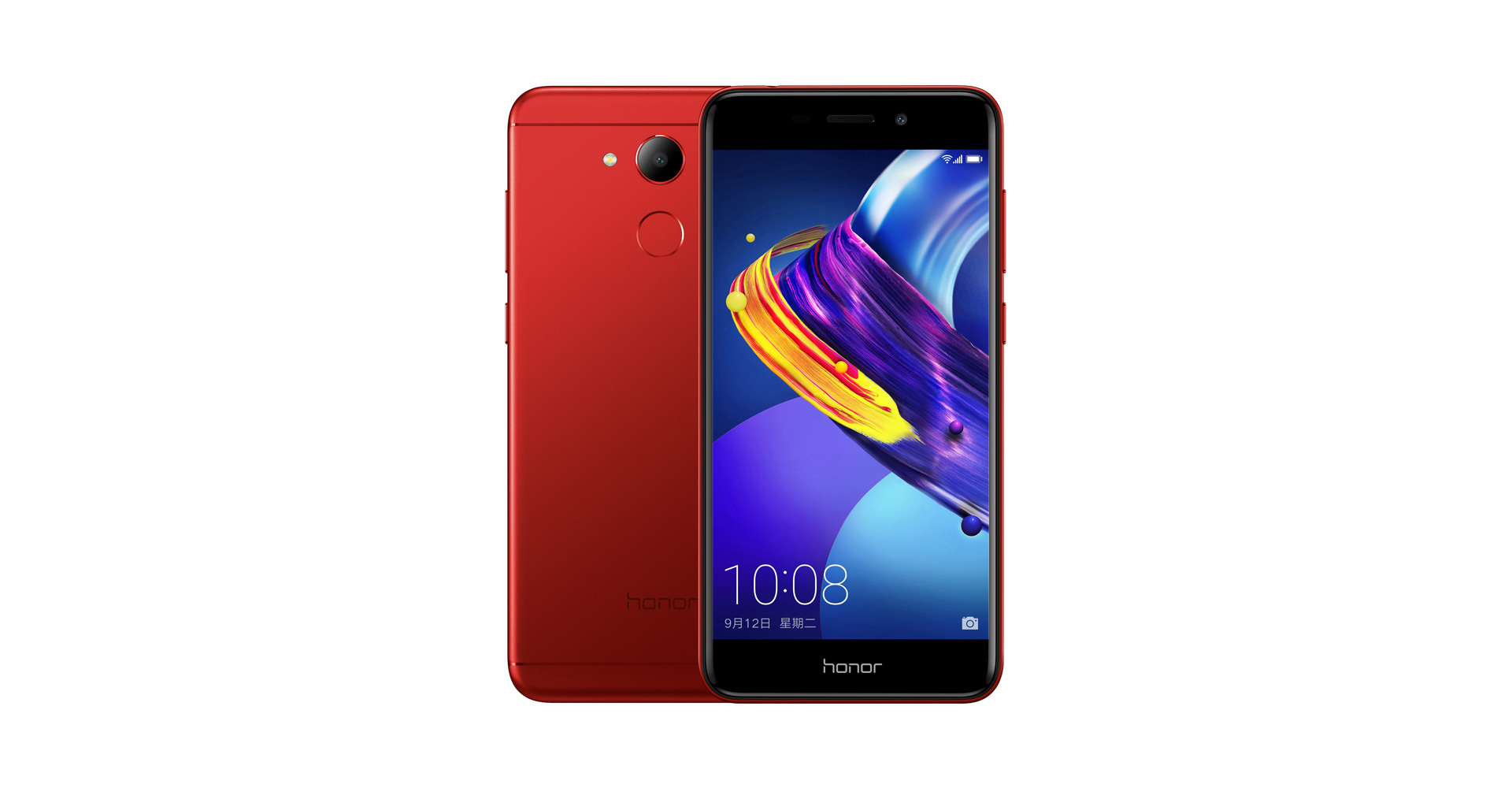
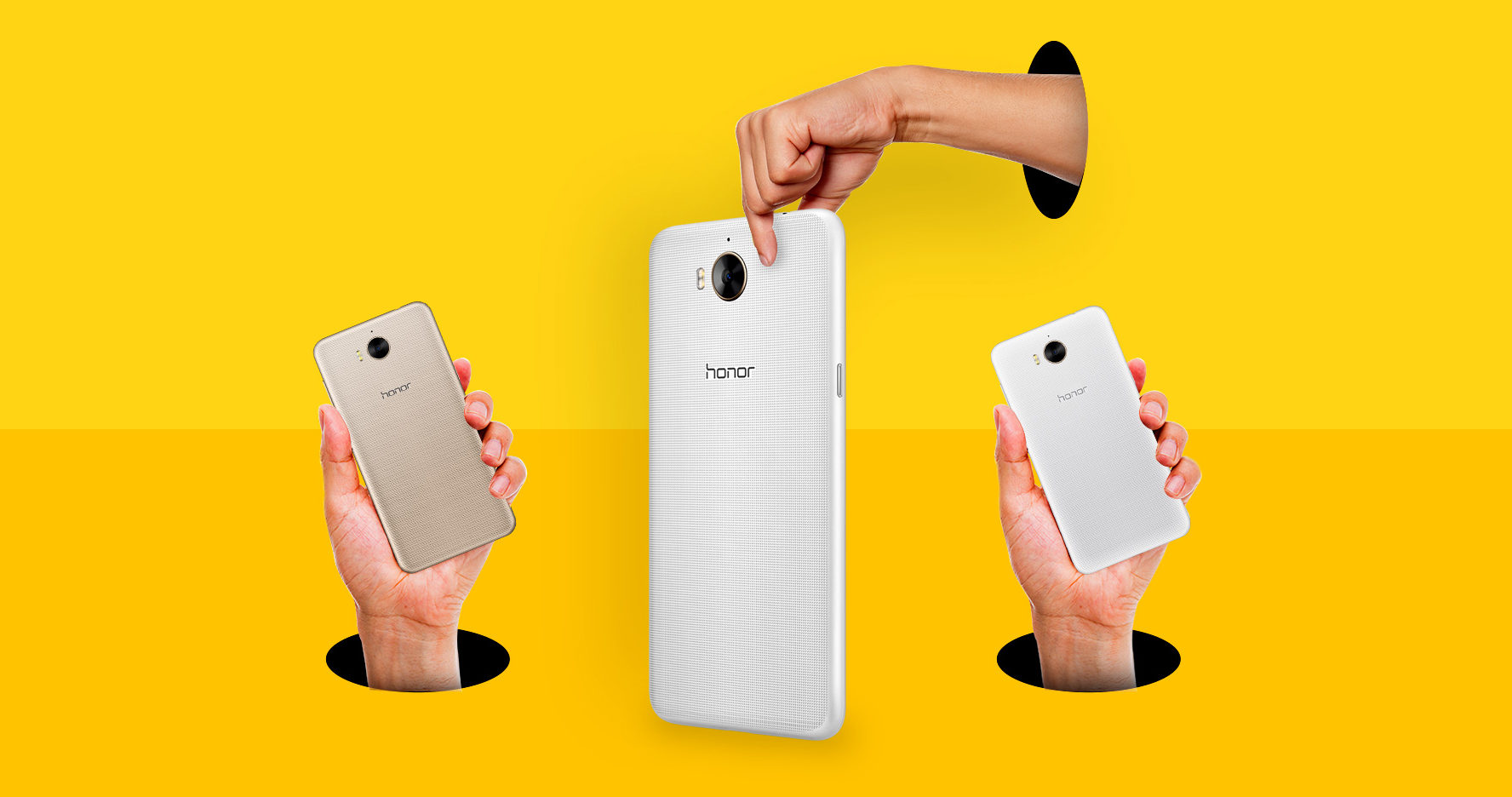
The Honor V9 Play is a more affordable version of the Honor V9 (Honor 8 Pro) flagship released back in February. Although it has ditched most of the features of its bigger sibling such as the 2K display, dual rear cameras, large RAM and built-in storage. The Honor V9 Play comes in the same cool colors as the V9.
Honor V9 Play Design
The Honor V9 Play features an all-metal design like the V9 but at first look, you can tell there is a difference in the craftsmanship. The design is the same you will find on similar devices in this price range.
Buttons are on the right, SIM tray is on the left and there are speaker grilles flanking the micro USB port at the bottom.
Honor V9 Play Specs
The Honor V9 Play has a 5.2-inch HD display. It comes in 3GB and 4GB RAM variants with 32GB of expandable storage, and is powered by the MT6750 processor.
There is a 13MP f/2.2 aperture and 1.12um pixel sensor on the back. On its left is a LED flash and below it is a fingerprint scanner that unlocks in 0.4s. The front camera is an 8MP sensor.
The V9 Play has a hybrid dual SIM slot (nano only, 128GB Max.). There is a 3000mAh battery that charges via a micro USB port at the bottom. There is a 3.5mm audio jack at the top, Bluetooth 4.1, VoLTE and a FM radio.
The phone will come with EMUI 5.1 based on Android 7.0 Nougat out of the box.
Honor V9 Price and Availability
The Honor V9 Play will sell for ¥999 (∼$153) for the 3GB RAM variant and ¥1199 (∼$184) for the 4GB RAM variant. It will be available in red, blue, champagne gold, and rose gold when it goes on sale on September 12.
[envira-gallery id=”148167″]
Honor 6 Play
Right on the heels of the V9 Play is the Honor 6 Play. The 6 Play is targeted at the entry-level category and seems like a competition for the unannounced Redmi 5A.
The phone doesn’t have the same metal body design as the V9 Play. Instead it sports a polycarbonate body with a unique hatching design.
It has a 5.0-inch HD display, a MT6737T SoC, 2GB of RAM and 16GB of expandable storage. There is an 8MP camera with dual LED flash on the back and a 5MP front facing camera with its own LED flash.
Essential Phone is now reaching all the customers who have ordered it. Its teardown has revealed that since it is very hard to open, repairing the device is quite difficult. This may dismay some buyers from purchasing the Essential Phone. However, JerryRigEverything has released a new video on his YouTube channel to show that the Essential Phone can easily pass various kinds of torture tests.
The video begins by showing the contents of the Essential Phone’s box package which contains items like USB-C to 3.5mm audio jack adapter, USB-C cable and a wall plug apart from the handset. The Essential Phone’s display is protected by Gorilla Glass 5 coating and comes with a ceramic rear. It has a very hard titanium frame.
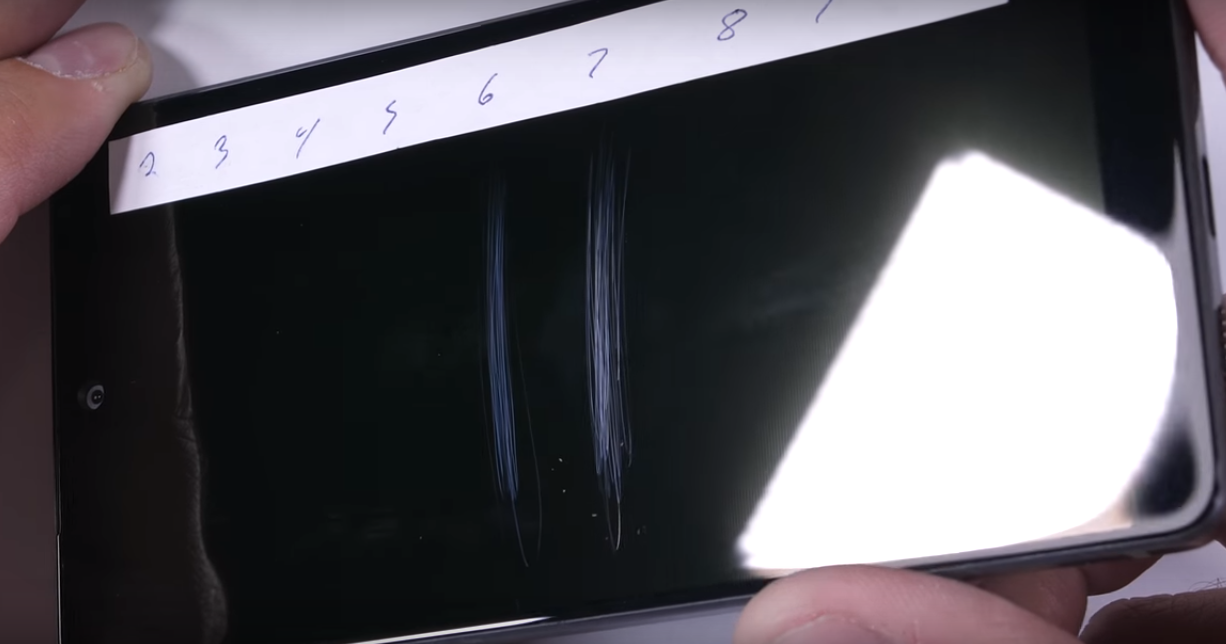
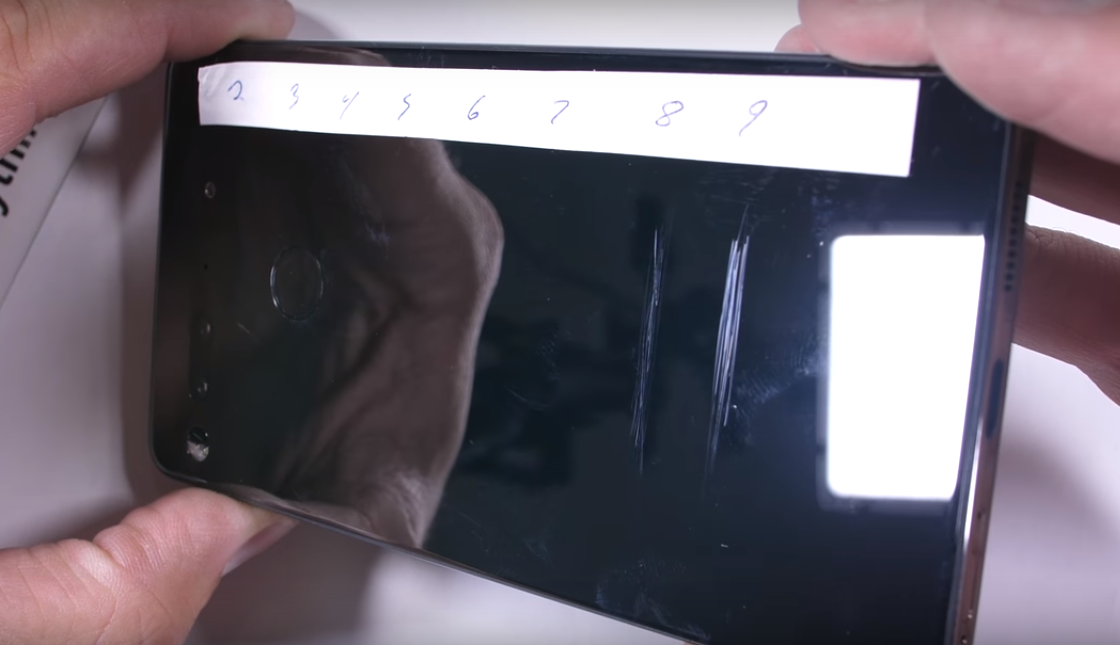
The first test that is performed on the display is to check its durability on Mohs scale of hardness. As it can be seen in the video, the display remains till level 5 of scratching. However, the display scratches on level 6 and deeper grooves show up on level 7. According to Zack from JerryRigEverything, the scratch tolerance of Essential Phone’s display is on par with other flagships like the Samsung Galaxy S8 and Apple iPhone 7.
Placed under the same front glass at the top is the selfie camera of 8-megapixel. Hence, it is protected from scratches. The earpiece is not placed under the display but it is present as a very thin line just above the selfie camera. It seems to be covered under some kind of fabric.
The ceramic rear is not only very hard but also makes the phone appear brilliant. However, the downside is that it can easily attract fingerprint marks and scratches.
Scratching it with a razor blade does not leave any marks on it. The two holes present at the top of the ceramic panel is meant for connecting modular accessory. These holes contain very strong magnet. The dual 13-megapixel sensors are covered by glass that sits flush on the ceramic panel. On Mohs scale of hardness, the ceramic panel developed scratches on level 8. The fingerprint scanner too is well protected.
The titanium frame is not of titanium carbide that is highly durable in nature. The frame of the Essential Phone scratches at level 6 which indicates that it is does not feature pure titanium. The handset features a little plastic rim around its edges can absorb the pressure if it falls.
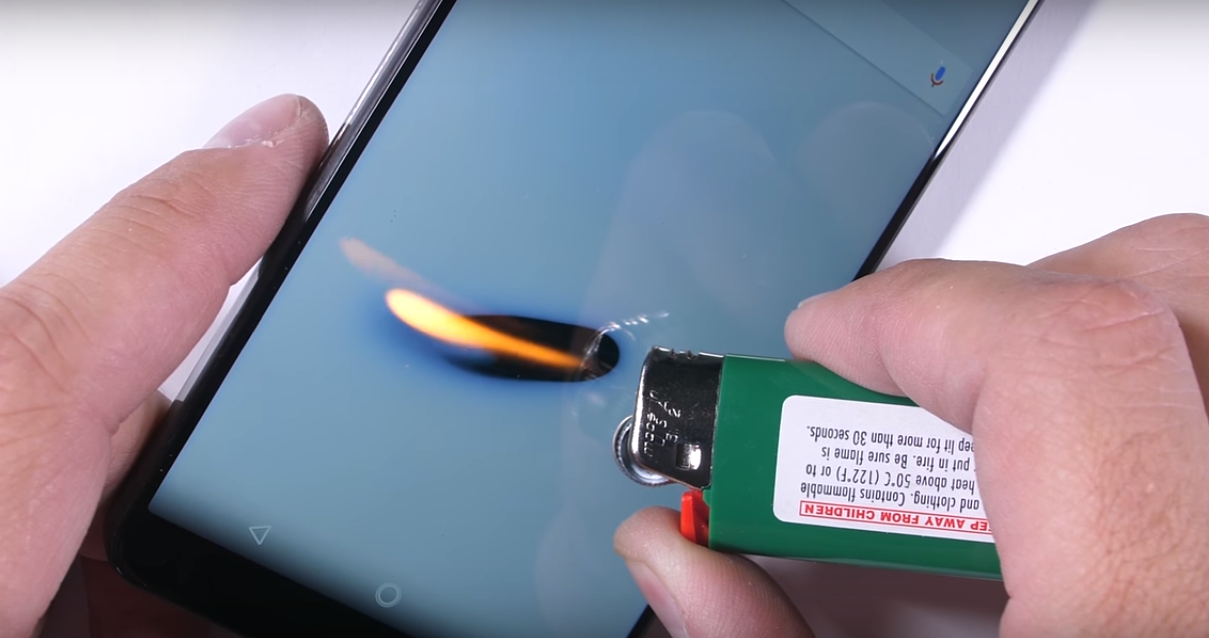
In the flame test, the IPS Quad HD display of the Essential Phone was subjected to flame from a lighter for about 9 seconds which darkened the spot. However, when the heat disappeared, the affected area back normal. The phone is so hard that it could hardly bend in the bend test.
The build quality of the Essential Phone is indeed impressive. However, the lack of various features like 3.5mm jack, water resistance, microSD card slot and wireless charging makes it a device that many may not be interested to buy.
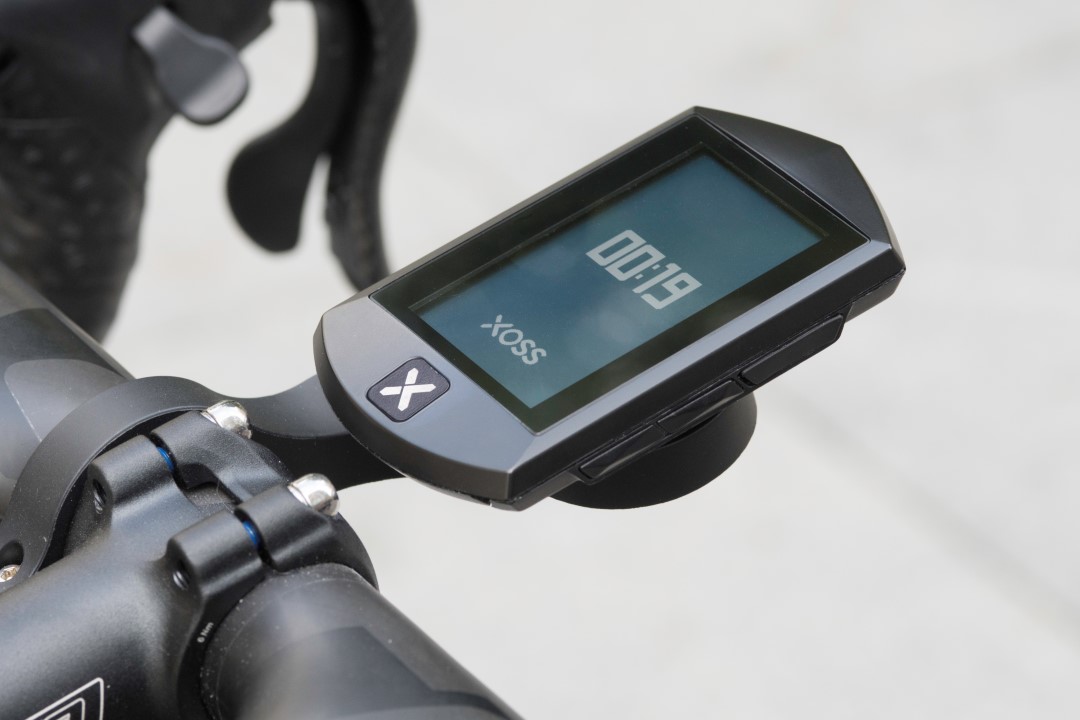
If you enjoy cycling, then it is only wise that you have an accurate and reliable cycling computer. Not just one that keeps track of your basic cycling info like time and distance, but one that can pair with your other sensors, provide mapping and navigation, and sync to the cloud. The Kickstarter-backed XOSS Sprint is one of the few that combines all these functions all for an affordable price.
XOSS Sprint Specs
The XOSS Sprint has a high-resolution (240 x 400) SHARP 2.7-inch LCD display with great outdoor visibility. There is 512MB of built-in storage which may sound small. However, XOSS says they have compressed and optimized their map data such that users can download offline maps for a continent onto it.
The Sprint also provides turn-by-turn navigation for users. With the accompanying app, you can plan your routes or even copy those uploaded on the website by other users. You also shouldn’t worry about getting lost as the XOSS Sprint uses a quad-positioning system (GPS, GLONASS, BeiDou and Galileo).
XOSS has designed what it calls FUSION technology which allows you to connect both ANT+ and Bluetooth sensors simultaneously. FUSION lets you add up to six different sensors and pairing is simple.
Pair your heart rate monitor and the cycling computer will alert you if your heart rate is too high or goes up too fast. It will also alert you if you are going to fast based on a preset speed limit.
Another key feature of the Sprint is its app (available on Android and iOS) and cloud service. Users can synchronize specific tracks and can even link their data to their Strava account as well as share workouts on Facebook, Twitter and Instagram.
The XOSS Sprint has a 1000mAh battery said to last up to 37-hours of GPS recording on a single charge or 90 days on standby. The device can be recharged via a USB type-A port.
What’s more? The Sprint has an IPX6 waterproof rating so even if it starts to rain while you are out, your tracker is safe. It also has a background light that is easy on the eyes.
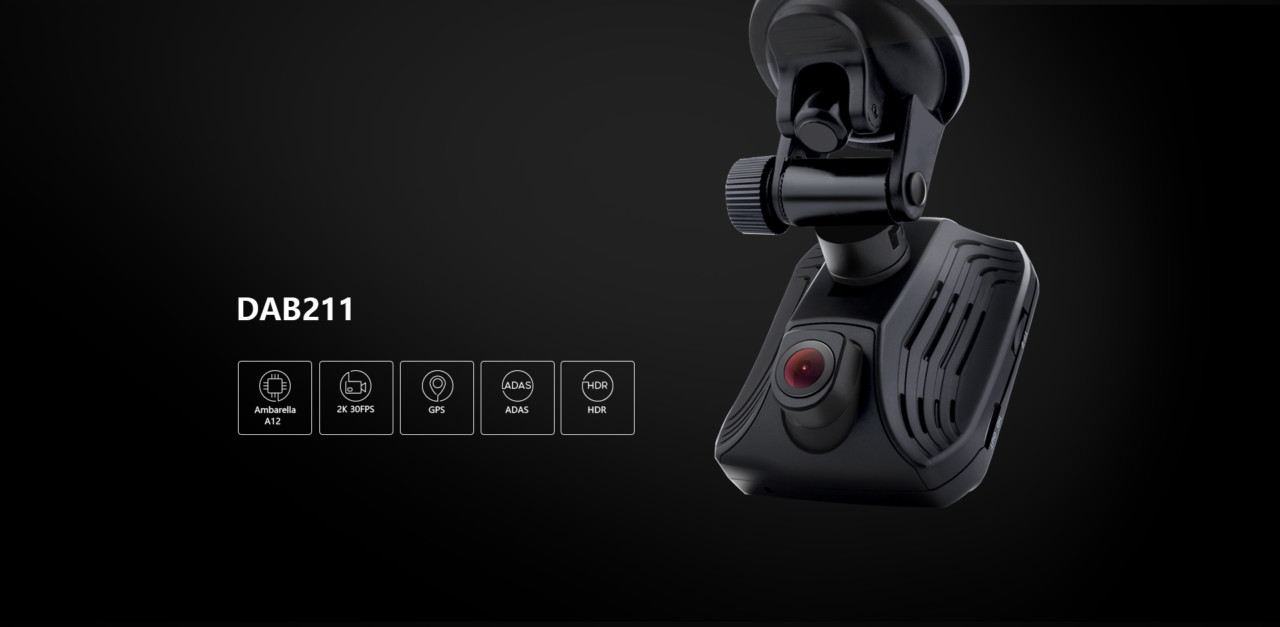
Recently, Azdome has launched a new Ambarella dash cam, DAB211, and made an overall introduction to its various functions, performance, unboxing video, installation, application scenarios, but haven’t officially announced the price, many friends must be eager to know how much it would cost. Today the editor will report the estimated price to you only here.
According to the previous news report about DAB211, everyone should know that DAB211 is a stable, HD, multi-functional and multi-purpose dash cam with Ambarella A12 chip, OV4689 sensor, 1440p, HDR, ADAS, built-in GPS, night vision and hidden design, etc, which comes with a 100% satisfaction guarantee, such a superior product, the editor estimates the price at $120, how much do you think it will cost? Currently, in the market, there are very few high-cost effective dash cams like DAB211, great quality and a low price, enchanted with it? Go for it! Action speaks louder than words.
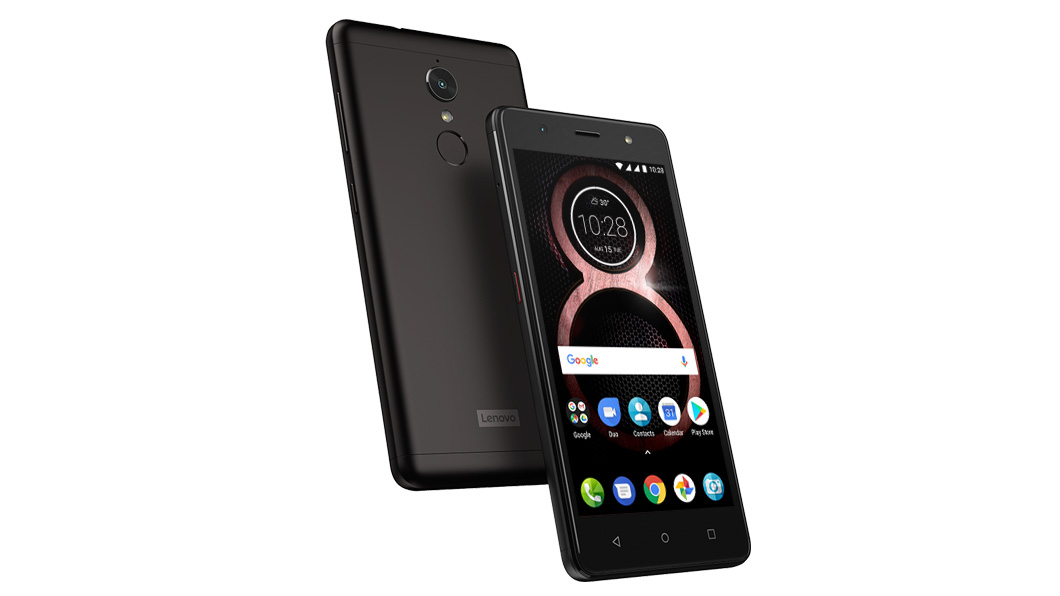
Lenovo has unveiled the third of the K8 series. Not only does it drop the “Plus” or “Note” suffixes, the Lenovo K8 also ditches the dual rear cameras and 108op display present in its siblings. Does that mean it isn’t any good? You would have to read to the end to find out.
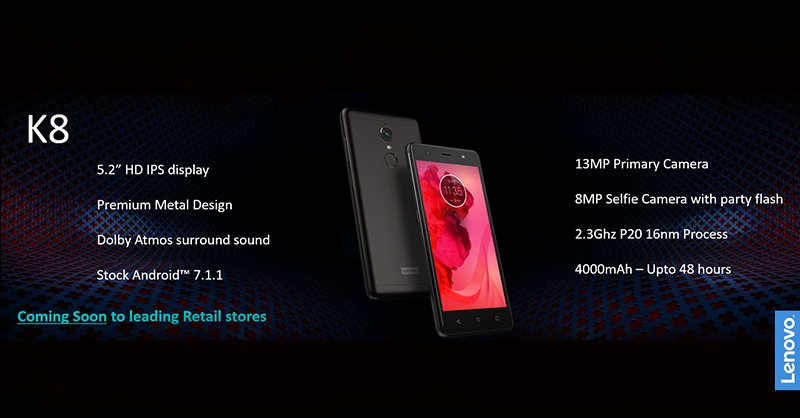
The Lenovo K8 features a 5.2-inch HD IPS display with 2.5D glass. There is 3GB of RAM but Lenovo fails to disclose the capacity of the built-in storage. It has MicroSD card support but there is no info on if it is a dedicated slot or a hybrid slot. The K8 is powered by the Helio P20 processor clocked at 2.3GHz
The Lenovo K8 doesn’t have dual rear camera sensors but settles for a single 13MP camera with PDAF and flash. The 8MP front camera also gets its own LED flash.
There’s no TheatreMax but there’s Dolby Atmos for an improved audio experience. The K8 also has a dedicated music key and a rear-mounted fingerprint scanner.
Two key features unique to all the three K8 phones is the 4000mAh battery and the pure Android (7.1.1) software. Lenovo says the K8 should last 48 hours on a single charge. Sadly, there is no mention of turbo-charge. Other features present include a 3.5mm audio jack, dual nano SIM slots, FM radio, VoLTE,WiFi and Bluetooth 4.2.
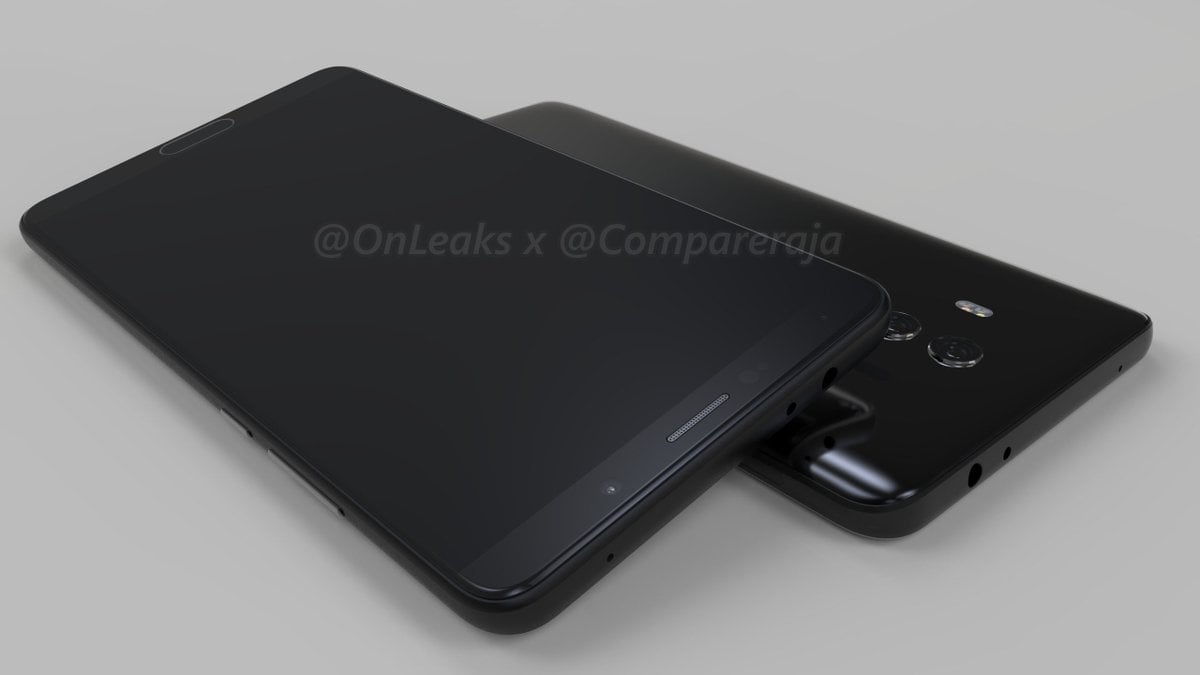
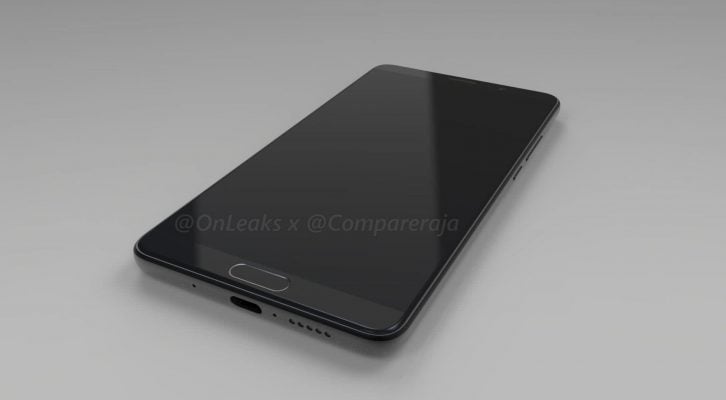
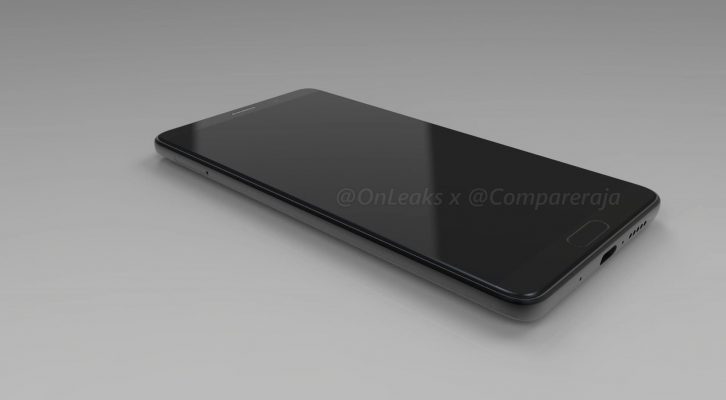
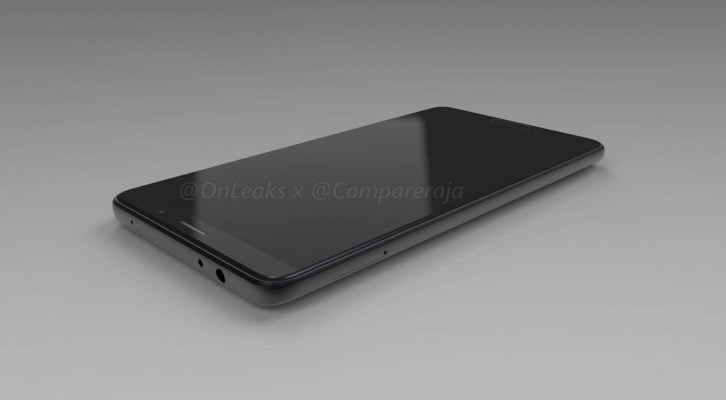
Huawei’s Mate series flagship for 2017, the Huawei Mate 10 is billed to go official on October 16 after the iPhone 8, Galaxy Note 8 and Mi Mix 2 must have hit the market. The Mate 10 will launch in time to take on the Galaxy Note 8, iPhone 8 and other and Huawei seems to have positioned the device well enough to take on its competitors. The specifications of the Mate 10 is almost entirely known and it includes a 10nm Kirin 970 chip with Artificial Intelligence. On the design angle, the flagship is expected with a full-screen display and even though the device is yet to leak in real life photos, renders of the Mate 10 has been leaked by popular tipster @onleaks.
The renders are a collaborative effort of Ccompareraja and the tipster who by the way, has a track record of releasing near perfect renders that turn out looking like the real smartphone whenever it is launched. That is because the renders are most times factory CAD-based renders just as in this case. There is also a 360-degree video render of the upcoming flagship model. The images show the device from all angle and it didn’t reveal a bezel-less design but the Mate 10 had tiny bezels at the sides of the display. The edges are also well rounded and this time around, there isn’t going to be a rear fingerprint sensor but a front fingerprint sensor embedded in the home button.
The tipster also reveals the Mate 10 will have a dimension of around 150.2 x 77.5 x 8.4 mm. The device will also come with a dual camera setup at the rear with a slight camera bump design. In addition, the Mate 10 will sport a 5.9-inch screen and from the renders, is likely to have a glass back. There is a USB Type-C port for charging and data connectivity and also, the Mate 10 will be having a 3.5mm audio jack.
The device is also expected to feature the EntireView design which Huawei recently patented. The Mate 10’s 5.9-inch display will come with a resolution of 2160 x 1080 pixel. The dual cameras are also expected to feature the Leica badge but that isn’t reflected on the renders. The configuration may still be a 12MP main sensor teaming up with a 20MP monochrome sensor just like it was featured on the Mate 9 and Huawei P10.
Huawei CEO Richard Yu had disclosed at IFA that users are in for much faster performance, longer battery life, and more compact design with the Mate 10 and it sure looks like one to look forward to. You can check out the video render from below.
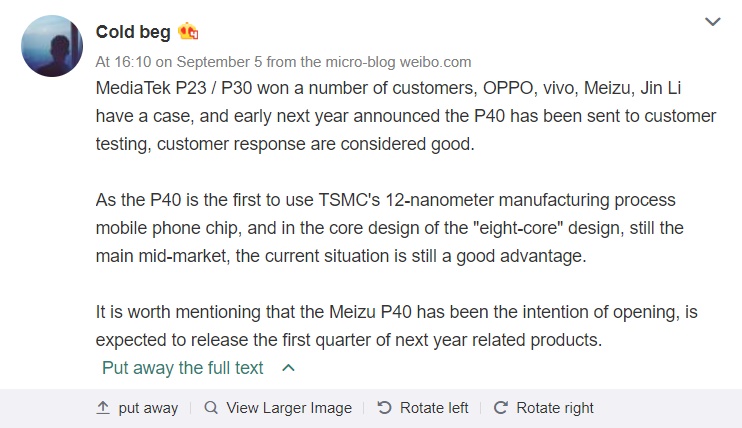
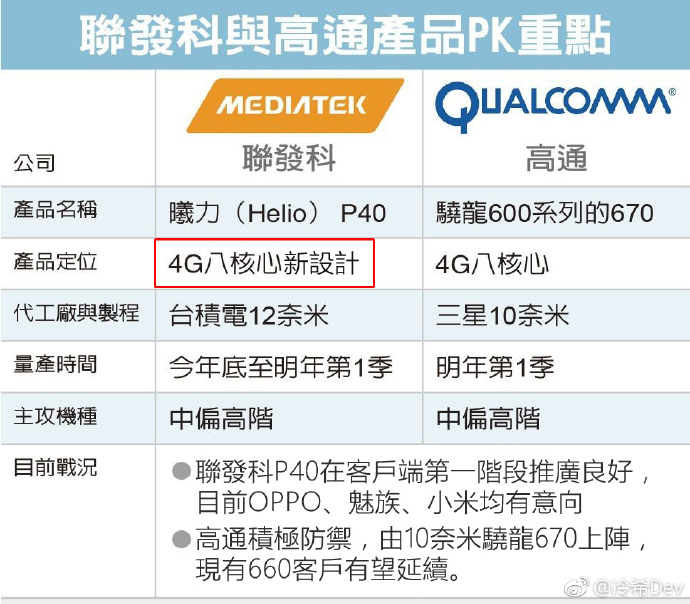
Yesterday, we reported that Taiwanese semiconductor company MediaTek, has a new SoC in the works. The new processor called the Helio P40 is said to feature a hexacore design and will be built on TSMC’s new 12nm process.
Mediatek is said to be wooing smartphone manufacturers to sign up for the new chip. According to Weibo user (@冷希), samples have been sent to customers to test and they’ve found their first customer in Meizu. First set of devices are expected to arrive in Q1 2018. It should come as no surprise seeing as both manufacturers seem to be best of friends.
Meizu’s flagship, the Pro7 Plus is the first device to be powered by the Helio X30, which is MediaTek’s most powerful SoC. Even though Meizu’s latest smartphone is powered by a Qualcomm processor, its VP, Li Nan has said the Blue Charm company will continue to use processors from the three manufacturers (Mediatek, Qualcomm, and Samsung).
Gearbest is running a promo called Autumn Bumper Harvest. You can read more about it here. If you are a Xiaomi fan, you may want to visit the online store to see what items are on sale. Nevertheless, below is a list of three items which can be purchased for less when you apply their resective coupons.
Mi Band 2
The Mi Band 2 is still selling pretty well. Its sales even pushed Xiaomi to the top of the list of wearable sellers for Q2 2017. Gearbest sells the smartband for $22.29 but if you use the coupon code harvest001 during checkout, you can pick it up for just $13.99.
Huami Amazfit PACE
Xiaomi doesn’t have a smartwatch but the Amazfit which is made by the same company (Huami) behind the Mi Bands is usually referred to as a Xiaomi smartwatch. Priced at $99.89 on a regular day, using coupon code harvest007 brings it down to $92.99.
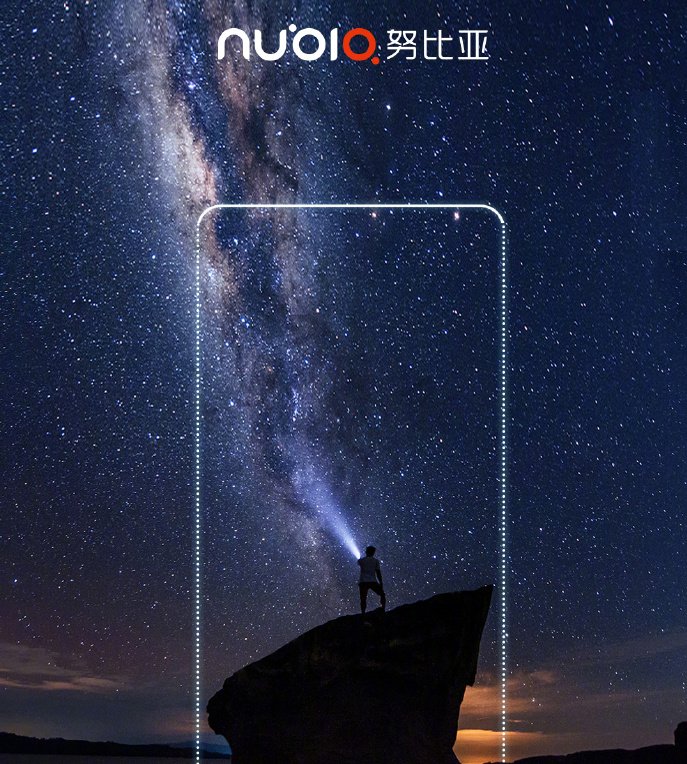
Full screen display is the rave right now and more manufacturers are jumping on the train. The latest is ZTE’s offshoot company Nubia, and their new teaser hints at a full-screen smartphone in the pipeline.
The teaser image released on Weibo yesterday shows an outline for a smartphone against a star-filled background. Though the bottom part of the phone where the lower bezel should be is missing. In spite of that, we have a rough mental picture of what the phone will look like.
Can you see the image uses a mix of dotted and straight lines? It is easy to tell that the display of the phone will end where the dotted lines stop, while the top bezel will be limited to the area the straight line covers.
Nubia is not new to bezel-less designs. Its Nubia Z17 flagship has non-existent side bezels but still keep the forehead and chin pretty thick. For this new smartphone, things will be different. No side bezels and a thinner chin and forehead.
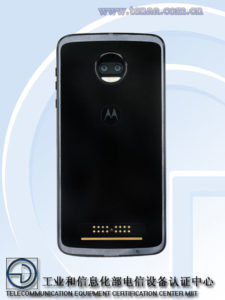
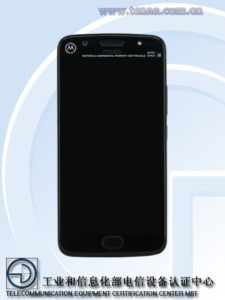
Lenovo recently unveiled the Motorola Moto G5S and Moto G5S Plus in India early last month and before then had listed up the smartphones for sale on Motorola Germany’s website. But the tech company has been silent about launching the premium smartphones in its home country, China. Looks like the Moto models are now set to go official in China. Both the G5S and G5S Plus have now appeared on TENAA‘s website indicating that they have received certification.
The TENAA listing shows the specifications of both models are the same with the ones revealed when they were unveiled in India. Obviously, the Moto G5S is the cheaper model of the two and that is reflected on its specs. The device features a 5.2-inch full HD display covered with Gorilla Glass 3. The Indian variant of the Moto G5S gets 4GB of RAM and 32GB of storage but China will be getting both the 3GB + 32GB version as well as the 4GB + 64GB variant. The device is also listed as powered by a 1.5GHz processor which is already known to be the Snapdragon 430 chip.
In addition, the Moto G5S comes with a metal body and a single rear camera, unlike the G5S Plus which has a dual camera setup at the rear. The G5S gets its juice from a 2810mAh battery. The battery is a removable one and the camera is configured as a 16MP sensor at the rear and a 5MP front camera.
On the other hand, the Moto G5S Plus features a bigger 5.5-inch 1080p display on top of an all metal-unibody. The device is powered by a 2,35GHz processor which is the Snapdragon 625 SoC. The China version will come with just 6GB of RAM and 128GB storage unlike the 4GB RAM + 64GB storage combo unveiled in India. As stated earlier, the major upgrade in the Moto G5S Plus is the addition of dual rear cameras. The G5S Plus dual cameras consist of two 13MP rear cameras in the Monochrome + RGB format with a 3D depth sensor for bokeh effects.
No word yet on when both models will go official in China but that may not be too far away.
We use cookies on our website to give you the most relevant experience by remembering your preferences and repeat visits. By clicking “Accept”, you consent to the use of ALL the cookies.
This website uses cookies to improve your experience while you navigate through the website. Out of these, the cookies that are categorized as necessary are stored on your browser as they are essential for the working of basic functionalities of the website. We also use third-party cookies that help us analyze and understand how you use this website. These cookies will be stored in your browser only with your consent. You also have the option to opt-out of these cookies. But opting out of some of these cookies may affect your browsing experience.
Necessary cookies are absolutely essential for the website to function properly. This category only includes cookies that ensures basic functionalities and security features of the website. These cookies do not store any personal information.
Any cookies that may not be particularly necessary for the website to function and is used specifically to collect user personal data via analytics, ads, other embedded contents are termed as non-necessary cookies. It is mandatory to procure user consent prior to running these cookies on your website.










 The TENAA listing shows the specifications of both models are the same with the ones revealed when they were unveiled in India. Obviously, the Moto G5S is the cheaper model of the two and that is reflected on its specs. The device features a 5.2-inch full HD display covered with Gorilla Glass 3. The Indian variant of the Moto G5S gets 4GB of RAM and 32GB of storage but China will be getting both the 3GB + 32GB version as well as the 4GB + 64GB variant. The device is also listed as powered by a 1.5GHz processor which is already known to be the Snapdragon 430 chip.