During the launch of the Mi Mix 3, Xiaomi‘s CEO Lei Jun provoked the ire of fellow Chinese giant Huawei when he asserted that the MI mix 3 camera configuration surpasses those of the Huawei P20 Pro. Now, we all know the P20 Pro still sits all on DXOMark ranking as having the most powerful camera. The Mi Mix 3’s DXOMark score emerged at the same time as its launch and it still fell below the P20 Pro. That still did not prevent Lei Jun from laying claims to having a better camera specification on its flagship Mix 3.
Sure, Huawei isn’t going to let that slip by without any response and it comes from no less a person than Huawei’s vocal Consumer Business Group chief, Richard Yu. In a social media post, Richard Yu stated “Any smartphone maker cannot surpass Huawei’s P20 Pro in a short period of time. Only we can surpass ourselves.”
This may sound like a storm in a teacup but it underscores the stiff and growing rivalry that exists among China top phone makers. Huawei has steadily maintained a lead in the Chinese market while Xiaomi sits at the fourth spot, going by shipping estimates from the third quarter. The Huawei P20 Pro is the first camera to feature a triple setup at the rear and the reviews have been awesome. The recently announced Mate 20 Pro keeps up with the triple camera setup, powered by a more powerful chipset. Xiaomi is obviously trying to grab some share Huawei with the Mix 3 which is cheaper and has claimed, “has a better camera”. We’ll sure be seeing more jibes from these rivals in the coming days.
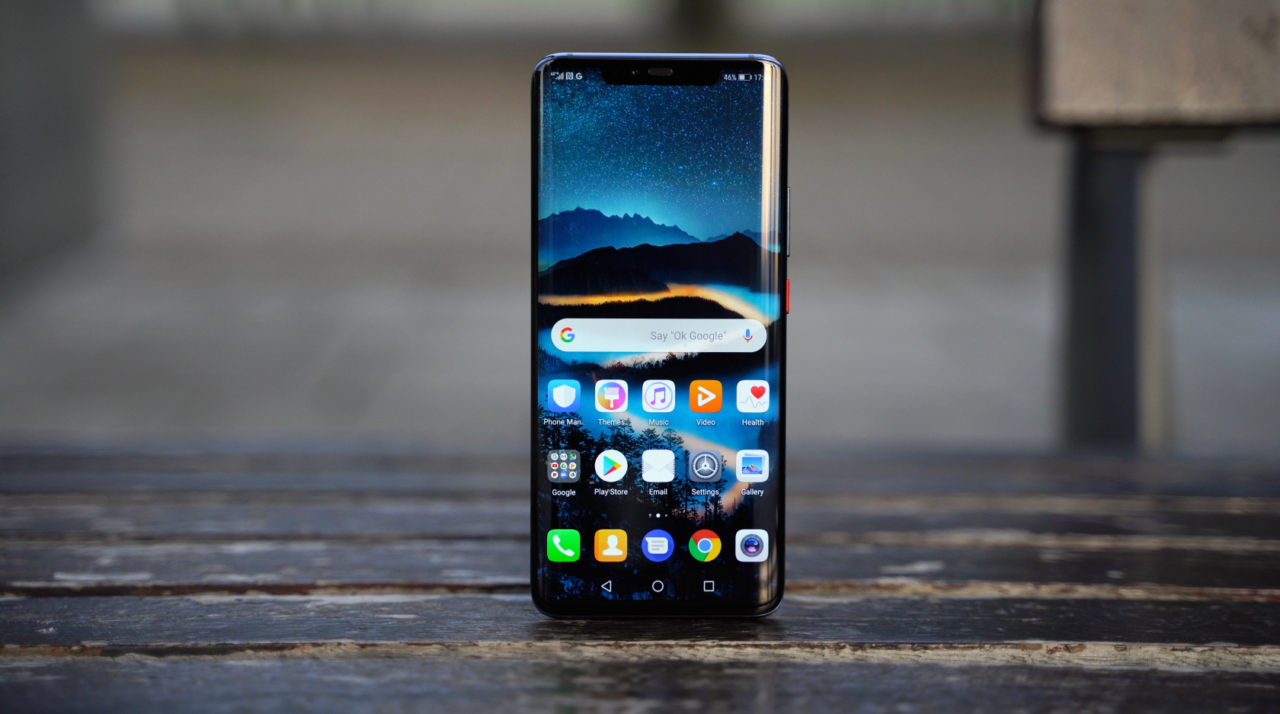
The Mate 20 Pro is the latest and probably the greatest phone made by Huawei. In this review, we are going to go through the main features, pros and cons of this device and I we will try to answer the question if this phone is worth the hype… and if it’s worth a hefty price tag of about 1000 EUR. Learn more in our full Huawei Mate 20 Pro review.
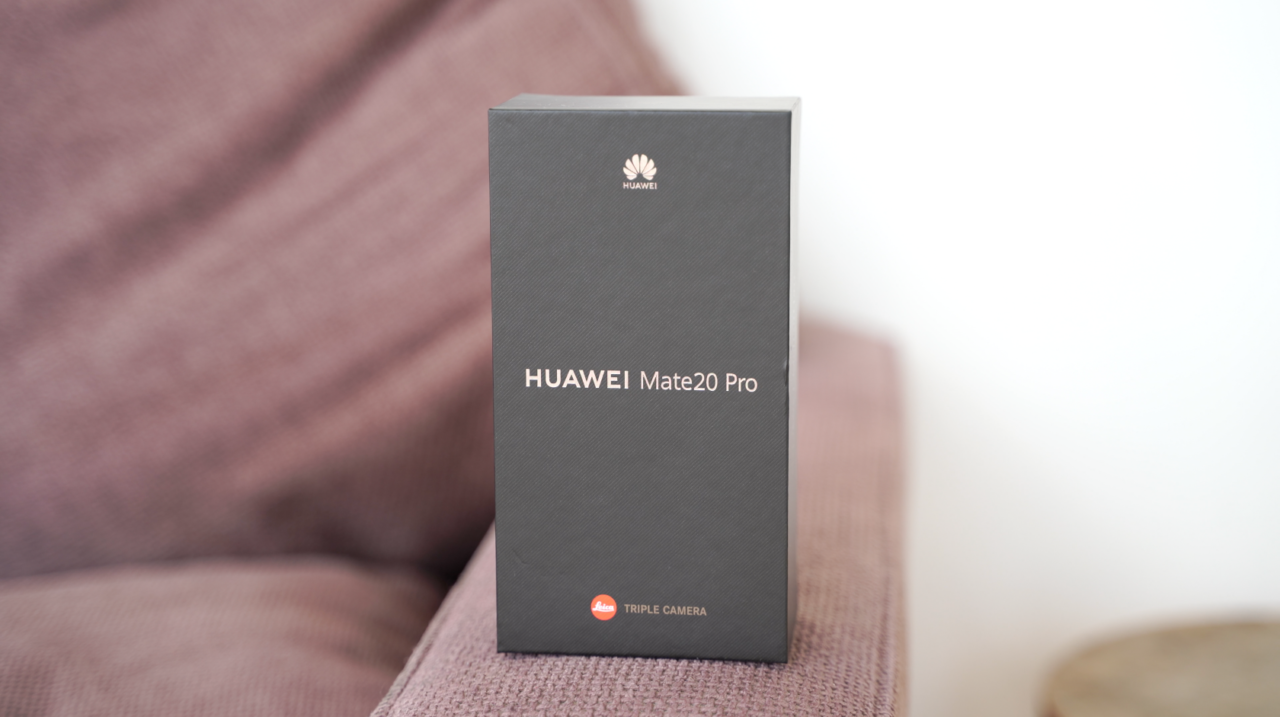
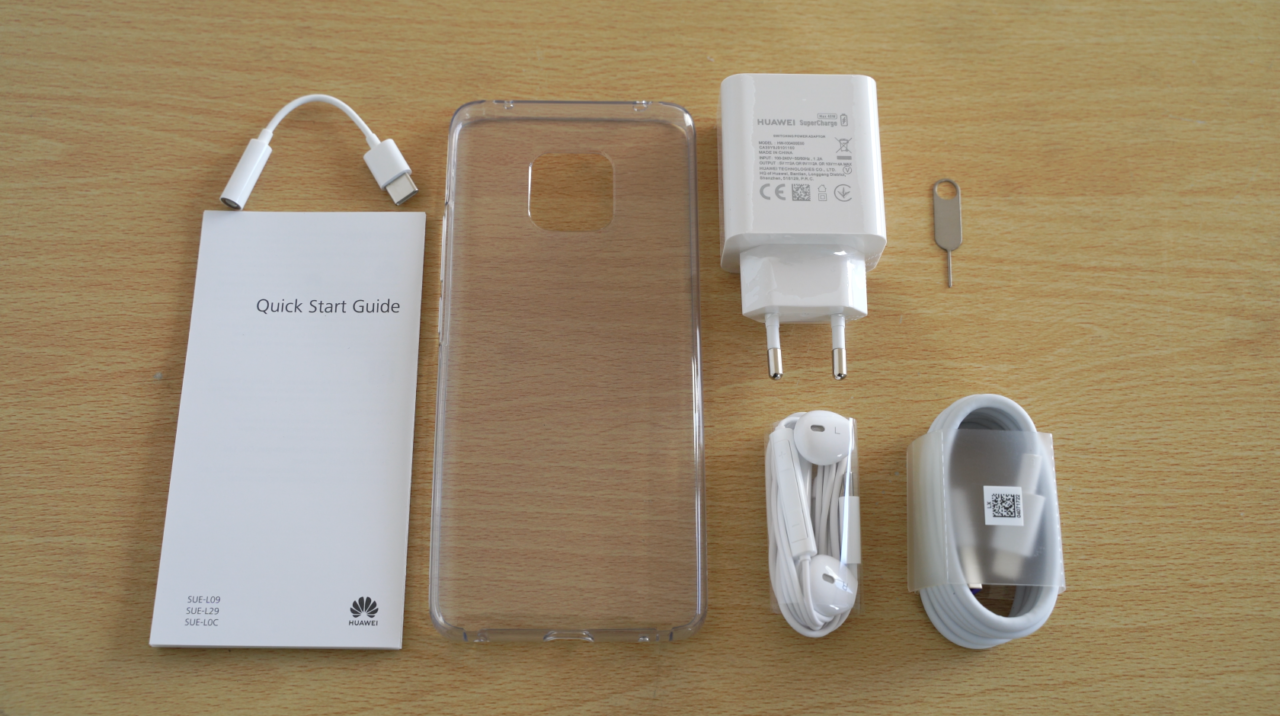
The phone ships with all the usual items and some extras include a soft TPU case and a headphone jack adapter.
DESIGN AND DISPLAY
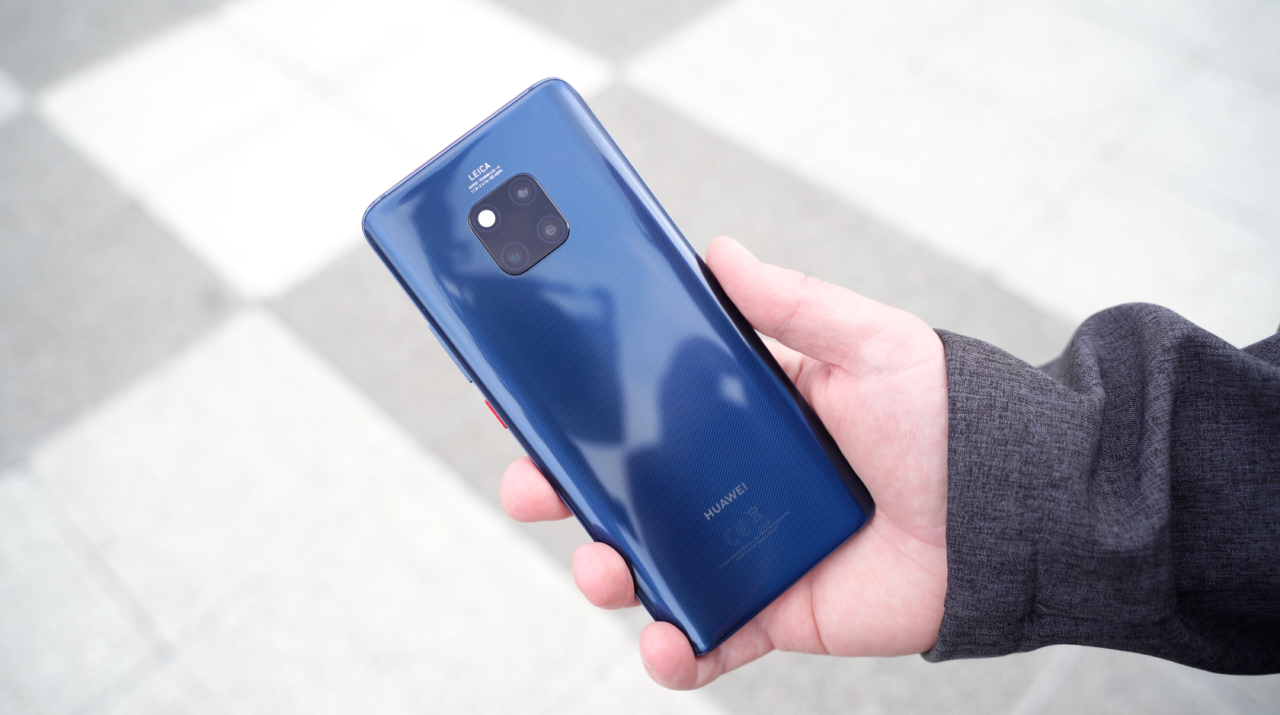
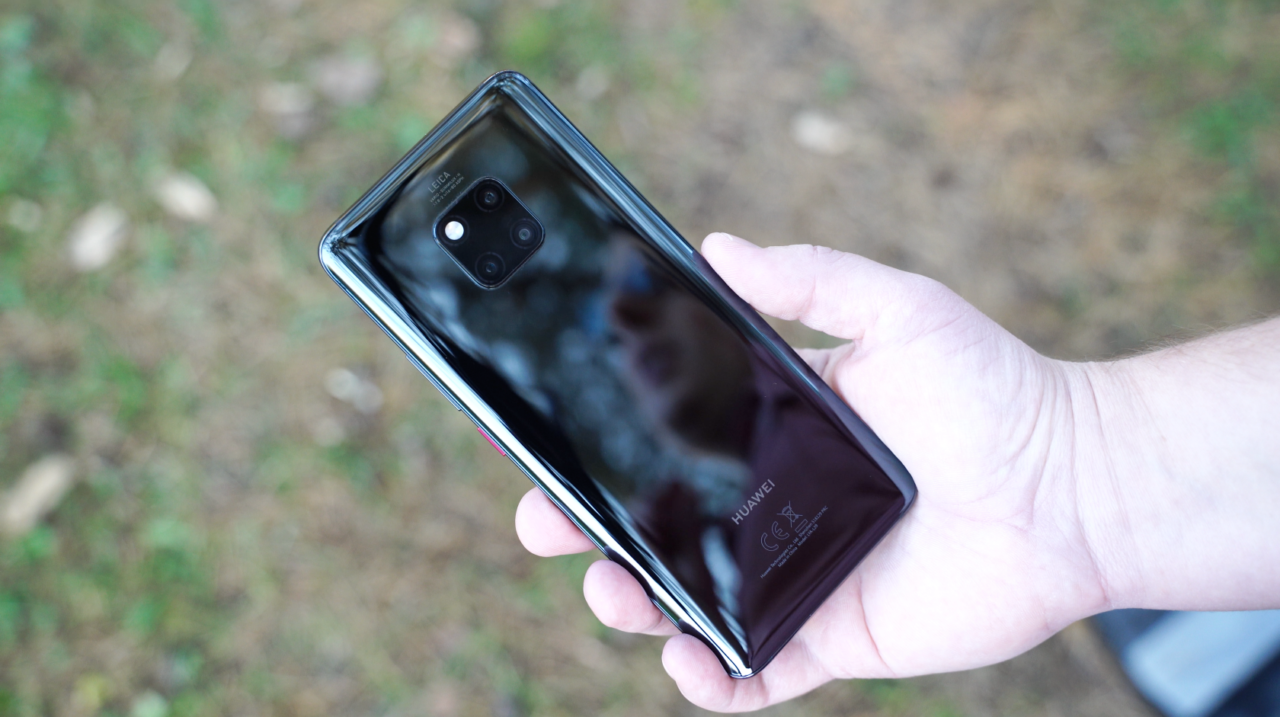
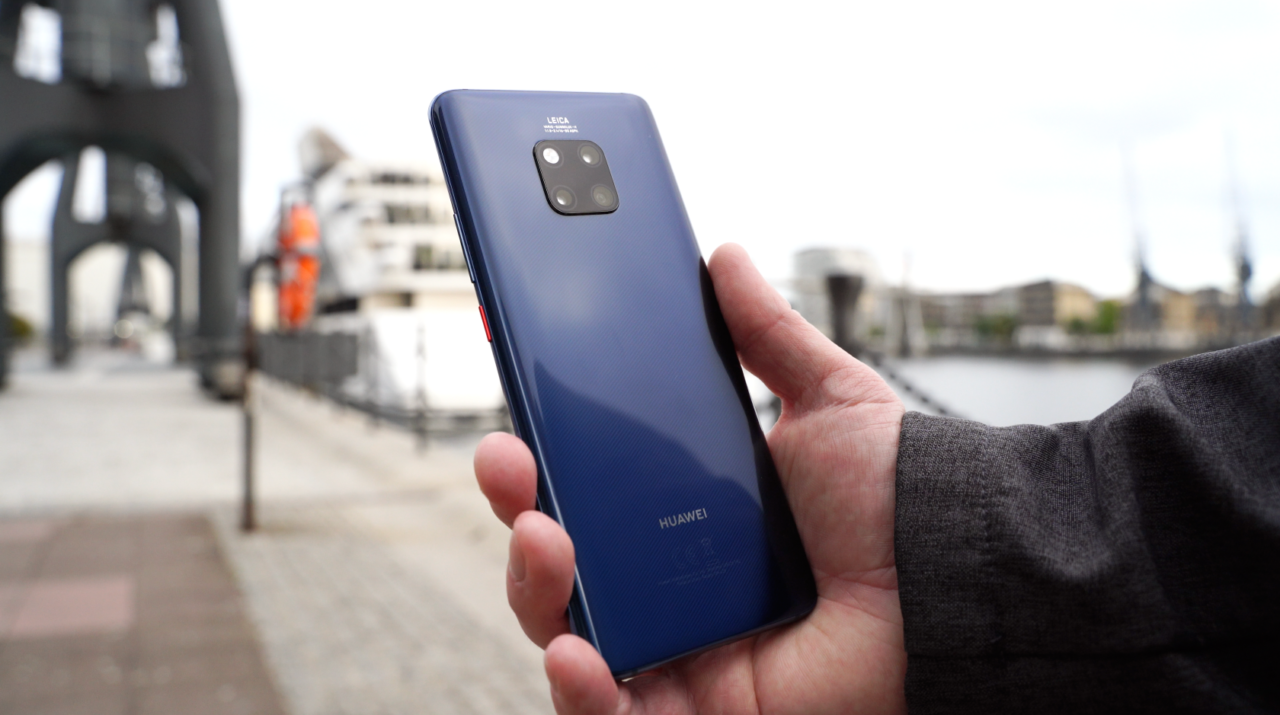
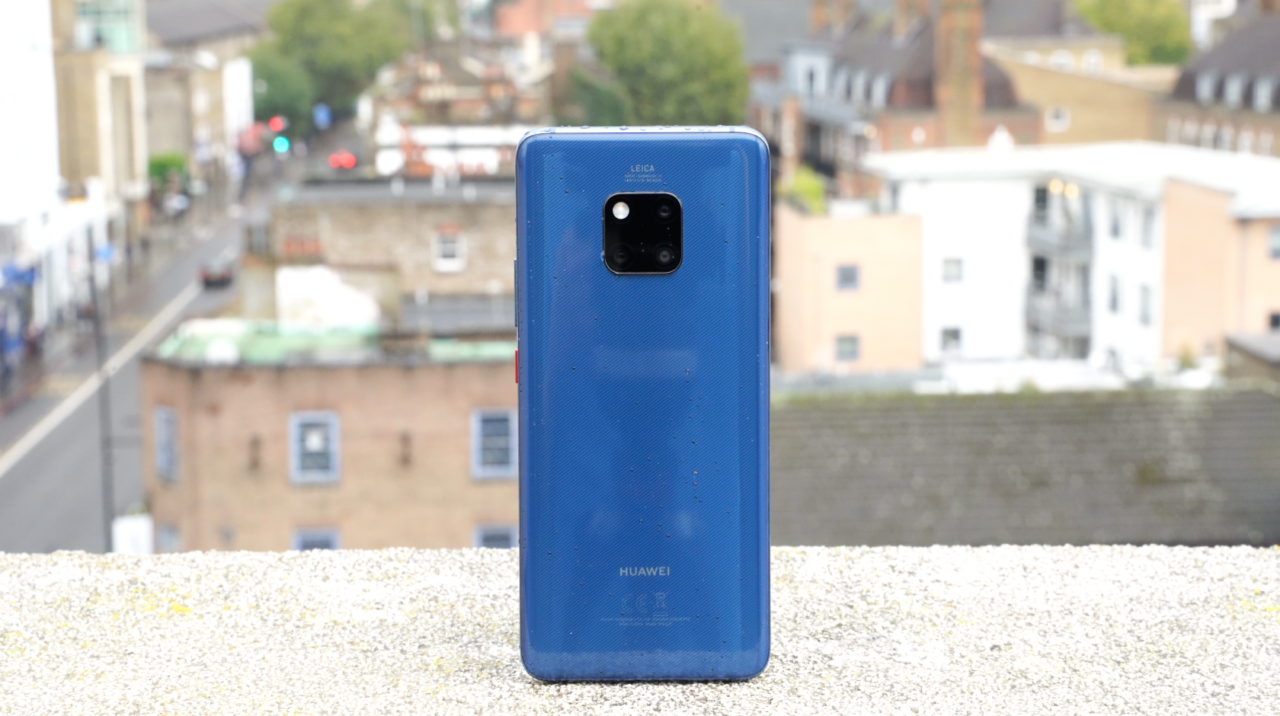
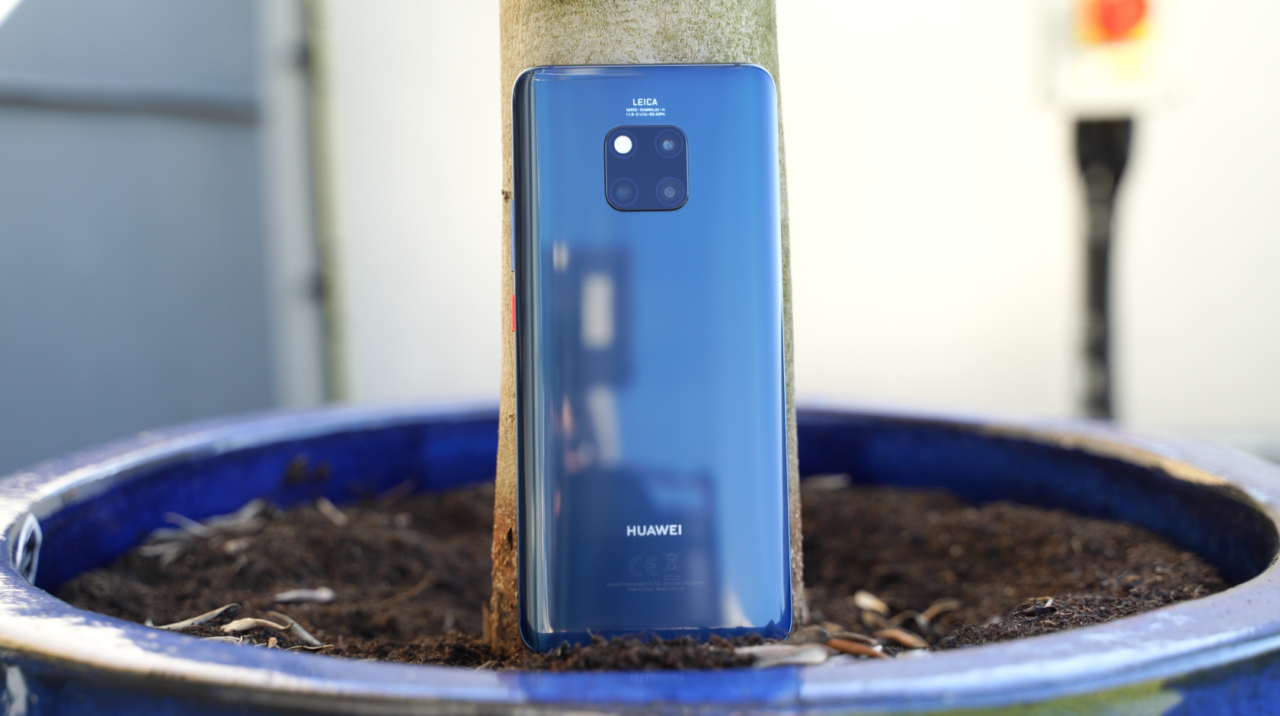
The phone comes in Emerald Green, Pink Gold, Black, Twilight and Midnight Blue color options.
I have the latter one. Even though I wanted to get the Twilight color, the blue model looks just gorgeous. I also had a chance to check out the black color option that looks nice and clean.
The Mate 20 Pro carries a ridiculously high price tag of about 1000 EUR here in Europe but it does offer a ton of premium features.
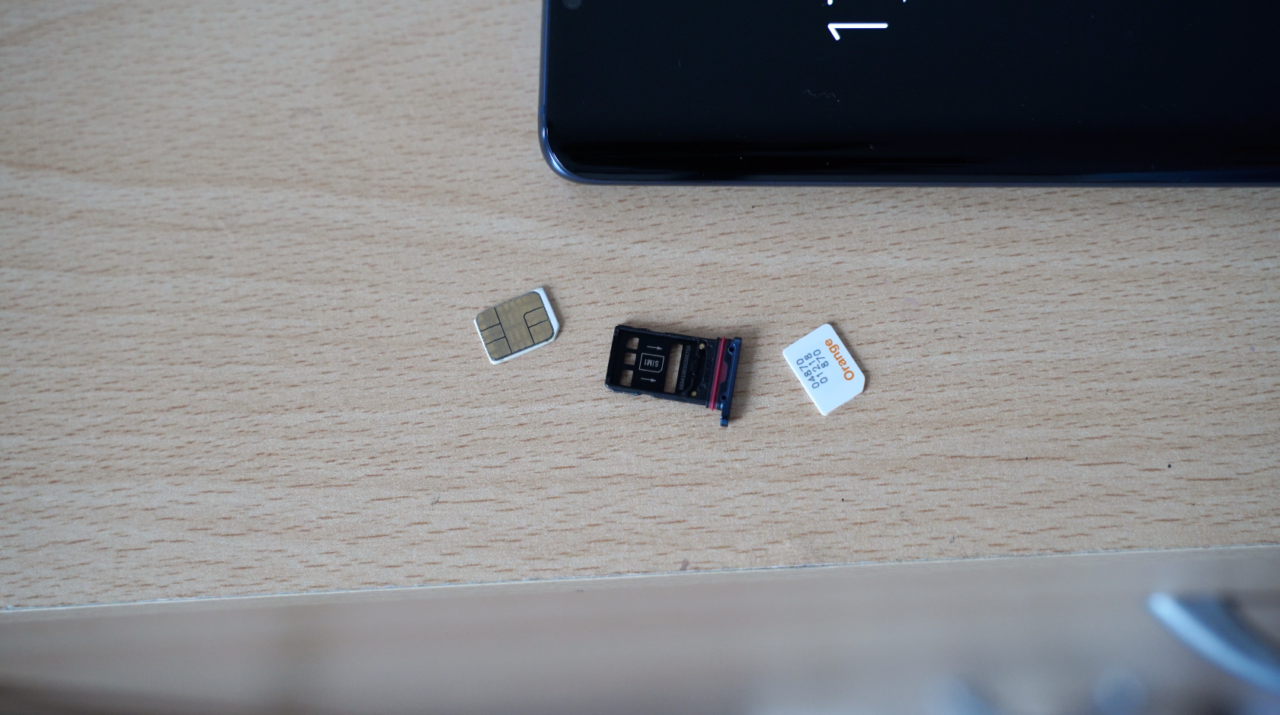
The Mate 20 Pro is a true powerhouse as it ships with the latest Kirin 980 chipset, 6GB of RAM and 128GB of storage which is expandable via the Nano Memory – the new type of memory cards introduced by Huawei. Innovation in this department is great but a lot of users would love to see a more conventional microSD card slot.
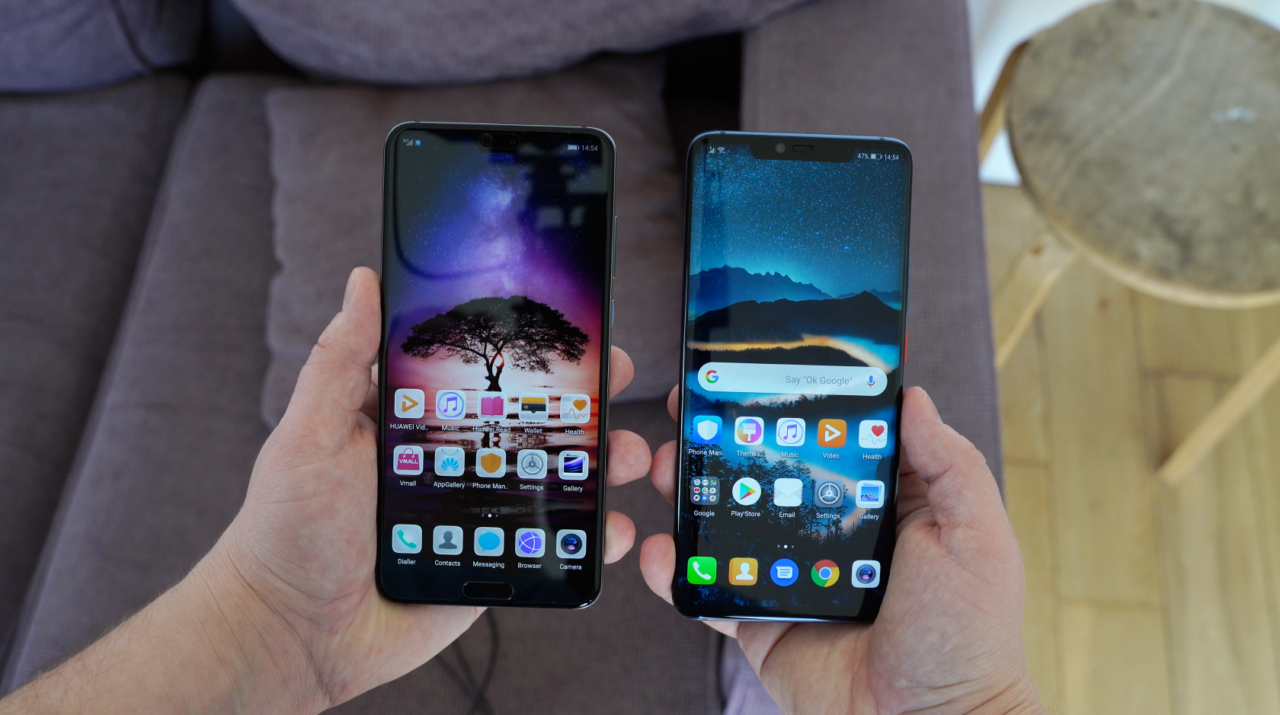
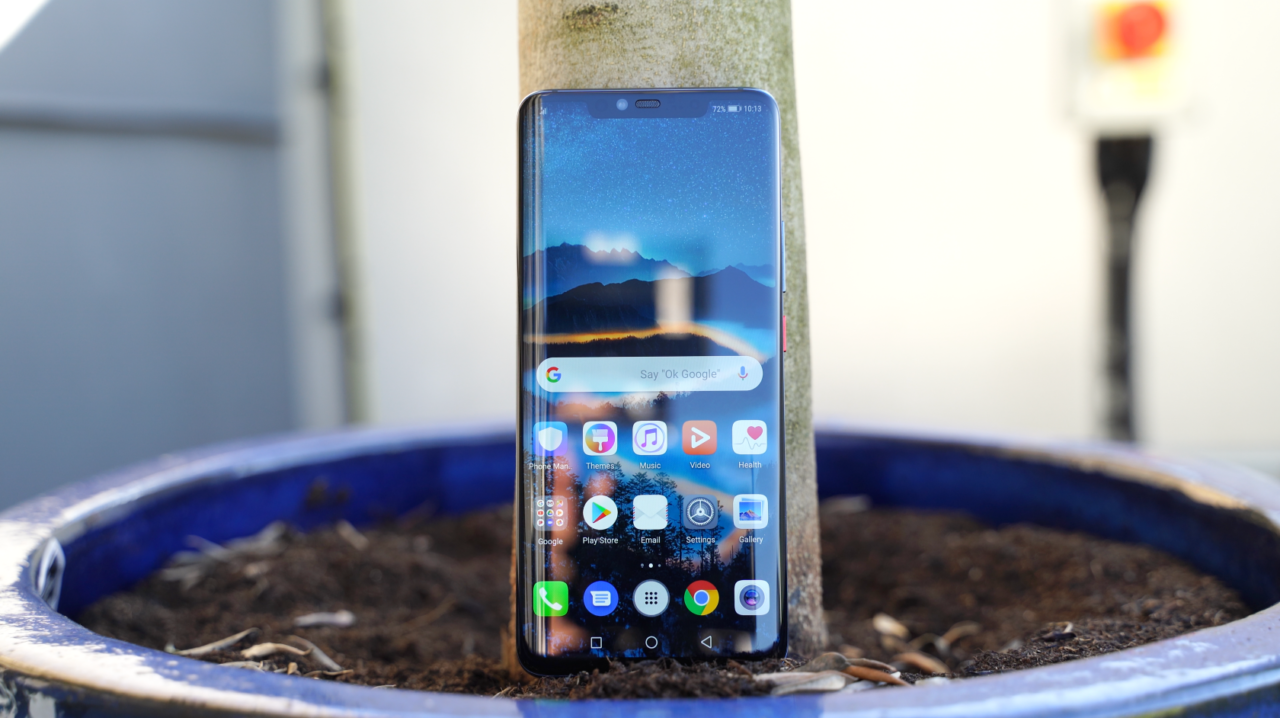
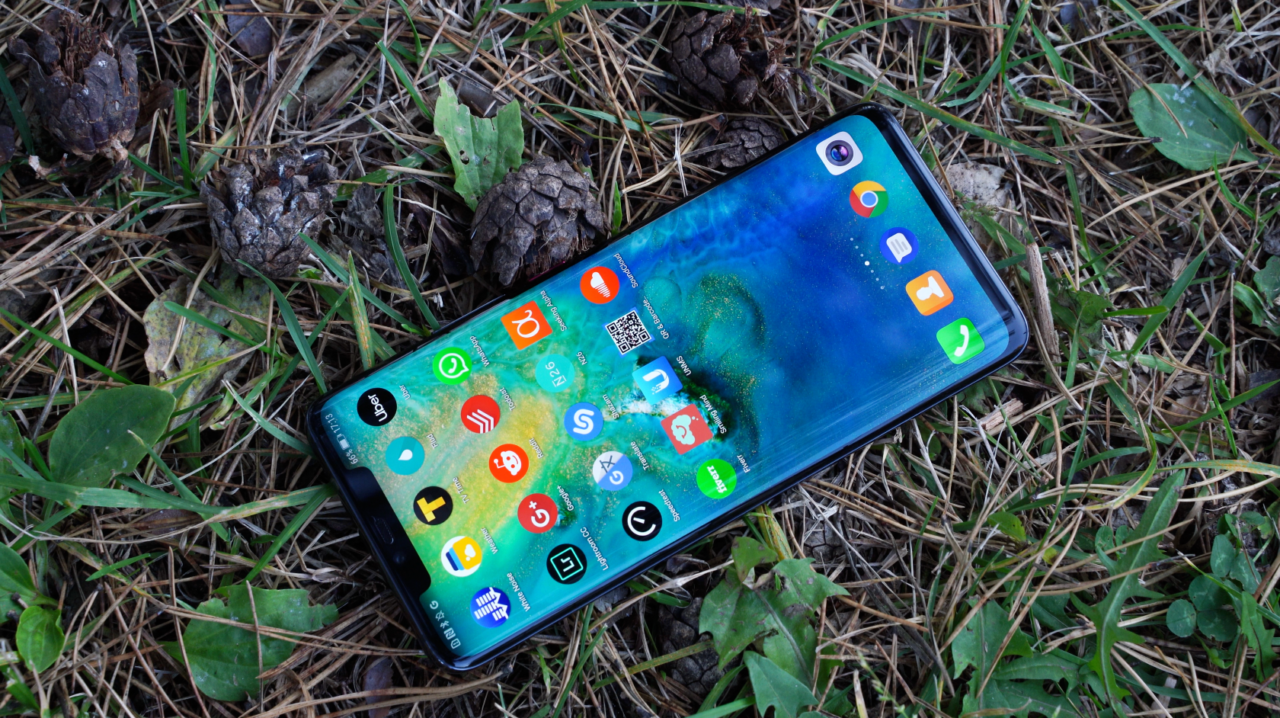
At the first glance, the Mate 20 Pro is yet another flagship phone that has a familiar design – glass on the front and rear, a metal frame and display with the notch. However, this is one of the most innovative phones of 2018 since it packs a lot of features we haven’t seen on other devices.
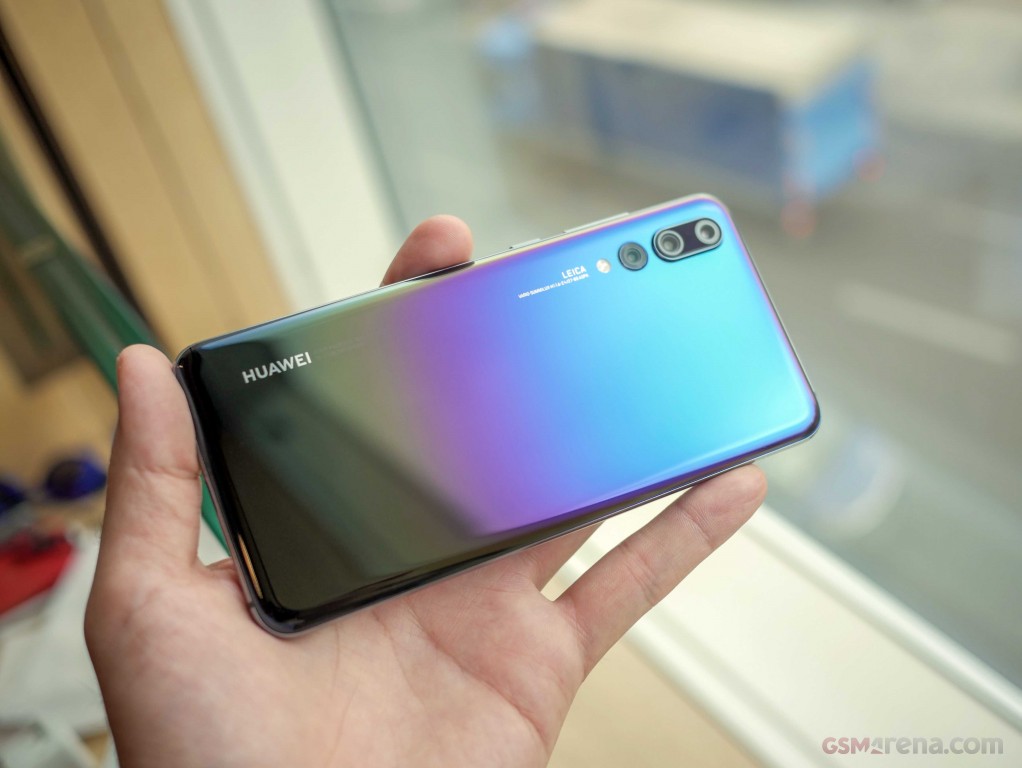
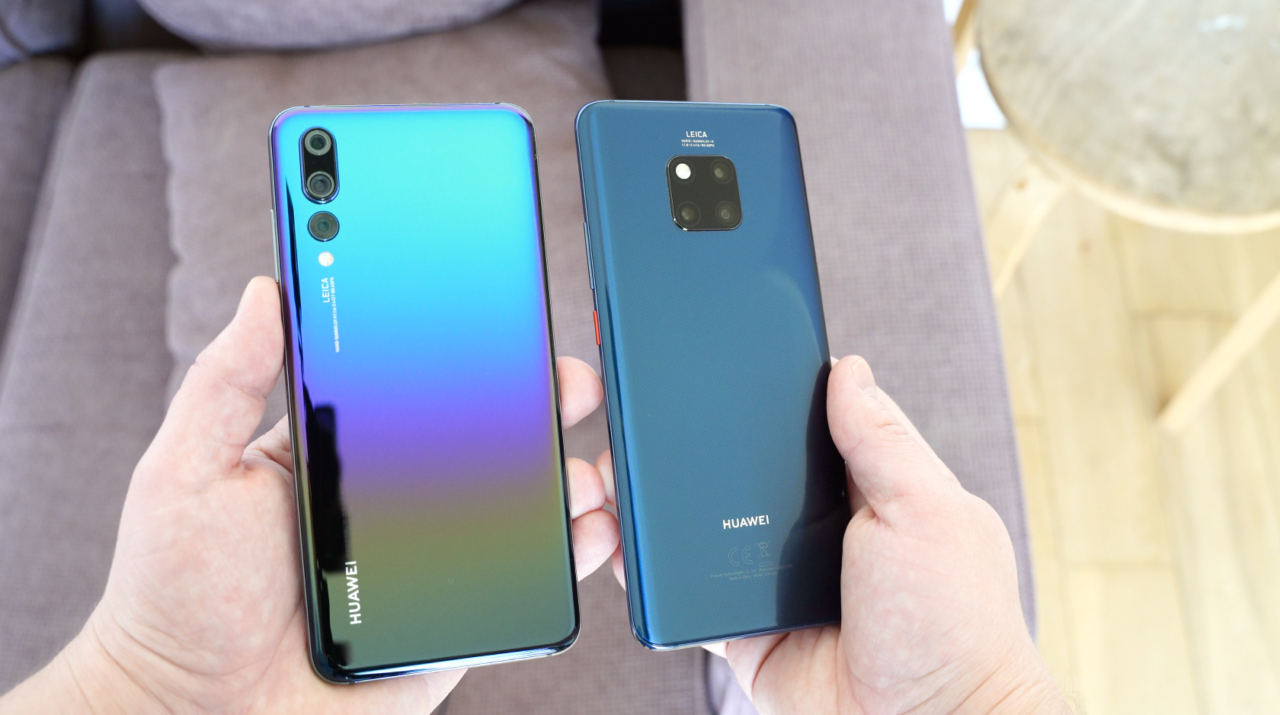
Also, the phone looks a lot different than the last year’s Mate 10 Pro and this year’s P20 Pro. By the way, this is the Morpho Aurora color of the P20 Pro. It would be nice if Huawei released the Mate 20 Pro with this color finish later on.
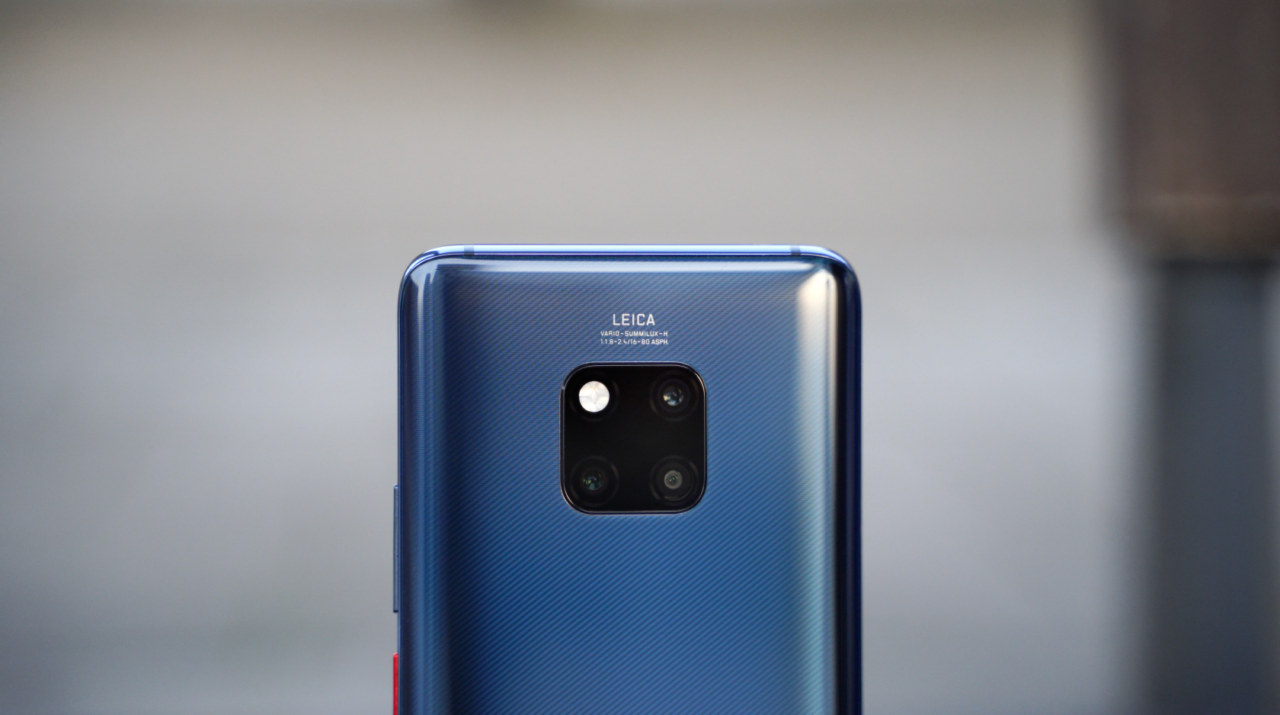
First of all, the backplate of the phone uses Hyper Optical Pattern design which is said to be more durable, easy to grip and fingerprint resistant. In practice, it’s really nice to the touch and it indeed attracts fewer fingerprints than conventional glass. It’s still quite slippery, though.
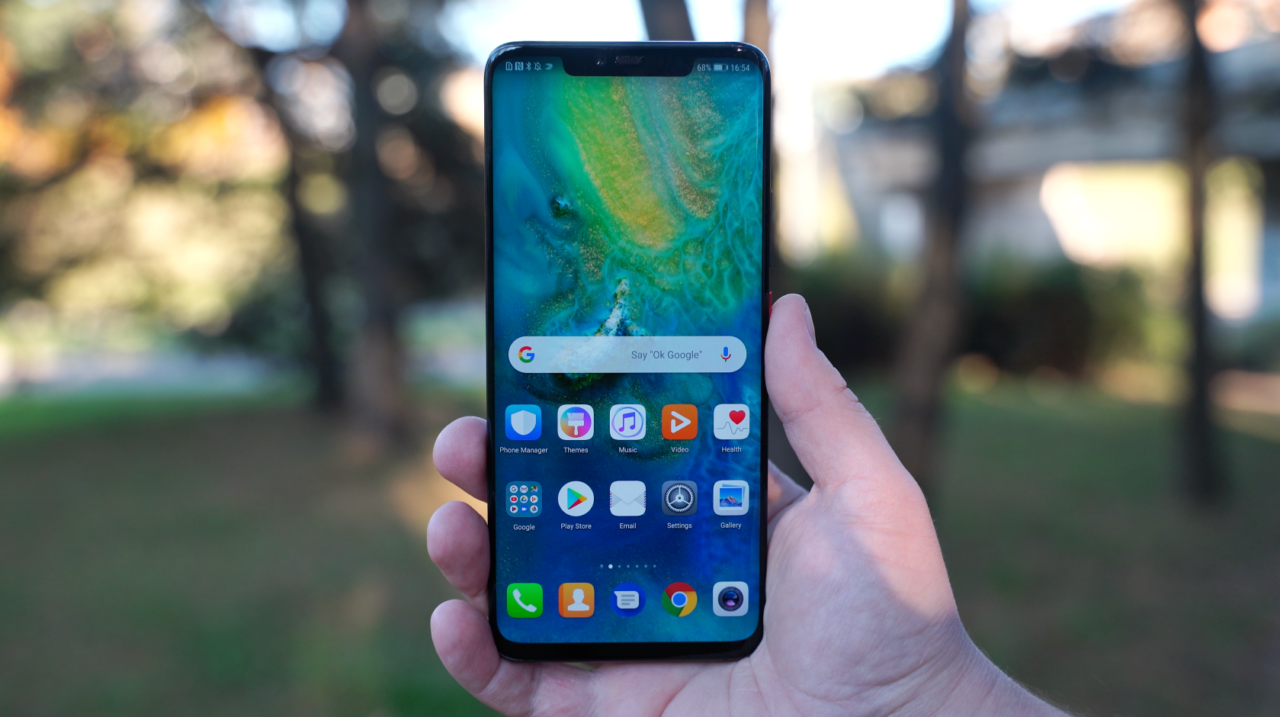
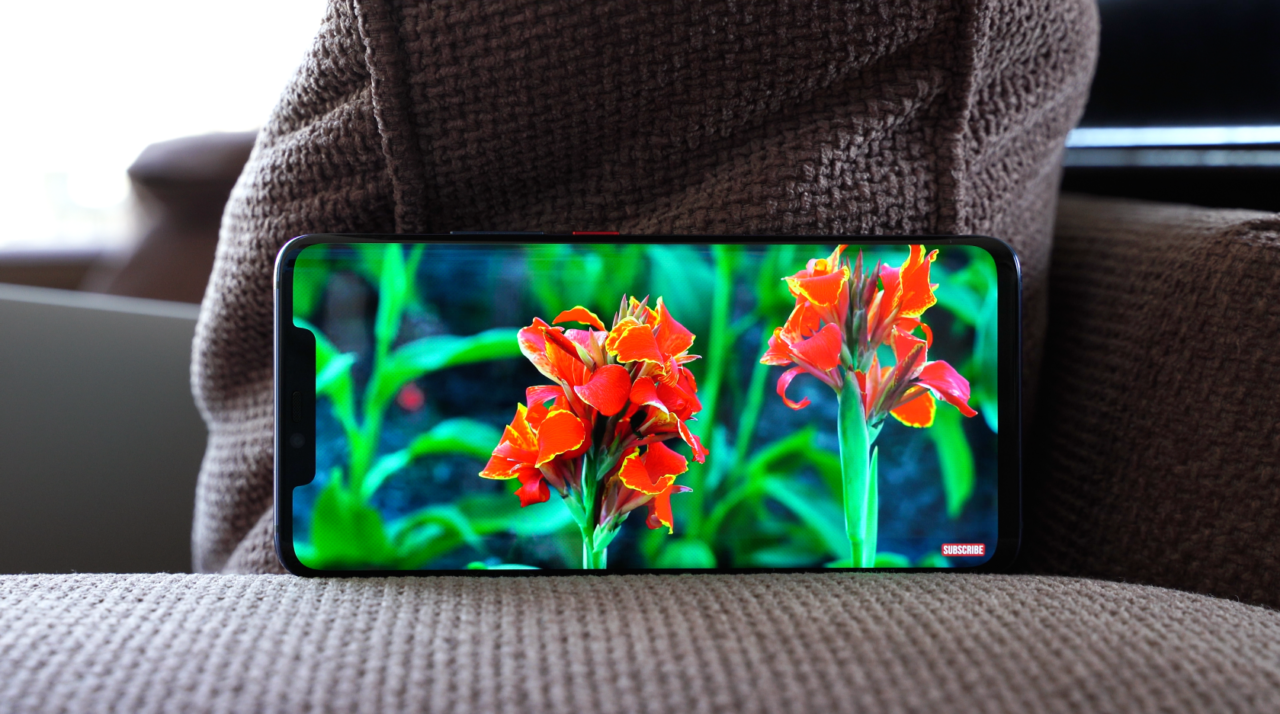
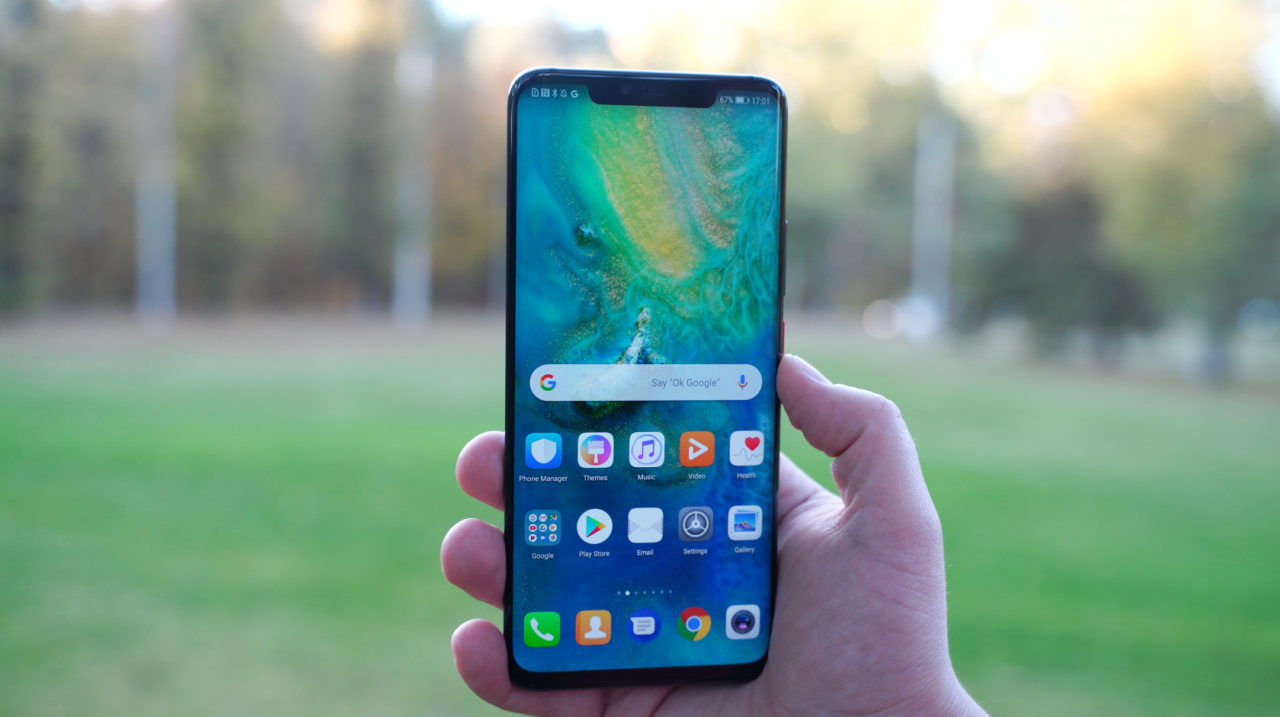
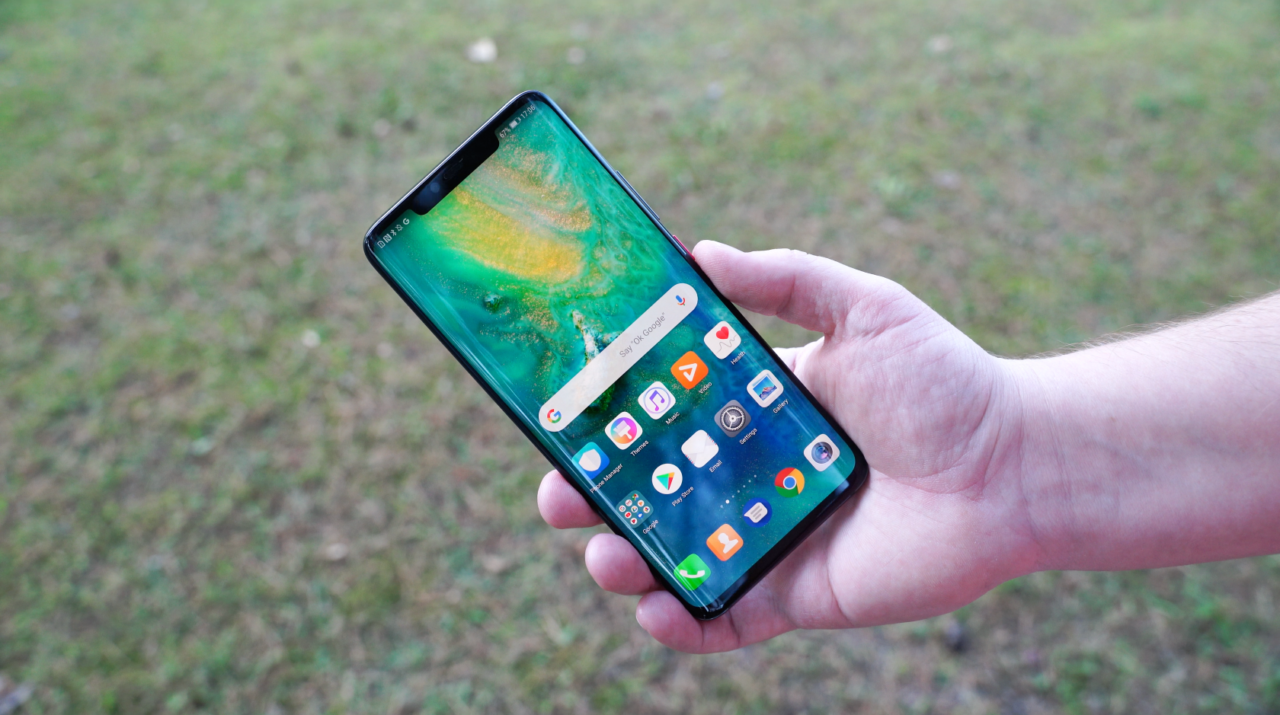
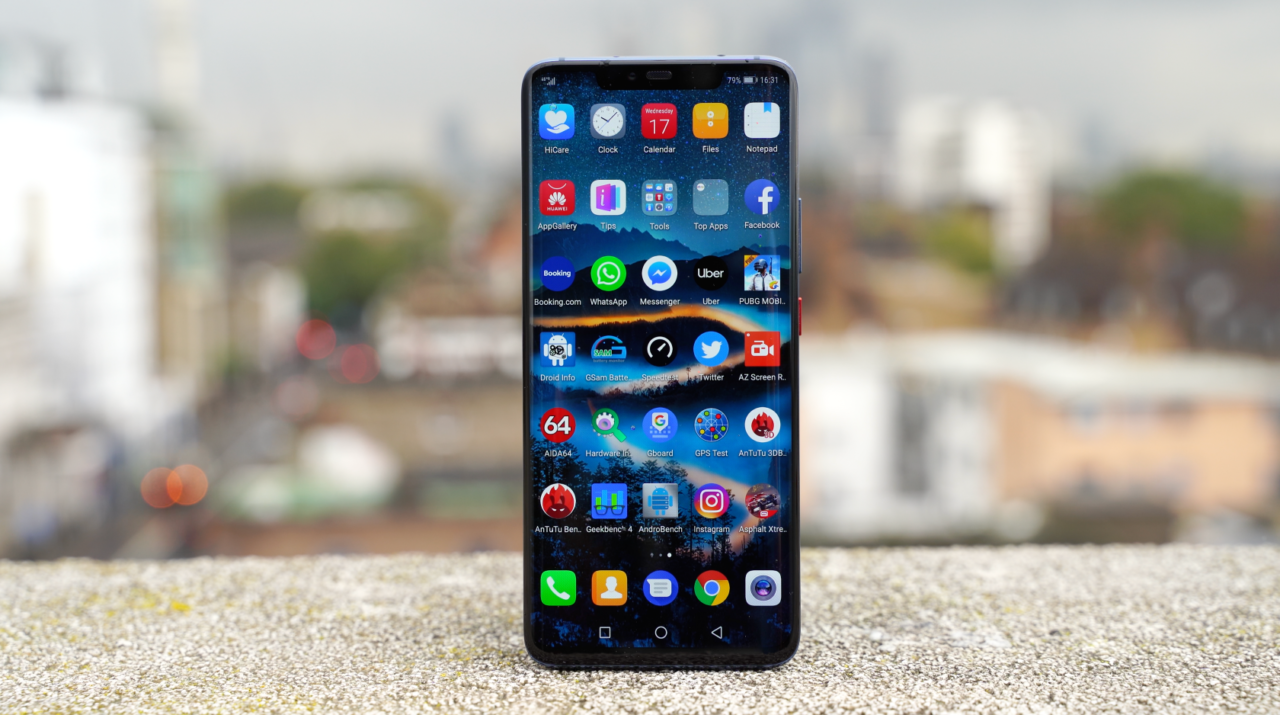
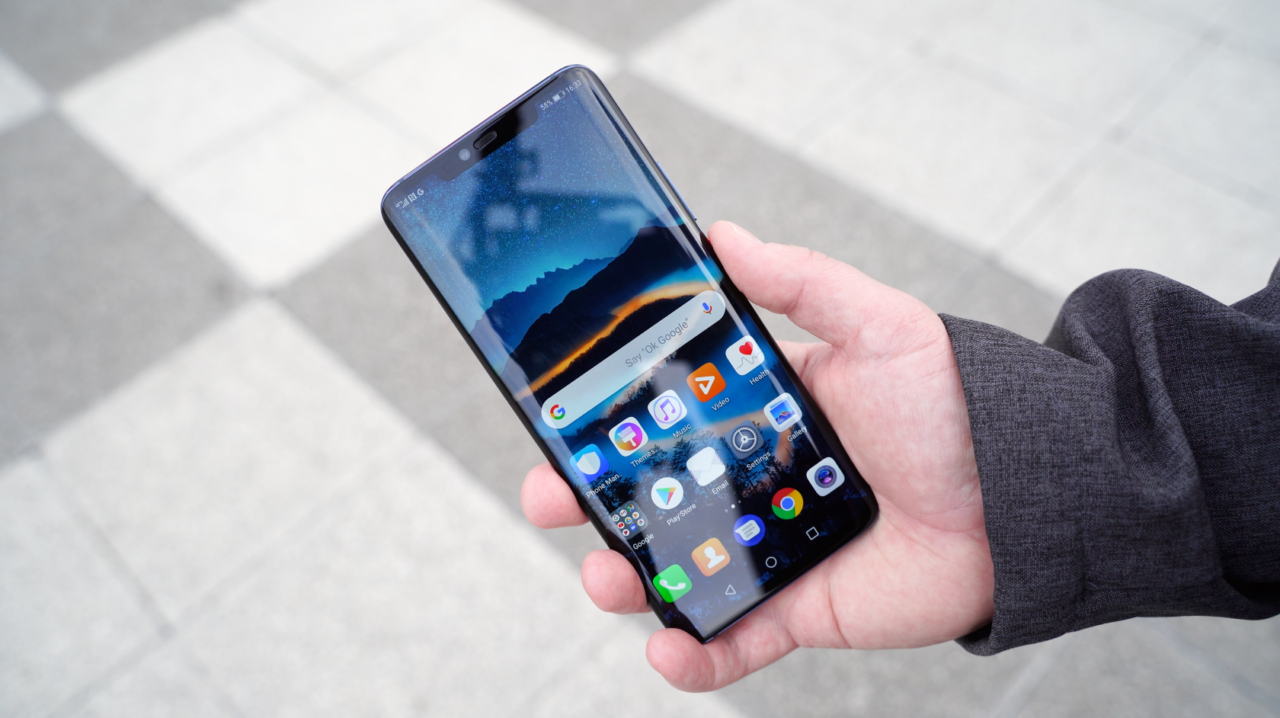
The 6.39″ (1440 x 3120px) HDR OLED display has the notch but you can hide it if you don’t like it.
The screen is super sharp and vibrant thanks high resolution. In addition, I like the color reproduction and I had no issues seeing it outdoors due to great brightness output. Despite a huge panel, the phone is fairly compact due to slim bezels on each side. Also, it’s really comfortable to hold the device in one hand.
One of the highlights of the phone – in-display fingerprint scanner. Well, it takes a bit more time to set it up but it works really well. It may be just a tad slower to unlock the phone but it works 10/10 times. Well done, Huawei, I hope other manufacturers will implement this feature soon.
In addition, Huawei improved the face recognition feature and it is now called 3D Face Unlock. There is an IR laser system inside the notch that contributes to excellent face unlock feature performance. I can see a massive improvement over the P20 Pro in terms of speed and accuracy. Also, this feature works well in low light.
On the back, you can find an upgraded Leica camera setup that now consists of regular, telephoto and wide-angle cameras: 40 MP, f/1.8, 27mm (wide); 20 MP, f/2.2, 16mm (ultrawide);8 MP, f/2.4, 80mm (telephoto).
On the front, you can find a beefy 24MP selfie shooter. We will talk about image quality in just a bit.
The phone also an LED notification light and IR blaster. However, there is no headphone jack but the sound quality via the supplied adapter has been excellent. Just like most of the flagships, the Mate 20 Pro is IP68-certified for water and dust resistance.
A lot of consumers roasted the P20 Pro for not having a wireless charging feature but the Mate 20 Pro has it and the device takes it to another level. First of all, the new Mate provides 15W of power output. What’s more interesting is that the device works as a wireless charging pad, which lets you charge other phones. I know that many will say this is a gimmick but I love innovation and I personally use this feature with my Galaxy S9+… that has kind of average battery life.
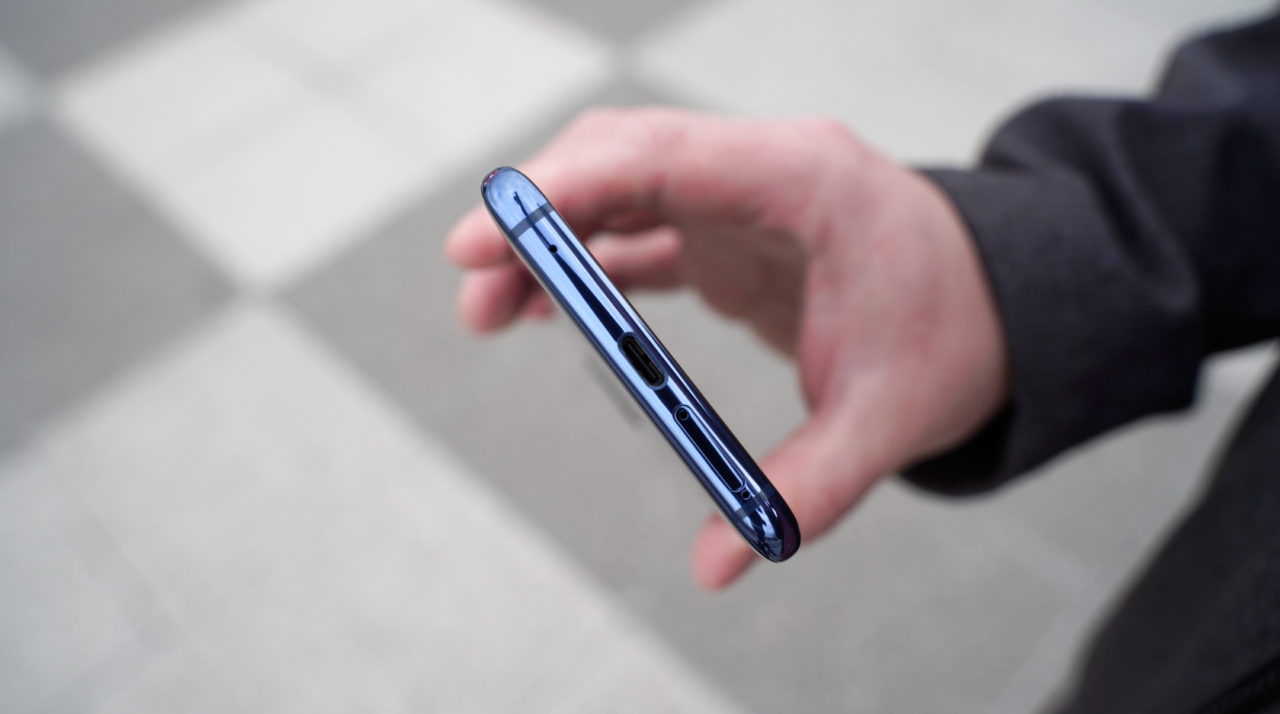
The Mate 20 Pro has a dual stereo speakers system. What’s interesting is that the bottom firing speaker is implemented in the USB-C port. This has never been done before and I applaud the Huawei for being the first to do that. The sound quality is really good overall as it is balanced and clear.
HARDWARE and PERFORMANCE
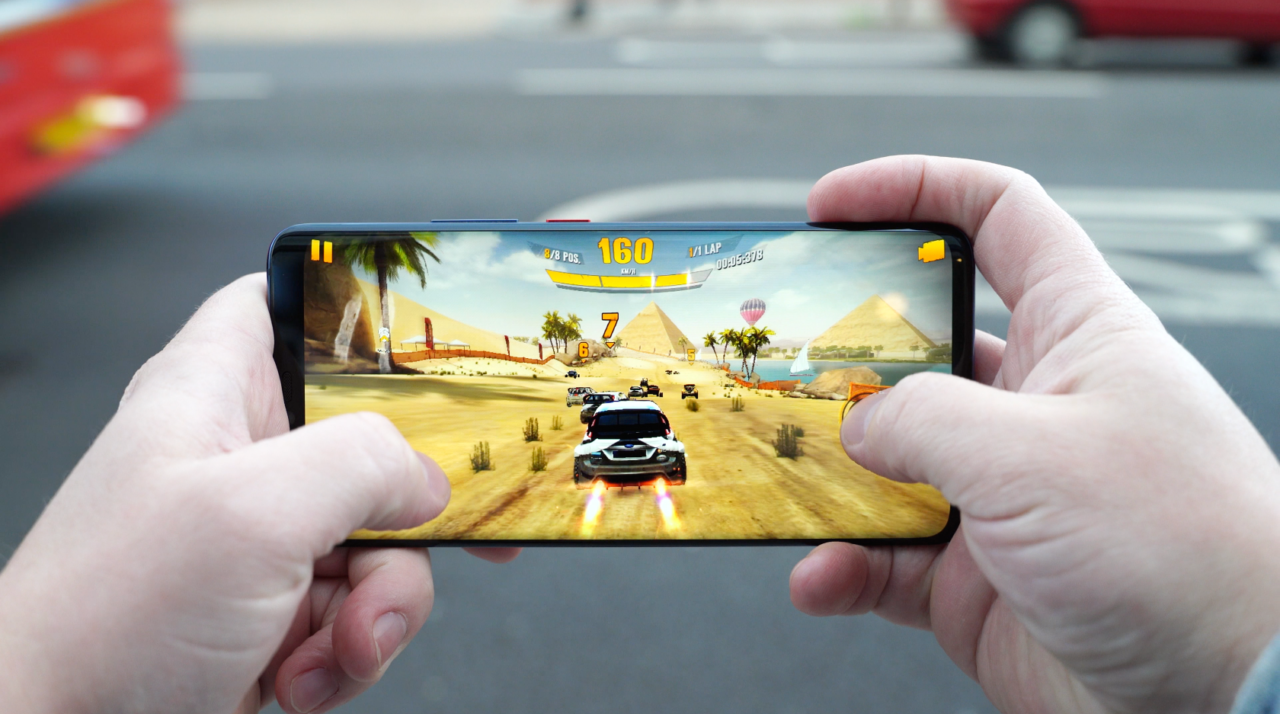
Great specifications of the Mate 20 Pro assure excellent gaming performance. In fact, the new Mate is the first Android phone that uses a 7nm CPU.
[envira-gallery id=”219487″]
I played quite a few 3D games on the highest graphics settings to push the hardware to its limits and there was no stutter, no lag and the graphics looked nice. In addition, the phone did not get hot even after 30 mins of gaming.
USER INTERFACE
[envira-gallery id=”219538″]
The Mate 20 Pro is also really fast and snappy on the daily basis thanks to the EMUI 9.0 that is based on the Android 9. Two integrated NPU’s alongside 7nm processor are here to assure the best user experience in terms of speed and responsiveness.
Besides all the features and customization options, the user interface has a new control system that gets rid of the navigation bar and it is based on swipes. It took me just a couple of hours to get used to it and I love it. If you don’t like it, you can always use more conventional navigation methods. The user interface is very different from the stock Android but if you follow my channel, you know that the EMUI has grown on me as I’ve been using the P20 Pro since the official launch.
I can’t say I need all the features but it’s always great to have plenty of options to choose from. Most importantly, the Mate 20 Pro is ridiculously fast and fluid even after installing plenty of apps. Flagship-grade performance.
IMAGE QUALITY
Notice: pictures uploaded on the website are resized by 50% to reduce loading time.
The highlight of the camera app is the ability to switch from telephoto and wide-angle cameras very quickly. There are plenty of camera modes but my favorites are auto, night and the pro mode that allows you to adjust a few image settings.
I have to tell you that it is really awesome to have so many camera lenses on a phone. Regular, zoom and my favorite 16mm wide-angle lens usually take really nice and detailed pictures and you can capture the same scene from a different perspective. I took almost all pictures side by side in auto, wide angle and telephoto modes and I uploaded them to my Facebook page in case you want to see more camera samples.
The pictures taken in auto mode look nice, sharp and detailed. I also like the colors and dynamic range is decent. The only complaint is that you cannot use zoom or wide angle lens in full 40MP. That’s why I used the default 10MP mode to take most of the shots. In addition, I could only test the camera on a cloudy day, meaning that the lighting conditions were not ideal.
Portrait shots usually look really nice as the object or subject is nicely separated from the background with almost no artifacts and the bokeh looks creamy. You can also take super macro pictures which is another standout feature of the Mate 20 Pro. The main lens can focus up to 2.5cm and the results are really good.
[envira-gallery id=”219667″]
Low-light image quality is really good too even though some shots have a yellow tint and images taken with the telephoto lens could look better.
However, if you use a dedicated night mode, you can take one of the best low-light pictures on a phone. Just like the P20 Pro, the Mate 20 Pro allows you to take long exposure shots without a tripod and the results are simply amazing. This is arguably the best night image quality I’ve seen on any smartphone.
[envira-gallery id=”219702″]
Selfies look nice. They are sharp, detailed and the colors are quite accurate. Selfie portrait shots look nice too as there no severe artifacts around the subject and pictures will look nice on social media. You can also change the background blur effects and you may have already seen that if you follow me on Instagram.
4K video quality has improved dramatically over the P20 Pro. It is now super smooth and stable thanks to the hybrid stabilization system (OIS + EIS). There is quite a lot of detail and sharpness too. However, there is some jello effect going on and video using telephoto cameras does not look great. Keep in mind that the phone runs on a very early software build and I’m sure Huawei will improve that because the powerful hardware is here.
1080p selfie video looks great as it is smooth and stable. Finally, the sound recording quality is good.
BATTERY LIFE
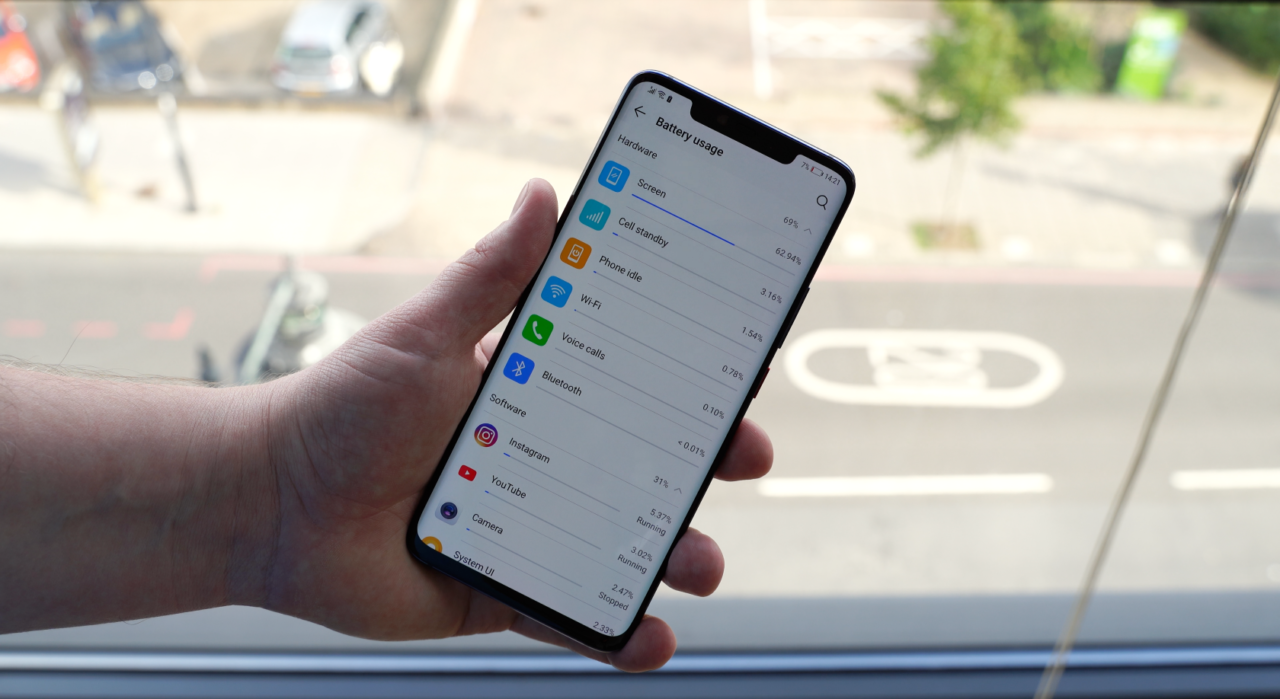
The Mate 20 Pro has a massive 4200mAh battery that has been performing extremely well. In fact, the new Mate probably has the best battery life on any flagship smartphone.
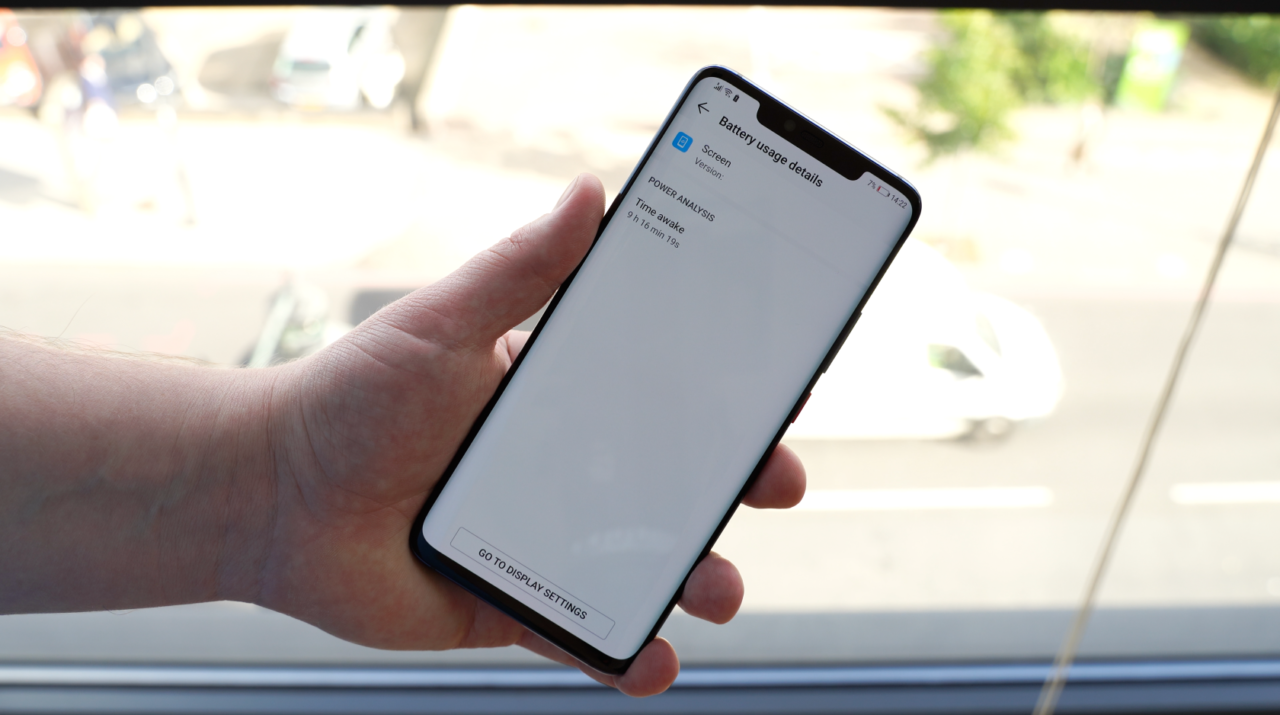
I could get 9 hours of screen-on time (SOT) under heavy usage of the phone, which is really impressive. If you use the phone just for the basic stuff, you can expect to get over 12 hours of SOT.
Another example: I unplugged the phone at 8 AM, used it quite a bit for taking pictures, reading news and social media, used max. screen brightness setting a lot and … the phone still had 73% of the battery 9.30PM. This is a simply amazing result and it’s certainly the best battery life flagship smartphone I’ve ever had.
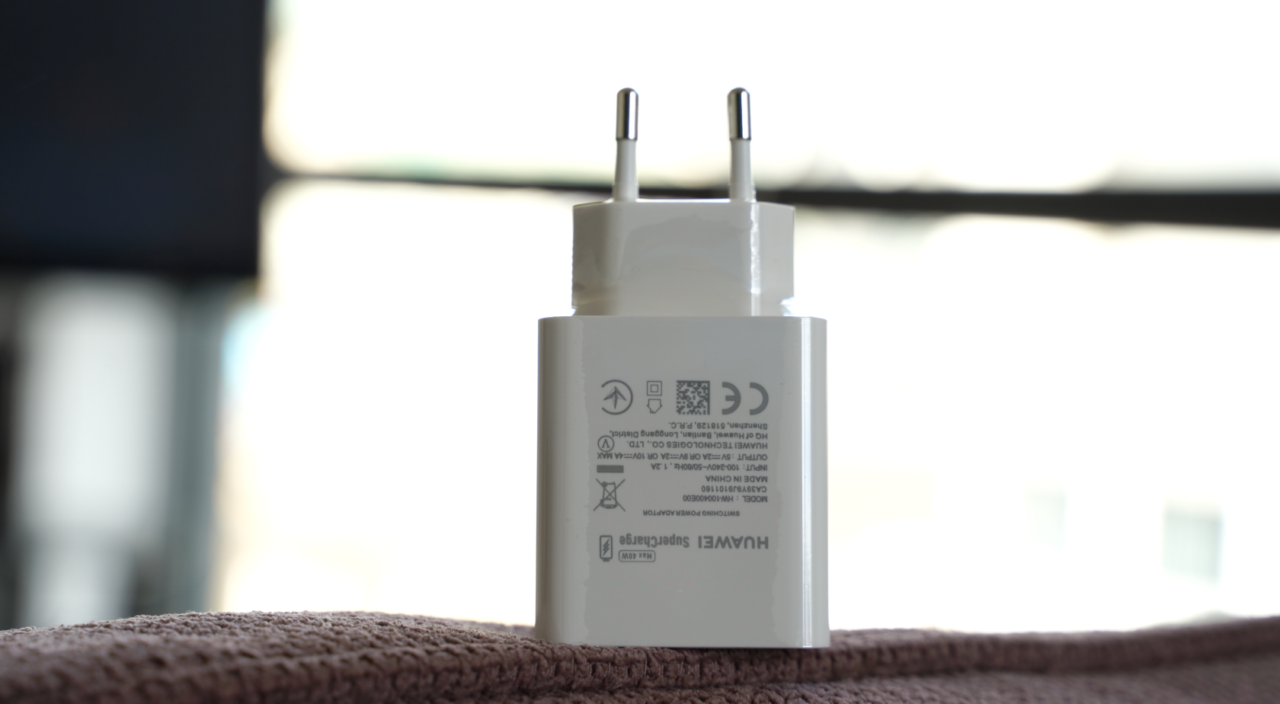
What’s even more impressive is that the Huawei introduced a super fast 40W charging tech that allows you to charge the phone’s battery up to 70% in just 30 mins. In other words, you can fully charge the phone in under 1 hour with the supplied super fast charger.
CONNECTIVITY
The Mate 20 Pro offers ultra-fast 4.5G network speeds, excellent signal reception, great call quality, super fast Wifi, and dual-frequency GPS that I found to be very accurate for both driving and walking. Also, there is NFC and plenty of sensors on board.
CONCLUSIONS
The Huawei Mate 20 Pro is an expensive phone but it offers plenty of innovative features and it might be one of the most complete smartphones the money can buy at the moment but there are a few caveats to consider.
I love the design, great build quality, sharp display, great overall performance, one of the best and versatile cameras, insanely good battery life, plenty of connectivity options and the phone is really comfortable to hold in the hand.
I also love Huawei for implementing plenty of innovative features like world’s first 7nm CPU, an in-display fingerprint scanner, the speaker that is embedded in the USB-C port, reverse wireless charging, 40W super fast charging, the lens that is capable of 2.5cm minimum focusing distance and the new Nano Memory standard.
The downsides of the Mate 20 Pro include the lack of the headphone jack, not really impressive video quality using zoom camera but that may be improved with the future software updates since the phone still runs on an early software build.
Other than that, the Huawei Mate 20 Pro is a true flagship smartphone that is just loaded with features, it has a ton of power and it is easily one of the best smartphones of 2018, despite a hefty price tag. In fact, this is my new daily driver for a reason and that says a lot as I’m usually very picky with each gadget I use.
Xiaomi held a conference on Thursday last week where the flagship Mi Mix 3 was officially announced. The Chinese tech giant did not announce only the Mix 3 but also launched a portable AI Bluetooth speaker. The product is officially called Xiaomi XiaoAI Bluetooth Speaker Portable Edition.
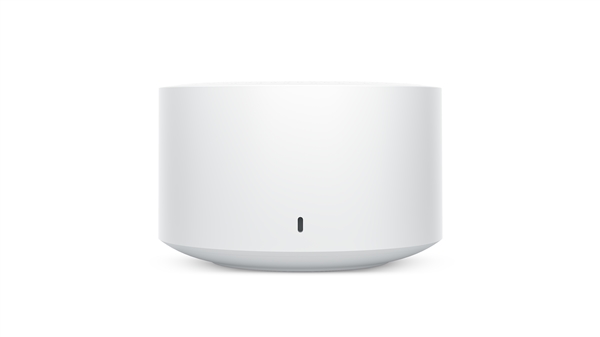
The new speaker adopts a compact round shape similar to the portable Xiaomi Bluetooth Mini speaker but this time around, you get a built-in XiaoAi voice assistant. It is actually a trimmed down version of the rectangular-shaped Mi AI speaker. There is equally a Mi Ai Speaker Mini but this version is way smaller and can easily fit into the pocket. It is lightweight, weighing just 52 gram and comes only in white colour. It has a waterproof build, making it suitable for use in the bathroom or other places where it is exposed to water.
The Xiaomi XiaoAI Bluetooth Speaker Portable Edition uses DRC technology to provide a rich sound output with a dynamic sound compression algorithm that provides a cleaner sound with no distortion and adequate bass. The speaker also comes with voice assistance feature powered by XiaoAI. The voice assistant offers useful functions such as weather forecast, establishing a telephone connection to someone on the contact list. Unfortunately, this feature is only available in the Chinese language as with other Mi AI speakers. Regardless of that, the speaker is an affordable companion with robust sound output capable of prolonged music playback. Thanks to its 480mAh battery, the speaker boasts of 45 days standby time and 4 hours of music playback. It can also be used to receive calls via a connected smartphone.
The pricing of the Xiaomi XiaoAi Bluetooth Speaker Portable Edition is just 49 yuan ($7). It will go on sale in China on November 28 via Xiaomi Mall while reservation will open on November 19.
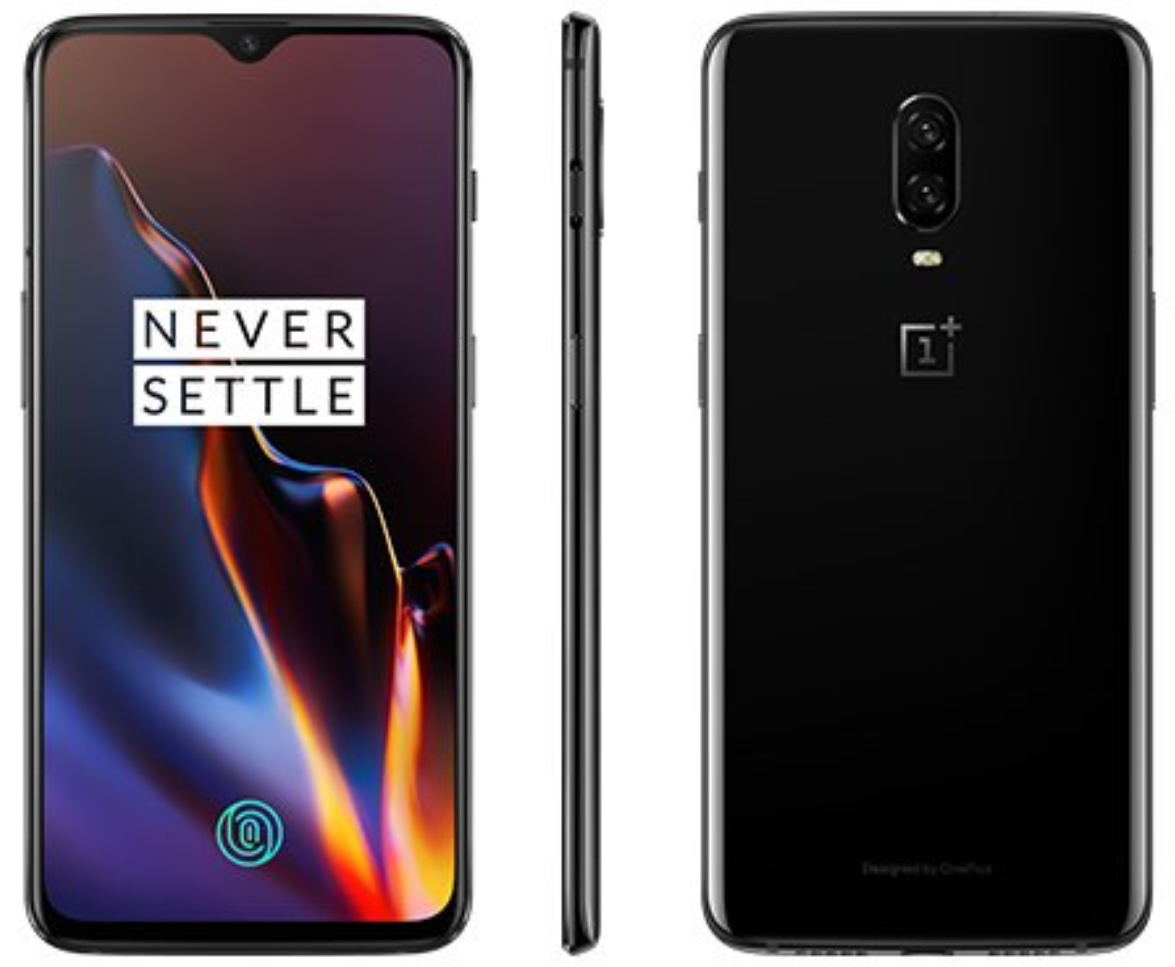
OnePlus is back again with a brand new smartphone and following the usual tradition, the new model will be called as the OnePlus 6T. The core of the new smartphone is essentially going to be the same as the OnePlus 6. However, there are going to be some really big changes when it comes to the external design of the phone. That and everything else about the new phone will be covered in this comprehensive OnePlus 6T Specs rumor roundup article.
DESIGN:
Better Notch Implementation
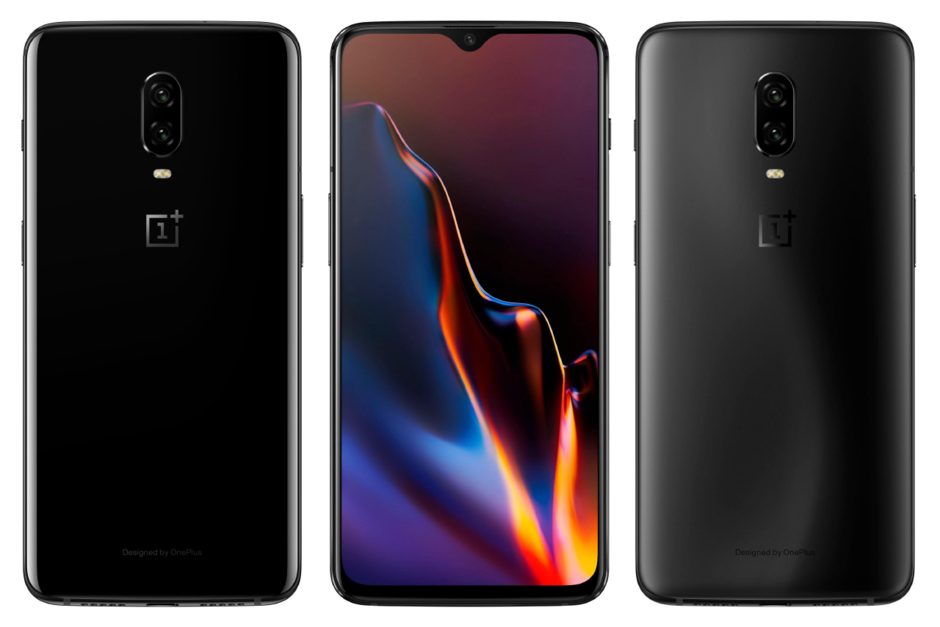
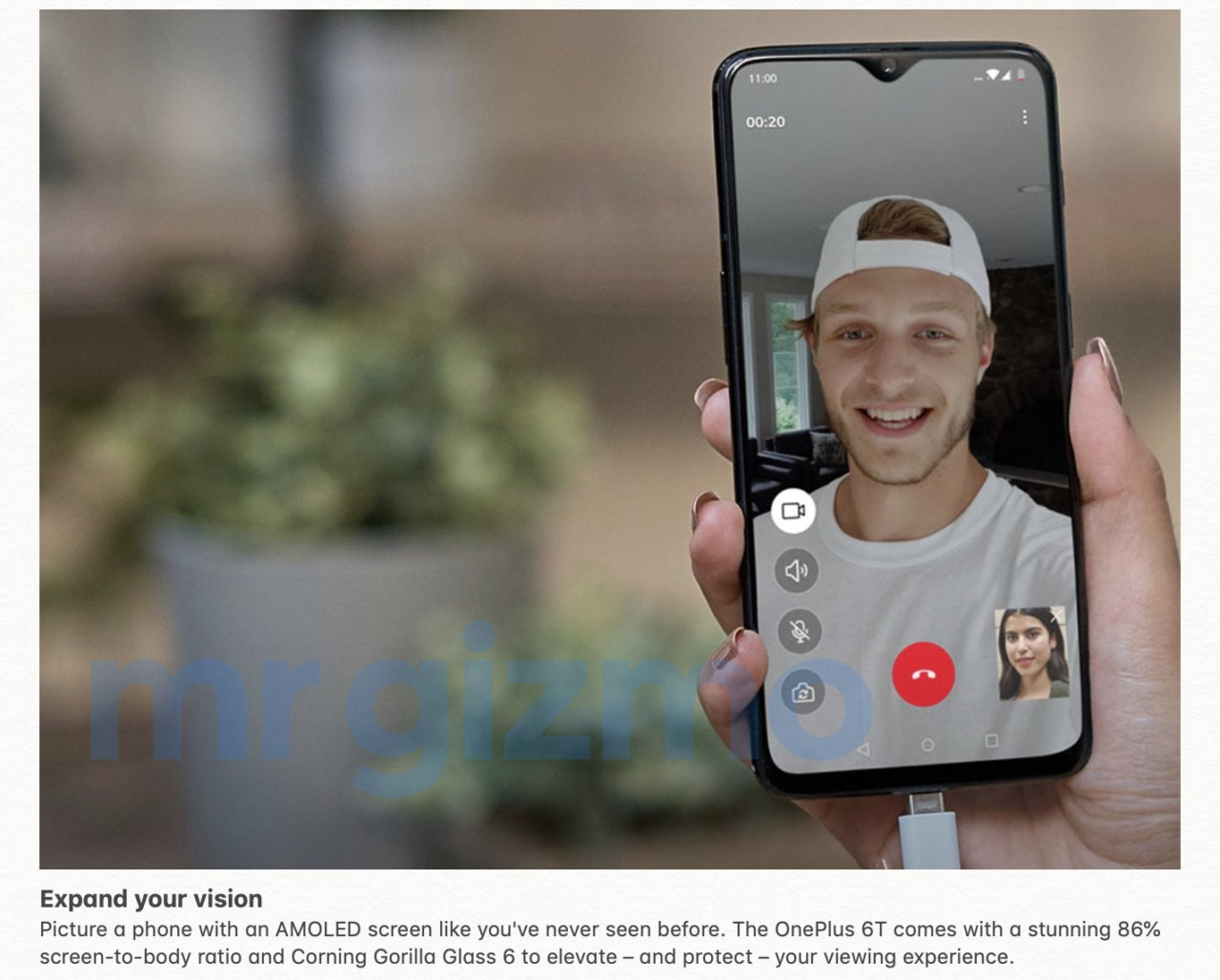
OnePlus is making some significant changes in terms of design on the new OnePlus 6T. While the basic design on the back should remain the same as its predecessor, the front will see a new notch design. As with the OPPO R17 Pro, the OnePlus 6T will upgrade its front design to a waterdrop notch. To be honest, and I’m sure a lot of our readers will agree with me, the waterdrop notch has finally made notches bearable. In fact, unlike the traditional notch design, waterdrop notches look like a natural extension of the phone and the fact that you will most likely get a smaller chin at the bottom too (at least that’s what we are hoping after seeing the renders), we expect the screen to body ratio to increase up to 86%.
Revolutionary Screen Unlock
Another important change in terms of design is going to be the placement of the fingerprint sensor. The phone no longer has a physical fingerprint sensor cut out on its body, instead, it will get the new “screen unlock” feature. Yes, that’s the name for OnePlus’ in screen fingerprint technology and it is said to be really fast and efficient. That’s not what we’ve heard of in screen fingerprint sensors in general, but the company is known to refine existing features and personally, I m expecting the sensor to be good enough to replace traditional fingerprint sensors. The company has confirmed the new screen fingerprint feature on multiple occasions and we’ll know soon enough whether the implementation lives up to our expectation.
RIP Headphone Jack
Another confirmed news is that the OnePlus 6T will ditch the headphone jack. This move is a bit controversial especially since the company has been a solid advocate of a dedicated headphone jack until recently. The OnePlus 5T had it and so did the OnePlus 6. But the 6T will join the likes of Apple and Google in doing away with a dedicated 3.5mm headphone port. Instead, you’ll have to rely on Type-C and Bluetooth earphones for your music needs.
However, the company explains that saying goodbye to the headphone jack did have its benefits. The OnePlus 6T will have a larger battery (“substantial enough for the user to notice” — most likely 3700mAh) and this also opens up space for an in screen fingerprint sensor. Given the benefits, I’d personally say its not a bad deal. But not everyone agrees.
New Color Options
Not much is known about the color schemes of the upcoming OnePlus model, but it’s being said that the company is readying a purple color for the phone. If you remember, we had recently covered an article that showed a number of gradient color finishes for the current OnePlus 6 model which never saw the light of the day. The sunset red gradient, in particular, was my personal favorite. Maybe, this time, with the OnePlus 6T, the company could be bold enough to release a couple of gradient finishes. After all, that’s the trend going on right now in the market.
Note that the traditional midnight black and mirror black models are said to come as standard options for the new model apart from these additional variants.
No IP Rating or Wireless Charging
The OnePlus 6T is confirmed to be water resistant to a certain extent (just like the OP6) but it’s not going to be IP certified. The company explains that it’s not worth the additional cost of getting an IP rating certificate for the device. Further, even this year, we won’t be getting wireless charging on the device.
Now, I could have lived with a non-IP rated but water resistant OnePlus 6T, however, the lack of wireless charging, especially in this age where even the new Xiaomi Mi Mix 3 (which btw is priced very competitively) comes with a wireless charger inside the box (yes, no kidding!), it’s definitely a disappointment. However, the proprietary wired dash charging tech is going to be available on the new model as well, which btw is really really fast, so you can’t complain that the phone lets you down in the charging department.
OnePlus 6T Specs
In this department, expect minimal changes. So you should have the same Snapdragon 845 processor on board with a slightly better camera setup. The display will be a 6.4-inch FHD+ panel with nearly 86% screen to body ratio.
No 64GB Variant?
Recent rumors have claimed that the OnePlus 6T won’t have a 64GB variant, unlike its predecessors. Personally, I find it hard to believe that the company would skip the 64GB version in favor of 128 and 256GB variants. Rumor mill states that the OnePlus 6T Mirror Black will have 6/8GB + 128GB variants while the Midnight Black model will have 8+128/256GB variants. Unfortunately, these don’t come from verified sources so take them with a pinch of salt.
Improved Camera Setup
The front camera should be upgraded to a 20MP f/1.7 aperture setup for better selfies. The rear setup is said to be the same with 16MP+20MP f/1.7 lens, but with the help of AI, the company is will improve its overall camera performance. In fact, with the help of a special low light “Night Mode”, the phone should offer a much better night photography experience. This was one area where the 6 struggled to consistently get good quality images, so its successor is said to have improved in this particular department. Personally, don’t expect something like Google’s Night Sight where the difference is night and day. However, using AI, the overall performance of the phone in low light conditions could turn out to be better than its predecessor.
We know for sure that the OP6T is getting a bigger battery, however, an exact figure is unavailable from official sources. In a recently leaked battery label of the OnePlus 6T, it was seen to sport a 3700mAh battery. Considering how the OP6 did pretty well with its 3300mAh battery capacity, this kind of upgrade will definitely take the new model’s battery life to another level.
New UI
I’m sure many would agree when I say that OnePlus’ Oxygen OS is one of the best adaptation of Android in the market today. However, the new model is said to have some changes as compared to its previous iterations of UI. OxygenOs is said to get an overhaul with gesture only navigation, deep AI integration, and a lot more. This kind of makes me nervous since I like the current OxygenOS design but let’s hope for an even better experience after the overhaul. Further, its almost confirmed that the phone will come with Android 9 right out of the box.
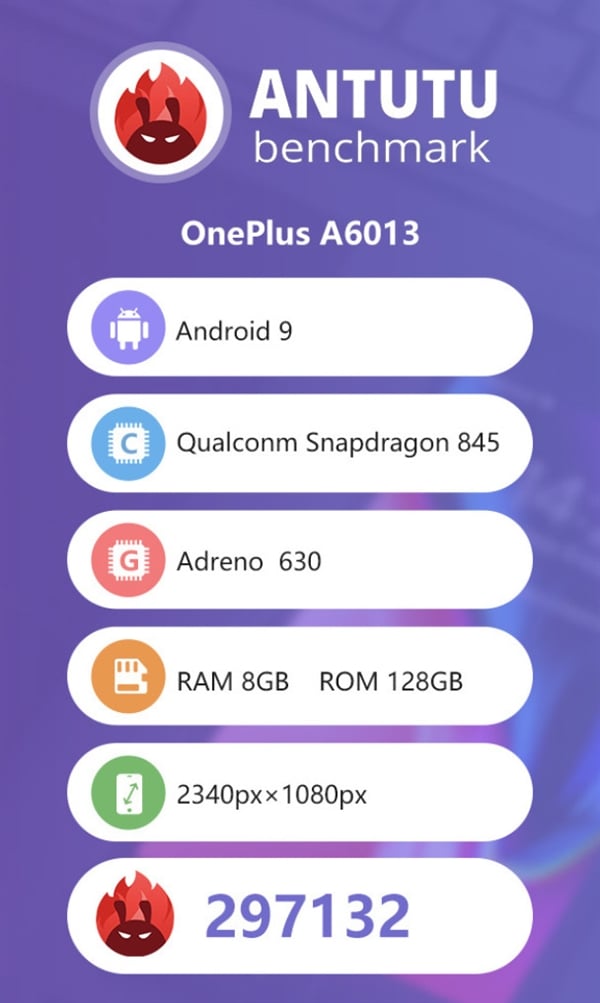
In terms of benchmarks, OnePlus 6T scores 2387,8925 on Geekbench (similar to OP6) and 297132 in AnTuTu tests.
OnePlus 6T Price & Availability
We know for sure that the OnePlus 6T will launch on October 29 (not 30th!) in New York and October 30th in New Delhi, India. The phone goes on sale on Amazon India on November 2. Shipping starts worldwide from November 6. Also, pop-up events will be held all over the world in 27 major cities on November 2. Full details here!
Coming to the pricing, a price hike is in the cards. That has been the tradition so far and that’s likely going to continue with the OnePlus 6T as well. The 6 started at $529 which means the new 6T could start anywhere between $550-$600. CNET suggests a price tag of $550, while our own Giztop says its close to $569. Which one is true? We’ll know for sure in two days!
Pricing can never be confirmed until the official launch, so take this information with a pinch of salt.
OnePlus + T-Mobile
It’s worth mentioning that the OnePlus 6T is likely going to be the first company flagship to get the backing of a large US carrier, namely T-Mobile. Nothing is official yet, but multiple reports claim that a partnership between the two is in the cards. We’ll get more details at the time of the launch for sure.
I know this turned out to be a really long article, but it covers everything that you need to know about OnePlus 6T specs, rumors and price in detail!
It’s been a year since the OEMs have started pushing the 5G compatibility tests. Now, Oppo has got a success in getting support for 5G connectivity. Today, Oppo Global Vice President and President of China Business Department, Brain Shen took to Weibo to announce the latest development. The new Oppo’s development of 5G compatibility has laid a foundation stone for the 5G smartphone’s commercial availability by next year.
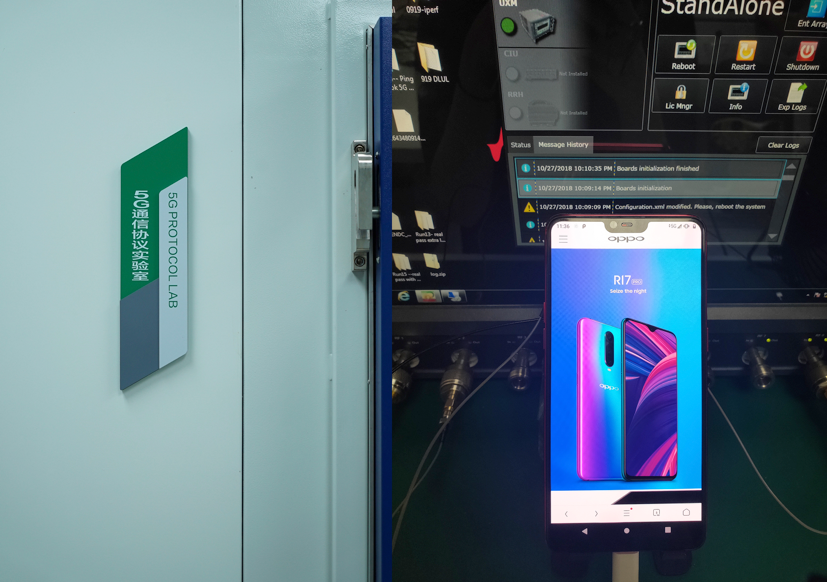
Oppo conducted the successful test at Oppo Reasearch Institue in China. Oppo VP, Brain further detailed that Oppo customized R15 smartphone with a compatible 5G hardware. In the lab testing environment, Oppo connected it with the 5G components such as Systemboard, RF, RFFE, and antenna which led to a live 5G connectivity on the mobile device. Even a “5G” logo also appeared in the top right corner of the screen.
Oppo has already joined hands with Qualcomm under the banner of “5G Pilot” program at recent Beijing 2018 Qualcomm China Technology and Cooperation Summit. Oppo VP added that they want to be a key contributor in providing and complying with the 5G standard. in the past, they can also be seen promoting the 5G product development and commercialization. Oppo wants to become world’s first manufacturer to become the first brand to commercially launch the 5G smartphone as soon as possible.
Although, Oppo started researching and developing on the 5G technology in 2015. It catered to the overall research of 5G standard development and explored the features of 5G compatible smartphones. The claims are even verified by International Standards organization 3GPP which states that Oppo is the highest ranked company in submitting 5G related documents.
Earlier this year, Oppo also tested the first 5G video call using 3D structured light technology. It is the successful implementation of 3D vision technology that Oppo has developed. Oppo’s research center director, Henry Tang also talked about the 3D vision in his latest speech of “Ubiquitous Reality – When 5G Meets 3D Vision”.
It is a milestone and a great success for Oppo. Now, we hope Oppo to bring the 5G compatible devices earlier next year.
Are you also waiting for 5G compatible devices next year?
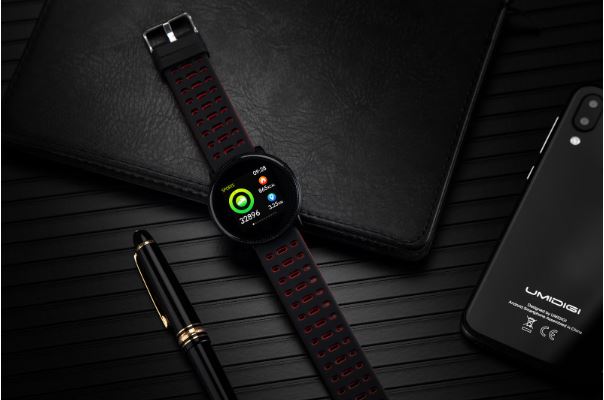
It’s been a trend nowadays that everyone wants to own a smartwatch for its useful features. Smartwatches are now selling like hotcakes, and even the manufacturers are enriching them with lots of advantages. Similarly, UMIDIGI is going to launch a new smartwatch very soon. Its photos and other giveaway details have surfaced just before launch. UMIDIGI is a major smartphone maker in China and is now keeping with the new trends by launching a new smartwatch next few days.
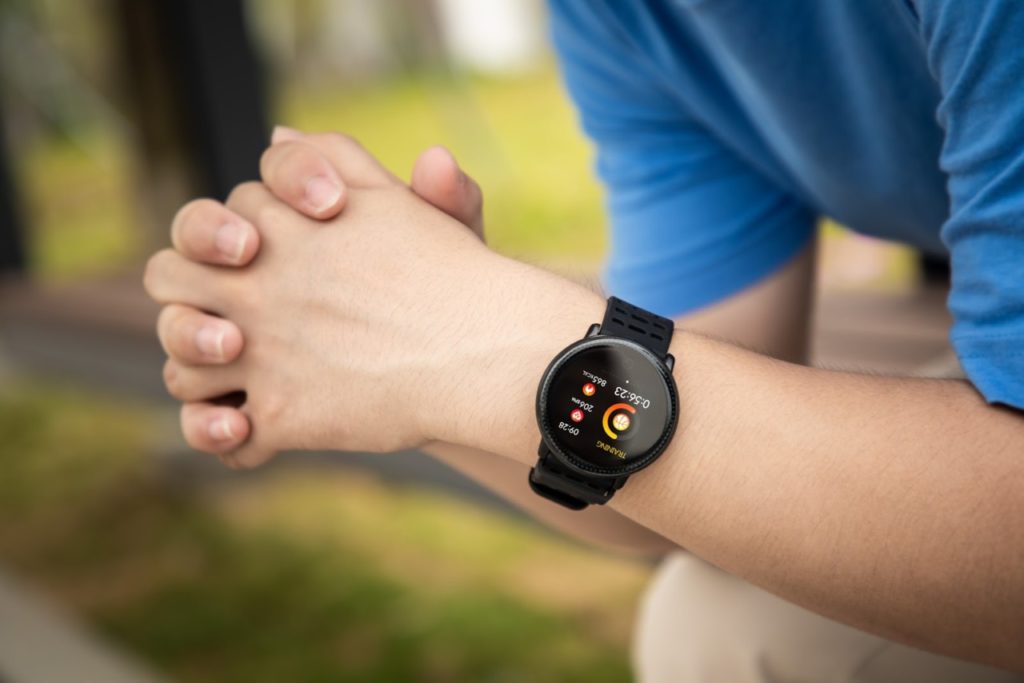
UMIDIGI Uwatch can be seen in the leaked photos with different bands and elegant User Interface. It carries a classic circular dial with a big screen having black color UI elements. Further, from the pictures, it is revealed that Uwatch will carry features such as steps monitoring, calories count and so on. Moreover, the new watch is looking impressive on the wrist with different bands.
UMIDIGI Uwatch will be compatible with both iOS and Android phones. To make it more user-friendly and feature enriched, UMIDIGI has added sensors like a pedometer, heart rate monitor, etc. These will help users facilitate with features like sleeping monitor, sedentary reminder, notification access, remote camera, etc.
Its pricing and availability details are still unknown, but we expect some more information in the upcoming few days. UMIDIGI will make it available for the users at 11.11 sale event in China. UMIDIGI has hinted that the new premium smartwatch will be made available with affordable pricing.
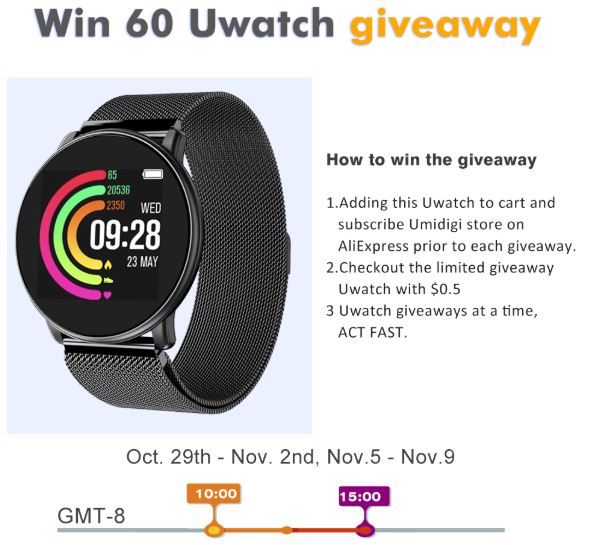
The Chinese maker is giving away 60 Uwatches for free, but you have to follow the below-mentioned rules to enter the giveaway.
Additionally, the company will also launch its new entry-level smartphone, UMIDIGI A3. It is available for booking at $7.6 from AliExpress. Well, you have to shell out additional $75.99 on 11.11 sale to complete the purchase.
Currently, we have to wait for some more days for UMIDIGI watch to launch. Are you waiting for the UMIDIGI Uwatch?
The Mi MIX 3 launch was one of the biggest events last week. The phone can be termed one of Xiaomi’s best and its specs and features are proof. Xiaomi has released unboxing photos of all the color variants and they are worth looking at.
The Mi MIX 3 comes in three colors – Sapphire Blue, Jade Green, and Onyx Black. All three have a black front bezel. As seen in the images, the Mi MIX 3 comes in a black box. It is apparent, Xiaomi has no plans of changing the design of the retail box for its flagships.
Inside the box is the phone, a black TPU case, a USB-C cable, a travel adapter and….. a white wireless charger! Yes, the Mi MIX 3 comes with a wireless charger included in the box irrespective of the version you buy. This is unusual but a move that will score Xiaomi points. I don’t think there is any manufacturer that bundles its phone with a wireless charger. Do correct me if I’m wrong.
[envira-gallery id=”219385″]
In a Weibo post yesterday, Xiaomi’s CEO said the reason behind the decision to ship the Mi MIX 3 with a 10W wireless charger is to increase the adoption rate of the technology. This actually makes sense.
Surely, there are people who own phones that support wireless charging but do not own a wireless charger. So, if there is a wireless charger bundled with the phone when you purchase it, there is a high chance you’ll use it which is what Xiaomi plans to achieve.
The Mi MIX 3 is Xiaomi’s second Mi MIX phone this year. It has a 6.39-inch Super AMOLED screen with a Full HD+ resolution. Slide the phone and it reveals a 24MP + 2MP dual front-facing camera combo in front for selfies and on the back is a 12MP + 12MP dual camera combination. There are a bunch of camera features including 960fps slow-motion recording.
The Mi MIX 3 is powered by a Snapdragon 845 processor with up to 10GB of RAM and 256GB of storage. It has a 3200mAh battery with support for Quick Charge 4+. The Mi MIX 3 runs MIUI 10 based on Android 9 Pie out of the box. The phone also supports frequency bands used in about 226 countries which makes it a great choice for frequent travelers.
Last week it was announced that the Lenovo Z5 Pro will be unveiled on November 1. Following the announcement, Lenovo‘s CEO has released a poster for each day counting down to the event. The posters for yesterday and today confirm some features of the phone.
The poster released yesterday confirms the Lenovo Z5 will have a mechanical slider which we are already aware of but goes into details. According to the poster, the Z5 Pro’s uses a double helix for the slider with what appears to be six guidance “sensors”. The poster also says that the slide mechanism can last more than 300,000 times. This is the same figure OPPO gave for the automated slider of the OPPO Find X.
[envira-gallery id=”219380″]
There are other details this poster confirms such as dual front-facing cameras and dual rear cameras. The rear cameras are arranged vertically and are positioned in the middle. There is no hole for the fingerprint scanner which means it is under the display.
The second poster which was released today reveals the Lenovo Z5 Pro will have a chipset for hardware level security encryption. This feature is supposed to make the phone appealing to businessmen and professionals who want a phone with a high-level security.
The poster has an image of a chipset with the word “Turbo” written on it. We are not sure but it may mean the phone also has a software performance improvement feature similar to OPPO‘s Hyper Boost technology.
Quick Charge is Qualcomm’s fast charging technology. The QC 4+ technology is available on mobile platforms like Snapdragon 660, Snapdragon 670, Snapdragon 710 and Snapdragon 845. Fresh information that has surfaced from the recently held Qualcomm’s 4G/5G Summit in Hong Kong has revealed that the company is now working on Quick Charge 5.0 that will offer 32W fast charging.
The latest version of Quick Charge carries support for 18W rapid charging. Competitor technologies such as Huawei’s SuperCharge offers up to 40W fast charging, OPPO’s Super VOOC charging supports up to 50W fast charging and mCharge technology from Meizu offers up to 55W rapid charging. According to Qualcomm, its next-generation fast charging technology will be equipped with triple camera system that will allow it to support up to 32W rapid charging and 15W wireless charging. This technology could be called Quick Charge 5.0.
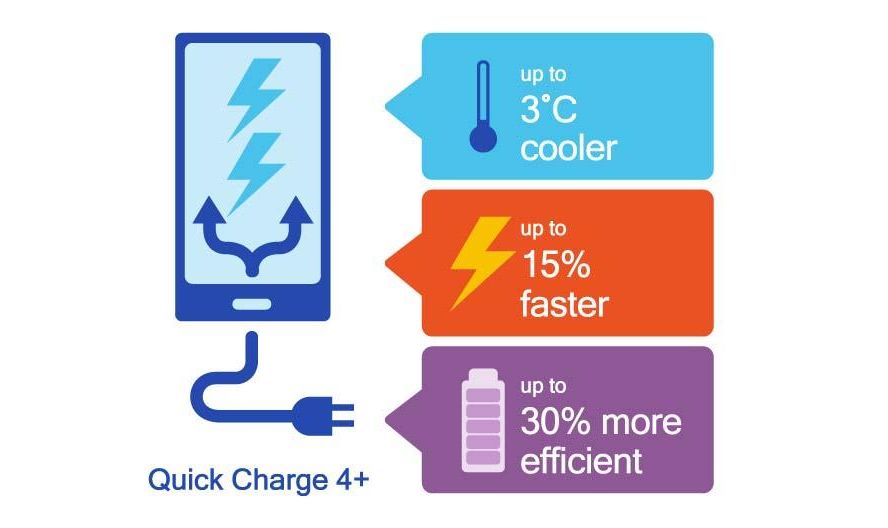
The existing Quick Chare 4+ technology offers Engine Fast Charging system that divides the power line in to two parts instead of one. This allows the phone to prevent overheating while carrying out fast charging. Also, QC 4+ tech charging keeps the device 3-degree Celsius cooler while charging. It is up to 15 percent faster and 30 percent more efficient than its predecessor. The triple charge system will similarly allow the phone to support 32W rapid charging without getting hot. It is expected to arrive with more advanced features than QC 4+.
It is speculated that the Quick Charge 5.0 will arrive with Snapdragon 855 (or Snapdragon 8150) that may get official by the end of this year. The exact specifications of the chipset are not available. It will be a 7nm SoC that will arrive to rival with other 7nm SoCs like Apple A12 and Kirin 980.
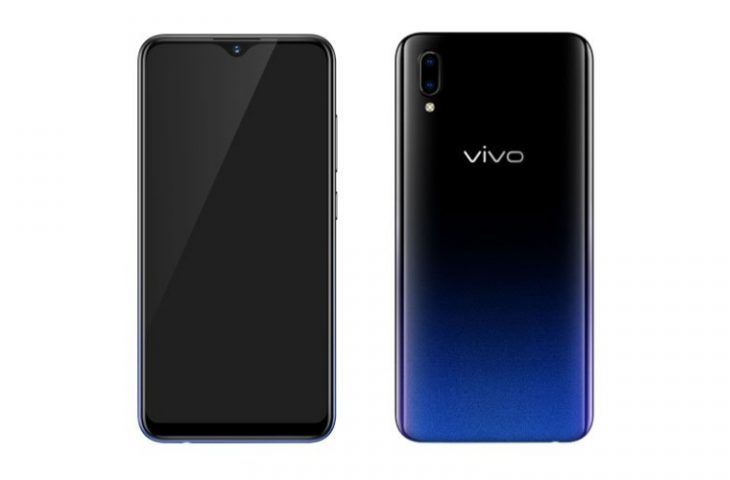
A recent report has revealed that Vivo may soon release Vivo Y95 smartphone in November as a successor for the Vivo 83 phone. A China Telecom website listing for the Vivo Y93 suggests that China will be also receiving this new Y-series smartphone in the coming month. The listing suggests that it could be the first smartphone to feature the new Snapdragon 439 mobile platform that was announced in June this year.
A Vivo phone with variants V1818A and V1818T was spotted with full specifications on the website of Ministry of Industry and Information Technology (MIIT) and TENAA, the Chinese telecom authority. However, these listings had not revealed the product name of the device. The China Telecom listing of the Vivo V1818A reveals that it will be arriving in China as Vivo Y93 smartphone.
Qualcomm had launched Snapdragon 429, Snapdragon 439 and Snapdragon 632 mobile platforms in June. The Honor 8C and Meizu Note 8 are the first phones to arrive with Snapdragon 632. Phones powered by other two SoCs have not released yet. The SD439 is a 14nm chipset that includes Adreno 505 graphics and 1.9 GHz quad cores of Cortex A53 and 1.45 GHz quad cores of Cortex A53.
Coming back to Vivo Y93, the SoC of the smartphone will be coupled with 4 GB of RAM. It will be equipped with an internal storage of 64 GB. The handset is expected to release in China on Nov. 15 with a price tag of 1,598 Yuan (~$230). It will be arriving Zixia Red and Starry Night Black colors.
A waterdrop notch screen of 6.2 inches is available on the Vivo Y93 smartphone. The display carries support for HD+ resolution of 720 x 1520 pixels. The handset is packed with a 3,935mAh battery. There is no confirmation on whether the phone carries support for fast charging. Also, the handset does not seem to feature a fingerprint scanner. So, the users of Y95 could be only relying on face unlock feature for unlocking it.
The Vivo Y93 is loaded with Android 8.1 Oreo OS. Apart from internal storage, it offers additional space for storing contents through microSD card slot. There is a selfie camera of 8-megapixel on the device. The rear panel of the phone is equipped with 13-megapixel + 2-megapixel dual camera setup.
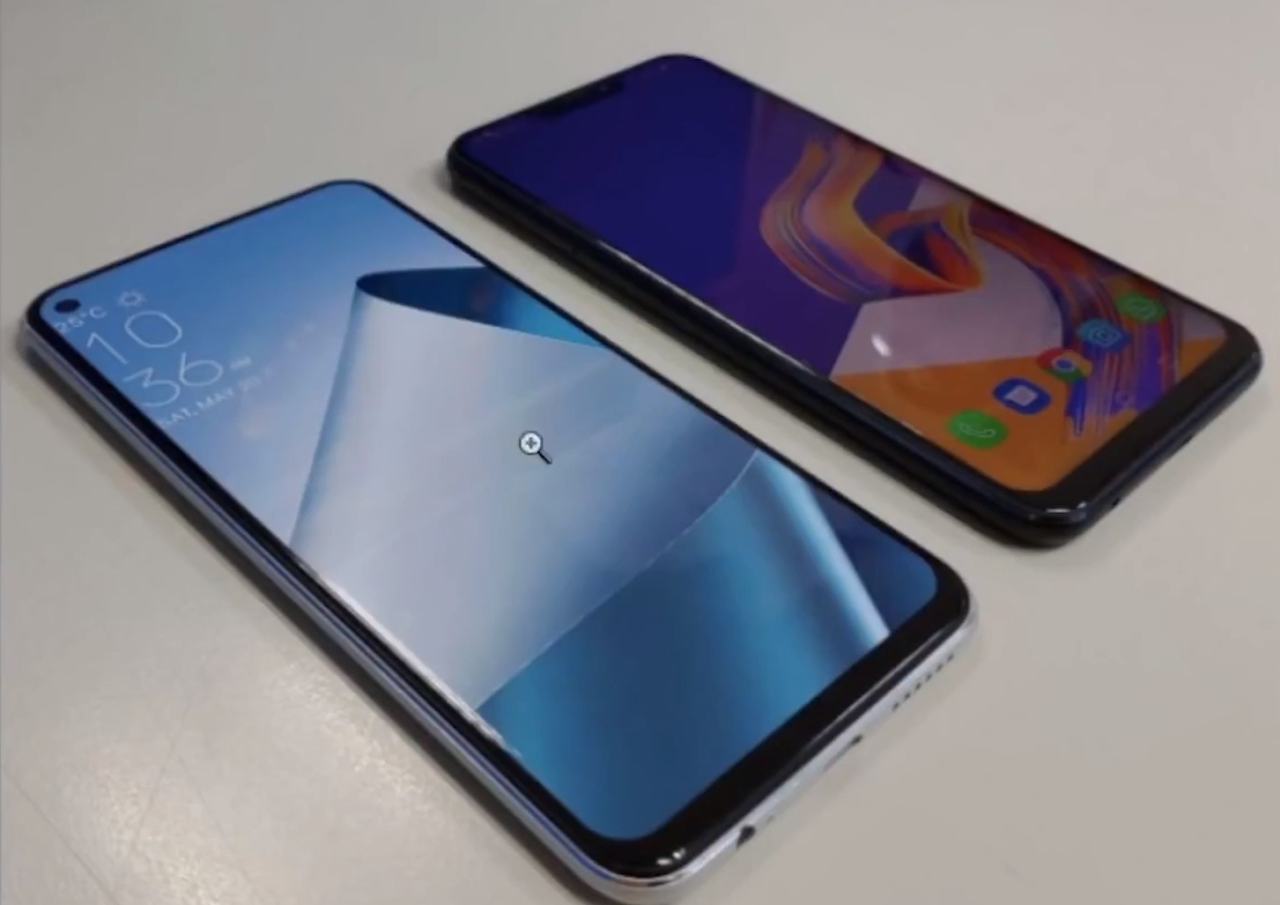
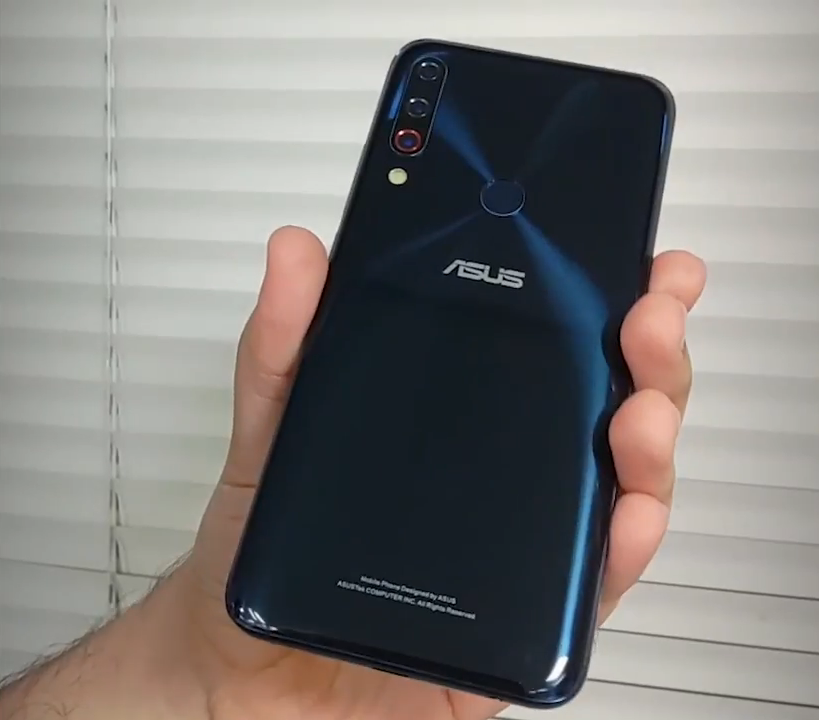
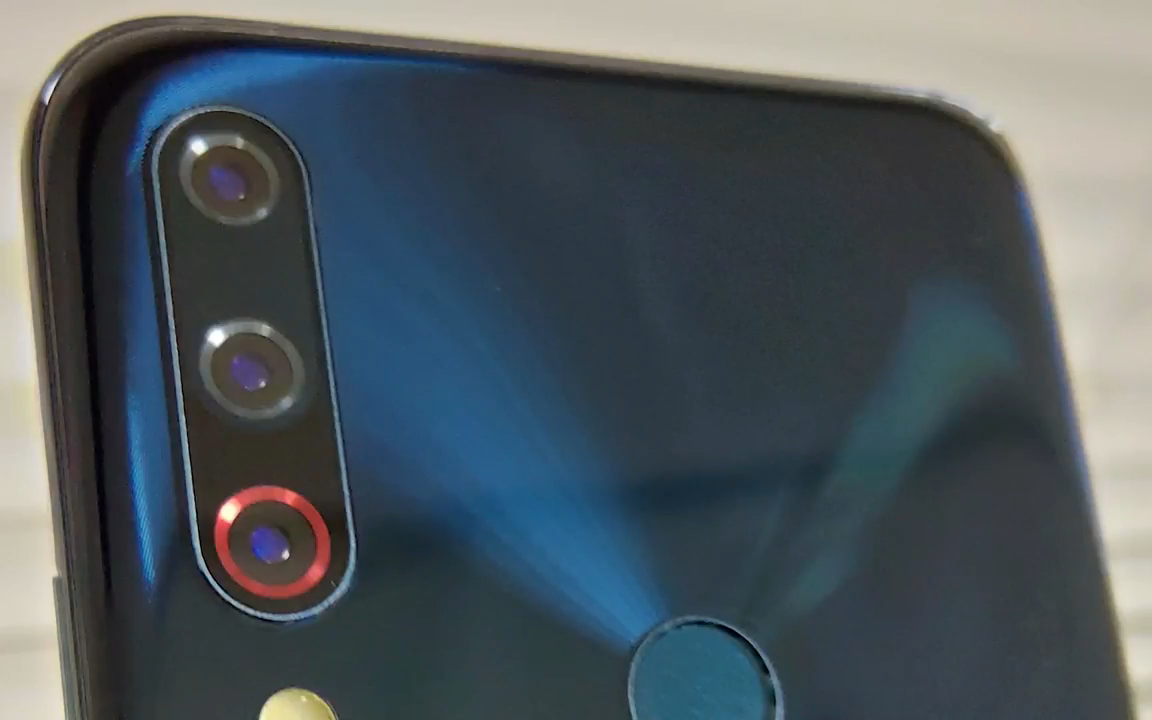
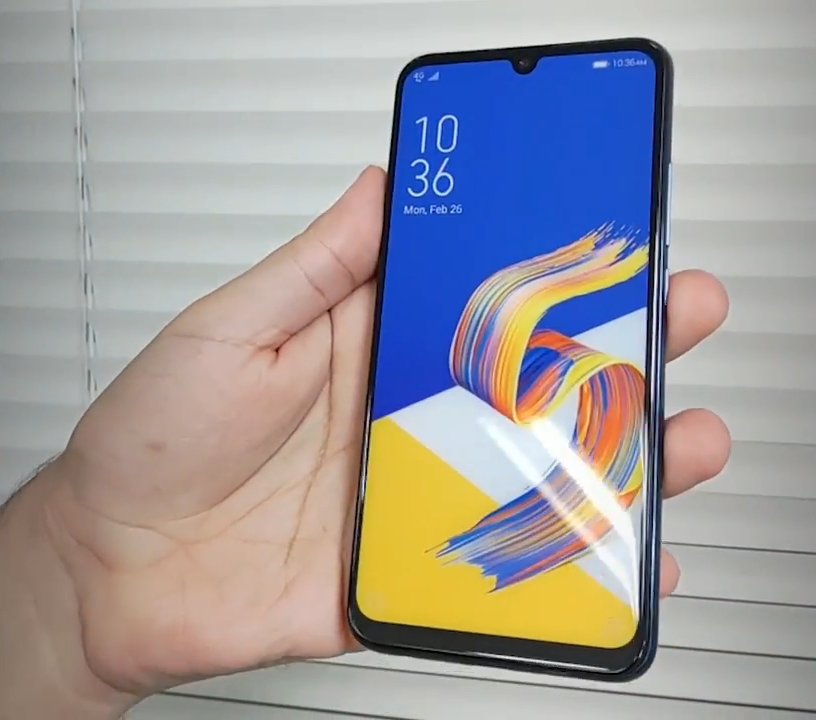
The ASUS ZenFone 5 series of smartphones was made official at the Mobile World Congress (MWC) 2018 tech trade show that was held in February this year. The Taiwanese company could be working on ZenFone 6 series that may go official at the upcoming MWC event in February 2019. Fresh photos of the ZenFone 6 smartphone that were shared by C4ETech YouTube channel today reveal that it will be arriving with an in-display camera and a rear-mounted triple camera unit.
In the first image, the ZenFone 6 prototype is placed beside the ZenFone 5Z. Compared to the ZenFone 5Z, the ZenFone 6 appears to be sporting a notch-less display surrounded by slimmer bezels. An in-screen camera is situated on the top-left corner of its display. The bottom edge of the ZenFone 6 protype has a 3.5mm audio jack, a USB-C and an external speaker grille.
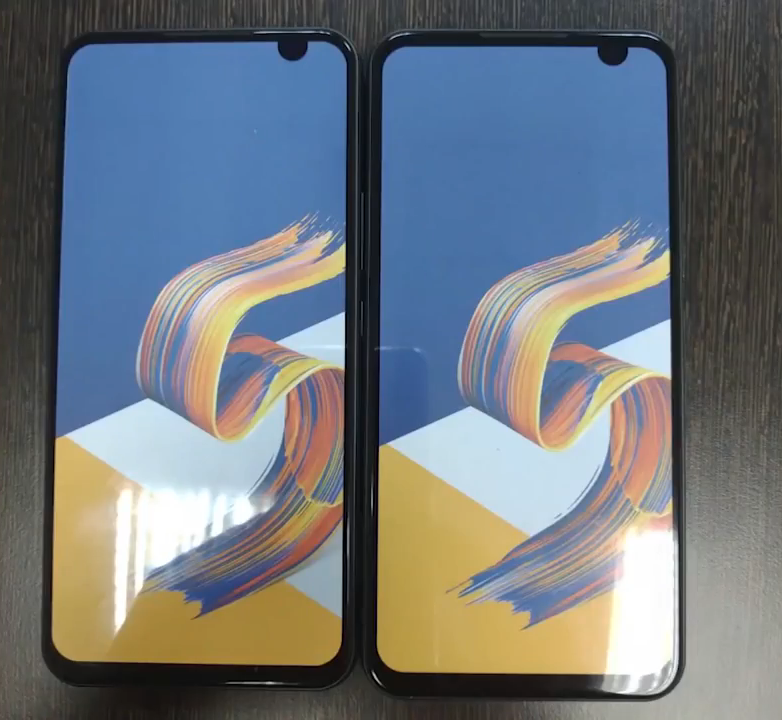
In the second image, the in-display camera can be seen at the top-right corner of the screen of the ZenFone 6 prototype. There is another image showing another prototype of the phone with a smaller display notch like the OPPO R17 or F9.
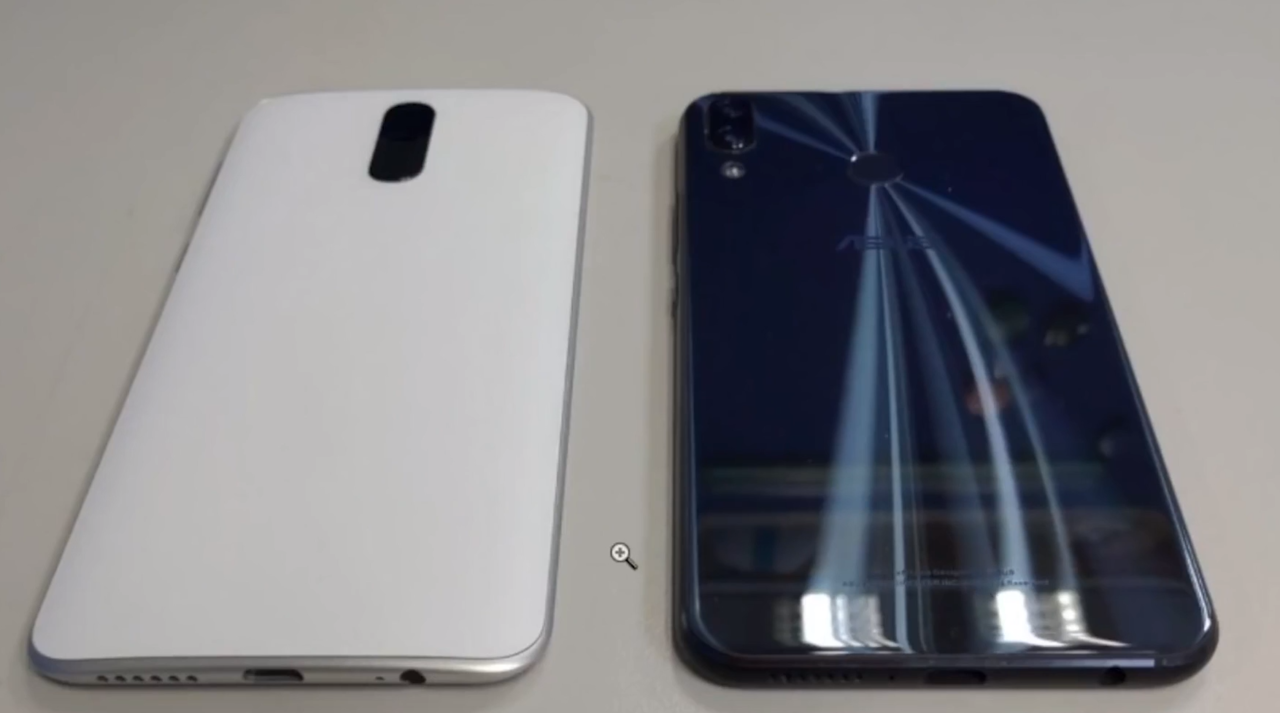
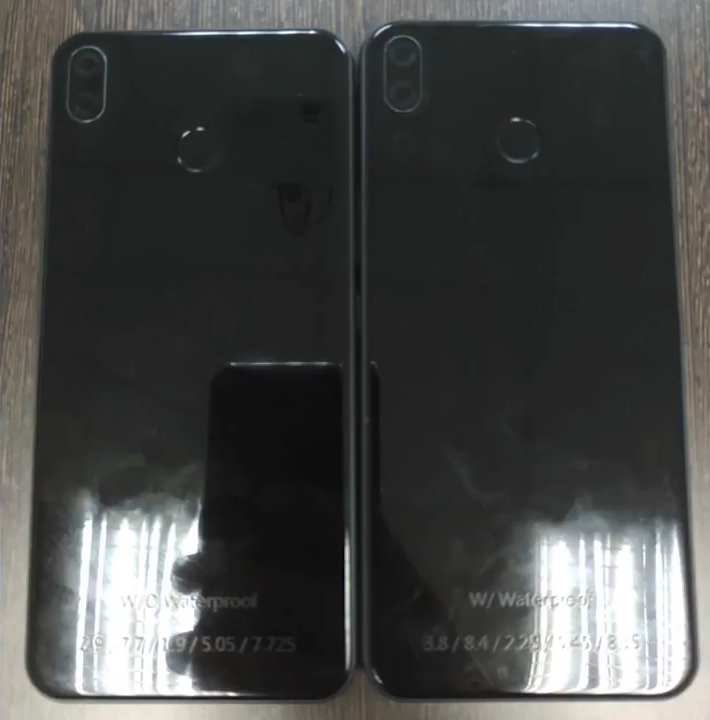
There are couple of other images that show that the ZenFone 6 is equipped with a triple camera unit and a fingerprint scanner on its rear shell. Lastly, there is another image showing the handset with a dual camera setup.
Since the above images belong to the prototype of ZenFone 6, there is no guarantee on the design that the company may have adopted for its ZenFone 6 series of smartphones. There is a possibility that the successor of the ZenFone 5Z may feature a triple camera system and the device that will arrive to replace the ZenFone 5 may come equipped with dual rear cameras. The rumor mill is expected to reveal more information on the upcoming ZenFone 6 series through forthcoming leaks.
Whats your opinion on the leaked images of ZenFone 6 prototypes? Share us your views by posting your comments below.
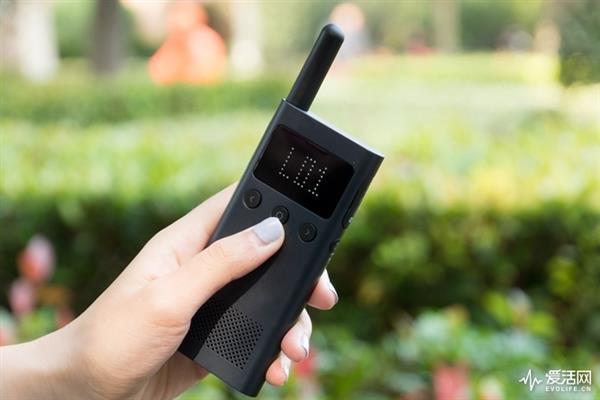
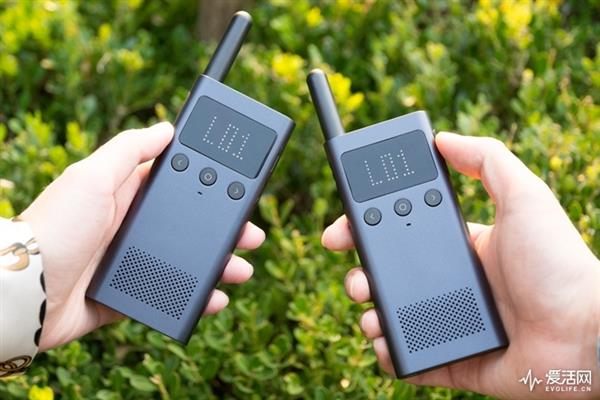
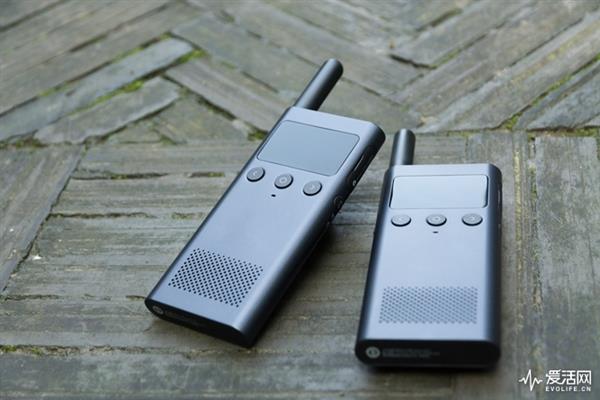
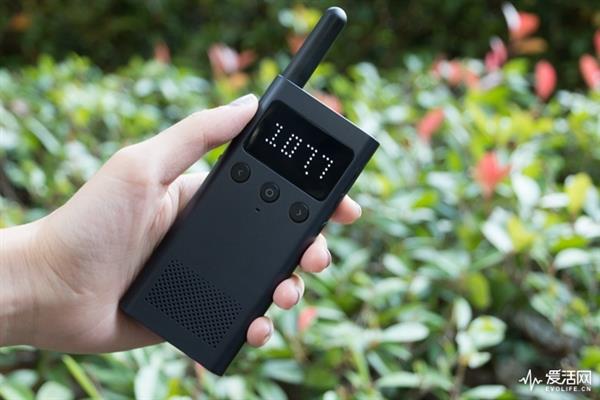
Apart from the highly popular smartphone division, Xiaomi has several products ranging from smart home gadgets to cameras and several others, under its MIJIA brand. It’s been over two weeks since a new product was launched under the MIJIA brand. The product is the Xiaomi MIJIA Walkie-Talkie 1S. The name should sound familiar since its predecessor is a popular one. We got some cool hands-on pictures of the MIJIA Walkie Talkie 1S courtesy of Chinese blog Evolife.cn.
If you find the design of the first-generation MIJIA Walkie Talkie attractive, you will definitely fall in love this one. Xiaomi trimmed down the size of this model. It comes with a more compact and minimalist design. Xiaomi MIJIA Walkie-Talkie 1S is said to be 41% thinner and 43% lighter than the first-gen model. It weighs just 114g with a thickness of 14mm while the body is 24mm wide. The smaller size means a slightly smaller battery capacity as it packs a 2190mAh battery unlike the 2600mAh cell on the first-gen model. The battery offers up to 5 days standby time and can last up to 16 hours when used continuously.
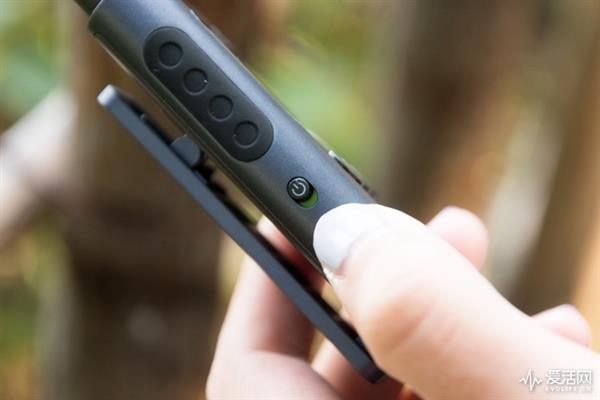
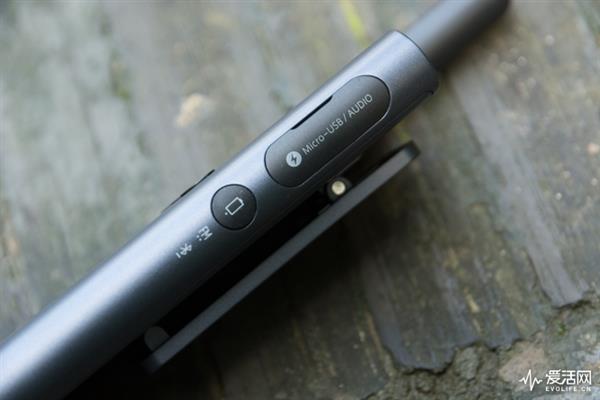
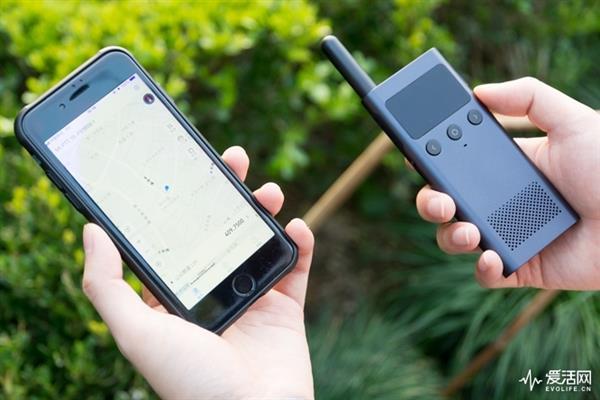
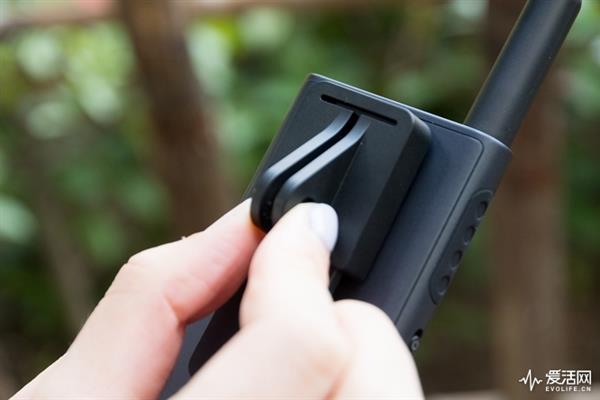
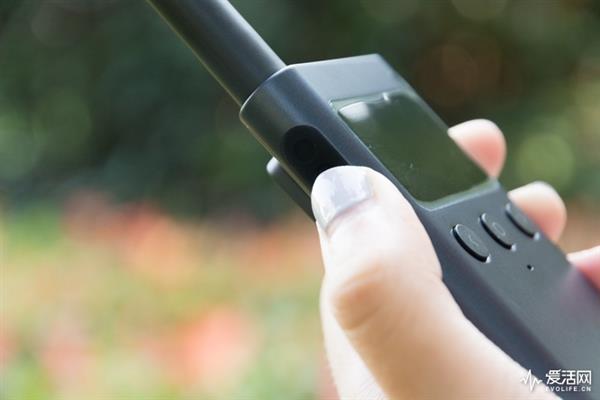
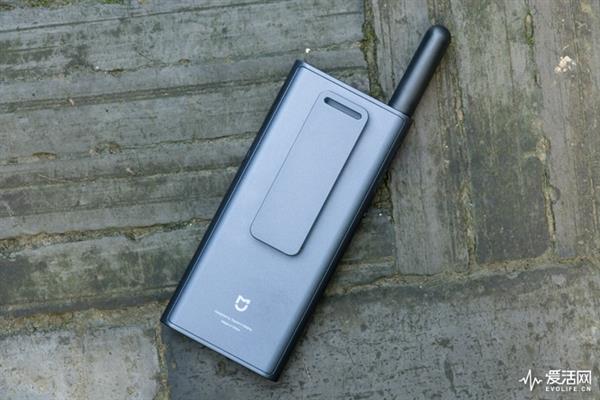
The Xiaomi MIJIA Walkie-Talkie 1S solid build also includes a new speaker design which is meant to give it clearer and louder sound output. The maximum volume is increased by an impressive 162% from the previous model which makes it effective for use in a noisy environment. The frequency range is also increased, ranging from 300Hz to 1kHz. Just like the first-gen walkie-talkie, it also comes with FM Radio so apart from communication, you also get entertained. For connectivity, the device comes with a 3.5mm audio jack and Bluetooth 4.0. So, you can decide to use it hands-free. Yes, there is also a hook to strap it to your pocket. There’s a MIJIA Walkie-Talkie app which enables users to share their positions with colleagues and to also set up the device in addition to using the physical buttons on the body. In addition, there is microUSB port lying near the headphone jack with a dust plug covering the two.
As for the price, Xiaomi still retains the 249 yuan ($36) price tag of the first-gen model on the MIJIA Walkie Talkie 1S. The gadget is available as a pair and it comes in White and Blue colours with a sleek coating. The walkie-talkie is already available to buy outside China via online retailers like GearBest, Banggood, Geekbuying and others, but at a higher price. Meanwhile, you can check out some more pictures of the gadget from below.
AirPods, TicPods and now FlyPods! Honor is joining the wireless earbuds train and they have named it FlyPods.
Along with the Magic 2 and the Honor Watch, Huawei’s sub-brand will also announce the FlyPods wireless earbuds on October 31. This is their own take on Apple‘s AirPods.
The poster shows a partial outline of the earbuds and we can tell it will have a stem just like the AirPods. Expect the usual features we have seen from other wireless earbuds such as touch controls, noise isolation, and a rechargeable case.
Huawei was supposed to announce a new version of its own wireless earbuds, the FreeBuds at the Mate 20 event in London but it didn’t. Images of the FreeBuds 2 surfaced online ahead of the event and they showed Huawei has changed the design.
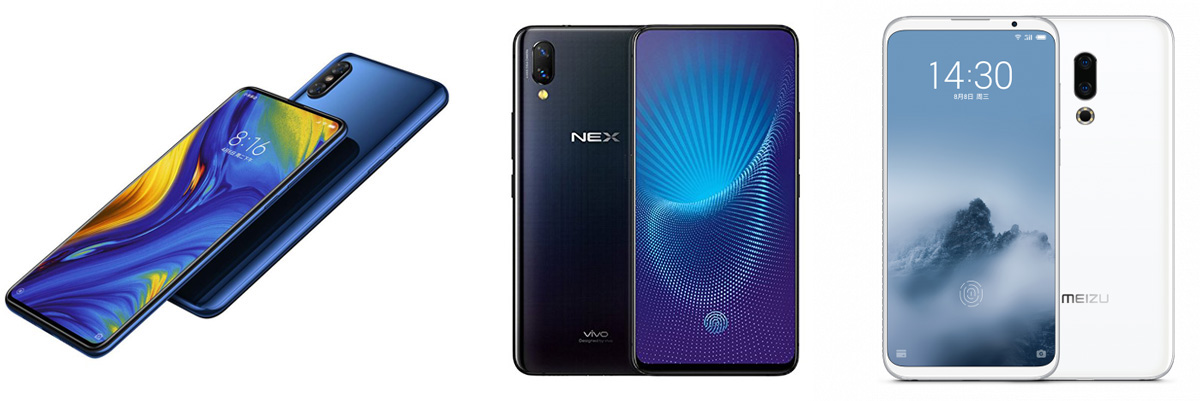
2018 is the year of aesthetical innovation in the smartphones market, and the newly-announced Xiaomi Mi Mix 3 is a perfect example of it. But the device which started this trend in 2018 is Vivo NEX S with its pop up front camera. In this comparison, we will compare Xiaomi Mi Mix 3, Vivo NEX S and, given its quality-price ratio, another device from another Chinese company which is trying to conquer the affordable flagships sector: Meizu 16 Plus.
Xiaomi Mi Mix 3 vs Vivo NEX S vs Meizu 16 Plus
Xiaomi Mi Mix 3
Vivo NEX S
Meizu 16 Plus
DIMENSIONS AND WEIGHT
157.9 x 74.7 x 8.5 mm, 218 g
162 x 77 x 8 mm, 199 g
160.4 x 78.2 x 7.3 mm, 182 g
DISPLAY
6.39 inches, 1080 x 2340p (Full HD+), Super AMOLED
6.59 inches, 1080 x 2316p (Full HD+), Super AMOLED
6.5 inches, 1080 x 2160p (Full HD+), 18:9 ratio, Super AMOLED
Dual 12 + 12 MP, f/1.8 OIS
Dual 24 + 2 MP front camera
Dual 12 and 5 MP, f/1.8 and f/2.4
8 MP f/2.0 front camera
Dual 16 + 20 MP, f/1.8 + f/2.6, OIS
20 MP, f/2.0 front camera
BATTERY
3200 mAh, fast charging with Quick Charge 4.0+, wireless charging
4000 mAh, fast charging 22W
3570 mAh, fast charging with mCharge 4.0
ADDITIONAL FEATURES
Dual SIM slot, pop up cameras
Dual SIM slot, pop up cameras
Dual SIM slot
Design
As it features the highest screen-to-body ratio and it has the first pop up camera in the market, as well as the thinnest design, I think that Vivo NEX S wins the design comparison. It is a definitely more attractive device, even though there are only marginal differences between it and Xiaomi Mi Mix 3. The only disadvantage is represented by its bigger dimensions, but it also has a bigger display.
Display
Talking about the display, I would pick the Xiaomi Mi Mix 3 for a simple reason: if we base on the specs on the paper, it should provide a better color reproduction. Why? Simple: because it boasts the HDR technology. On the other hand, Meizu 16 Plus has the biggest screen which is very useful for productivity and games.
Hardware/Software
Given that all of these devices feature a powerful Qualcomm Snapdragon 845 chipset under the hood, the only important difference between their hardware sides is represented by memory configurations. And on this aspect, Xiaomi Mi Mix 3 is the winner as it is available with up to 10 GB of RAM and up to 512 GB of internal storage. The internal storage may be even more important than you expected as these phones do not feature a micro SD slot to expand it.
Camera
The cameras which should provide the best overall performance should be the ones of Xiaomi Mi Mix 3. It features 4-axis OIS on the rear side and even a dual camera on the front side: the most impressive setup of the trio. The second place is for Meizu 16 Plus featuring OIS, laser autofocus and a six-LED flash on the back.
Battery
Vivo NEX S has the biggest battery with a capacity of 4000 mAh, even though it is not the thickest phone. And it also provides a way longer battery life than its opponents. Xiaomi Mi Mix 3 is disappointing with just 3200 mAh (but it is the only one which can be charged wirelessly), while Meizu 16 Plus sits in the middle.
Price
The launch price of Xiaomi Mi Mix 3 is about $571/€500, Meizu 16 Plus starts from $548/€480 and Vivo NEX S starts from $800/€700. The best value for money phone is definitely Xiaomi Mi Mix 3 because of its price and its outstanding camera performance, but overall I like Vivo NEX S slightly more because of its bigger battery.
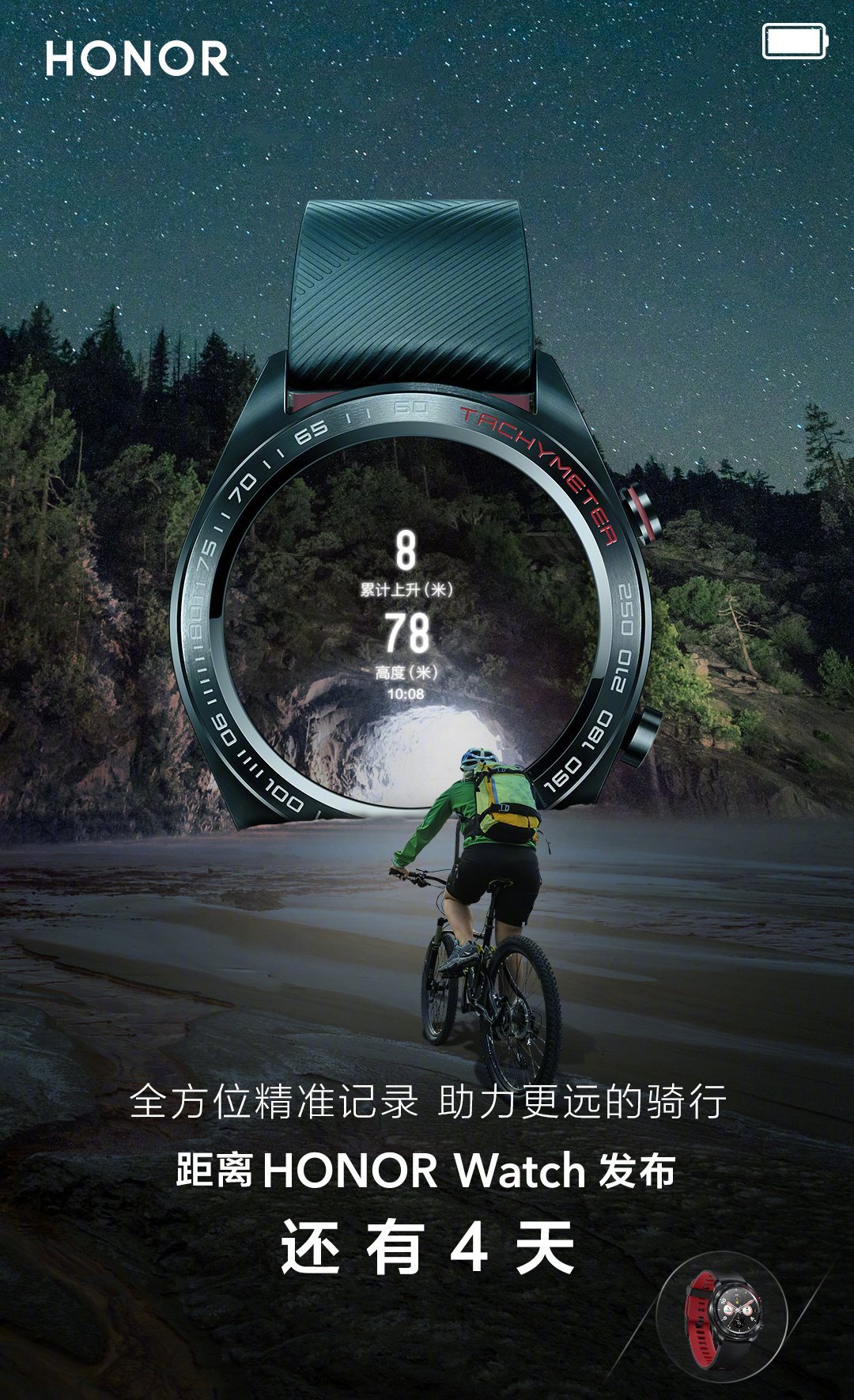
The Honor event scheduled for October 31 will not only be for the launch of the Magic 2 but also for the Honor Watch. The watch is expected to pack interesting features one of which is payment support. Honor has released a bunch of promotional images (and a new poster) that give us a closer look at the smartwatch.
The Honor Watch has a circular dial and a stainless steel frame. The rim has a tachymeter scale and there are two buttons on the right side. One of the buttons has a red marking and the other is plain. The strap in the poster seems to be made of rubber and has a two-tone design. The promotional images below show that there is a leather variant too.
The promotional images don’t show the watch up close save for one which also confirms that the watch has support for contactless payment. However, each of the images shows the watch with a different face, so it is safe to say this is a full smartwatch and not a hybrid.
When you hear of a special edition or new color variant, the first thing your mind goes to is a mobile phone. Occasionally, we see custom versions of certain mobile accessories such as power banks. However, all that seems to be changing as Xiaomi is now extending it to other products in its lineup.
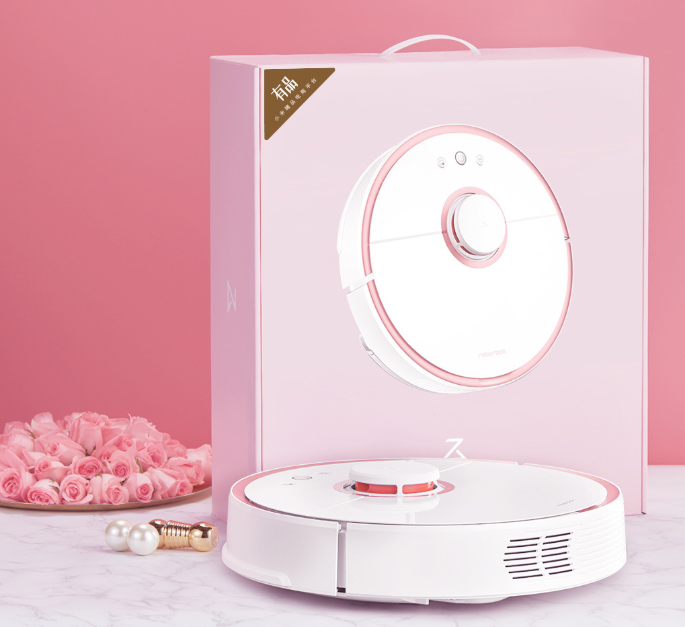
This week, it announced a special edition version of its Roborock Sweep One robot vacuum cleaner. The special edition vacuum cleaner has a new color scheme – Rose Gold – and comes in a special gift box. This isn’t the first time the Roborock Sweep One will get a special edition. A few months ago, an Inter Milan Edition was released.
Unlike the original version and the Inter Milan Edition which come in white with gray or blue accents respectively, the Rose Gold edition has pink accents. The underside is also pink.
Apart from the color and obviously, the retail box, the Rose Gold Roborock Sweep One has the same functions as the regular version. Cleaning times can be programmed, suction pressure can be adjusted depending on the type/size of dirt, and battery capacity remains 5,200mAh.
After announcing first sports phone, Cubot is here with its Cubot E01 Bluetooth speakers. It features IPX6 waterproof certification along with TWS (True Wireless Stereo) technology. Last week, at an event held in Hong Kong, Cubot announced E01 Bluetooth Speakers with its first ever sports smartphone.
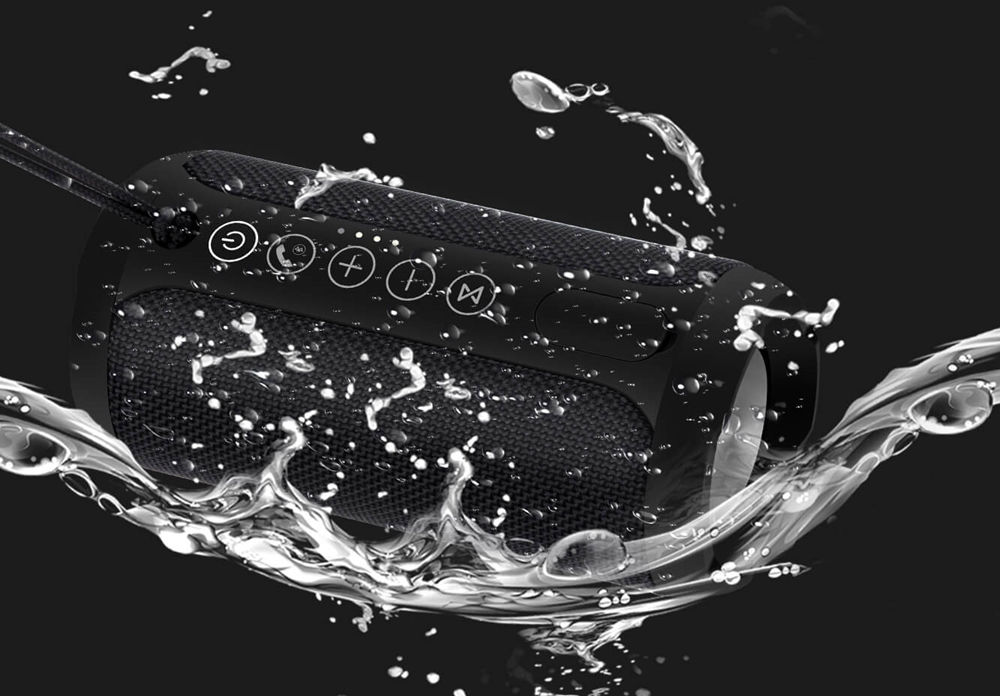
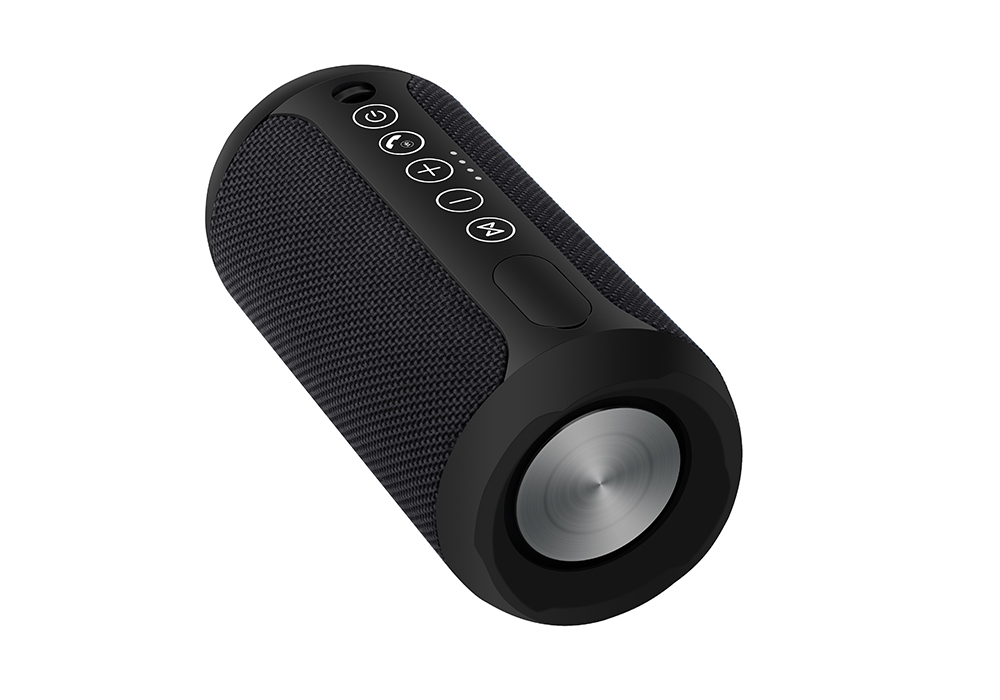
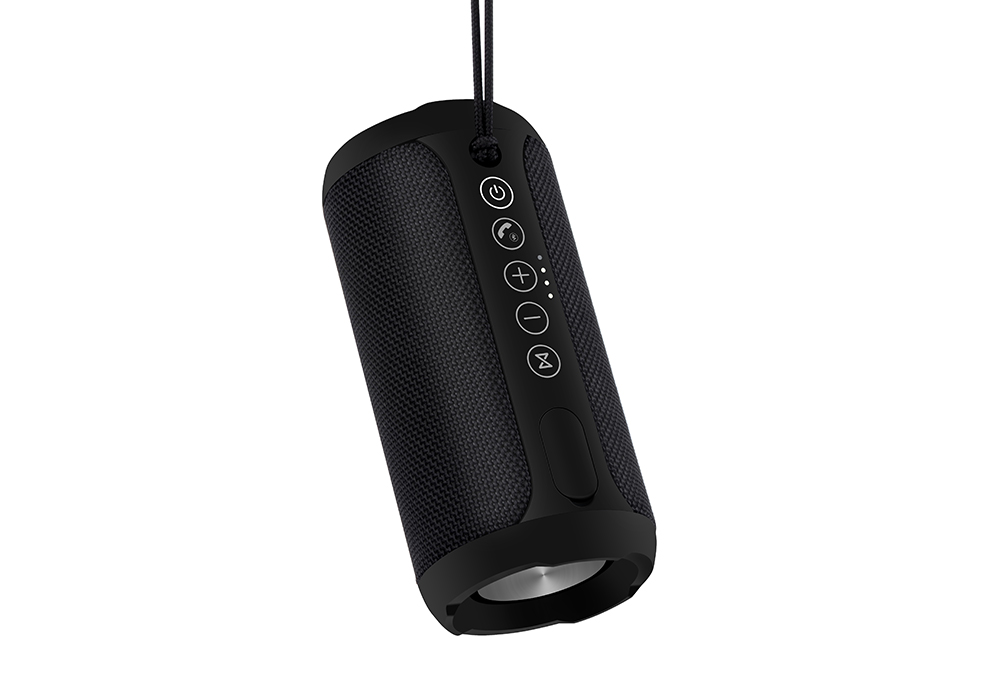
Cubot E01 Bluetooth speaker draws 12-watt power for its dual 2*6W speakers. In order to give in-depth, realistic sound, the company has added dual bass diaphragms. You can carry these portable Bluetooth speakers wherever you go. It has a built-in huge 2200 mAh battery which can provide 8 hours of playtime. It supports Bluetooth 4.2 allowing your devices to connect instantly. It has a speaker impedance of 4 Ω with the frequency range of 60Hz~18kHz.
Cubit E01 Bluetooth speakers measure 168mmx75mm and weigh at 390 grams. Its TWS (True Wireless Stereo) technology allows dual E01s to connect at the same time with simultaneous output of the left and the right channels. You can use the new Cubot powerful speakers even in wet conditions or during heavy rain, thanks to its IPX6 certification.
Its dual multiple 6-watt speakers allow the Bluetooth speaker to deliver crisp, robust sound. Its portable design will let you enjoy the immersive sound quality in your home or outdoor environment. Bluetooth 4.2 will allow the compatible devices to connect to your devices from upto 10 meters away.
Cubot also announced Cubot G01( gamepad ), Cubot J01( Armband ), Cubot B01(Cycling Mobile phone holder), and
Cubot U01(Blue headset) at the same event.
So, you can own this beautifully crafted yet useful device from Cubot store.
Chinese phone manufacturer, Xiaomi has just announced a photography contest and it is open to all Mi phone users around the world except Mainland China. The contest is called Xiaomi Photography Challenge with a total bounty of $50,000 to be won by a few lucky chaps.
As stated, the contest is open to you if you have a Xiaomi phone, just any Mi phone and it will run from October 26 to December 6th, 2018. The photo’s EXIF data is a requirement and the size must be between 300KB and 10MB. The challenge is actually divided into three stages. The Upload Stage is already up and running from October 25 to November 22. As the name implies, this stage is for contestants to upload their photos on the Mi.com contest landing page. The photos are divided into four categories; natural looks (portraits, selfies etc), Dreamscape (Night scene, low light, shadow), Piece of the world (Nature, city, still life etc), and Why so serious (Lifestyle, humour, new perspective). After the upload stage, the Evaluation stage will run from November 23rd, 2018 until November 26th, 2018and three likes qualifies all entries for this stage. During this stage, professional judges will examine all qualifying photos to select 25 finalists for each category for a total of 100 finalists (Top 100). The Voting Stage will then take place from November 27th until December 6th 2018. During this stage, users can visit the official challenge page to vote on the Top 100.
A winner will emerge from each category based on the votes of Mi fans all over the world. Each of the winners in the four categories will go home with $10,000, while the second prize winner in each of the four categories will be awarded $2,000 each. The four third prize winners will receive $500 USD each. All winners will have to send a copy of their passport in order to claim their prizes. The contest is free to enter. All you need is a Xiaomi account.
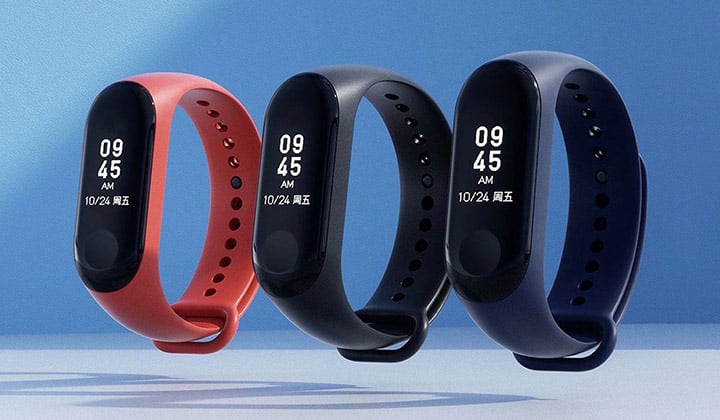
Xiaomi is keen on bringing new devices in the market with impressive features. Similarly, in May this year, Xiaomi announced various new devices including Mi 8, Mi Band 3 and others. In order to make these devices more user-friendly and feature-rich, Xiaomi consistently rolled multiple updates. Today, Xiaomi is rolling out a new firmware update for Mi Band 3 with an ability to bring weather forecast feature. It packs several other improvements like new animations, etc.
In order to improve the overall efficiency and user experience, Xiaomi Mi Band 3 is getting a new update. It brings a temperature and weather information feature of your selected place. The weather card on the Band 3 will give you the current temperature and a forecast for the whole day. It also packs new exercise mode animation.
To get the latest firmware, you should have the latest version of Mi-Fit app. After updating the app, you need to connect your wearable with it, then head over to settings menu and tap check for update option. Xiaomi has already updated the Mi band 3 with the night mode and the ability to mute the paired mobile device.
Moreover, Xiaomi Mi Band 3 is a significant upgrade over Mi Band 2 with a more accurate step counting algorithm. Xiaomi Mi Band 3 allows you to view messages, SMS, incoming caller ID, and all your activity data by just churning out Rs 200 extra against the pricing of Mi band 2. Further, the upgraded version has 24 hours heartbeat count feature, water resistance up to 50 meters, sleep monitor, etc.
The market is brimming with high-end fitness trackers and smartwatches that enables its wearer to monitor his/her daily activities while encouraging them to lead a healthier lifestyle. Regrettably, these devices don’t come cheap. If you’re fitness purist looking for a cost-effective smartwatch that boasts an impressive array of features, you might want to take a gander at the Hey 3S smartwatch. Xiaomi’s partner WeLoop launched this feature-rich watch in April last year, taking the wearable realm by storm.
Before we shed light on the top-end specs and features that make the Hey 3S an irresistible smartwatch, let us take a look at the discount Xiaomi is currently offering on the well-received smartwatch in collaboration with GeekBuying. Aside from that, we’ll even show how you can save a considerable amount of more money during the checkout process.
Sporting an uncanny resemblance to the Apple Watch, the Hey 3S would normally set you back a pretty penny on online and offline stores, but you can buy it for just $94.99 on GeekBuying. This is a noteworthy 47% reduction in the device’s original asking price of $179.99. This discount will be valid for the black color version of the Hey 3S smartwatch. Alternatively, you can avail a 40% off on the red color version of the Hey 3S smartwatch that usually carries a $158.99 price tag. Thanks to the aforesaid discount, you can now get your hands on the red-tinted Hey 3S watch at a slashed price of just $94.99.
On top of that, you can use coupon code NFHCOFMA to save an extra $10 at the time of checking out. This helps you bring your already reduced grand total further down to $89.99 without breaking much of a sweat.
An absolute bargain at this price, the Hey 3S sports an eye-catching a 1.28-inch display bearing a screen resolution of 176×176 pixels with Corning Gorilla Glass 3 on top for added protection. Weighing in just 38g, the Hey 3S features a GPS sensor and a 9-axis motion sensor and helps its wearer to keep a track of various training activities such as distance traveled.
You can follow this link if you’re interested in checking out more details about the WeLoop Hey 3S smartwatch and take advantage of the discount. Note that the promotion sale is slated to end in just 1 day.
We use cookies on our website to give you the most relevant experience by remembering your preferences and repeat visits. By clicking “Accept”, you consent to the use of ALL the cookies.
This website uses cookies to improve your experience while you navigate through the website. Out of these, the cookies that are categorized as necessary are stored on your browser as they are essential for the working of basic functionalities of the website. We also use third-party cookies that help us analyze and understand how you use this website. These cookies will be stored in your browser only with your consent. You also have the option to opt-out of these cookies. But opting out of some of these cookies may affect your browsing experience.
Necessary cookies are absolutely essential for the website to function properly. This category only includes cookies that ensures basic functionalities and security features of the website. These cookies do not store any personal information.
Any cookies that may not be particularly necessary for the website to function and is used specifically to collect user personal data via analytics, ads, other embedded contents are termed as non-necessary cookies. It is mandatory to procure user consent prior to running these cookies on your website.












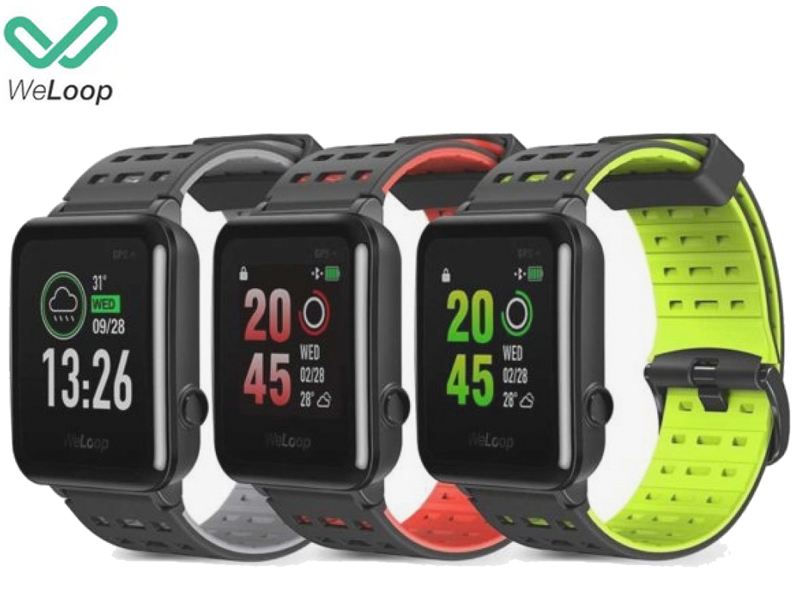 If you’re fitness purist looking for a cost-effective smartwatch that boasts an impressive array of features, you might want to take a gander at the Hey 3S smartwatch. Xiaomi’s partner WeLoop launched this feature-rich watch in April last year, taking the wearable realm by storm.
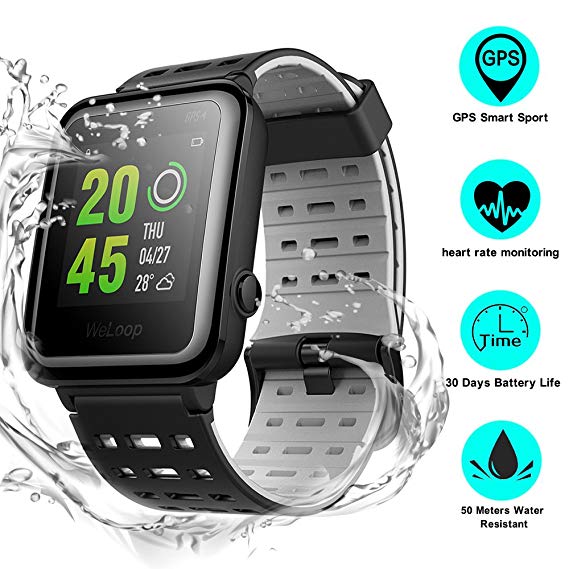 Alternatively, you can avail a 40% off on the red color version of the Hey 3S smartwatch that usually carries a $158.99 price tag. Thanks to the aforesaid discount, you can now get your hands on the red-tinted Hey 3S watch at a slashed price of just $94.99.